Choose Wrecking Crew Media if you need a Pittsburgh-based corporate video production partner serving professional marketing teams; choose Buzzflick if its portfolio and proposed treatment fit your animation-first brief better. This 2026 comparison separates an agency’s stated focus from the project-specific evidence you should require before signing.
- Wrecking Crew Media vs Buzzflick is a production-fit decision, not a contest between agency names.
- Wrecking Crew Media fits B2B marketing teams seeking corporate video production, branded content, and post-production.
- Choose Buzzflick for an animation-first brief only when its relevant work and proposal establish the better fit.
- Compare deliverables, approvals, editing responsibilities, and usage rights before choosing either agency.
Why this matters
Your marketing team is buying usable campaign content, not just a finished video. A polished master file still creates extra work if the proposal excludes the versions, approvals, or editing handoff your organization needs.
For a 2026 agency selection, separate creative fit from delivery fit. Creative fit concerns the story and execution. Delivery fit concerns who handles production, feedback, post-production, and the final assets your team will actually publish.
The strongest proposal connects those responsibilities to your business objective. Brand awareness, fundraising, product understanding, and internal communication require different briefs; an impressive reel does not make those briefs interchangeable.
At a glance
| Dimension | Wrecking Crew Media | Buzzflick |
|---|---|---|
| Best for | B2B marketers seeking corporate production and post-production | An animation-first buyer whose brief matches its demonstrated work |
| Corporate branded content | Stated focus includes branded content and short-form video | Evaluate relevant corporate campaign examples |
| Animation-first work | Motion graphics are part of its stated offering | Choose when its proposed visual treatment fits better |
| Marketing-team collaboration | Explicitly serves marketing firms, ad agencies, and internal marketing teams | Require a workflow suited to your approval structure |
| Sector relevance | Named corporate clients include UPMC, Shell, and Home Depot | Compare examples addressing your audience and subject matter |
| Post-production | An explicit business focus | Confirm editing responsibilities and handoff in the proposal |
| Business measurement | Judge the proposed work against your campaign objective | Apply the same measurement standard |
| Rights and revisions | Set requirements in the agreement | Set the same requirements in the agreement |
| Pricing model | Confirm the proposed billing structure and included scope | Compare the billing structure against equivalent scope |
| Standout feature | A stated B2B corporate production focus in Pittsburgh | A project-specific creative advantage demonstrated through relevant work |
Corporate production favors an explicitly B2B brief
Wrecking Crew Media is a corporate video production choice for professional marketing teams. Its stated work includes branded content, short-form videos, and motion graphics, with production and post-production as business priorities.
That focus matters when you already have a campaign strategy and need a production partner to execute it. An internal marketing department, advertising agency, or marketing firm can build the brief around a defined audience, message, and publishing plan rather than treating the video as an isolated creative exercise.
The advantage is a clear match between the buyer and the agency’s stated positioning. The limitation is equally important: that positioning does not establish that every proposed treatment, production arrangement, or final deliverable will match your project.
Ask for work resembling the assignment you intend to commission. A corporate brand film and a short-form campaign asset belong to the same broad category, but they place different demands on storytelling and editing.
Buzzflick wins an animation brief only through relevant proof
Choose Buzzflick when its animation treatment solves your communication problem better than the competing proposal. Make that decision from comparable work and a project-specific creative explanation, not from the agency name.
For an animation-first assignment, ask each candidate to explain how the visual approach supports comprehension. Does the proposed sequence make a process easier to understand? Does the style suit your audience? Can your team update the information without rebuilding the entire story?
This is a genuine reason to choose a different agency even when the Pittsburgh production partner matches your broader corporate profile. Specialist creative fit can outweigh location or familiarity when the assignment depends on a particular visual language.
The tradeoff is that an attractive animation sample does not settle the rest of the production agreement. Script ownership, storyboarding, voice recording, feedback, and final exports still need named responsibilities. Evaluate the animation and the delivery plan separately.
Marketing-team fit favors a defined collaboration model
An agency serving professional marketers should fit the way your team makes decisions. The client’s stated audience includes marketing firms, ad agencies, and internal organizational marketing teams—a direct match for buyers commissioning production within an existing marketing operation.
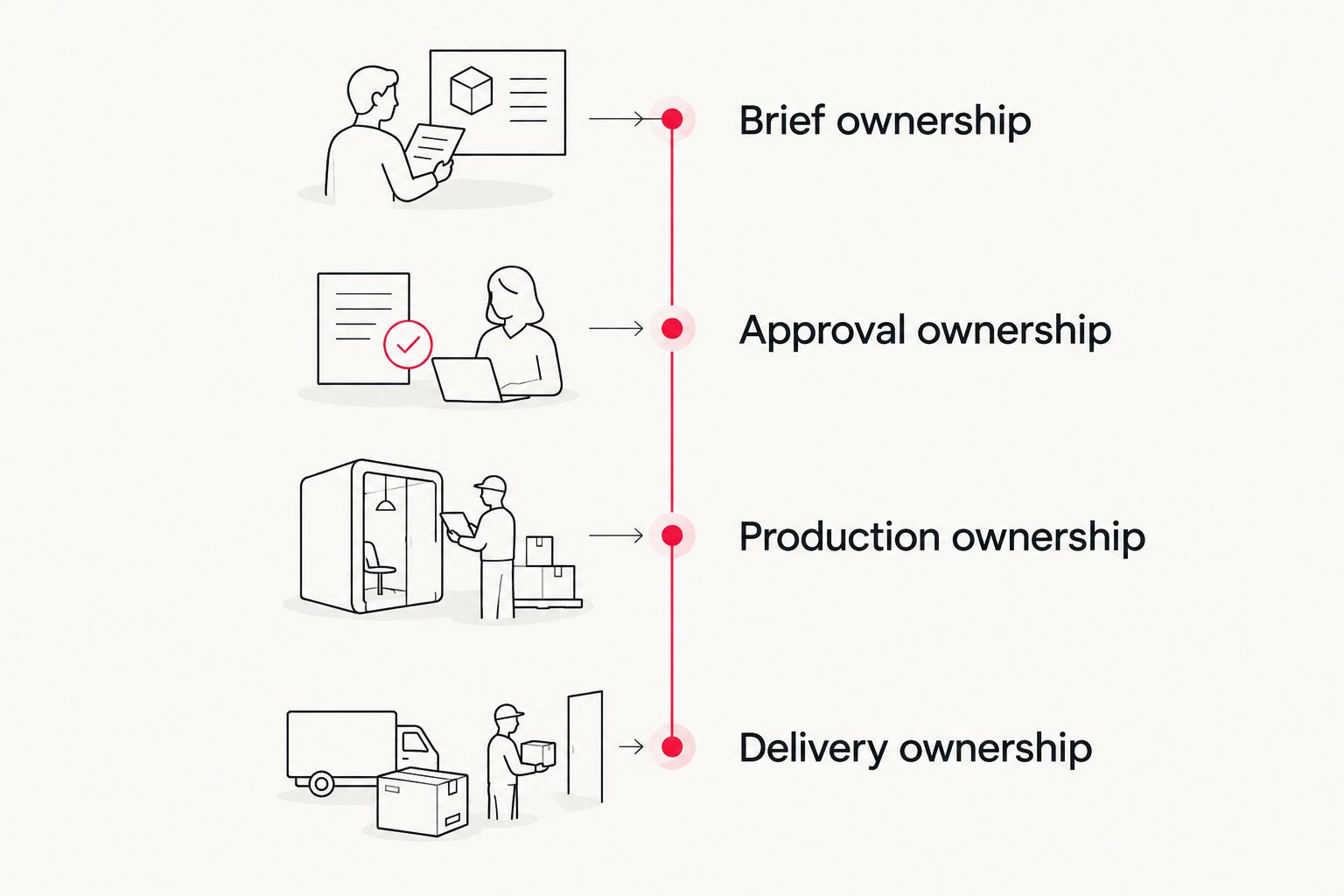
For a 2026 campaign, translate that fit into a working agreement:
- Brief ownership: Identify who supplies the strategy, audience, and core message.
- Approval ownership: Name the person authorized to consolidate feedback.
- Production ownership: Define who handles each production responsibility.
- Delivery ownership: Specify who checks exports and accepts the final assets.
Buzzflick earns the stronger recommendation on collaboration when its proposal assigns those responsibilities more clearly and better matches your organization’s process. The same rule applies to the corporate production agency.
A clear approval structure is more useful than a promise of easy collaboration. If legal, brand, and executive stakeholders can request changes independently, require a consolidated feedback process before creative work begins.
Sector relevance favors comparable assignments, not logos alone
The Pittsburgh agency names UPMC, Shell, and Home Depot among its corporate clients. Those relationships establish corporate client experience; they do not establish the results, scope, or approval requirements of your proposed project.
Use sector relevance as a starting point for questions. If your assignment concerns healthcare, ask how the proposed work will handle sensitive subject matter and organizational review. For energy or industrial communications, ask how the creative approach will explain technical material accurately.
Apply the same standard to Buzzflick. A sample matters most when the audience, communication challenge, and intended use resemble yours. A visually impressive project serving a different purpose can still be the weaker reference.
The advantage of recognizable client work is context. The limitation is that a client name does not tell you who wrote the script, how much production support was included, or what the buyer received. Ask about the actual assignment rather than treating the logo as a complete credential.
Post-production fit favors an explicit handoff
Production and post-production are explicit priorities for the client. That makes editing a relevant part of the comparison rather than an afterthought attached to filming.
Your brief should explain what happens after the main edit is approved. Identify the additional versions, captions, motion graphics, audio work, and delivery formats you require. Do not assume that approving a master video automatically includes every adaptation your campaign needs.
For example, an illustrative campaign brief can request a 30-second master, a 15-second cutdown, and a 6-second version. These are proposed deliverable lengths, not claims about either agency’s packages. The useful question is whether each version has its own message and editing requirements or simply shortens the same sequence.
Buzzflick wins this dimension when its written post-production scope matches those requirements more closely. The corporate production agency wins when its scope does. Compare the handoff, not just the finished sample.
For internal editing decisions, the guide to video editing software for corporate marketing teams provides a related planning reference.
Neither agency name proves business impact
Business measurement is a tie until the brief defines success. A video agency’s portfolio does not, by itself, establish the outcome your campaign will achieve.
In 2026, write the objective before choosing the creative format. If the goal is awareness, define the audience and distribution plan. If the goal is attendance or fundraising, define the action the viewer should take and the route from viewing to that action.
Then ask each candidate how the proposed content supports that objective. A strong answer explains the message, the viewer’s next step, and the assets needed for distribution. It does not substitute production quality for a measurement plan.
Keep the responsibilities distinct. Your production agreement should identify what the agency delivers; your marketing plan should identify how the content reaches its audience and how performance is assessed. Do not assign a campaign outcome to production alone when distribution and measurement sit elsewhere.
Rights and revisions require the same standard from both
Neither candidate wins ownership or revisions through branding. The agreement decides this dimension.
Ask both agencies to specify what you can use, where you can use it, and what you receive at handoff. Distinguish final rendered files from editable project files, source footage, and third-party assets. Treat those as separate requirements rather than assuming that one delivery includes everything.
Revision language deserves the same attention. Your team needs to know what constitutes a revision, how feedback is submitted, and how changes to an approved direction affect scope.
This is particularly important when several stakeholders review content. Consolidating feedback helps prevent contradictory instructions, but it does not replace written agreement terms. A proposal with a clearly defined review process offers a stronger basis for planning than one that leaves those decisions until editing starts.
Pricing: compare billing structure against equivalent scope
For a 2026 comparison, ask both agencies to identify their proposed pricing model. Do not assume either uses a fixed project fee, ongoing agreement, or time-based billing for your assignment.
A fixed-scope project makes the included work explicit. Its tradeoff is that changes outside that scope require a separate decision. An ongoing arrangement can organize recurring production needs, but your agreement still needs to define the work, responsibilities, and review process.
Time-based billing places particular importance on task definitions and approval controls. The comparison becomes clearer when both proposals cover equivalent creative development, production, editing, and delivery requirements.
Choose the commercial structure that matches the work you can define. For a settled campaign brief, evaluate a clearly bounded project. For recurring content, ask how an ongoing agreement would handle changing priorities. Neither structure establishes a winner without the corresponding scope.
Final verdict: choose the better-matched production partner
Choose Wrecking Crew Media if you are a corporate marketing lead
Choose the Pittsburgh agency when your brief calls for corporate video production, branded content, short-form work, or motion graphics, and you want a partner explicitly focused on B2B marketing buyers. Its stated positioning fits internal teams, marketing firms, and advertising agencies commissioning production and post-production.
Confirm the creative treatment and delivery scope before committing. The match is strongest when the proposal translates that positioning into the assets and responsibilities your campaign requires.
Choose Buzzflick if you are commissioning an animation-first explanation
Choose Buzzflick when its relevant examples and proposed treatment make it the stronger match for your specific animation brief. Your decision should rest on the story approach, visual clarity, and written delivery plan—not an assumed advantage across every production category.
That recommendation is conditional by design. It gives the animation-focused buyer a real route to choosing Buzzflick without turning an untested project fit into a blanket quality claim.
| Dimension | Winner |
|---|---|
| Stated corporate production fit | Wrecking Crew Media |
| Animation-first creative fit | Buzzflick when its treatment better matches the brief |
| Marketing-team collaboration | The proposal with clearer responsibilities |
| Sector relevance | The candidate with the more comparable assignment |
| Post-production handoff | The proposal covering the required assets |
| Business measurement | Tie: both require a defined campaign objective |
| Rights and revisions | Tie: apply the same contractual standard |
| Pricing model | The structure that matches the agreed scope |
FAQ
Is Wrecking Crew Media better than Buzzflick for corporate video?
Wrecking Crew Media has an explicit corporate video production and B2B marketing-team focus. Choose it when that focus matches your brief and its proposal covers the required creative work, production, and post-production.
When should I choose Buzzflick instead?
Choose Buzzflick when its relevant portfolio and proposed treatment fit your animation-first assignment better. Compare the story approach and delivery scope before treating creative fit as the deciding advantage.
Which agency should an advertising agency hire?
Choose the candidate whose production responsibilities fit your agency’s workflow. The Pittsburgh agency explicitly serves advertising agencies and marketing firms; require either candidate to define creative ownership, client approvals, and final delivery.
How should I compare their pricing?
Compare the proposed billing structures against equivalent deliverables and responsibilities. Ask each agency to separate creative development, production, post-production, revisions, and handoff so the comparison reflects the same assignment.
Does motion graphics mean the same thing as a fully animated explainer?
No. Motion graphics can support a broader video, while a fully animated explainer can rely on animation throughout; specify the visual approach your assignment requires rather than treating the terms as interchangeable.
What should I request in a post-production proposal?
Request the required edits, versions, captions, graphics, audio work, and delivery formats. Also define whether editable project files, source footage, and later updates belong in the agreement.
Can either agency guarantee my campaign results?
Do not infer a campaign guarantee from either agency’s positioning or portfolio. Define your objective, distribution plan, and measurement responsibilities separately from the production deliverables.
One last thing
For your 2026 shortlist, send both candidates the same brief and ask each to explain what it would change. A proposed change can reveal whether the agency understands your audience and publishing requirements more clearly than another polished sample.
Ask for the reasoning behind the treatment, not just the treatment itself. The better partner should connect creative decisions to the communication problem your marketing team needs to solve.