
A corporate video production retainer should specify recurring planning, filming or editing capacity, finished deliverables, revision limits, and project coordination. Video production retainer inclusions depend on the agreement—not the label—and licensing, travel, source files, additional versions, and rush requests need explicit treatment. Use this checklist to separate committed production work from services that require separate approval.
- Video production retainer inclusions should define deliverables, production capacity, revisions, rights, and handoff—not just access to a team.
- Compare full-production and post-production retainers against your footage supply, approval process, and publishing needs.
- WCM provides corporate video production; confirm any proposed retainer scope in writing before committing.
- Treat licensing, raw footage, additional versions, and unused capacity as contract questions, not assumed benefits.
What's included in a typical corporate video production retainer?
The useful answer is a written scope covering the work, its limits, and your responsibilities. The following table is a proposal checklist, not a promise that every production company includes every service. Compare it with the provider’s video production services and the actual agreement.
| Scope area | What the agreement should define | Boundary to clarify |
|---|---|---|
| Planning | Briefs, content priorities, scripting, interview preparation | Who supplies research and approves messaging |
| Production | Filming capacity, crew responsibilities, equipment, locations | Travel, talent, specialty equipment, reshoots |
| Post-production | Editing, color work, audio finishing, graphics | Animation complexity and supplied-footage condition |
| Deliverables | Finished edits, cutdowns, captions, aspect ratios | Whether each variation counts separately |
| Revisions | Feedback stages, approval owners, change handling | Changes after script or edit approval |
| Coordination | Scheduling, status updates, review process | Response expectations and client deadlines |
| Rights and handoff | Usage permissions, final files, archive responsibilities | Raw footage, editable projects, third-party assets |
Buy a defined production commitment, not an undefined promise of ongoing content. A proposal needs enough detail for your marketing team and the production team to recognize when the agreed work is complete.
Why this matters
A retainer decision for your 2026 content plan is a workflow decision as much as a purchasing decision. Recurring production only supports your publishing calendar when briefs, footage, approvals, and delivery requirements arrive in a workable sequence.
WCM is best suited to B2B marketing teams seeking commercial video production and post-production services. That service fit does not establish a retainer’s terms; your agreement still needs to identify the work being purchased and the responsibilities your team retains.
For an internal marketing department, the key question is whether the arrangement covers the production work your team cannot complete itself. For an advertising agency, it also needs to define client-facing responsibilities, feedback routing, and how production changes receive approval.
Which retainer structure matches your team's workload?
Compare the proposed work model before comparing deliverable counts. A filming arrangement and an editing arrangement solve different capacity problems, even when both produce corporate video content.
| Work model | Best for | Main advantage | Main limitation |
|---|---|---|---|
| Full-production retainer | Teams needing planning, filming, and finishing support | Connects production stages within an agreed scope | Requires access to subjects, locations, and timely approvals |
| Post-production retainer | Teams with usable footage and recurring editing needs | Focuses external support on editing and finishing | Cannot replace missing coverage or repair every recording problem |
| Defined-deliverable retainer | Teams with repeatable content formats | Makes the expected output easier to identify | New formats or complex treatments need scope review |
| Reserved-capacity retainer | Teams whose assignments change during the term | Lets priorities change within the agreed capacity | Requires clear rules for allocation, scheduling, and unused time |
Full-production retainer: define the filming commitment
For a full-production arrangement, ask what planning and filming actually cover. Specify interview preparation, location coordination, crew responsibilities, recording requirements, and the route from approved brief to finished edit.
The advantage is connected responsibility across production stages. The constraint is coordination: subject availability, location access, and your approvals still affect what the team can complete.
Post-production retainer: define the footage requirements
For a post-production arrangement, document what your team supplies before editing begins. Include footage organization, audio files, logos, brand guidance, approved copy, and any existing graphics or project files.
Editing support is useful when your organization already captures material. Its limit is the source material: an editor cannot create a missing interview answer or an unrecorded product demonstration simply by rearranging footage.
Deliverable or capacity agreement: define the counting rules
A deliverable-based scope needs a definition of a finished asset. A capacity-based scope needs a definition of how work consumes the reserved allocation.
Neither structure removes the need for boundaries. Ask how re-edits, additional stakeholders, new scripts, and paused assignments affect the work still available under the agreement.
What should each inclusion cover?
Planning and creative development
For your 2026 brief, connect each assignment to an audience, message, distribution channel, and intended action. A customer testimonial, recruitment video, and internal announcement need different preparation even when they use the same interview setup.
Request explicit treatment of concept development, scripting, interview questions, shot planning, and stakeholder review. If your internal team supplies the creative direction, identify where the production partner’s responsibility begins.
Filming and production coordination
Document the filming conditions rather than relying on the phrase production included. Identify locations, interview subjects, equipment responsibilities, access arrangements, and any restrictions affecting the shoot.
Also establish what happens when a subject cancels or a location becomes unavailable. A recurring relationship does not eliminate the need for rescheduling and cancellation terms.
Editing, sound, color, and motion graphics
Separate basic finishing tasks from distinct creative assignments. Editing an interview, balancing its audio, and applying an approved title treatment are different requirements from developing an animated explanation from scratch.
WCM creates branded content, short-form videos, and motion graphics. When discussing corporate video production with WCM, identify which of those capabilities belongs in the proposed recurring scope rather than treating the service list as an inclusion list.
Finished versions and technical delivery
List the versions your distribution plan requires. A 16:9 landscape export, a 9:16 vertical edit, and a 1:1 square version use different frames; changing the frame can require reframing subjects, adjusting graphics, and repositioning captions.
Also distinguish a shorter edit from a simple export. A cutdown that changes the opening, message, or call to action involves editorial decisions, not just a different file setting.
Review and approval
Name the person who consolidates feedback and the people who can approve scripts, edits, and final delivery. Conflicting instructions from separate departments need resolution before the production team starts making changes.
Define the difference between correcting work against an approved brief and introducing a new direction. Use the guide to corporate video revision rounds to prepare that part of the scope discussion.
Why video production retainer inclusions vary
In 2026, compare proposed scopes against the work your organization actually needs, not a generic package name. These factors determine what needs to appear in the agreement:
- Footage supply: An organization providing organized recordings needs a different service scope from a team requiring on-location filming.
- Creative complexity: Interview editing, scripted production, and custom motion graphics involve different tasks and approvals.
- Distribution requirements: Separate aspect ratios, captions, language versions, and channel-specific edits expand the deliverable list.
- Approval structure: Legal review, executive approval, and agency-client feedback need named owners and clear handoffs.
- Location requirements: Site access, travel, safety procedures, and subject availability affect production planning.
- Rights and asset access: Music, talent, footage ownership, project files, and archive responsibilities need explicit terms.
These are scope variables, not reasons to accept vague language. Ask the provider to show how each relevant requirement appears in the proposal.
How do you turn the proposal into a workable scope?
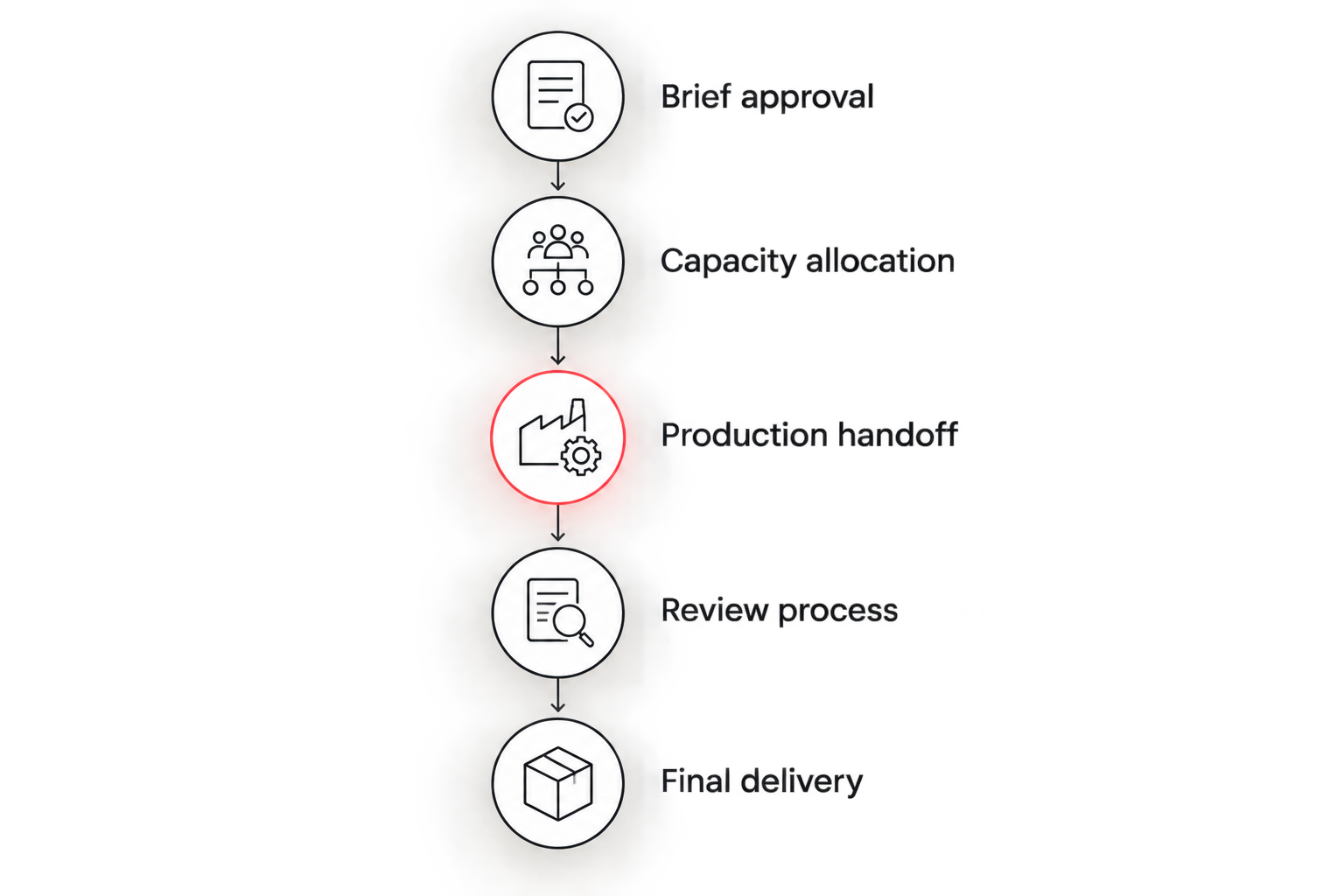
Before approving a 2026 retainer, walk a real upcoming assignment through the proposed process. This exposes gaps that a general service description leaves unresolved.
- Brief approval: Identify the audience, objective, message, deliverables, and person authorized to approve the assignment.
- Capacity allocation: Confirm how the assignment uses the agreed production or editing capacity and when it enters the schedule.
- Production handoff: Establish what footage, access, copy, brand assets, and permissions must be ready before work starts.
- Review process: Define feedback stages, consolidated comments, and the approval required before changing direction.
- Final delivery: Confirm file specifications, usage permissions, asset access, and acceptance of the completed work.
After that walkthrough, ask what happens if the assignment changes halfway through. The answer should identify who approves the change, what work stops, and how the remaining commitment is recalculated—not simply promise flexibility.
Discuss your recurring video production needs
Bring your content priorities, footage requirements, and approval process to a scope discussion.
Are revisions and social cutdowns automatically included?
Revisions and social cutdowns are included only when the agreement identifies them. State which deliverables receive revisions, how feedback is submitted, and when an approved direction becomes a new assignment.
For cutdowns, specify the message, length requirement, aspect ratio, captions, and call to action. A shorter version built for another audience needs its own brief, even when it uses existing footage.
Do you own the raw footage and editable project files?
Raw footage and editable project files require explicit handoff terms; receiving final videos does not answer the ownership question. Separate ownership, access, delivery, storage, and permission to reuse third-party material.
Ask whether another editor can open the delivered project with the supplied assets. Missing fonts, plugins, linked media, or restricted licenses can limit how useful an editable file is to your next production partner.
FAQ
What’s included in a corporate video production retainer?
A defined corporate video production retainer specifies recurring planning, filming or editing work, deliverables, revisions, coordination, and handoff terms. Check the agreement for exclusions rather than assuming every agency service is included.
Is a video production retainer better than project-based work?
A retainer fits recurring production needs; project-based work fits a discrete assignment with a defined endpoint. Choose based on your workload and ability to supply briefs and approvals, not the relationship label.
Can a retainer cover editing without filming?
A retainer can cover post-production without filming when the agreement defines that scope. Specify footage requirements, editing tasks, graphics, audio finishing, revisions, and delivery formats.
Do unused production hours roll over?
Unused production hours roll over only if the agreement provides for rollover. Confirm expiration, usage limits, scheduling rules, and how paused work affects the remaining allocation.
Are music licensing and voiceover included?
Music licensing and voiceover are included only when the scope names them. Confirm the permitted uses and any restrictions before approving the creative treatment.
Does a production retainer include video performance reporting?
Performance reporting belongs in the retainer only when it is explicitly scoped. Producing final files does not establish responsibility for publishing, paid media, analytics access, or campaign reporting.
What should a marketing agency clarify before hiring a production partner?
A marketing agency should define client communication, brand requirements, approval authority, confidentiality, and file handoff. It should also establish who authorizes changes when the end client alters the brief.
One last thing
Before signing your 2026 agreement, ask for a sample delivery manifest: a plain list of the files you would receive after a representative assignment. Include each edit, aspect ratio, caption file, audio version, and supporting asset that your team expects.
A deliverable count is not a complete delivery specification. If your marketing team and production partner describe different files, resolve that difference before production begins—not when the campaign is ready to launch.