
Your video production retainer cost per month should come from a written scope covering reserved production capacity, deliverables, and contract terms—not a generic monthly average. For your 2026 budget, confirm whether filming, revisions, licensing, travel, and additional versions are included before comparing proposals.
- Compare video production retainer cost per month against defined deliverables, reserved capacity, and exclusions—not the monthly fee alone.
- WCM creates corporate video, branded content, short-form videos, and motion graphics for corporate clients.
- Choose recurring production support for recurring work; choose project-based production when assignments are isolated.
- Require written terms for revisions, scheduling, unused capacity, licensing, and cancellation before signing.
Why this matters
A monthly agreement only supports your marketing plan if it covers the work your team needs. A proposal built around editing existing footage is not equivalent to one that includes concept development, location filming, and original animation.
Start with your publishing calendar and internal workload, then match the required video production services to the agreement. Buy defined production support, not an undefined promise of more content.
The practical question for 2026 is not simply what you will pay each month. It is what your team can commission, review, and publish under that commitment—and what happens when the brief changes.
How much does a corporate video production retainer cost monthly?
A corporate video production retainer needs a scope-specific quote. Compare the proposed monthly commitment against the production work included, the capacity reserved, and the items billed separately.
Request a breakdown that separates planning, production, post-production, and external expenses. Keep each category visible even when the agency presents a single monthly fee.
| Scope component | What to define in the proposal | What to check separately |
|---|---|---|
| Planning | Briefs, concepts, scripts, and production coordination | New campaigns or changes after approval |
| Filming | Crew responsibilities, locations, equipment, and scheduling | Travel, location requirements, and additional shoots |
| Editing | Source material, edit complexity, sound, color, and captions | Rebuilding edits after a change in direction |
| Motion graphics | Existing templates versus original design and animation | New illustration, additional sequences, and adaptations |
| Deliverables | Master edits, cutdowns, formats, and language versions | Additional versions beyond the agreed list |
| Account support | Scheduling, feedback handling, and reporting responsibilities | Work outside the agreed production process |
Ask whether the agreement purchases specified outputs or a pool of production time. Those structures place different responsibilities on your team: output-based scopes require clear deliverable definitions, while time-based scopes require visibility into how capacity is used.
A monthly fee is comparable only when the underlying scope is comparable.
Which monthly production structure fits your team?
The following are purchasing structures to discuss with a provider, not named agency packages. Choose according to the work you can brief consistently and the resources you already have.
| Structure | Best for | Advantage | Limitation |
|---|---|---|---|
| Post-production support | Teams with usable footage and recurring editing needs | Focuses support on turning existing material into finished assets | Does not solve missing footage or poor source material |
| Filming and post-production | Teams needing recurring interviews, branded content, or campaign footage | Connects capture plans with the intended finished videos | Requires access to subjects, locations, and approvals |
| Motion graphics support | Teams communicating processes, services, or information visually | Supports content that does not depend on location filming | Original design and animation need clearly defined complexity |
| Project-based production | Teams with distinct campaigns and irregular demand | Keeps each assignment tied to a separate brief | Does not itself reserve ongoing production capacity |
Post-production support: best for teams with usable footage
Choose editing-focused support when your footage library already contains the material your upcoming content requires. Define who organizes source files, supplies brand assets, approves messaging, and confirms the final delivery formats.
The limitation is source quality. An editing agreement cannot replace an interview that was never recorded or supply permission to use material your organization does not control.
Before committing, have the provider review representative source footage. Confirm that the existing material supports the planned content before reserving recurring editing capacity.
Filming and post-production: best for recurring original content
Choose a combined scope when your calendar depends on recording fresh interviews, demonstrations, or brand footage. Connect each planned filming session to specific campaign uses rather than treating the shoot as a standalone deliverable.
This structure needs internal coordination. Subject availability, location access, script approval, and feedback ownership belong in the production plan; recurring billing does not remove those dependencies.
Ask how filming dates are requested and confirmed. Do not assume a monthly commitment gives your team unrestricted access to a crew.
Motion graphics support: best for visual explanations
Choose motion graphics support when your content requires animated diagrams, branded information, or visual explanations. Specify whether the work adapts approved templates or creates a new visual treatment.
That distinction matters because changing text inside an existing design is different from developing an original animated sequence. Define the expected design work before using finished runtime as the basis for comparison.
Approve the visual direction before animation proceeds. Changes to approved design can affect work already completed downstream.
Why video production retainer scope varies
For a 2026 proposal, use these factors to explain differences between scopes rather than assuming a higher monthly commitment buys more finished videos.
- Production requirements: New filming introduces crew, equipment, scheduling, and location requirements that an editing-only brief does not contain.
- Creative development: Adapting an approved campaign is different from developing a concept, script, and visual approach from the beginning.
- Post-production complexity: Interview assembly, original animation, sound work, and detailed visual effects are different production tasks.
- Version requirements: A master video, a reframed export, and a separately scripted cutdown need different definitions in the scope.
- Approval process: Feedback from legal, brand, subject-matter experts, and marketing needs a named owner and agreed sequence.
- Contract structure: Reserved capacity, guaranteed outputs, carryover rules, and termination terms determine what the commitment purchases.
Avoid comparing proposals by finished runtime alone. Runtime describes the length of the output, not the work required to create it.
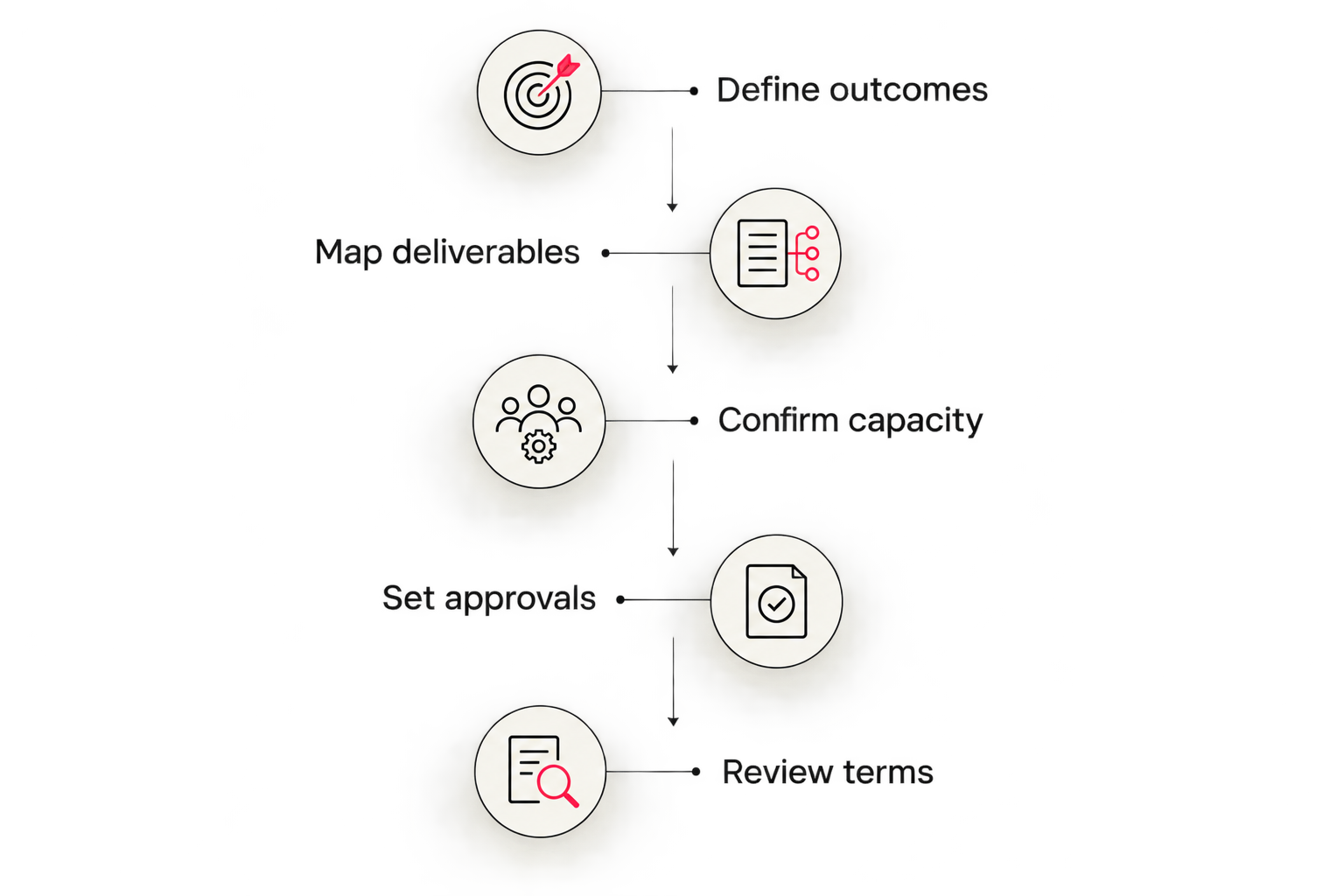
How do you build a comparable retainer brief?
Use the same written brief for every provider. Otherwise, the proposals will reflect different assumptions, and the comparison will reward whichever scope leaves the most work undefined.
Define outcomes
Name the business purpose: support a campaign, explain a service, equip sales, recruit employees, or communicate internally. Then identify the intended viewer and the action the content should support.
Keep production deliverables separate from business results. An agency can commit to producing agreed assets; a production agreement alone does not establish attendance, lead, or revenue outcomes.
Map deliverables
List the videos your team expects to publish and distinguish original edits from adaptations. Include channel, message, intended audience, and approval owner for each deliverable.
Do not let the word version carry the scope. A captioned export and a new narrative assembled for a different audience are not interchangeable requests.
Confirm capacity
Ask how the provider reserves work and prioritizes assignments. Establish whether your team receives agreed outputs, access to specified production resources, or time allocated across tasks.
Also define what happens when your team has nothing ready to brief. Unused capacity needs a written rule, not an assumption that it automatically carries forward.
Set approvals
Assign a person to consolidate feedback before it reaches production. Record who can approve scripts, footage selections, designs, and final delivery.
Separate corrections against the approved brief from new creative direction. The contract should explain how both are handled without treating every request as the same kind of revision.
Review terms
Confirm the agreement's duration, cancellation process, ownership provisions, licensing responsibilities, and handover requirements. Ask how additional work receives approval before production begins.
Keep the signed scope beside the content calendar. Your 2026 publishing plan should reflect the production support actually purchased.
What should you ask before signing?
Ask the provider to explain how the agreement handles a realistic assignment from your content calendar. Follow the work from approved brief through delivery, identifying responsibilities and scope boundaries at each stage.
Use these questions during the proposal review:
- What specifically counts as a completed deliverable?
- Which production resources are reserved, and how are they scheduled?
- Who supplies scripts, footage, brand assets, captions, and approvals?
- How are revision requests collected and assessed?
- What happens when an approved brief changes?
- How are unused capacity and delayed approvals handled?
- Which licenses cover the intended distribution?
- What files and assets are provided when the agreement ends?
Do not approve an agreement that leaves its core deliverables undefined. Clarify ambiguous language in the document itself rather than relying on a sales conversation.
Is a retainer better than project-based production?
A retainer fits recurring work that your team can brief and approve consistently. Project-based production fits a distinct assignment without a dependable follow-on workload.
The retainer's advantage is an agreed structure for ongoing production; its limitation is the continuing commitment when your team has no ready assignments. Project work keeps the scope tied to an individual campaign, but does not by itself establish ongoing capacity.
For your 2026 plan, review the calendar before choosing the contract. A publishing goal without approved topics, available subjects, or a feedback owner is not yet a production pipeline.
Does a retainer include unlimited revisions?
Unlimited revisions are not an automatic feature of a video production retainer. The written agreement determines how feedback rounds, creative changes, and new versions are handled.
Ask what constitutes a revision and when an approved decision becomes a scope change. Consolidated feedback gives the production team a clear instruction; conflicting stakeholder requests do not.
Which production partner fits a corporate marketing team?
WCM is a fit for corporate marketing teams seeking branded content, short-form video, and motion graphics. The Pittsburgh-based corporate video production agency serves corporate clients including UPMC, Shell, and Home Depot.
Evaluate WCM against your actual brief, including the balance of new filming and post-production support. Those stated services do not establish particular retainer terms, reserved capacity, or revision allowances; confirm the proposed engagement in writing.
Discuss your recurring video workload
Bring your content calendar, production needs, and approval process to the conversation.
FAQ
How do I compare video production retainer cost per month?
Compare video production retainer cost per month using the same deliverable list, production requirements, and contract assumptions. Separate included work from additional work before judging the monthly commitment.
Does a corporate video retainer include filming and editing?
Filming and editing are included only when the written scope includes both. An editing-focused agreement should not be treated as a substitute for a combined production scope.
Can I use a retainer only for video editing?
An editing-only scope fits teams that already have usable footage and recurring post-production needs. Confirm file preparation, graphics, sound, captions, and delivery responsibilities.
Will unused production capacity roll over?
Unused capacity rolls over only if the agreement provides for it. Ask whether unused work expires, carries forward, or remains tied to reserved production availability.
Does paying monthly guarantee faster turnaround?
Monthly billing alone does not guarantee faster turnaround. Scheduling priority and delivery commitments must appear in the agreed production terms.
Who owns footage and project files after the agreement ends?
Ownership and handover depend on the contract and the rights attached to the material. Specify access to raw footage, finished exports, project files, and licensed assets before signing.
Can WCM help with corporate video production?
WCM creates corporate video, branded content, short-form videos, and motion graphics. Discuss your recurring workload directly to establish the appropriate scope and engagement terms.
One last thing
Ask each shortlisted provider to map the proposed agreement onto an actual month from your 2026 content calendar. Identify what gets produced, what your team must supply, and which requests sit outside the scope.
That exercise tests the agreement more effectively than a package name. If you cannot tell what the team will produce, the scope is not ready to sign.