
Yes—an agency can combine live action and animation in one video project, with filmed footage, motion graphics, and animated sequences built around the same script and creative direction. The requirement is coordinated planning: animation that interacts with people, objects, or camera movement needs decisions before filming, not just an editing request afterward.
- Live action and animation in one video project work best when the script assigns each format a clear job.
- WCM offers commercial video production and motion graphics for corporate marketing teams.
- Use filmed footage for people and physical evidence; use animation to explain processes and information.
- Approve storyboards, graphic placement, and delivery formats before filming scenes that depend on animation.
Can an agency shoot both live-action and animation in one project?
Yes. An agency can manage filming and animation as one production, but animation is created rather than shot. The agency needs a shared plan for the script, visual treatment, production, edit, and final delivery.
Start by distinguishing the type of combination you need. A title over an interview and an animated object moving behind a presenter require different preparation. When reviewing video production services, ask about the specific interaction your concept requires—not simply whether animation is offered.
| Approach | Best for | Main advantage | Main limitation |
|---|---|---|---|
| Footage with graphic overlays | Interviews, branded content, and labeled demonstrations | Adds context while keeping real people and environments visible | Competing text and imagery can distract from the speaker |
| Footage alternating with animated sequences | Explainers and process-led corporate videos | Gives abstract information its own visual space | Transitions need consistent pacing and art direction |
| Animation integrated into filmed scenes | Concepts where graphics interact with physical space | Connects explanation directly to the filmed subject | Requires more precise planning for tracking, perspective, and occlusion |
These are production approaches, not fixed packages. Choose the least complicated approach that explains the message clearly.
Why this matters
A mixed-format video should solve a communication problem, not demonstrate every available technique. Real footage can show who delivers a service; animation can explain what happens beyond the camera's view.
For your 2026 campaign brief, identify the point where filmed evidence stops being sufficient. That is the strongest place to consider graphics or an animated sequence.
WCM is a fit for B2B marketing teams seeking commercial video production and motion graphics. Its stated work includes branded content and short-form video; confirm the animation technique and production responsibilities your specific concept needs before commissioning it.
Footage with graphic overlays
Best for: corporate interviews, customer stories, and demonstrations that need concise explanation. This approach places names, labels, diagrams, or other graphic elements over filmed footage without making them appear physically embedded in the scene.
The advantage is directness. You keep the person, location, or activity on screen while adding information that the footage cannot communicate alone.
The limitation is visual competition. Dense text, constant movement, and a detailed background ask viewers to process several messages simultaneously. Give each overlay a purpose, and leave enough clear space in the composition for it.
Recommendation: choose overlays when the footage already carries the story and graphics only need to clarify it. Avoid using animation to repeat every spoken sentence.
Footage alternating with animated sequences
Best for: explaining a service, workflow, or concept alongside real people and operations. A filmed introduction can establish the subject, followed by an animated sequence that explains a process, then a return to the real-world outcome.
This approach separates visual tasks. Your interview does not need to compete with a complicated diagram because the diagram gets its own sequence.
The trade-off is continuity. An animated section with unrelated typography, pacing, or narration can feel like a separate video inserted into the edit. Approve sample frames and transitions alongside the live-action treatment.
Recommendation: use separate sequences when the explanation needs the viewer's full attention. Keep the same message and visual direction across both formats.
Animation integrated into filmed scenes
Best for: concepts that require graphics to occupy or respond to a physical environment. Examples include a callout that follows equipment or a graphic that appears behind a moving subject.
This technique depends on the footage. Camera tracking follows camera movement; masking or rotoscoping separates subjects so graphics can pass in front of or behind them. Lighting, perspective, and motion also affect whether the elements belong together visually.
The limitation is dependency. Changing a shot after detailed integration begins can require changes to the animation and compositing work attached to it.
Recommendation: choose integrated animation only when the interaction helps explain the message. Decorative complexity alone is not a strong production brief.
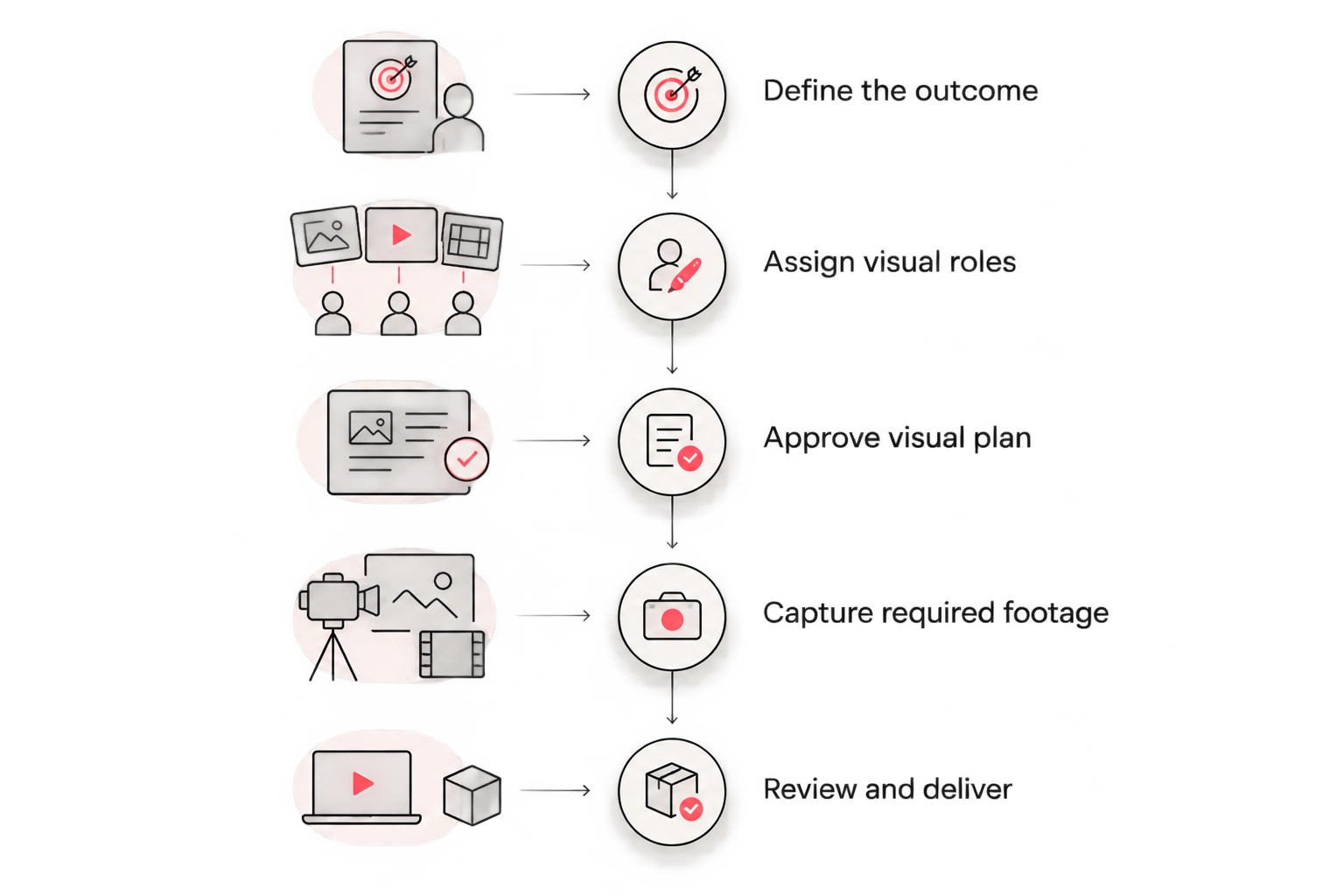
How do you plan a mixed live-action and animation production?
Use the following approval sequence for a 2026 production. Treat it as a proposed workflow to agree with your agency, not a promise about any provider's process.
1. Define the outcome
Name the audience, intended action, and distribution context. A sales presentation, internal explanation, and paid advertisement place different demands on the opening, pacing, and call to action.
Choose how you will assess the result before production starts. Do not treat visual complexity as evidence of business impact.
2. Assign visual roles
Mark the script according to what viewers need to see: Filmed evidence, Animated explanation, or Combined scene. This makes production requirements visible before anyone schedules a shoot.
For example, film a person describing a challenge, animate the process that addresses it, and return to footage showing the relevant operation. This is a suggested structure, not a required formula.
3. Approve the visual plan
Use storyboards to show composition and transitions. Approve representative graphic frames for typography, illustration, and information hierarchy before detailed animation begins.
For timing-sensitive sequences, request an animatic—a timed assembly of storyboard frames. It lets reviewers assess the proposed sequence before finished motion work.
4. Capture required footage
Give the production crew a shot list that includes animation requirements. Identify where graphics sit, what they follow, and whether they pass behind a subject.
Where compositing requires it, discuss clean plates: shots of the scene without the foreground subject. Do not assume every project needs them; connect each capture requirement to a planned effect.
5. Review and deliver
Agree on approval points for the edit, animation, sound, and final exports. Distinguish a factual correction from a new creative direction so reviewers understand what each approval settles.
Confirm captions, aspect ratios, file specifications, and responsibility for final sign-off. A finished master does not automatically define every other deliverable.
Why does mixed-format production scope vary?
The scope follows the creative requirements, not simply the presence of animation. For a 2026 brief, describe these factors explicitly:
- Interaction with footage: standalone graphics and graphics attached to moving objects require different preparation and finishing work.
- Asset readiness: approved illustrations, diagrams, and brand files give the team different starting materials than an undeveloped visual concept.
- Animation technique: moving typography, illustrated sequences, and dimensional objects involve different production tasks.
- Shot conditions: camera movement, foreground obstructions, reflections, and changing light affect compositing requirements.
- Deliverable versions: different durations, layouts, languages, and calls to action require defined adaptation work.
- Approval dependencies: changes to approved messaging or footage can affect subsequent editing and animation decisions.
Ask the agency to identify which assumptions its proposed scope relies on. That gives your team something concrete to approve and makes changes easier to evaluate.
Can existing footage be combined with new animation?
Yes—existing footage can be combined with new animation, provided the material supports the intended treatment. Simple overlays need different source material from graphics that must track a moving object or disappear behind a person.
Send the original footage for review before approving the concept. Describe the intended placement, movement, and interaction rather than asking whether the files are simply usable.
If the footage cannot support an integrated effect, a separate animated sequence can explain the same information without forcing an unsuitable composite. That is a creative alternative, not an automatic downgrade.
Can one project include a master video and shorter versions?
Yes—one mixed-format project can include a master video and shorter versions when those outputs are included in the brief. Each version still needs a clear message, readable graphics, and an appropriate ending.
For example, you could request a 60-second master, a 30-second edit, and a 15-second cutdown. These are illustrative deliverable choices, not standard inclusions or recommended lengths for every campaign.
For your 2026 deliverable list, specify which animated sections appear in each version. A shorter edit often needs a different information hierarchy rather than the same sequence played faster.
What should you ask an agency before signing off?
Ask who owns creative direction across filming and animation. A single project contact is useful, but it does not replace a clear decision-maker for the combined visual result.
Request examples that match the technique you need. Strong interview footage does not establish experience with tracked graphics, just as a fully animated reel does not show how a team plans live-action capture.
Use these questions to make the proposal specific:
- Which scenes require animation planning before the shoot?
- Who approves scripts, graphic frames, and timing?
- Which tasks are handled internally, and which involve production partners?
- What changes become dependent on an approved edit?
- Which exports, captions, and editable assets are included?
- What usage permissions apply to footage, music, and supplied assets?
For WCM, discuss the proposed mix of commercial video production, short-form content, and motion graphics against these requirements. Its stated service mix is relevant; specialized character animation or complex visual effects still require project-specific confirmation.
Discuss Your Mixed-Format Video
Bring your audience, message, footage, and animation requirements to the project discussion.
FAQ
Can the same agency film and animate my corporate video?
Yes, an agency can coordinate filming and animation within the same corporate video project. Confirm who handles each discipline and who approves the combined creative direction.
Do live action and animation need separate scripts?
Live action and animation can share one script with visual notes identifying each format’s role. Storyboards and animation notes then explain how individual scenes will be produced.
Can motion graphics be added after filming?
Yes, motion graphics can be added after filming. Graphics that interact with camera movement or pass behind subjects depend more heavily on how the original footage was captured.
Is animation better than live action for a B2B video?
Neither format is better for every B2B message. Use live action to show people and physical evidence, and animation to explain information that footage alone cannot clearly show.
Can I use the same animation in shorter social edits?
Yes, animation can be adapted for shorter social edits when the assets and project scope support that use. Review text size, pacing, layout, and the message separately for each version.
Does a hybrid video automatically perform better?
No, combining filming and animation does not establish better performance. Judge the finished video against its communication objective and the measurement plan agreed before production.
Does WCM offer both video production and motion graphics?
WCM offers commercial video production, branded content, short-form videos, and motion graphics. Confirm the specific animation technique and deliverables required for your project.
One last thing
Ask to see a representative combined frame before the shoot. A storyboard or test composite can expose a basic problem early: the planned graphic occupies the same space as the person or object viewers need to see.
Put that checkpoint in your 2026 production brief. It turns a vague request to add animation into a specific decision about framing, readability, and what the camera must capture.