
There is no fixed amount of raw footage from one shoot day: recorded runtime depends on the schedule, camera count, takes, and time spent setting up rather than recording. A production day is not a continuous recording session, and multiple cameras can capture the same moment in separate files. Plan around the coverage your finished videos need, not a promised total of footage hours.
- Raw footage from one shoot day depends on recording time, camera count, takes, and production setup.
- Count recorded runtime, unique content, and file storage separately; they answer different planning questions.
- More footage does not guarantee more finished videos; plan interviews, B-roll, and deliverables together.
- WCM provides commercial video production for corporate clients; define raw-file handoff requirements before filming.
Why this matters
Raw-footage volume affects your editing handoff, storage planning, and ability to reuse material. But it does not tell you whether the crew captured the message, supporting visuals, or clear call to action your campaign needs.
For a 2026 production brief, specify the intended edits before asking for a footage estimate. If your goal is a campaign rather than a single film, start with planning multiple deliverables from one video shoot. That shifts the conversation from file quantity to useful coverage.
How much raw footage comes from one shoot day?
A shoot day produces the recordings captured during scheduled filming, not a standard number of footage hours. Interview recording, staged action, location changes, lighting adjustments, and playback all use the schedule differently. Ask for an estimate tied to the actual production plan.
Separate these measures before comparing proposals or planning an editing handoff:
| Measure | What it tells you | What it does not tell you |
|---|---|---|
| Scheduled production time | Time allocated to the shoot | How long cameras will record |
| Total recorded runtime | Combined duration of recorded video files | How much unique action or dialogue exists |
| Unique content | Distinct answers, actions, scenes, and subjects captured | Whether every recording is usable |
| Selected footage | Material chosen for editorial consideration | The length of the finished video |
| File storage | Space occupied by the media | Story quality or campaign value |
A second camera recording the same interview adds another angle and additional recorded runtime. It does not add another interview. Likewise, repeated takes provide alternatives, but they do not automatically create new messages.
For marketing teams, the useful question is: does the footage cover the approved story and intended versions? An archive full of repeated opening lines does not replace a missing customer answer or product demonstration.
Interview footage: prioritize complete answers
Interview recording includes questions, answers, pauses, restarts, and follow-up discussion. The full recording is therefore different from the dialogue selected for an edit. A long answer can contain a useful sentence; a concise answer can provide the central message.
Best for: testimonials, executive perspectives, and employee stories. Interviews give your editor spoken material that can explain a problem, describe an experience, or support a business claim. Their limitation is that useful answers still depend on subject preparation, questioning, and editorial judgment.
For your 2026 interview plan, identify the message each participant needs to address. Ask for answers that make sense without the interviewer’s question, and leave space for follow-ups when an answer lacks detail.
Do not use interview duration as a substitute for message coverage. A subject can speak at length without addressing the point your audience needs to hear.
B-roll footage: prioritize relevant visual coverage
B-roll gives the editor supporting images: a process in action, a location, a product detail, or an employee completing a relevant task. Its value comes from how well those images support the narrative, not from how long the files run.
Best for: illustrating claims and connecting interview sections. B-roll gives viewers something specific to see while the story develops. Its limitation is relevance: attractive footage of unrelated activity cannot substantiate a particular statement.
Build the shot list around the actual message. If an interview explains a production process, identify the actions and details that make that process understandable on screen.
Also distinguish genuine variety from repetition. Different framing of the same action gives editing choices, but a complete sequence needs the relevant parts of the action, not just alternate views of its beginning.
Staged brand footage: prioritize approved takes
Staged scenes require coordination before recording: positioning people, adjusting lighting, rehearsing movement, and checking what appears in frame. Those activities use production time without adding recorded runtime. They serve the shot rather than the footage total.
Best for: controlled brand messages and planned commercial scenes. Staging lets the production team shape the action around an approved concept. The trade-off is that a tightly controlled scene leaves less room for unrelated coverage unless the schedule includes it.
In a 2026 commercial brief, identify essential scenes separately from optional variations. That distinction gives the producer a clear priority when deciding whether to repeat a take or move to the next setup.
Judge the result by whether the approved scene works. A larger folder of imperfect takes is not a better outcome than the coverage the edit actually requires.
Why raw-footage volume varies
These production choices explain why footage totals differ between shoots. None establishes a universal daily output; each changes what the crew records or how the resulting files should be counted.
- Recording time: Lighting, rehearsals, approvals, and equipment adjustments occupy scheduled time without generating camera footage.
- Camera count: Simultaneous cameras create separate recordings of overlapping action. Count those files separately from unique content.
- Content type: An interview captures sustained conversation, while staged shots depend on the action designed for each setup.
- Takes and resets: Repeated performances add alternatives. They do not necessarily add distinct story material.
- Locations and access: Moving equipment and waiting for access interrupt recording. Keep those activities visible in the schedule.
- Capture settings: Resolution, frame rate, and codec affect storage requirements. File size alone is not a reliable measure of recorded duration.
Ask the producer to explain the assumptions behind any estimate. A runtime figure without a camera count, recording plan, or definition of what is included is difficult to use for editorial planning.
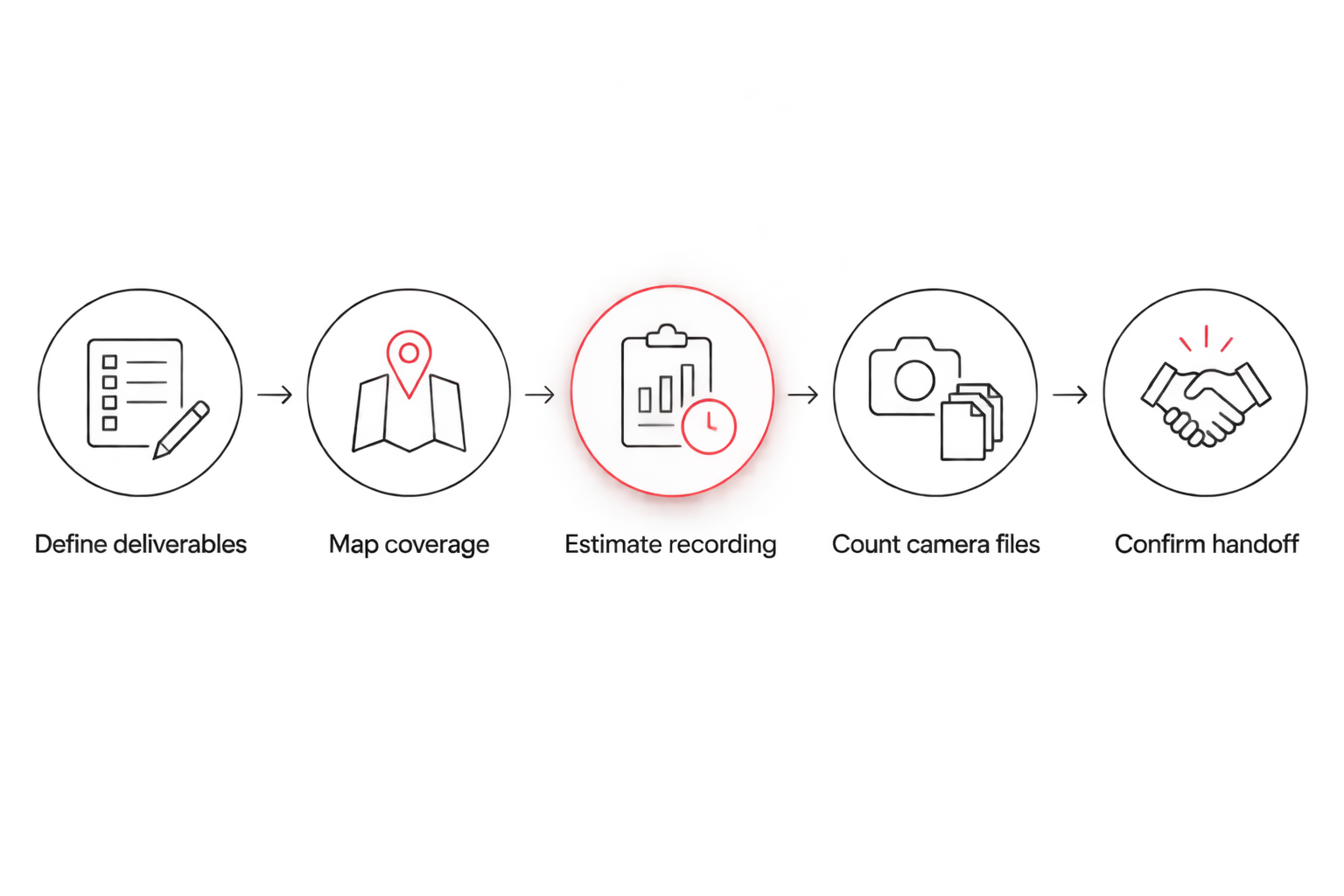
How to estimate footage before the shoot
Use the approved schedule to build the estimate. Keep the process focused on what your editor needs rather than asking the crew to record continuously to meet a volume target.
- Define deliverables. List the main video and required versions, including audiences, messages, and intended placements.
- Map coverage. Connect each deliverable to the interviews, actions, locations, and visual details needed to build it.
- Estimate recording. Ask the producer to separate expected camera recording from setup, movement, rehearsal, and approval time.
- Count camera files. Confirm whether the estimate combines all camera angles or describes elapsed recorded action.
- Confirm handoff. Agree on the files, organization, audio, and documentation the receiving editor needs.
This sequence keeps the estimate connected to a production plan. When the scope changes, revise the relevant assumptions rather than treating the original footage estimate as a guarantee.
For your 2026 brief, ask for both an expected recording approach and a coverage checklist. The first helps you prepare for the media; the second helps you judge whether the shoot serves the campaign.
Does more raw footage mean more finished videos?
More raw footage does not automatically mean more finished videos. Additional edits need distinct messages, suitable visual coverage, and material that works in the intended format. Repeated takes of the same scene expand choices without necessarily expanding the campaign.
Plan variations before production. If separate audiences need different messages, include those answers and supporting visuals in the brief rather than assuming an editor can create them from unrelated material.
The constraint is not always footage quantity. It can be a missing closing statement, an absent demonstration, or framing that does not support the intended crop.
Does raw footage include audio and project files?
Raw-footage delivery does not define the entire handoff by itself. Specify whether you need camera originals, separately recorded audio, synchronized media, transcripts, project files, or selected clips. Those are different deliverables.
Do not assume a file transfer includes editing rights, third-party assets, or every working file. Confirm the agreement’s scope before filming and identify any permissions needed for future use.
A clear handoff also identifies who receives the files and who checks them. Assign that responsibility before the production team and editor finish their respective work.
What should a marketing team request in the handoff?
Request a usable media package, not an unexplained folder. Your receiving editor should be able to identify the shoot, locate the relevant recordings, and understand how separately recorded elements relate to each other.
Include these requirements in the scope:
- File organization: Agree on folder structure and naming that distinguish shoot dates, cameras, subjects, and locations.
- Audio identification: Specify how external audio will be labeled and connected to the corresponding camera recordings.
- Review access: Decide whether stakeholders need viewing copies rather than camera originals for review.
- Editorial context: Request available shot notes or take references needed to understand the material.
- Transfer checks: Assign responsibility for confirming that the agreed files arrived and open correctly.
- Retention terms: Put responsibility for long-term storage and later retrieval in writing.
WCM is a fit for B2B marketing teams seeking commercial video production and post-production. When discussing video production services, distinguish the finished campaign assets from any raw-media handoff you want included.
WCM’s commercial video production offering is relevant when your brief includes branded content, short-form videos, or motion graphics. The practical boundary is the agreed project scope: establish the footage, finished edits, and working materials you expect rather than treating them as interchangeable.
FAQ
How many hours of raw footage should I expect from a shoot day?
There is no fixed number of raw-footage hours per shoot day. Ask for an estimate based on scheduled recording, camera count, content type, and setup requirements rather than total time on location.
Does a second camera double the amount of usable content?
A second camera adds another recorded angle, not another unique interview or event. It provides editing choices, but usable content still depends on the answers, action, and technical quality captured.
Is raw footage ready to post on social media?
Raw footage is not the same deliverable as a finished social video. Select and edit the material, then complete the sound, color, captions, graphics, and export work required by the brief.
Should I ask for every take or just selected footage?
Ask for camera originals when your editor needs access to the full recorded material; ask for selected footage when a narrower handoff serves the project. Originals retain alternatives, while selections depend on the criteria used to choose them.
Can I tell footage duration from the folder size?
Folder size alone does not reliably tell you footage duration. Capture settings and compression affect file size, so review recorded runtime and storage requirements separately.
Do I automatically own the raw footage after paying for production?
Do not assume payment establishes raw-footage ownership or delivery rights. Confirm the contract’s terms for camera originals, reuse, third-party materials, and project files.
What should I do if I need more videos from the same shoot?
Define the additional videos before filming and identify the messages and coverage each requires. Existing footage supports another edit only when it contains suitable material and the necessary usage permissions.
One last thing
Duplicate backups increase stored data without increasing captured content. Before judging a delivery by its folder size, ask whether the total includes duplicate copies, viewing files, or other material beyond the camera originals.
For your next 2026 shoot, make the acceptance checklist about message coverage, usable sound, relevant visuals, and the agreed handoff. Those checks tell you more about the value of the day than a footage-hours target.