
Licensed music cost for corporate video depends on the track and the rights your distribution plan requires; there is no universal fee for a corporate video in 2026. A license can exclude paid advertising, additional edits, or client use, so the headline license fee alone does not establish your total obligation. Get a written quote for the intended use before approving the soundtrack.
- Licensed music cost for corporate video depends on usage rights, not just the selected track.
- Compare library music, commercial recordings, and commissioned music against the same distribution brief.
- WCM is best for B2B marketing teams seeking corporate video production, short-form videos, and motion graphics.
- Confirm paid advertising, client coverage, edits, territory, and duration before approving music.
Why this matters
Music approval is both a creative decision and a rights decision. A track that works under an interview still needs permission covering the finished video's actual use, including any advertising or distribution by another organization.
Treat music as a separate scope item within your corporate video production budget. Your production agreement should identify who selects the track, who obtains permission, and who retains the documentation. That division matters when an agency produces content on behalf of a client.
For a 2026 campaign, approve the distribution brief alongside the creative brief. A soundtrack decision made without both leaves an essential question unanswered: where can you legally use the finished work?
How much does licensed music cost for a corporate video?
The answer is a quote tied to a defined license, not a standard corporate-video rate. Compare music proposals only after each proposal covers the same channels, users, territories, and duration.
The following breakdown shows what to request rather than assigning unsupported amounts:
| Quote component | What it covers | What you need confirmed |
|---|---|---|
| Composition permission | Permission to synchronize the underlying musical work with video | Who controls the composition and whether the permission covers your use |
| Recording permission | Permission to use the chosen sound recording | Whether the recording rights are included or require separate clearance |
| Distribution scope | The permitted ways to publish or exhibit the finished video | Website, social posts, advertising, presentations, events, or broadcast |
| License duration | How long the permission applies | The start date, end date, and treatment of existing published videos |
| Additional uses | Uses beyond the original agreement | New edits, other clients, additional campaigns, or expanded distribution |
U.S. copyright guidance distinguishes the musical composition from the sound recording. Using an existing recording in a video therefore requires attention to both rights; a licensing provider can grant them together only when it controls or represents the necessary permissions.
Ask for an itemized explanation even when the provider offers a combined license. A single line on an invoice should not conceal restrictions that affect the campaign.
Compare the licensing paths before choosing a track
Different music sources solve different production needs. None removes the need to read the agreement.
| Music option | Best for | Main advantage | Main limitation |
|---|---|---|---|
| Production-library music | Teams seeking a track for a defined corporate video brief | A provider can offer documented permissions for both composition and recording | Coverage depends on the selected license; do not assume exclusivity |
| An existing commercial recording | Campaigns whose concept depends on a particular song | The creative team can build around the intended recording | Composition and recording permissions require verification, potentially with separate rights holders |
| Commissioned original music | Brands seeking music written for a specific creative direction | The composition can follow the video's pacing and tone | Ownership, revisions, exclusivity, and reuse still require a written agreement |
Choose the rights model before committing the edit to a track. A creative preference is not clearance, and a commissioned piece is not automatically owned by the commissioning company.
Why licensed music cost varies
The scope of permission determines what you need to request. These factors belong in every licensing inquiry for a 2026 corporate campaign:
- Distribution channels. Identify organic social, websites, paid advertising, internal platforms, events, and broadcast separately. Permission for one does not establish permission for the others.
- Territory. State where the campaign will run and describe publicly accessible online distribution. Ask the licensor to confirm the applicable territory.
- Duration. Specify the intended campaign period and what happens to videos that remain published afterward. Do not infer perpetual rights from a downloadable file.
- License holder and client. Identify the production company, commissioning agency, end client, and any other organizations that will publish the work.
- Versions and reuse. Describe cutdowns, alternate languages, revised end cards, and future campaigns. Ask whether the agreement treats them as permitted versions or additional uses.
- Track and rights ownership. Confirm who controls the chosen composition and recording. Exclusivity requests and separately controlled rights change the permissions you must secure.
A shorter edit does not, by itself, establish a narrower licensing obligation. The intended audience, channels, and contractual terms still matter.
How to get a usable music licensing quote
Give every prospective licensor the same brief. Otherwise, you are comparing different permissions rather than equivalent proposals.
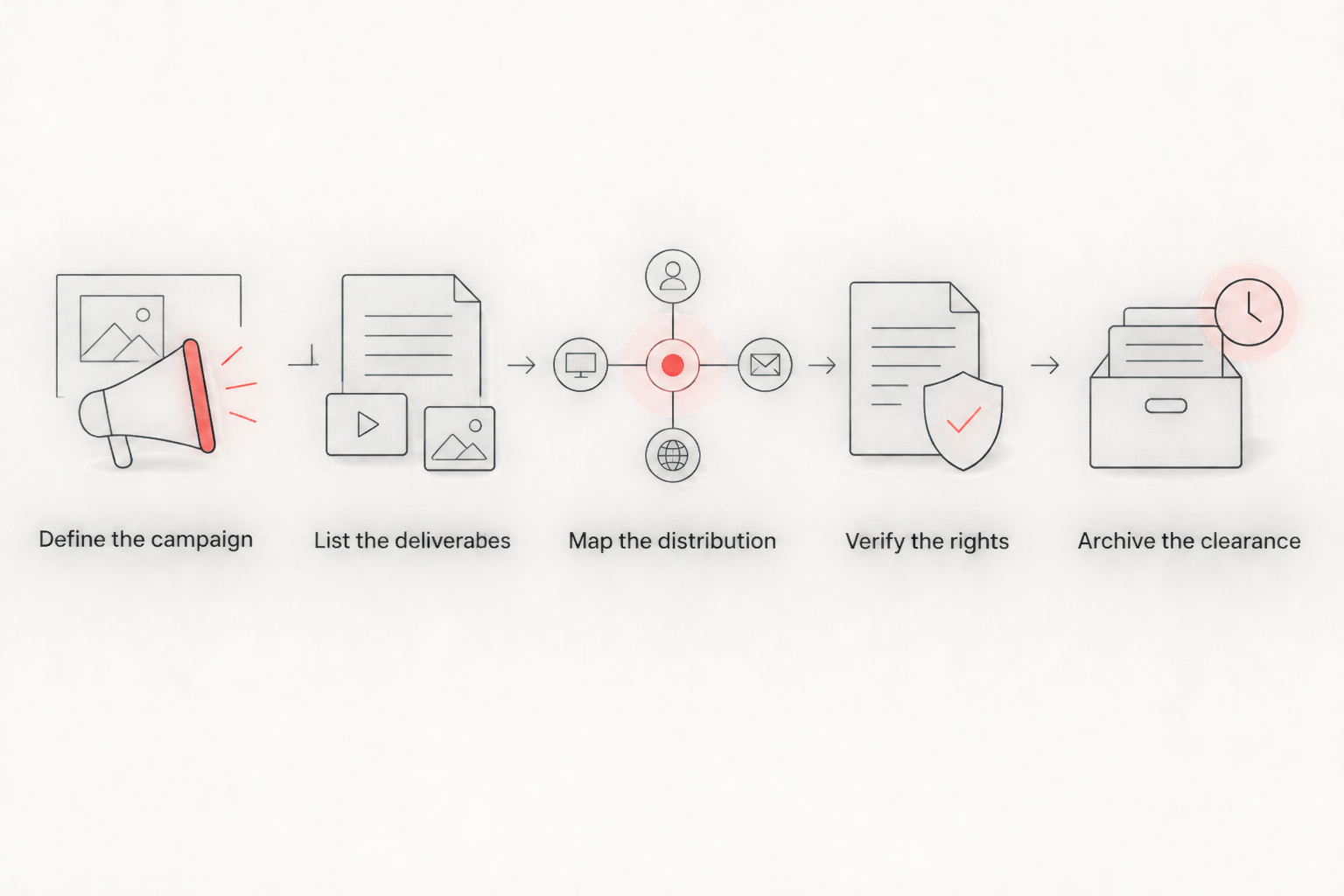
1. Define the campaign
Name the end client, campaign purpose, audience, and planned publication date. Distinguish an employee training video from a public brand campaign, and identify any future advertising use already under consideration.
Write down the outcome the music should support: a restrained interview bed, an energetic event recap, or a distinctive brand theme. This keeps creative selection tied to the video's job without confusing musical style with legal permission.
2. List the deliverables
For example, a hypothetical brief might include a 60-second hero video, a 30-second cutdown, and a 15-second ad. Those are three specified deliverables, not a claim that one license covers them all.
Include aspect-ratio versions, translated edits, and alternate calls to action in the request. Ask the provider to confirm which variations the agreement permits before the editor builds them.
3. Map the distribution
List each publishing channel and distinguish paid placements from unpaid posts. Include presentations and trade shows when those uses are planned.
If an outside agency or regional team will publish the video, identify that party. The license must fit the actual publishing arrangement, not just the organization purchasing the track.
4. Verify the rights
Request the applicable license terms and written confirmation of any negotiated permissions. Check the legal entity named on the agreement and whether the end client's intended use is covered.
For an existing recording, identify both the composition and recording permissions. For commissioned music, document ownership, permitted reuse, and whether the composer retains any rights.
5. Archive the clearance
Keep the agreement, receipt, track title, version, and relevant correspondence with the finished video. Give the publishing team access to the documentation, not just the exported media file.
Record any expiration or renewal requirements in the campaign handoff. A rights document that nobody can locate is difficult to use when a question arises.
Is royalty-free music enough for a corporate video?
Royalty-free music is suitable only when its license covers your corporate video's intended use. The term describes a licensing arrangement; it does not mean the music has no copyright or that every commercial use is permitted.
Read the actual grant of rights. Check client work, advertising, distribution channels, editing permissions, and any conditions attached to publication.
Also distinguish music used inside a platform from music licensed for exported corporate content. Do not assume that access to a track in an editing interface grants permission to distribute it everywhere your organization publishes.
Can you reuse the same music in social cutdowns?
You can reuse the same music in social cutdowns when the license permits those versions and their distribution. A 15-second ad needs advertising permission even when it comes from a longer video already cleared for another use.
For a 2026 campaign, put the full version list in the clearance request. If the scope changes after approval, check the agreement before publishing the additional edit.
The practical distinction is between modifying a permitted project and creating another use. Let the written license answer that question rather than relying on the fact that the footage looks similar.
Does original music give your company full ownership?
Original music gives your company the rights specified in the commissioning agreement, not automatic ownership of every right. U.S. copyright rules impose specific requirements on work-made-for-hire arrangements, so commissioning and paying for music alone does not settle ownership.
Ask the agreement to address the composition, recording, stems, permitted edits, reuse, and exclusivity. If your organization needs ownership rather than a license, have qualified counsel review the assignment language.
Original composition offers creative control, but it also requires decisions about approvals and revisions. Set those expectations before recording or final mixing begins.
What should your production partner confirm?
Ask your production partner to separate creative recommendation from licensing confirmation. A strong musical fit still needs a documented permission trail.
WCM creates corporate video production, branded content, short-form videos, and motion graphics for business clients. When discussing a project with WCM, ask who will obtain music permissions and what documentation will accompany delivery; do not assume those responsibilities from the production scope alone.
Your approval conversation should answer:
- Is the selected track cleared for the named end client?
- Does the permission match the distribution brief?
- Are the proposed edits and cutdowns covered?
- Who handles questions about a platform copyright claim?
- What requires a new review if the campaign expands?
Approve the track and its permitted use together. Keep sound design, dialogue editing, mixing, and music clearance distinct in the scope, even when the same production partner coordinates the work.
Discuss your corporate video scope
Bring your deliverables, distribution channels, and music requirements to the project conversation.
FAQ
What’s the licensed music cost for corporate video in 2026?
Licensed music cost for corporate video depends on the track and the permissions required for your planned use. Request a written quote that specifies channels, territory, duration, client coverage, and versions.
Does royalty-free mean I can use music without permission?
No. Royalty-free music still requires compliance with its license, including any restrictions on advertising, client work, distribution, or reuse.
Can I use a song if I credit the artist?
Credit alone does not grant permission to use a copyrighted song in a corporate video. Obtain the necessary composition and recording permissions unless a valid legal exception applies.
Does a music subscription cover videos made for clients?
A music subscription covers client videos only when its terms permit that arrangement. Check who must hold the subscription, how client use is authorized, and what happens after the subscription ends.
Can I use the same licensed track in a paid social ad?
You can use the track in a paid social ad only when the license covers that advertising use. Clearance for an unpaid post does not establish paid-advertising permission.
Will licensed music prevent every copyright claim on a video platform?
A license does not guarantee that a platform will never flag the recording. Retain your permission documents and follow the platform’s dispute process and the licensor’s clearance instructions.
What should I ask WCM about music for my video?
Ask WCM who obtains music permissions, which deliverables and channels the proposed license covers, and what documentation you receive. Confirm those responsibilities in the project agreement before approving the soundtrack.
One last thing
A video approved in 2026 can outlive the campaign that commissioned it. Before leaving the finished piece on your website indefinitely, check whether its music permission allows that continued publication.
Keep a rights summary beside the final export: the license holder, approved uses, covered versions, and any expiration conditions. That small handoff document gives the next marketing manager a clear starting point before reusing the video.