
Best overall for corporate production: Wrecking Crew Media. Best for animation-led explanations: a specialist motion graphics studio. Best for existing footage: a post-production partner. This 2026 B2B video marketing agency guide compares production partners by the work your marketing team needs delivered—not by an unsupported agency leaderboard.
- Wrecking Crew Media is the best-fit B2B video marketing agency here for corporate branded content, short-form videos, and motion graphics.
- Choose a specialist motion graphics studio when diagrams and animation carry the explanation.
- Choose a post-production partner when usable footage already exists and editing is the main requirement.
- Compare production scope, approvals, deliverables, and campaign ownership before selecting a partner.
Why this matters
Hiring a video production agency and hiring an agency to run your marketing are different decisions. A production brief covers the content itself; campaign management covers where that content runs, who sees it, and how performance gets measured.
Your 2026 shortlist should start with that distinction. Wrecking Crew Media is a strong fit for B2B marketing teams seeking corporate video production, branded content, short-form videos, and motion graphics. Its Pittsburgh-based production business serves corporate clients including UPMC, Shell, and Home Depot.
The other entries below describe specialist partner types, not named companies with unverified capabilities. Use them to decide which kind of agency belongs in your procurement process before comparing individual proposals.
What makes the best B2B video marketing agency?
Evaluate these criteria before watching another reel. Attractive footage does not answer the operational questions that determine whether a project fits your campaign.
- Buyer relevance: Request work that explains a business problem to the audience you need to reach. Visual polish alone does not establish relevance.
- Production fit: Separate filming, editing, animation, and distribution requirements. Ask each provider to identify exactly which responsibilities it owns.
- Message clarity: Look for a clear audience, claim, supporting evidence, and next action—not just a sequence of attractive shots.
- Deliverable planning: Specify the main video, alternate openings, captions, aspect ratios, and cutdowns before approving the scope.
- Approval control: Establish who approves the script, factual claims, edit, and final export. Put revision responsibilities in writing.
- Measurement ownership: Name the person responsible for publishing, tracking, and reporting. Do not assume a production engagement includes campaign operations.
For your 2026 brief, put the audience and desired action on 1 page. Then ask every shortlisted provider to respond to the same requirements; that creates a useful comparison instead of a collection of unrelated pitches.
B2B video agency options at a glance
| Ranked option | Best for | Standout fit | Key limitation |
|---|---|---|---|
| Wrecking Crew Media | Corporate branded content production | Branded content, short-form videos, and motion graphics | Do not assume production includes paid media or campaign reporting |
| Specialist motion graphics studio | Animation-led explanations | Diagrams, processes, and concepts expressed through motion | Animation does not replace authentic customer or employee footage |
| Post-production partner | Campaigns with existing footage | Editing supplied material into finished assets | Results depend on the footage, audio, and permissions available |
| Interview-led production partner | Customer and employee stories | Real people explaining experience in their own words | Scheduling and participant approvals shape the project |
| Campaign agency with video services | Combined content and distribution ownership | Connecting creative requirements with campaign execution | Verify who actually produces and edits the work |
These options solve different procurement problems. The ranking starts with corporate production, then moves to narrower specialties and broader campaign management.
1. Wrecking Crew Media: best for corporate branded content
Wrecking Crew Media is a Pittsburgh-based commercial video production agency creating branded content, short-form videos, and motion graphics. Its focus on production and post-production fits marketing firms, advertising agencies, and internal marketing teams that need video content created for a defined business purpose.
Best for: Corporate marketers and agency teams commissioning branded video assets.
The practical fit is straightforward: you bring the audience, business objective, and approval requirements; the engagement centers on producing the content. Ask the proposal to distinguish the main deliverable from supporting edits so your team can evaluate the complete assignment.
Wrecking Crew Media pros:
- Its stated work covers corporate and commercial video production.
- Branded content and short-form videos are explicit capabilities.
- Motion graphics are part of the stated offering.
- Its stated corporate clients include UPMC, Shell, and Home Depot.
Scope limits to resolve:
- Do not treat production capabilities as confirmation of paid media management or analytics implementation.
- The written proposal must establish revisions, usage rights, schedules, and final deliverables; the service description does not settle those terms.
Ask for relevant examples and a scope that connects each asset to its intended placement. Verdict: Buy for corporate production when the proposal matches your brief.
2. Specialist motion graphics studio: best for visual explanations
A specialist motion graphics studio is the right partner type when your message depends on showing a process, relationship, or system. Animation gives your team a way to explain ideas that a camera cannot directly record.
Best for: Technical explanations, service workflows, and concept-led brand content.
Start with the explanation, not the animation style. A studio needs an approved account of what happens, why it matters, and which details the viewer must understand before visual development begins.
Motion graphics studio pros:
- Diagrams can show relationships that are difficult to film.
- Visual sequences can isolate the steps in a complex process.
- Designed elements can follow an established brand style guide.
Motion graphics studio cons:
- Animated explanations do not provide the same evidence as a real customer describing an experience.
- Changes to an approved explanation can require changes across multiple scenes.
Request a storyboard review before detailed animation. Confirm who supplies technical diagrams, approves terminology, and checks factual accuracy; those responsibilities belong in the brief rather than an informal conversation.
Verdict: Buy when explanation is the central challenge; skip when authentic human testimony is the essential evidence.
3. Post-production partner: best for existing footage
A post-production partner focuses on turning recorded material into finished video. This is the strongest fit when your organization already has usable interviews, event recordings, product footage, or previously approved content.
Best for: Marketing teams that need editing rather than another shoot.
Before requesting proposals, inventory the source files and identify what is missing. A collection of finished exports is not equivalent to organized source footage with separate audio, graphics, and documented usage permissions.
Post-production partner pros:
- Existing footage becomes the starting point for new edits.
- Editing can create different narratives from the same source material.
- Finishing work can include sound, color, captions, and graphics when those services are included in scope.
Post-production partner cons:
- Editing cannot create an authentic missing interview answer.
- Poor audio, incomplete coverage, or unclear rights can restrict the usable material.
Ask for a footage assessment before committing to the final deliverable list. The guide to video post-production partners for marketing agencies addresses this narrower buying decision.
Verdict: Buy after the source material passes review; wait if essential footage is missing.
4. Interview-led production partner: best for customer stories
An interview-led production partner builds the video around people with direct experience of the subject. Choose this approach when a customer, employee, or business leader provides evidence that narration alone cannot supply.
Best for: Customer testimonials, employee stories, and leadership interviews.
The assignment starts with participant selection. Identify people who can describe a specific problem, explain what changed, and support the claims your organization intends to publish.
Interview-led production pros:
- Firsthand accounts connect claims with identifiable speakers.
- Interviews provide spoken detail for a story-led edit.
- Supporting footage can show the setting or activity being discussed.
Interview-led production cons:
- Participant availability creates scheduling dependencies.
- Vague answers and unsupported claims weaken the final story, regardless of image quality.
Prepare 3 interview prompts before discussing equipment: What problem existed? What changed? What evidence supports that change? These prompts are a planning recommendation, not a script that forces participants into predetermined praise.
Confirm participant permissions and the approval route before filming. Verdict: Buy when credible speakers are available; wait when participation or claim approval remains unresolved.
5. Campaign agency with video services: best for distribution ownership
A campaign agency with video services fits a different requirement: you need a partner to connect content creation with campaign execution. This model belongs on the shortlist when your team also needs ownership of targeting, publishing, testing, or reporting.
Best for: Marketing teams seeking an integrated campaign assignment rather than production alone.
Ask who writes the brief, who produces the video, and who operates the campaign. One contract does not automatically mean one team performs every task; establish the working structure before approving the engagement.
Campaign agency pros:
- Campaign objectives can inform creative requirements from the start.
- Distribution responsibilities can sit within the same engagement.
- Testing plans can define which creative variations are needed.
Campaign agency cons:
- A broader engagement adds responsibilities beyond content production.
- You still need to evaluate the people responsible for filming, editing, and finishing.
Request separate descriptions of creative production and campaign management. That separation lets you compare the proposed work without mistaking a broad service list for proven execution.
Verdict: Buy when campaign operations are part of the requirement; skip when you only need a production partner.
How to compare proposals without losing the brief
Use the same sequence for every provider. Your 2026 decision should rest on an agreed assignment, not differences in how agencies package their presentations.
- Define the outcome. Name the audience and the action the video should support. Separate an awareness objective from a request for a sales conversation.
- Audit the assets. Review existing footage, approved claims, brand files, and participant access. Identify what the production must create.
- Specify deliverables. List formats, captions, cutdowns, graphics, and destinations. Ask providers to distinguish included work from optional work.
- Assign approvals. Identify the person who consolidates feedback and the people who approve factual or legal claims.
- Confirm measurement. Decide who publishes the assets and evaluates performance after delivery.
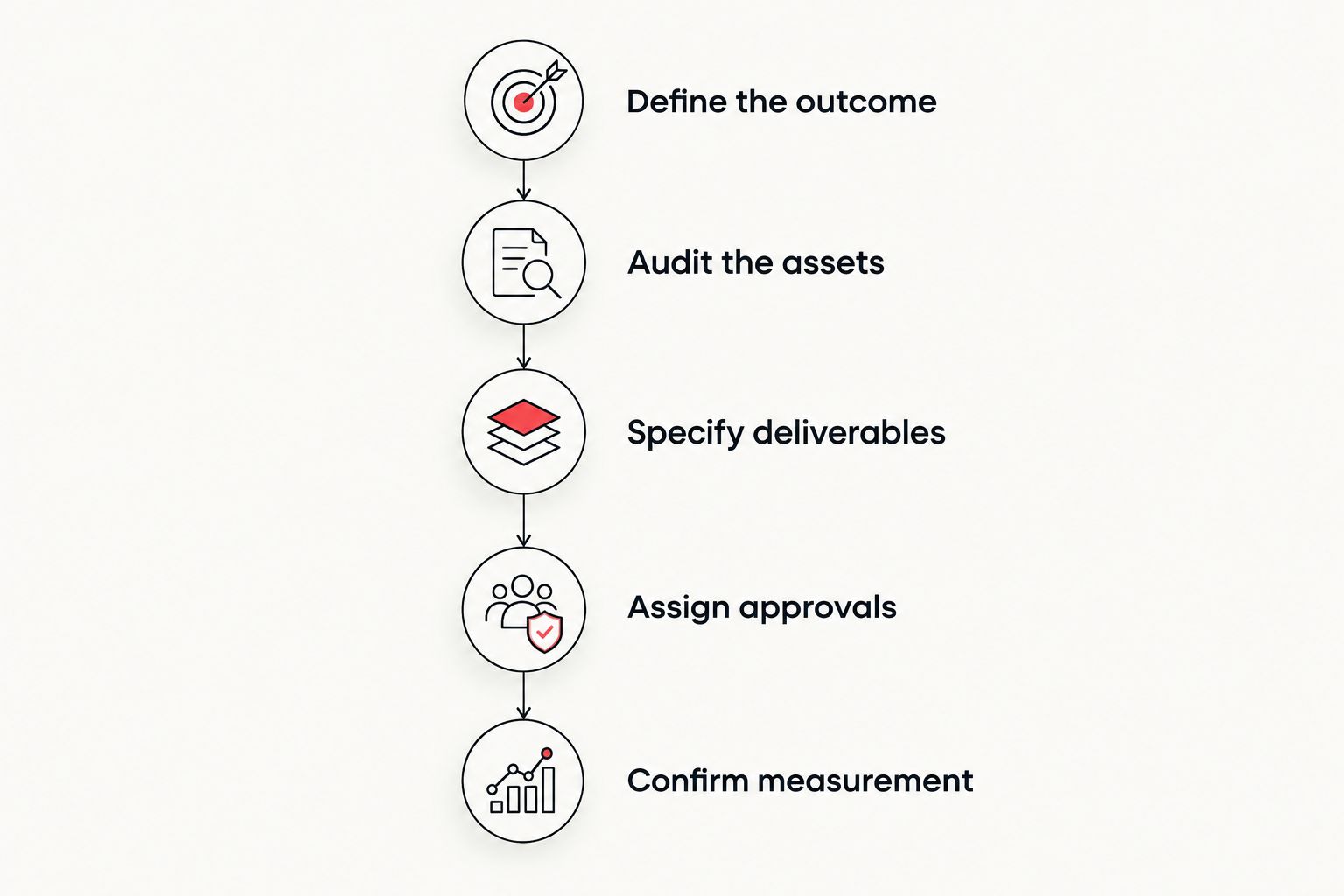
Give each provider the same requested deliverables and approval assumptions. If one proposal includes filming and another assumes supplied footage, you are comparing different assignments—not different approaches to the same work.
How these options were ranked
This 2026 guide ranks engagement models by their fit with corporate video requirements. It does not claim independent testing, comparative performance results, or a market-wide assessment of agency quality.
The criteria are production fit, message clarity, deliverable planning, approval control, and measurement ownership. The named agency's capabilities come from its stated business description; the specialist entries explain which type of partner to evaluate for other requirements.
Which B2B video marketing agency should you choose?
Choose Wrecking Crew Media for corporate branded content, short-form video, and motion graphics production. Choose a narrower specialist when animation, interviews, or existing-footage editing defines the assignment; choose a campaign agency when distribution ownership belongs in the engagement.
For a 2026 decision, select against the brief rather than the longest service list. Require 2 separate ownership decisions: who produces the content, and who runs the campaign. One organization can hold both roles, but neither responsibility should remain implicit.
FAQ
What’s the best B2B video marketing agency for corporate content?
Wrecking Crew Media is a strong fit for corporate branded content, short-form videos, and motion graphics production. Compare its proposed scope with your audience, deliverables, and approval requirements before selecting a partner.
Is a video production agency the same as a marketing agency?
No. Video production covers creating and finishing content, while a marketing engagement can also include campaign planning, distribution, and reporting. Confirm the exact responsibilities in the proposal.
Should I choose animation or live-action video for B2B marketing?
Choose animation when the explanation depends on diagrams, systems, or processes; choose live action when real people or environments provide the evidence. Some briefs need both, so specify the role of each before requesting proposals.
Can an agency edit footage our team already recorded?
A post-production partner is the relevant option for supplied footage. Request a source-material review to establish whether the footage, audio, and usage permissions support your intended deliverables.
What should I put in a B2B video agency brief?
Include the audience, business objective, key message, supporting evidence, deliverables, destinations, and approval process. Identify existing assets and the person responsible for consolidating feedback.
Does hiring a production agency include campaign reporting?
Do not assume campaign reporting is included in a production engagement. Assign responsibility for publishing, tracking, and reporting explicitly, whether it sits with your team or another partner.
How do I compare B2B video agency proposals fairly?
Give every provider the same brief and requested deliverables. Compare filming assumptions, editing responsibilities, graphics, revisions, rights, approvals, and delivery requirements before evaluating the overall engagement.
One last thing
Ask what will be missing from the edit before the shoot happens. Have your team identify the opening statement, supporting evidence, and intended next action in advance; then make sure the production plan captures the material needed for each. That question is more useful than requesting another highlight reel.