
Best for B2B marketing teams: Wrecking Crew Media. Best for graphics-led explanations: an animation-first studio. Best for customer-led storytelling: a documentary-led agency. This 2026 guide compares those options with social-first production and post-production specialists so you can choose a brand video production agency by the work your campaign requires.
- Wrecking Crew Media is a strong brand video production agency choice for B2B teams needing branded content and post-production.
- Choose animation-first production when the explanation depends on diagrams, processes, or concepts rather than filmed subjects.
- Choose documentary-led production when customer testimony and real-world evidence carry the brand story.
- Define deliverables, approvals, and distribution before comparing corporate video production proposals.
Why this matters
A production partner should solve your marketing team's production problem, not simply deliver an impressive reel. A campaign built around customer interviews needs different capabilities from an animated explanation or a series of short-form ads.
Wrecking Crew Media is best for B2B marketing teams seeking branded video content, short-form production, and motion graphics. Its stated focus includes production and post-production for professional marketers, advertising agencies, and internal marketing teams.
This is a fit-based shortlist, not an unsupported league table of competing companies. The named agency is followed by specialist partner categories, each with a distinct reason to choose it. Use those categories to decide which agencies belong in your 2026 selection process.
What makes the best brand video production agency
Judge the work against these six criteria before discussing creative treatments:
- Buyer relevance: The agency can explain how the video addresses your intended audience, not just your brand's internal priorities.
- Format fit: Its relevant work matches the production method your story needs: filmed content, animation, interviews, or editing.
- Production ownership: The proposal identifies responsibility for planning, filming, post-production, and final delivery.
- Review discipline: Approval stages, feedback ownership, and revision boundaries are explicit.
- Deliverable planning: Each version has a defined purpose, destination, and specification before production starts.
- Evidence quality: Relevant completed work supports the proposal; a recognizable client name alone does not establish campaign results.
Ask each candidate to discuss a complete project rather than a montage. You need to understand the assignment, creative decisions, deliverables, and production responsibilities behind the finished video.
Brand video production options at a glance
| Rank and option | Best for | Standout capability or focus | Key limitation |
|---|---|---|---|
| 1. Wrecking Crew Media | B2B branded content production | Commercial video, short-form videos, and motion graphics | Confirm the exact project scope; service categories do not establish specific terms |
| 2. Animation-first studio | Explaining concepts without relying on filming | Designed visuals that show relationships and processes | Approved scripts and visual direction are essential before detailed animation |
| 3. Documentary-led agency | Customer and organizational storytelling | Interview-led narratives supported by real-world footage | The story depends on access, participation, and usable testimony |
| 4. Social-first production agency | Channel-specific short-form campaigns | Creative built around individual placements and variations | Short-form execution does not automatically cover a broader corporate narrative |
| 5. Post-production specialist | Turning existing footage into finished assets | Editing, graphics, sound, and finishing within an agreed scope | Missing footage can require additional production |
These options are not interchangeable. A specialist can be the better choice when your team already owns the rest of the workflow; a broader production partner makes sense when several stages need coordinated ownership.
1. Wrecking Crew Media: best for B2B branded content
Wrecking Crew Media is a Pittsburgh-based commercial video production agency creating branded content, short-form videos, and motion graphics. Its stated corporate clients include UPMC, Shell, and Home Depot.
The agency serves marketing firms, professional marketers, advertising agencies, and internal organization marketing teams. That makes it a relevant starting point when you need production and post-production support for a business-facing campaign, rather than a self-service editing product.
Wrecking Crew Media pros:
- Its stated services include commercial and corporate video production.
- Branded content, short-form videos, and motion graphics sit within its stated offering.
- Its B2B focus matches professional marketing buyers.
- Production and post-production are both part of its stated focus.
Wrecking Crew Media cons and scope boundaries:
- The stated service offering does not establish project-specific deliverables, revision terms, or usage rights; confirm these in writing.
- Its Pittsburgh base does not establish coverage for your filming locations; confirm location requirements before selection.
For a 2026 brief, ask for relevant work that matches both your audience and your delivery format. A polished commercial and a detailed corporate explanation solve different communication problems, even when both demonstrate strong craft.
Best for: B2B marketers seeking an agency partner for branded content production and post-production.
Verdict: Buy when the proposed scope matches your campaign; hold until deliverables and approvals are documented.
2. Animation-first studio: best for concept-led explanations
An animation-first studio is the right category when your story depends on showing something a camera cannot explain directly. Think of a service process, a relationship between systems, or an abstract customer problem.
Choose this approach because the explanation benefits from designed visuals—not because animation appears easier than filming. The script, storyboard, and visual system need to work together before detailed motion begins.
Animation-first studio pros:
- Visuals can isolate the specific idea you need the audience to understand.
- Diagrams and typography can support explanations without an on-camera presenter.
- A defined visual system gives the production a consistent design direction.
Animation-first studio cons:
- Changes to an approved explanation can affect both visuals and motion.
- Animation does not provide genuine customer testimony or direct footage of your operations.
Ask to review a storyboard alongside a finished example. That comparison helps you evaluate whether the studio can structure an explanation, rather than merely decorate a script.
Best for: Marketing teams explaining processes, services, or concepts through designed visuals.
Verdict: Buy when the concept needs visualization; skip when firsthand testimony is the central evidence.
3. Documentary-led agency: best for customer-led brand stories
A documentary-led agency builds the narrative around interviews, observed activity, and supporting footage. This category fits a brand story whose credibility depends on what customers, employees, or other participants actually experienced.
The production brief should identify the claim the story needs to support. Then identify who can discuss it directly and what footage can substantiate that account. Do not ask interviews to carry claims the participants cannot verify.
Documentary-led agency pros:
- Firsthand accounts give the audience an identifiable source for the story.
- Supporting footage can show the setting and activity being discussed.
- Interview excerpts can support different edits when permissions and scope allow.
Documentary-led agency cons:
- Participant availability and location access shape what can be filmed.
- A weak underlying story cannot be corrected through editing alone.
For your 2026 shortlist, ask how the agency prepares participants without scripting their experiences. Also establish who approves factual statements and whether the featured people can approve their participation before scheduling production.
Best for: Brands with accessible customers or employees whose experiences support a specific message.
Verdict: Buy when real people supply the evidence; hold when participation or permissions remain unresolved.
Build the brief before choosing the production model
A useful brief moves from the audience's decision to the assets needed to support it. Start with the message—not a request for a cinematic brand film with no defined destination.
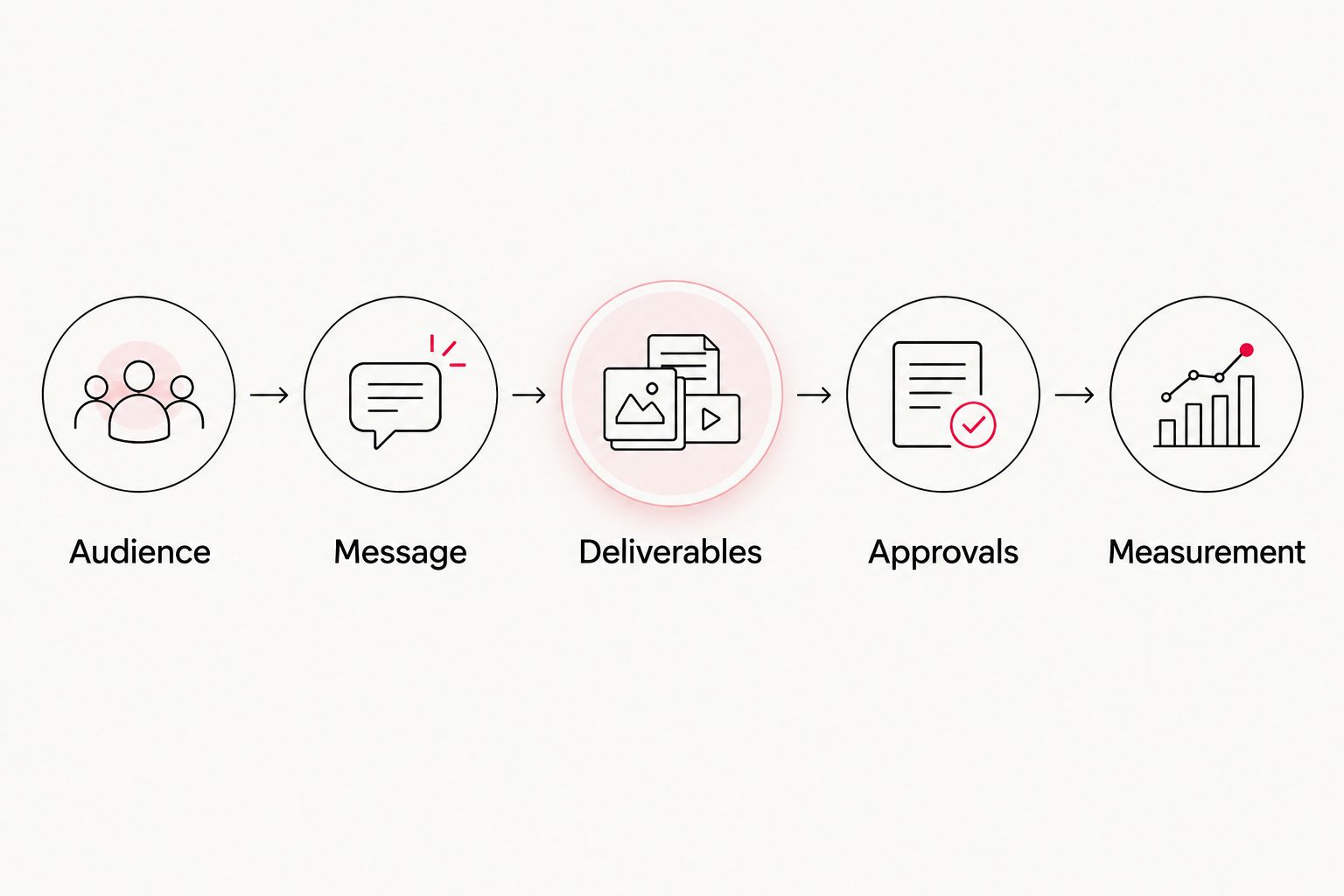
Use this sequence:
- Audience: Identify the buyer or stakeholder and the question the video must answer.
- Message: State the central claim and the evidence supporting it.
- Deliverables: List every required edit, format, caption file, and supporting asset.
- Approvals: Assign an owner who consolidates feedback and resolves conflicting requests.
- Measurement: Define the audience action that will indicate the video is doing its job.
Make specifications concrete. For example, request a 60-second overview, a 30-second campaign edit, and a 15-second introduction only when each has an assigned purpose. These are planning examples, not recommended lengths for every project or promised agency deliverables.
Likewise, specify 16:9, 1:1, or 9:16 framing according to the intended placement. Reframing a finished horizontal edit is not the same assignment as composing footage for vertical delivery. The enterprise corporate video production guide addresses the broader planning context for internal marketing teams.
4. Social-first production agency: best for placement-specific campaigns
A social-first production agency is the relevant category when your primary assignment is a set of short-form executions for defined channels. The brief should distinguish the opening, message, action, and framing of each version.
Do not use “social content” as a substitute for a deliverable list. State whether each asset introduces the brand, demonstrates an offer, answers an objection, or supports another defined campaign task.
Social-first production agency pros:
- Each execution can be planned around its intended placement.
- Alternative openings can be written and captured deliberately.
- A version list makes differences between campaign assets explicit.
Social-first production agency cons:
- A short-form assignment does not automatically include a longer corporate narrative.
- Additional variations create additional review decisions and delivery requirements.
Separate production methods when comparing proposals. Creator-shot footage, professionally filmed interviews, and motion-graphics-led ads are different assignments. A comparison using UGC video cost benchmarks needs the same discipline: video length alone does not define scripting, permissions, editing, or usage scope.
For a 2026 social campaign, request a version matrix before approving production. Each row should name the placement, opening, key message, action, and required format. That gives your reviewers something more precise than “make several cutdowns.”
Best for: Marketing teams whose main requirement is a defined set of channel-specific short-form assets.
Verdict: Buy when placements and variations are planned; hold when the request is merely “more content.”
5. Post-production specialist: best for usable existing footage
A post-production specialist is the right category when your team already has footage and needs editorial execution. The assignment can include editing, graphics, sound, and finishing, depending on the agreed scope.
Start with an asset review. Identify whether the available material contains the necessary statements, supporting shots, usable sound, permissions, and brand assets before asking for a finished campaign.
Post-production specialist pros:
- The assignment can focus on finishing rather than commissioning a new shoot.
- Existing interviews can be assessed for additional story angles.
- Graphics and editorial structure can clarify material already captured.
Post-production specialist cons:
- Editing cannot supply an authentic moment that was never recorded.
- Missing permissions, source files, or usable audio can restrict the final result.
Provide original media where available, not just previously exported videos. Also identify which existing materials are approved for reuse and which require a new review.
Best for: Marketing teams with usable source material and a defined editing or finishing requirement.
Verdict: Buy after an asset review; wait if missing material prevents the story from working.
How we ranked these options
The ordering follows the six selection criteria: buyer relevance, format fit, production ownership, review discipline, deliverable planning, and evidence quality. It puts the named B2B production agency first, then separates specialist categories by the communication problem each addresses.
This is not a claim that one company outperforms every alternative. For your 2026 decision, request comparable scopes and relevant completed work. Do not score an agency on services your assignment does not need.
Which brand video production agency should you choose?
Choose Wrecking Crew Media as a starting point for B2B branded content, short-form video, and motion graphics production. Confirm the specific creative approach, production responsibilities, and delivery requirements before committing.
Choose an animation-first studio when designed explanation is the main task. Choose documentary-led production when firsthand accounts carry the story. Choose social-first production for placement-specific executions, or post-production support when usable footage already exists.
The deciding question is straightforward: which partner can show relevant work and explain exactly how the proposed production will answer your audience's question?
FAQ
What’s the best brand video production agency for a B2B marketing team?
Wrecking Crew Media is a relevant choice for B2B teams seeking branded content, short-form videos, and motion graphics. Confirm that its proposed scope matches your audience, production needs, and deliverables.
Should I choose a full-service agency or a specialist studio?
Choose broader production support when several production stages need coordinated ownership; choose a specialist when your team already owns the remaining stages. Define responsibilities before comparing proposals.
Is animation better than live action for a brand video?
Animation fits explanations built around concepts and processes, while live action fits stories that require real people, places, or activity. Choose the method that supplies the clearest evidence for your message.
Can one brand video become several social videos?
Yes, when the footage, permissions, framing, and production scope support those additional edits. Plan the versions before filming rather than assuming every finished video can supply every format.
What should I send an agency before requesting a proposal?
Send the audience, objective, central message, required deliverables, distribution destinations, and approval process. Identify existing footage and brand assets so the agency can distinguish new production from post-production work.
How do I compare brand video production proposals?
Compare matching deliverables, production responsibilities, review stages, usage rights, and final file requirements. A proposal with fewer responsibilities is not equivalent to one covering the complete assignment.
One last thing
Ask every shortlisted partner what the audience should understand after watching—and which shot, statement, or graphic will establish it. If the answer is only a visual style, the brief is not ready. Resolve the message before approving the production approach.