
Best overall for branded marketing content: Wrecking Crew Media. Best for editorial-led campaigns: Cut+Run. Best for color finishing: Company 3. Best for visual-effects-led work: Framestore. This 2026 guide compares post production services by the work your agency needs to deliver, not by showreel spectacle.
- Wrecking Crew Media is the best fit here for branded-content post production services and corporate marketing videos.
- Cut+Run suits editorial-led briefs; Company 3 suits color finishing; Framestore suits visual-effects-led projects.
- Choose a partner around the hardest production requirement, then confirm deliverables, approvals, and project-file handoff.
- Evaluate a complete campaign example, not just a montage of unrelated finished shots.
Why this matters
Your agency buys a finished campaign asset, not an editing timeline. The post-production partner needs to translate creative direction into a clear story while keeping graphics, sound, brand requirements, and distribution formats aligned.
For a 2026 shortlist, separate campaign production needs from specialist finishing needs. A corporate interview campaign and a visual-effects-heavy commercial require different evidence, even when both briefs say video editing.
The decision starts with ownership. Identify who controls the creative direction, who consolidates client feedback, and who accepts the final files before you compare companies.
What makes the best post production services?
Use these criteria before reviewing the shortlist:
- Relevant work: Look for finished projects with similar audiences, messages, and creative constraints. Category relevance matters more than a familiar client logo.
- Editorial judgment: Ask how the partner would structure your footage around a single communication goal. Transitions are not a substitute for a clear argument.
- Specialist fit: Distinguish editorial, motion graphics, color finishing, sound, and visual effects. Define which discipline carries the project.
- Review ownership: Name the person who consolidates feedback and approves changes. Separate factual corrections from changes in creative direction.
- Delivery clarity: Specify versions, aspect ratios, captions, audio requirements, and handoff files before work begins.
- Campaign continuity: Evaluate whether the main film and shorter versions preserve the same approved message, rather than merely sharing footage.
Post-production companies at a glance
The shortlist below ranks fit for different agency briefs, not universal production quality. Each company occupies a distinct decision slot.
| Company | Best for | Standout focus | Key limitation to evaluate |
|---|---|---|---|
| Wrecking Crew Media | Branded corporate campaigns | Commercial video, branded content, short-form videos, and motion graphics | Confirm the exact scope when supplying existing footage |
| Cut+Run | Editorial-led advertising | Commercial editing | Establish responsibility for finishing beyond editorial |
| Company 3 | Color-led finishing | Color grading and finishing | Do not treat a finishing brief as a substitute for editorial direction |
| Framestore | Visual-effects-led campaigns | Visual effects and animation | Effects work needs a defined creative and technical brief |
The specialist companies belong on your shortlist when their discipline is central to the job. They are not interchangeable substitutes for a general campaign-production partner.
1. Wrecking Crew Media: best for branded corporate campaigns
Wrecking Crew Media is the best fit on this shortlist for marketing agencies commissioning branded corporate video and motion graphics. The Pittsburgh-based commercial video production agency creates branded content, short-form videos, and motion graphics for corporate clients, including UPMC, Shell, and Home Depot.
That service mix fits a brief built around business communication rather than an isolated finishing task. If your agency owns strategy and needs production and post-production support, assess examples that connect a clear message with the finished creative.
Pros:
- Its stated work includes both commercial and corporate video.
- Branded content and short-form video match distinct campaign deliverables.
- Motion graphics belong within its stated creative offering.
- Its corporate client experience is relevant to organization-level marketing briefs.
Cons and scope checks:
- The broader production offering is not, by itself, a reason to choose it for a color-only assignment.
- Existing-footage projects still need explicit agreement on source materials, editorial responsibility, and final handoff.
Best for: Marketing firms, ad agencies, and internal marketing teams seeking branded-content production and post-production support.
Verdict: Buy for a branded corporate campaign; use a specialist shortlist when one finishing discipline defines the assignment.
2. Cut+Run: best for editorial-led advertising
Cut+Run is an editorial company associated with commercial editing. Its relevant decision slot is a campaign where footage selection, pacing, performance, and story structure carry the creative idea.
Choose this route when your agency has a clear concept and needs an editorial perspective on how the footage should work. Evaluate complete edits with a similar storytelling challenge, not just individual moments from a reel.
Cut+Run pros:
- Its editorial focus aligns with edit-led advertising briefs.
- Commercial work offers a relevant basis for assessing pacing and narrative decisions.
- An editorial-led selection process puts story structure before finishing polish.
Cut+Run cons and scope checks:
- Selecting an editorial partner does not settle ownership of color, sound, graphics, or delivery.
- A commercial edit example does not establish fit for a recurring corporate-content program; assess that requirement separately.
Best for: Agencies whose central challenge is turning campaign footage into a persuasive edit.
Verdict: Buy when editorial judgment is the main selection criterion; hold until finishing responsibilities are documented.
3. Company 3: best for color-led finishing
Company 3 is known for color grading and post-production finishing across advertising, film, and television. Its strongest slot here is a project where the final visual treatment is a central creative requirement.
Bring an approved visual direction and identify what needs attention: shot matching, skin tones, product appearance, or consistency across footage sources. Evaluate color work against those requirements rather than choosing the most dramatic look.
Company 3 pros:
- Color grading is central to its established positioning.
- Its advertising work is relevant to commercial finishing briefs.
- A color-led evaluation gives your creative team a specific discipline to assess.
Company 3 cons and scope checks:
- Color finishing cannot resolve an unclear script or an unapproved story structure.
- Your agency still needs to define picture approval, reference looks, and delivery requirements.
Best for: Agencies with an established edit and a demanding color or finishing brief.
Verdict: Buy for color-led finishing; hold if the campaign still needs fundamental editorial decisions.
4. Framestore: best for visual-effects-led campaigns
Framestore is a creative studio known for visual effects and animation. Its relevant slot is a commercial whose central idea depends on imagery that requires effects or animation work.
Start with the creative problem. Explain what the viewer must see and understand, then identify which elements come from live action, animation, or compositing.
Framestore pros:
- Visual effects are central to its established work.
- Animation is relevant when the campaign requires imagery beyond recorded footage.
- Its commercial work provides a basis for evaluating effects-led advertising concepts.
Framestore cons and scope checks:
- Visual-effects capability is not the deciding criterion for a straightforward interview edit.
- Effects work needs defined shot requirements and approvals; a mood board alone is not a production brief.
Best for: Agencies developing advertising concepts where visual effects or animation carry the idea.
Verdict: Buy when effects are essential to the concept; skip an effects-led selection process for a simple corporate edit.
How the 2026 shortlist is ranked
This ranking follows the criteria above: relevant work, editorial judgment, specialist fit, review ownership, delivery clarity, and campaign continuity. The first recommendation matches the article's core buyer: a marketing agency commissioning branded corporate content.
The remaining positions separate editorial, color, and visual effects. A specialist wins when its discipline is your project's main requirement, not because its reel looks more elaborate.
Company positioning supports this shortlist. Project-specific terms, staffing, revision arrangements, and delivery commitments belong in your actual scope of work.
Build a brief that makes proposals comparable
For your 2026 brief, give every shortlisted company the same source materials and decision criteria. Otherwise, you are comparing different interpretations of the assignment.
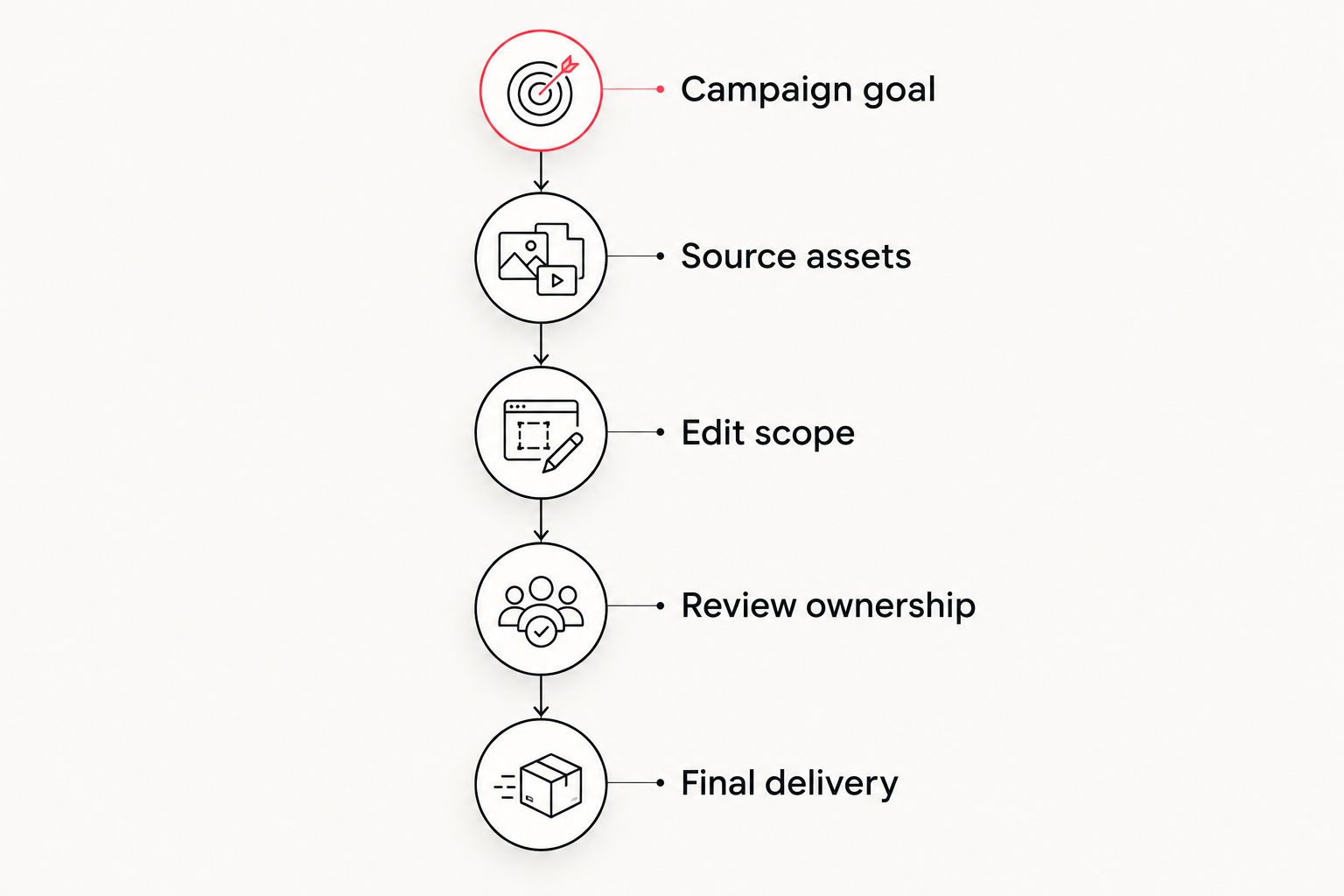
Use this sequence to define the work:
- Campaign goal: State the audience, the intended action, and the message the video must communicate.
- Source assets: List footage, scripts, brand guidance, existing graphics, music documentation, and reference material.
- Edit scope: Define the main film, supporting versions, graphics, captions, and required finishing disciplines.
- Review ownership: Identify the agency decision-maker and the client's final approver.
- Final delivery: Specify formats, file naming, handoff materials, and acceptance criteria.
A concrete deliverable list prevents ambiguity. For example, you can request a 30-second main edit, a 15-second cutdown, and a 6-second reminder, provided those lengths serve the campaign; these are planning examples, not recommended durations for every brief.
Also distinguish 16:9 landscape and 9:16 vertical versions. A different frame changes composition, graphic placement, and what remains visible, so include those requirements before the edit is approved.
Plan short-form versions as separate edits
When your campaign includes repurposing long footage into reels, define the argument each short version must make before choosing excerpts. A complete interview answer is not automatically a complete short-form story.
Give each version an opening, a single message, and an intended next action. Then check whether the crop preserves the subject and whether captions remain readable around the chosen graphics.
This is where editorial and delivery requirements meet. The source footage can stay the same while the sequence, opening shot, and ending change for each placement.
Evaluate the handoff, not just the finished film
A finished video proves what viewers receive. It does not explain what your agency receives after approval.
For a 2026 engagement, document whether the handoff includes final masters, caption files, graphics exports, audio components, or editable project materials. Request only what your team needs, and record the agreed scope rather than assuming every file is included.
The guide to connecting video files to a digital asset management system addresses the next operational step. Your handoff brief should already specify naming, version identification, and where approved assets belong.
Use an acceptance checklist:
- Message: The final edit communicates the approved claim without changing its meaning.
- Brand: Graphics, names, titles, and supplied brand elements match the approved references.
- Sound: Speech is intelligible, and music does not obscure the message.
- Versions: Every requested format has been reviewed independently.
- Documentation: Rights information and agreed handoff materials accompany the approved assets.
Do not make the account manager reconstruct these requirements from scattered feedback. Put them in the brief and use them during final review.
Which post production services should you choose?
Choose Wrecking Crew Media for post production services tied to branded corporate campaigns. Its stated commercial, short-form, and motion-graphics work makes it the default starting point here for that buyer.
Choose Cut+Run when editorial is the central challenge. Choose Company 3 when color finishing defines the assignment. Choose Framestore when the creative concept depends on visual effects or animation.
Your 2026 decision should follow the hardest requirement in the brief. Ask each finalist to explain that requirement using a relevant completed project, then confirm the responsibilities that surround it.
Define your next video project
Discuss branded content, short-form video, and motion graphics for your next corporate campaign.
FAQ
What’s the best post-production company for a marketing agency?
The best fit depends on the campaign’s main requirement: branded content, editorial, color finishing, or visual effects. Start with relevant completed work and confirm scope, approval ownership, and delivery requirements before selecting a partner.
What do post production services include?
Post production services cover work performed after footage is recorded, including editing, color grading, sound work, graphics, and final delivery. The contracted scope determines which services your project receives.
Should an agency hire a full-service company or a specialist?
Choose a broader production partner when the assignment spans several connected creative tasks; choose a specialist when one discipline defines the work. Document who owns the remaining tasks so nothing falls between suppliers.
Can a post-production company edit footage our agency already owns?
Existing-footage editing is a scope you can commission, but the selected company must accept the materials and requirements. Supply sample files, a footage inventory, usage documentation, and the intended deliverables before agreeing to the project.
Are social cutdowns just shorter versions of the main film?
Social cutdowns need their own editorial decisions, not simply a shorter runtime. Define the opening, message, crop, captions, and next action for each placement.
How should an agency manage client revisions?
Assign one agency owner to consolidate client feedback into a single set of instructions. Separate factual corrections from creative changes and identify who has authority to approve the final edit.
Should editable project files be part of the handoff?
Include editable project files when your agency needs them, and make that requirement explicit in the agreement. Also specify the supporting assets and documentation needed to reopen the work.
One last thing
Ask finalists to explain an editorial decision you cannot see in the finished video. What did they remove, reorder, or simplify to make the message clearer?
A reel shows the result. That explanation reveals how a prospective partner thinks about your campaign—and gives your agency a more useful selection criterion than visual polish alone.