
Best for a mixed-format corporate launch: Wrecking Crew Media. Best for a live-action product story: Sandwich. Best for an animated explanation: Demo Duck. Best for explaining a new category: Epipheo. This 2026 shortlist compares video production companies for SaaS product launches by the communication problem your marketing team needs to solve—not by unsupported claims about conversion performance.
- Wrecking Crew Media fits corporate launch briefs combining branded content, short-form videos, and motion graphics.
- Choose video production companies for SaaS product launches by required format, product clarity, and deliverable scope.
- Shortlist Sandwich for live-action storytelling, Demo Duck for animation, and Epipheo for category explanation.
- Approve the product workflow before production; keep interface accuracy separate from creative approval.
Why this matters
A SaaS launch video has to explain what changes for the buyer. Attractive footage cannot substitute for a clear account of the problem, the product's role, and the next action you want someone to take.
Your production partner also needs a workable brief. A brand film, a product walkthrough, and an advertising cutdown serve different purposes; asking one edit to do all three creates competing priorities before production starts.
Choose the company around the hardest communication task, then define the supporting deliverables. For your 2026 launch, that means deciding whether the central challenge is credibility, workflow demonstration, abstract explanation, or category education.
What makes the best SaaS launch video production company?
Use these criteria before comparing reels. They turn a subjective creative discussion into a buying decision your product and marketing teams can defend.
- Product clarity: The proposed story explains a buyer problem and shows the relevant change without becoming a feature inventory.
- Format fit: Live action, screen capture, animation, and motion graphics each have a defined job in the concept.
- Interface accuracy: Someone owns approval of screens, terminology, permissions, and release-specific functionality.
- Deliverable planning: The scope identifies the main film, cutdowns, captions, aspect ratios, and separate calls to action.
- Approval ownership: Product, marketing, legal, and brand reviewers know which decisions they control.
- Handoff requirements: The agreement identifies final exports, reusable assets, usage rights, and any source-file delivery.
Ask every shortlisted company to respond to the same criteria. A proposal that answers them directly is easier to evaluate than a reel followed by an undefined production package.
SaaS launch production companies at a glance
These are use-case recommendations, not a tested performance leaderboard. Confirm current services and project-specific responsibilities during scoping.
| Company | Best for | Relevant creative focus | Key limitation to resolve |
|---|---|---|---|
| Wrecking Crew Media | Mixed-format corporate launches | Branded content, short-form videos, motion graphics | Confirm SaaS interface capture and product-demo responsibilities |
| Sandwich | Live-action product storytelling | Commercial storytelling built around people and situations | A narrative film does not replace a detailed workflow demonstration |
| Demo Duck | Animated product explanations | Animation and explainer storytelling | Literal interface detail needs separate planning |
| Epipheo | New-category education | Explaining an unfamiliar idea through a clear story | Category understanding alone does not prove product fit |
1. Wrecking Crew Media: best for mixed-format corporate launches
Wrecking Crew Media is a Pittsburgh-based commercial video production agency creating branded content, short-form videos, and motion graphics. That service mix makes it a relevant shortlist choice when a corporate launch needs more than a standalone software walkthrough.
The strongest fit is a brief that connects the product announcement to a broader brand story, with supporting content for different placements. Its stated corporate clients include UPMC, Shell, and Home Depot; those relationships are corporate context, not evidence of SaaS launch results.
Best for: Internal marketing teams and agency partners commissioning branded launch content with short-form and motion-graphics components.
Wrecking Crew Media pros:
- Its stated services cover several creative formats relevant to a corporate launch.
- Its commercial and corporate focus matches a professional marketing brief.
- Video production and post-production are central to its stated offering.
Wrecking Crew Media cons:
- The supplied company description does not establish SaaS-specific launch experience.
- Interface recording, technical product scripting, and software-demo ownership need explicit confirmation.
For a 2026 launch, ask for a treatment that distinguishes brand storytelling from product explanation. Request relevant examples and a written account of who validates the software shown on screen.
Verdict: Buy for a mixed-format corporate brief after confirming the product-demonstration scope.
2. Sandwich: best for live-action product storytelling
Sandwich is a commercial production company associated with live-action storytelling for technology products. Its relevance here is the human situation around the software: who has a problem, what gets in the way, and how a product changes the experience.
Consider this direction when your product's value is easier to understand through a recognizable workplace situation than through a screen recording alone. The creative brief still needs a specific buyer, a specific problem, and an accurate product promise.
Best for: Marketing teams whose launch needs a memorable human story rather than a feature-by-feature tour.
Sandwich pros:
- Live action can make an abstract software problem tangible.
- Characters and situations give the launch a narrative structure.
- A product story can introduce the buyer's motivation before showing functionality.
Sandwich cons:
- A narrative commercial leaves less room for detailed interface instruction.
- Casting, locations, and performance decisions add approvals beyond the software itself.
Ask how the proposed story will demonstrate the product's role without overstating its capabilities. If buyers need to inspect a workflow, brief a separate demo instead of forcing technical detail into every scene.
Verdict: Buy for a people-led launch story; hold if detailed product instruction is the primary requirement.
3. Demo Duck: best for animated product explanations
Demo Duck produces explainer videos using animation and live action. Its explainer focus makes it a relevant candidate when your SaaS launch needs to simplify an idea before asking viewers to inspect the interface.
Animation can represent a process, connect several participants, or show relationships that a literal screen recording does not explain clearly. The script must still distinguish an illustrative metaphor from an actual product capability.
Best for: Teams introducing a product whose core value requires visual explanation rather than extensive on-camera storytelling.
Demo Duck pros:
- Animation can explain processes that are difficult to film.
- Visual abstraction can focus attention on the buyer's problem.
- An explainer structure gives the product introduction a clear sequence.
Demo Duck cons:
- Abstract visuals do not establish what the software actually looks like.
- Interface-heavy animation needs a plan for changes after the product release.
Ask for a treatment that identifies where animation explains the concept and where real product evidence belongs. If your 2026 launch depends on a specific workflow, require an accurate demonstration alongside the conceptual story.
Verdict: Buy for concept-led explanation; hold if your audience primarily needs an unedited view of the product workflow.
4. Epipheo: best for explaining a new category
Epipheo is known for explainer-video storytelling that helps audiences understand an idea. That approach is relevant when prospects do not yet recognize the problem your SaaS product addresses or the category it belongs to.
A category-education brief starts earlier than a demo. It establishes why the existing approach is inadequate, introduces a different way to think about the problem, and then connects that change to the product.
Best for: Marketing teams introducing an unfamiliar concept before presenting detailed software functionality.
Epipheo pros:
- An explanation-first structure gives unfamiliar ideas room to develop.
- A clear problem narrative can organize a complex launch message.
- Category education can establish context before interface details appear.
Epipheo cons:
- Explaining the category does not establish why your product is the right choice.
- Too much conceptual setup can delay the demonstration buyers need.
Ask where the proposed script moves from general education to product-specific evidence. Require a clear answer; a viewer should not finish the launch film understanding the category but remaining unsure what your software does.
Verdict: Buy for category education; hold if prospects already understand the problem and need product-level proof.
Build the launch scope before requesting proposals
The most useful 2026 production brief separates the message from the file list. Start with the buyer decision, then define the assets needed to support it.
For a practical starting brief, specify a 60-second launch film, a 30-second problem-led cutdown, and a 15-second announcement cutdown. These are suggested planning lengths—not performance benchmarks or promises about what every launch needs.
Use this sequence to make the scope actionable:
- Buyer decision: State what the viewer should understand or do after watching.
- Product proof: Identify the workflow, screen, customer statement, or demonstration that supports the message.
- Master story: Decide what belongs in the main film and what belongs in a separate demo.
- Channel versions: Name the placements, aspect ratios, captions, and calls to action.
- Approval owners: Assign final authority for product accuracy, brand presentation, and release approval.
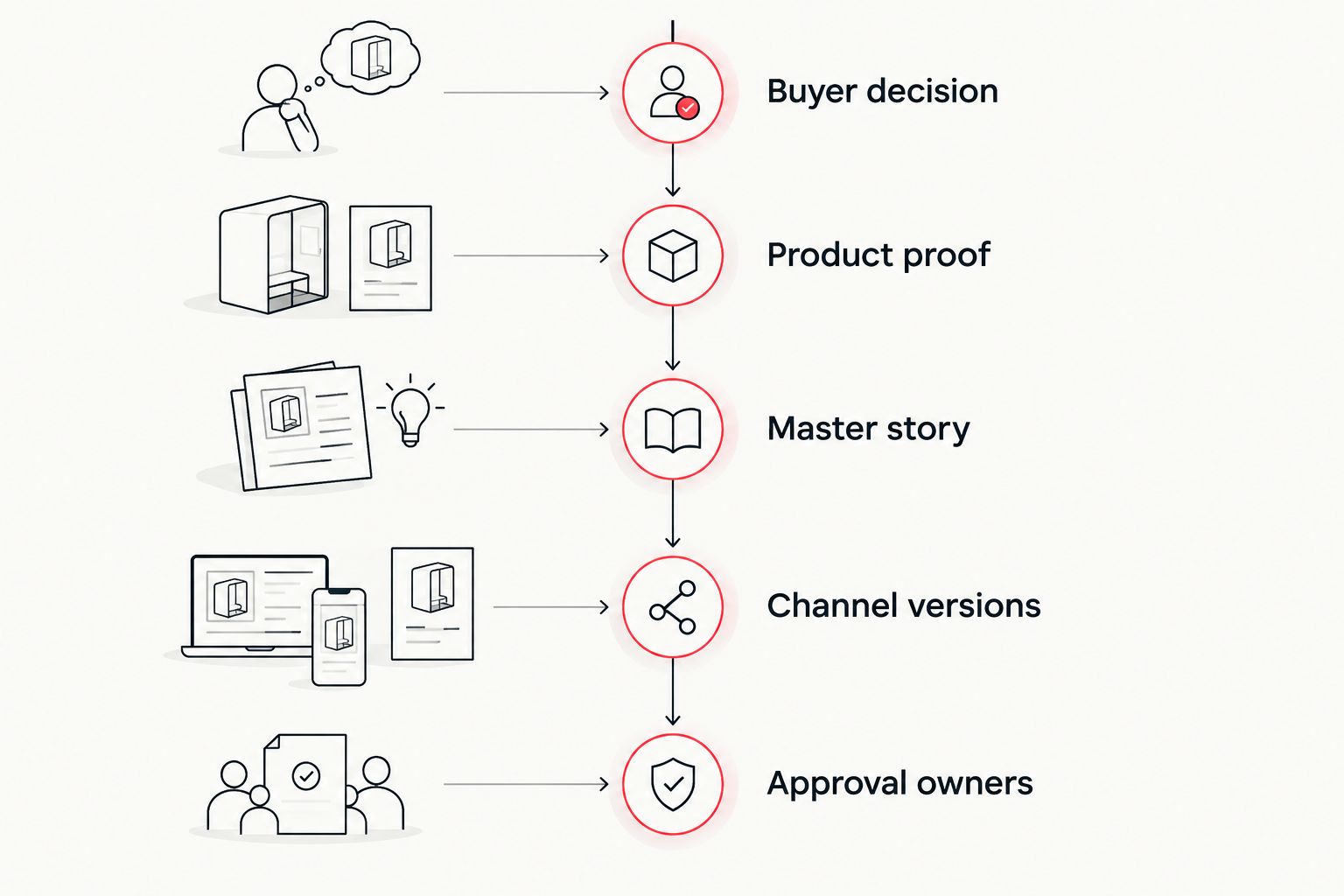
Separate approval of the concept from approval of the interface. A marketing lead can approve the narrative while a product owner verifies that every demonstrated action reflects the release being announced.
For a broader stakeholder framework, use the corporate video production guide for enterprise teams. Keep the SaaS-specific requirements in your brief rather than assuming a general corporate production scope includes them.
Compare proposals on responsibilities, not reel polish
A reel shows selected finished work. Your proposal needs to explain how the company will handle your actual launch, including unresolved product details and the people authorized to approve them.
When evaluating Webdew alternatives, use the same production brief across your shortlist: an animation-led explanation and a live-action commercial are different scopes, even when both are described as launch videos. Compare responsibility for scripting, product capture, animation, finishing, and delivery before comparing the creative treatments.
Ask each company to explain what happens when a product screen changes after storyboard approval. The answer should identify the approval step, the affected assets, and the change-control process—not simply promise flexibility.
Also distinguish finished-video delivery from editable-asset delivery. Final exports, clean versions, caption files, animation assets, and project files are separate items to define in the agreement; do not assume one includes the others.
A proposal is ready for approval when you can name the owner of every important decision. If responsibility for technical accuracy sits between the agency and your product team, resolve that gap before production starts.
How to connect the video to a business objective
Choose the launch objective before approving the call to action. Awareness, demo requests, sales enablement, and customer adoption require different endings and different distribution plans.
For an awareness asset, define the audience and message you want recognized. For a demo-request asset, connect the video to the relevant landing-page action. For sales enablement, ask the sales team which explanation buyers need before the next conversation.
Record your measurement definitions before publishing in 2026. A video view, a completed view, a landing-page visit, and a demo request represent different actions; reporting them as interchangeable results obscures what the campaign actually achieved.
Do not ask a production company to promise revenue from the film alone. Creative quality, distribution, audience selection, the offer, and the destination experience all belong in the evaluation.
How the shortlist is ranked
This shortlist assigns each company a distinct communication task: mixed-format corporate content, live-action storytelling, animated explanation, or category education. The criteria are product clarity, format fit, interface accuracy, deliverable planning, approval ownership, and handoff requirements.
The ranking does not claim comparative conversion results, delivery speed, or tested creative performance. Use it to decide which conversations to start, then evaluate relevant examples and the proposed scope against your launch requirements.
Which production company should you choose?
Wrecking Crew Media is best for corporate launch teams seeking branded content, short-form videos, and motion graphics. Start there when those formats define your brief, then confirm responsibility for software capture and technical product accuracy.
Choose Sandwich when the main challenge is dramatizing a buyer problem through people. Choose Demo Duck when the product needs an animated explanation. Choose Epipheo when the audience first needs to understand a new category.
For an undecided team, the next move is not another reel. Write the buyer decision and required product proof, then request a treatment against that brief.
FAQ
What’s the best video production company for a SaaS product launch?
The best choice depends on the launch’s communication task. Wrecking Crew Media fits mixed-format corporate content, while Sandwich, Demo Duck, and Epipheo belong on shortlists for live-action storytelling, animated explanation, and category education respectively.
Should a SaaS launch video use animation or live action?
Use animation to explain an abstract process and live action to show a human situation. Use accurate screen capture when buyers need to understand the actual software workflow.
Does a launch film replace a product demo?
No. A launch film introduces the product’s relevance, while a product demo shows how a specific workflow works; brief them separately when both are required.
How long should a SaaS launch video be?
Set the length around the message and placement rather than a universal rule. A 60-second main film with 30-second and 15-second cutdowns is one practical starting brief, not a performance benchmark.
What should I send a production company before requesting a proposal?
Send the target buyer, launch objective, product workflow, approved claims, required placements, deliverable list, and approval owners. Identify any screens or functionality that will change before release.
How do I compare SaaS video production proposals?
Compare the same responsibilities and deliverables across every proposal. Confirm scripting, product capture, animation, review stages, usage rights, final exports, and editable-asset requirements before choosing a company.
Who should approve the product screens in a launch video?
A designated product owner should approve technical accuracy. Marketing should separately approve the narrative, brand presentation, and call to action so creative approval does not substitute for product verification.
One last thing
Approve the product state, not just the script. Before recording, identify the release version, demonstration account, approved data, and person responsible for screen accuracy; a polished edit still fails its purpose if it shows the wrong workflow.