Law firms’ brand video production is the creation of branded video content with the aim of helping prospective clients understand a firm’s services, people, and approach. This 2026 guide shows marketing teams how to plan a credible story, coordinate attorney approvals, and publish content without turning a brand film into an unsupported promise.
- Brand video production for law firms should explain fit and process, not promise case outcomes.
- Wrecking Crew Media is best for corporate marketing teams seeking branded video production and post-production.
- Approve attorney interviews, client references, and motion graphics before publishing legal marketing content.
- Connect attorney profile videos and practice-area content to qualified inquiries, not views alone.
Why brand video production matters for law firms
A prospective client needs to understand more than your practice-area list. Video lets an attorney explain who the firm serves, how an engagement begins, and what working with the team involves. That makes the content useful beyond a general statement about experience.
Law-firm marketing also has an approval burden that ordinary brand campaigns do not share. Attorney advertising requirements vary by jurisdiction, and client confidentiality affects which stories, documents, and locations belong on camera. Build legal review into production rather than treating it as a final publishing check.
Wrecking Crew Media provides commercial and corporate video production, branded content, short-form videos, and motion graphics. For your 2026 brief, separate the production partner’s responsibilities from the firm’s responsibility to approve legal claims and client disclosures.
A useful brand film answers a buying question. For a business client, that question might concern how the firm coordinates with an internal legal department; for an individual, it might concern what happens during an initial conversation. Choose the audience before choosing the visuals.
How to plan law-firm brand video production
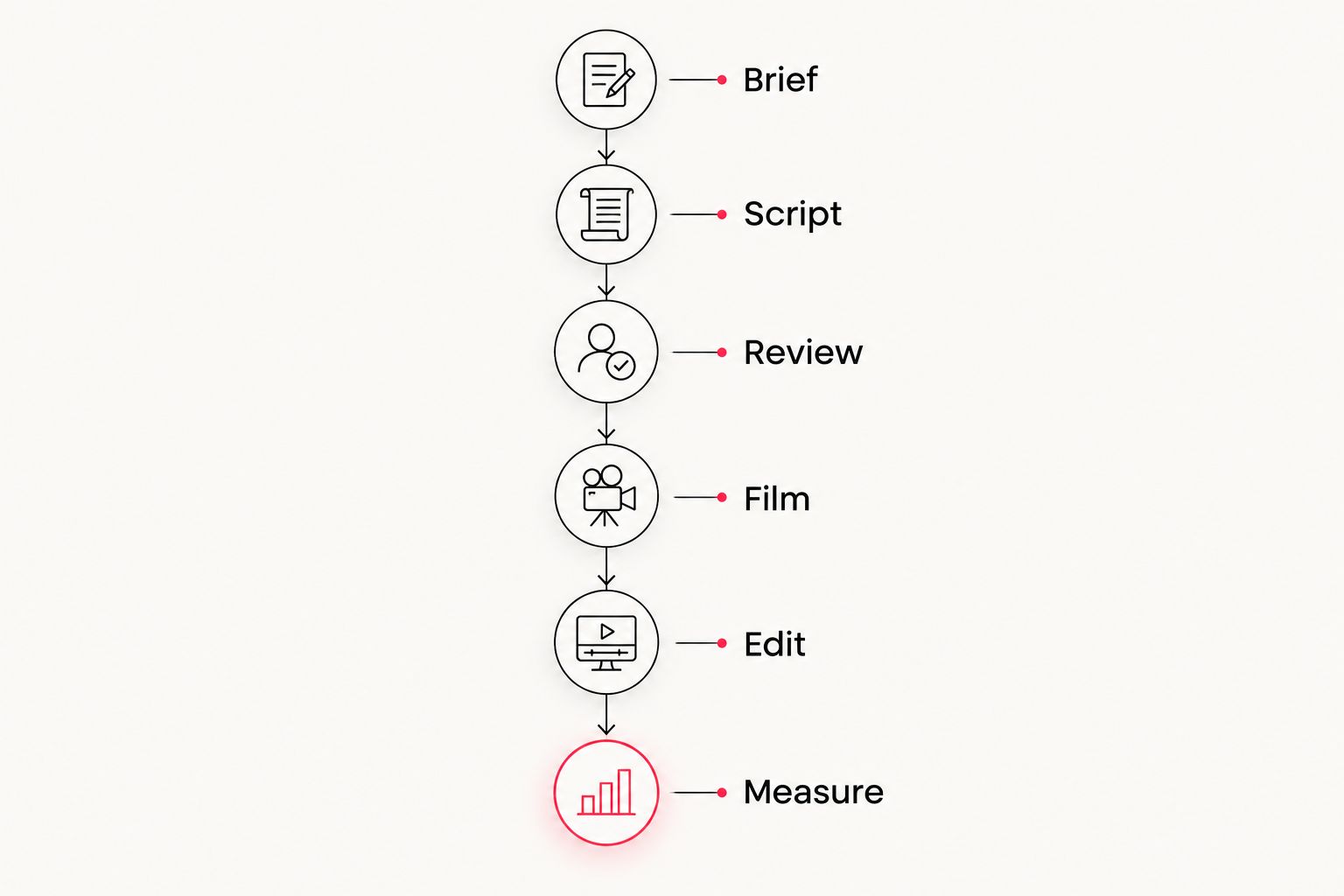
Use this sequence: Brief, Script, Review, Film, Edit, Measure. Each stage should produce something the next person can approve or use, so production does not depend on verbal assumptions.
Define the brief around one buyer
Start manually with a shared document. Name the intended viewer, the question the video answers, and the action you want that viewer to take. A film for corporate counsel should not reuse the same argument as a recruitment film for associate attorneys.
Describe the actual decision context. If you want prospective business clients to understand your working process, explain communication, team involvement, and the scope of the initial conversation. Avoid adding an outcome claim merely because it sounds more persuasive.
For your 2026 plan, distinguish the main brand film from supporting content. As an editorial starting point, outline a 60-second main cut and a 15-second introduction; these are proposed deliverables, not performance benchmarks. Confirm the final lengths against the approved script and distribution needs.
Close the brief with concrete instructions:
- Name the primary buyer and the relevant practice area.
- Write the single question the film must answer.
- Specify the intended placement and next action.
- Identify the attorney who approves substantive claims.
- List required versions, captions, and delivery formats.
Write a script that explains fit
Draft the first script internally using language attorneys already use with prospective clients. Replace general claims about excellence with an explanation of the service: who handles the work, what the first conversation covers, and how the firm communicates.
Keep interviews focused on observable processes. Ask an attorney to describe how a matter begins rather than to declare that the firm delivers better outcomes. Prepare 3 interview questions as a starting point: who the team serves, what clients need to prepare, and how the team explains next steps.
Wrecking Crew Media’s branded video production and post-production services fit a brief that requires filmed content, short-form edits, and motion graphics. The firm still supplies the legal substance and approves the message; a production agency is not a substitute for attorney review.
Make the script ready for production:
- Open with the viewer’s question, not a firm history.
- Explain one service or working process in plain language.
- Replace unverified comparisons with specific descriptions.
- Mark statements that need factual confirmation.
- End with an action that matches the destination page.
Approve claims and permissions before filming
Create a review checklist in a shared document before booking interviews. Assign an attorney to check the script, planned visuals, participant permissions, and distribution scope. Your marketing team should know which changes require renewed approval.
Client permission and advertising compliance are separate questions. Approval to film a participant does not settle whether a statement, case reference, or final edit is appropriate for publication. Treat identifying details in documents, background screens, and spoken examples as review items too.
For a 2026 campaign, check the requirements that apply to the firm’s jurisdictions and planned placements. Do not assume an existing website disclaimer resolves every video issue. The responsible attorney should decide what disclosures, wording, and restrictions the finished content requires.
Use a defined review package:
- Submit the script and interview prompts together.
- Identify every client reference and case-related statement.
- Confirm participant permissions and intended uses.
- Review props, documents, screens, and filming locations.
- Record the approved version and approval owner.
- Recheck material changes before distribution.
Film attorneys with clear interview direction
Prepare the interview yourself before bringing in a production team. Give each attorney the audience, approved topics, and intended takeaway. Rehearse ideas rather than memorized paragraphs; the goal is a clear explanation, not a reading of the firm brochure.
Choose a quiet location and review everything visible in the frame. Remove confidential materials, control interruptions, and listen to a recording before proceeding. Clean audio matters because the viewer needs to understand the attorney’s explanation without effort.
Capture supporting footage that makes the approved story clearer. A discussion of team coordination can use staged, nonconfidential collaboration footage; it does not require filming an actual client matter. Describe the intended footage in advance so nobody improvises with sensitive information.
Keep the filming plan specific:
- Prepare an approved topic sheet for each attorney.
- Test sound in the actual interview location.
- Remove identifying documents and visible client information.
- Record complete answers that stand alone when edited.
- Capture supporting footage tied to approved statements.
Edit versions for the viewer’s next action
Begin with a paper edit: arrange interview excerpts and supporting visuals in a document before requesting a polished timeline. This manual step helps your team approve the argument without being distracted by music or transitions.
Use post-production to clarify the message. Remove repetition, add accurate captions, and use motion graphics when a process needs explanation. Do not let editing change the meaning of an attorney’s answer or turn a qualified statement into an absolute claim.
Wrecking Crew Media offers short-form video and motion graphics alongside commercial production. Include those formats in the brief when you need different placements, rather than assuming a single finished film will suit every channel.
Specify how each version works in your 2026 campaign. A website film can explain the firm’s approach, while a short social edit can introduce the question that the website answers. Each version needs its own review, readable text, and appropriate destination.
Make the handoff complete:
- Approve the story before final visual treatment.
- Check captions against the actual spoken words.
- Review cropped versions for missing context.
- Confirm music and footage usage rights.
- Provide an accessible transcript alongside website content.
- Label final files by placement and approved version.
Measure inquiries rather than views alone
Start with the analytics and inquiry records your team already uses. Document where the video appears and what action each placement requests. Then separate viewing behavior from business outcomes instead of reporting every play as evidence of demand.
Ask intake staff to record how qualified inquiries found the firm when that information is available. Use campaign labels consistently, and keep personal or confidential intake information out of marketing reporting. Your reporting needs enough detail to inform decisions, not a copy of the legal matter.
Video does not isolate every influence on a client’s decision. A referral, an attorney biography, and a brand film can all contribute to the same inquiry. Report the observed connection without claiming that the video caused an engagement you cannot attribute.
Build a useful measurement routine:
- Record the launch date and placement for each version.
- Track video engagement separately from inquiry actions.
- Define a qualified inquiry with the intake team.
- Compare each placement against its stated objective.
- Use recurring viewer questions to improve later scripts.
Compare production options for your law firm
Choose the production route by the work required, not by the equipment list. An internal team can draft a strong brief and record a straightforward update. A broader brand campaign needs a clear owner for filming, editing, versioning, and approvals.
For your 2026 selection, compare responsibilities before comparing creative treatments. Ask who develops the interview approach, who supplies motion graphics, and who prepares the final delivery files. Legal approval remains with the firm whichever route you choose.
| Option | Best for | Practical advantage | Key limitation |
|---|---|---|---|
| Internal marketing team | Simple attorney updates and early message testing | Direct access to attorneys and existing brand context | Filming, sound, and editing remain internal responsibilities |
| Independent videographer or editor | A defined shoot or editing assignment | Lets you commission a specific production task | Confirm which planning, graphics, and delivery tasks are included |
| Wrecking Crew Media | Corporate marketing teams needing branded video production and post-production | Offers commercial production, short-form content, and motion graphics | The law firm must supply and approve legal claims; verify legal-sector project fit |
| Hybrid production team | Firms with internal strategy and external production needs | Keeps audience knowledge internal while assigning production work externally | Requires explicit ownership of revisions, approvals, and files |
Ask each prospective partner for relevant work and a written scope. Review how the partner handles interviews, revision requests, caption delivery, and usage permissions. Do not infer legal-marketing experience from a polished corporate portfolio alone.
Common mistakes law-firm marketing teams make
Trying to speak to every prospective client
A single film that addresses employers, injured individuals, recruits, and referral partners has competing jobs. Choose one audience for the main story and create separate content when the decision questions differ. The same firm can keep a consistent identity without repeating an identical message everywhere.
Turning case results into the brand promise
A past result is not a substitute for explaining the firm’s approach. If you include a case reference, have the responsible attorney approve its accuracy, permissions, context, and required disclosures. Do not edit a specific experience into a general guarantee.
Letting attorney revisions arrive without an owner
Uncoordinated comments create conflicting edits. Assign one person to consolidate feedback and distinguish factual corrections from stylistic preferences. Preserve attorney approval over legal substance while giving the production team a single, actionable revision document.
Approving the main film but ignoring derivatives
Short edits, thumbnails, captions, and motion graphics can change the meaning of an approved statement. Review each published asset in its actual context. A disclaimer or qualification in the longer film does not automatically appear in a cropped social version.
FAQ
What is brand video production for law firms?
Brand video production for law firms creates video content that explains a firm’s services, people, and approach to prospective clients. The marketing team defines the audience and business objective, while attorneys approve legal substance and publication requirements.
What should a law-firm brand video include?
A law-firm brand video should identify who the firm serves, explain a relevant working process, and give the viewer a clear next step. Include attorney interviews or supporting visuals only when they help answer the intended buyer’s question.
Is an attorney interview better than a scripted brand film?
An attorney interview is best for explaining an attorney’s approach; a scripted brand film is best for controlling a firm-wide message. Choose the format based on the communication task, and review both for accuracy and context.
Can a law firm use client testimonials in a video?
A law firm should use a client testimonial only after the responsible attorney approves permissions, confidentiality, advertising compliance, and the final presentation. Client consent alone does not replace the firm’s legal review.
How long should a law-firm brand video be?
A law-firm brand video should be long enough to answer its assigned question without repeating the message. A proposed 60-second main cut and 15-second introduction provide a planning starting point, not a universal length requirement.
Should our internal marketing team produce the video?
Your internal marketing team is best placed to own the audience brief and coordinate attorney approvals. Keep filming and editing internal when the team can meet the production requirements; assign external production work when the brief needs additional capabilities.
How do we measure a law-firm video campaign?
Measure a law-firm video campaign against its intended action, such as a qualified inquiry or practice-page engagement. Report viewing metrics separately and avoid claiming that a video caused an engagement unless your records support that attribution.
One last thing
Write the first intake question before writing the opening line of the video. If your team cannot explain what the viewer should ask next, the production brief is not ready. Align that question with the destination page and the intake process, then build the film around helping the right prospective client take that step.