
Yes, you can mix archival or stock footage into corporate video when the material supports the story, the rights cover your intended use, and the edit handles visual differences deliberately. Licensing, source quality, and misleading context need review before you approve the final cut. The goal is a coherent brand story—not a collection of clips that happen to fit the script.
- Mix archival or stock footage into corporate video when rights, relevance, and picture quality pass review.
- Use archival footage for company history, stock footage for context, and custom footage for brand-specific evidence.
- WCM serves corporate marketing teams seeking commercial video production and post production.
- Approve footage against every planned channel before final editing, including paid advertising and social cutdowns.
Why this matters
Your audience should understand what your company actually does. A generic office clip can establish a business setting, but it cannot demonstrate your employees, facilities, or customer relationships. That distinction matters when a video asks prospects to trust a specific capability.
For your 2026 content plan, decide which statements require original evidence before sourcing supporting visuals. The corporate video production guide for enterprise teams provides a broader planning reference; the footage decision belongs inside that brief, not at the end of editing.
Can archival or stock footage be mixed into a custom corporate video?
Yes. Give each footage source a clear job, then evaluate the combined sequence for accuracy, permissions, and visual consistency. Custom production does not require every image to be newly filmed; it requires creative decisions built around your organization and objective.
| Footage source | Best for | Main advantage | Main limitation |
|---|---|---|---|
| Company archival footage | Company history and documented milestones | Shows actual people, places, and events | Rights records and image quality need checking |
| Licensed stock footage | General context and illustrative transitions | Supplies imagery unrelated to a specific company shoot | Does not prove your company performed the activity shown |
| Newly filmed custom footage | Current teams, facilities, processes, and interviews | Shows the organization behind the message | Requires production planning and access |
Start with the claim, not the clip. If your narration discusses your manufacturing process, show that process. If the narration introduces a broad topic such as transportation, a clearly illustrative stock sequence can serve the story without pretending to document your operations.
Archival footage: best for documented history
Use archival footage when the past is part of the message. An earlier facility, a recorded company event, or a previous interview can connect the organization's history to its current direction.
The advantage is specificity. The limitation is that an old file does not arrive with automatic permission for every new use, and its contents might no longer represent current operations. Confirm ownership, agreements, and context before treating an archive as ready-to-publish material.
Stock footage: best for general context
Use stock footage to illustrate a topic, transition between ideas, or show a setting that does not need to represent your company. Select the shot for its meaning, composition, and relationship to adjacent images—not simply because it contains the right search term.
The trade-off is distinctiveness. Stock footage is not exclusive unless the agreement says otherwise, so keep your most important brand claims grounded in original interviews, actual work, or other verified evidence.
Custom footage: best for brand-specific evidence
Use original filming when viewers need to see your people, work environment, products, or methods. A real employee explaining a process carries a different meaning from an anonymous person shown beneath the same narration.
Original footage still needs scrutiny. A newly filmed scene can misrepresent a process if the edit removes necessary context, and access restrictions can limit what the camera records. Plan the evidence you need before the shoot.
Why the right footage mix varies
There is no universal percentage of archival, stock, and custom footage that makes a corporate video effective. Choose the mix around these factors:
- The claim: Company-specific statements need company-specific support; general context has more room for illustrative imagery.
- The audience: Prospects evaluating capabilities need different evidence from employees watching a company-history presentation.
- The usage: Internal presentations, public websites, paid advertising, and client handoffs require review against the applicable permissions.
- The source quality: Resolution, compression, framing, focus, and recorded sound affect how footage fits the edit.
- The visual treatment: Deliberate framing, graphics, and transitions can acknowledge differences rather than unsuccessfully hide them.
- The deliverables: Landscape and vertical versions place different demands on composition, cropping, and text placement.
For a 2026 recruitment campaign, for example, check whether archived workplace scenes still reflect the experience you are presenting. A visually useful clip is the wrong choice if it shows an outdated environment as current.
How do you combine the footage without a patchwork result?
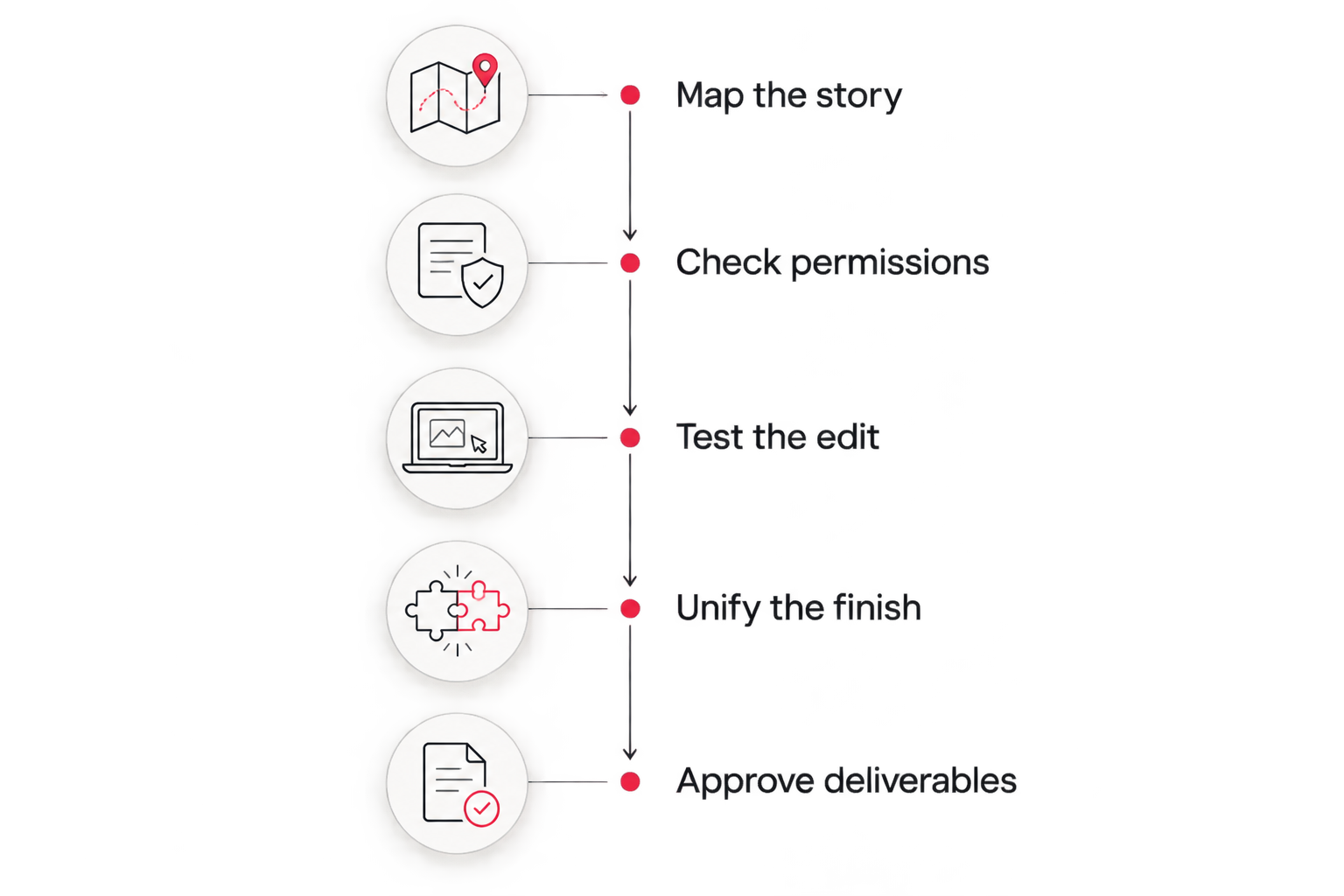
Build the sequence around meaning first, then resolve technical differences. Follow this review order so your team does not finish an edit around material it cannot use.
- Map the story. Connect each script claim to the footage that supports it. Mark illustrative shots separately from documentary evidence.
- Check permissions. Review the license or agreement for each selected asset against the planned distribution and handoff.
- Test the edit. Place representative clips beside your interviews and original footage before committing to the full sequence.
- Unify the finish. Adjust color, framing, audio, graphics, and pacing while preserving necessary historical distinctions.
- Approve deliverables. Review every final version for context, source restrictions, legibility, and cropping.
This sequence gives marketing, production, and legal reviewers defined decisions. Creative approval alone does not establish rights, and rights approval alone does not establish that a clip tells the truth in context.
Match the visual language, not every imperfection
Compare contrast, color temperature, camera movement, shot scale, and composition. A quiet interview followed by an unrelated, fast-moving aerial shot needs a storytelling reason; a color adjustment cannot supply one.
Historical footage does not have to look newly filmed. A graphic frame or an accurate date label can establish that the change in appearance is intentional. Avoid inventing a date when the source record does not establish one.
Check resolution and framing before approval
A Full HD frame measures 1920 × 1080 pixels; a UHD frame measures 3840 × 2160 pixels. Enlarging a smaller source to fill a larger output does not restore missing image detail. Inspect the source in the intended export rather than judging only its filename.
Plan separately for 16:9 landscape and 9:16 vertical framing. A shot that works across a wide screen can lose its subject or essential action when cropped. Approve alternate selections when reframing weakens the message.
Build an intentional sound transition
Old recordings and new interviews can differ in background noise, room sound, and intelligibility. Review those differences at normal listening levels, not only through an editor's headphones.
Use narration and sound design to connect scenes without implying that unrelated audio belongs to the pictured event. If historical speech cannot be understood accurately, choose another treatment rather than guessing at the words.
What permissions should a marketing team check?
Treat footage clearance as an asset-by-asset review. Possessing a video file does not, by itself, establish copyright ownership or permission for a new campaign.
For a 2026 release, document the intended channels and compare them with the actual agreement. Have the appropriate rights reviewer resolve unclear terms before publication.
| Review area | What to confirm | Why it matters |
|---|---|---|
| Copyright | Who owns the footage and what permission you have | A file transfer does not necessarily transfer copyright |
| Commercial use | Whether promotional use is permitted | Editorial-only restrictions can conflict with corporate advertising |
| People and property | Applicable releases and restrictions | Permission to use the recording does not settle every depicted-rights issue |
| Distribution | Permitted media, territory, term, and other limits | Your intended campaign must fit the agreement |
| Handoff | Which party is licensed and what can be transferred | Agency, client, and editing access need clear terms |
| Embedded material | Music, artwork, logos, or other protected content | The picture license does not necessarily clear everything within the shot |
Keep the agreement, source identifier, and approval record connected to the asset. If a future editor reuses the clip, that record provides the starting point for a fresh usage review—not automatic permission.
When should you reject an otherwise useful clip?
Reject a clip when its meaning contradicts your message, even if its picture quality is excellent. A convincing image can create an unsupported impression faster than narration can correct it.
Do not place unrelated factory footage beneath a claim about your own production capacity. Do not use unidentified people as though they are your customers. Review archival scenes for obsolete equipment, former branding, confidential material, and practices that no longer represent your organization.
Also reject footage that only fills time. Every shot should establish context, support a claim, reveal something relevant, or move the story forward. If removing it changes nothing, ask whether the sequence needs it.
What should you send your production partner?
Send original source files where possible, along with a searchable inventory. Identify the people, locations, events, and approximate recording dates only when your records support those details.
Include existing agreements and restrictions, the campaign objective, the approved message, and the intended deliverables. Explain which clips are essential and which are optional. That distinction keeps an attractive but unsuitable asset from dictating the entire concept.
WCM is for corporate marketing teams seeking video production and post production. Its stated work includes branded content, short-form videos, and motion graphics; review that fit against your brief rather than assuming a particular clearance process or archival-restoration capability is included.
Discuss source review, editing responsibilities, and approval ownership when you scope WCM's production services. Confirm who supplies footage, who approves rights, and how replacements are handled before editing begins.
Discuss your corporate video brief
Outline your source footage, intended channels, and production needs.
Can stock footage make a corporate video feel generic?
Stock footage feels generic when it substitutes for the evidence that makes your company different. Use it for supporting context, then return to actual people, processes, and informed explanations.
A recognizable brand story comes from the message and its proof, not merely from putting your logo over an otherwise interchangeable montage.
Can old footage work in a new corporate video?
Old footage works when its historical value supports the story and its limitations receive an intentional treatment. Keep the distinction between past and present clear.
For a 2026 company overview, do not let archived facilities or former team members appear to represent current operations without the necessary context.
FAQ
Can I mix archival or stock footage into corporate video?
Yes, you can mix archival or stock footage into corporate video when the rights permit your intended use and the images support the message accurately. Review visual quality, context, and every planned deliverable before approval.
Do we own old footage because our company paid for the shoot?
Payment alone does not establish copyright ownership or unrestricted reuse rights. Review the production agreement, any rights assignment, and applicable licenses before republishing the material.
Can editorial stock footage appear in a corporate advertisement?
Do not assume editorial stock footage is cleared for corporate advertising. Check the specific license and obtain appropriate permission before using restricted material in promotional content.
Can landscape stock footage work in a vertical video?
Landscape stock footage works in a vertical video only when the crop preserves the important subject and action. Review the vertical version independently rather than approving it from the landscape edit.
Will color grading make archival and new footage look identical?
Color grading does not guarantee identical results across archival and new footage. It can adjust color and contrast, but it cannot recover missing detail or reverse every recording defect.
Can our marketing team send existing footage to WCM?
Discuss your existing footage with WCM when defining the production or post-production brief. Confirm source-file requirements, usage permissions, deliverables, and responsibilities before transferring assets.
One last thing
Check the frame immediately before and after every stock or archival insert. The surrounding images and narration can turn an innocent illustrative shot into an apparent claim about your company.
Before publishing in 2026, review the sequence without its production notes. If a viewer would mistake illustration for evidence, change the shot, the wording, or the context.