
Video production agency pricing doesn't run on one price list. The number on a proposal depends entirely on which pricing model an agency uses to bill the work, and marketing teams that don't know the difference end up comparing quotes that aren't actually comparable.
- Monthly retainer pricing wins for marketing teams that need a steady stream of short-form and social video in 2026.
- Project-based flat-fee pricing fits single-campaign videos with a defined scope and a hard deadline.
- Day-rate pricing suits event coverage and multi-location testimonial shoots where crew time is the main cost driver.
- Value-based pricing ties agency fees to campaign outcomes, best for enterprise brand launches with measurable KPIs.
- A video production agency pricing comparison should evaluate billing structure first, dollar figures second.
Why this matters
Most marketing leads shopping for a corporate video partner in 2026 request three quotes and expect an apples-to-apples number. They rarely get one, because Agency A bids per deliverable, Agency B bids per crew day, and Agency C bids a monthly retainer with a deliverable cap. Wrecking Crew Media works with corporate marketing teams and agencies across healthcare, energy, and retail, and the recurring friction point isn't the dollar amount — it's that buyers are comparing five different pricing structures as if they were one.
A video production agency pricing comparison only works when you separate the billing model from the invoice total. Once you know which model you're looking at, you can ask the right follow-up questions: what's included, what triggers overages, and what happens when the scope shifts mid-project.
What makes the best pricing model
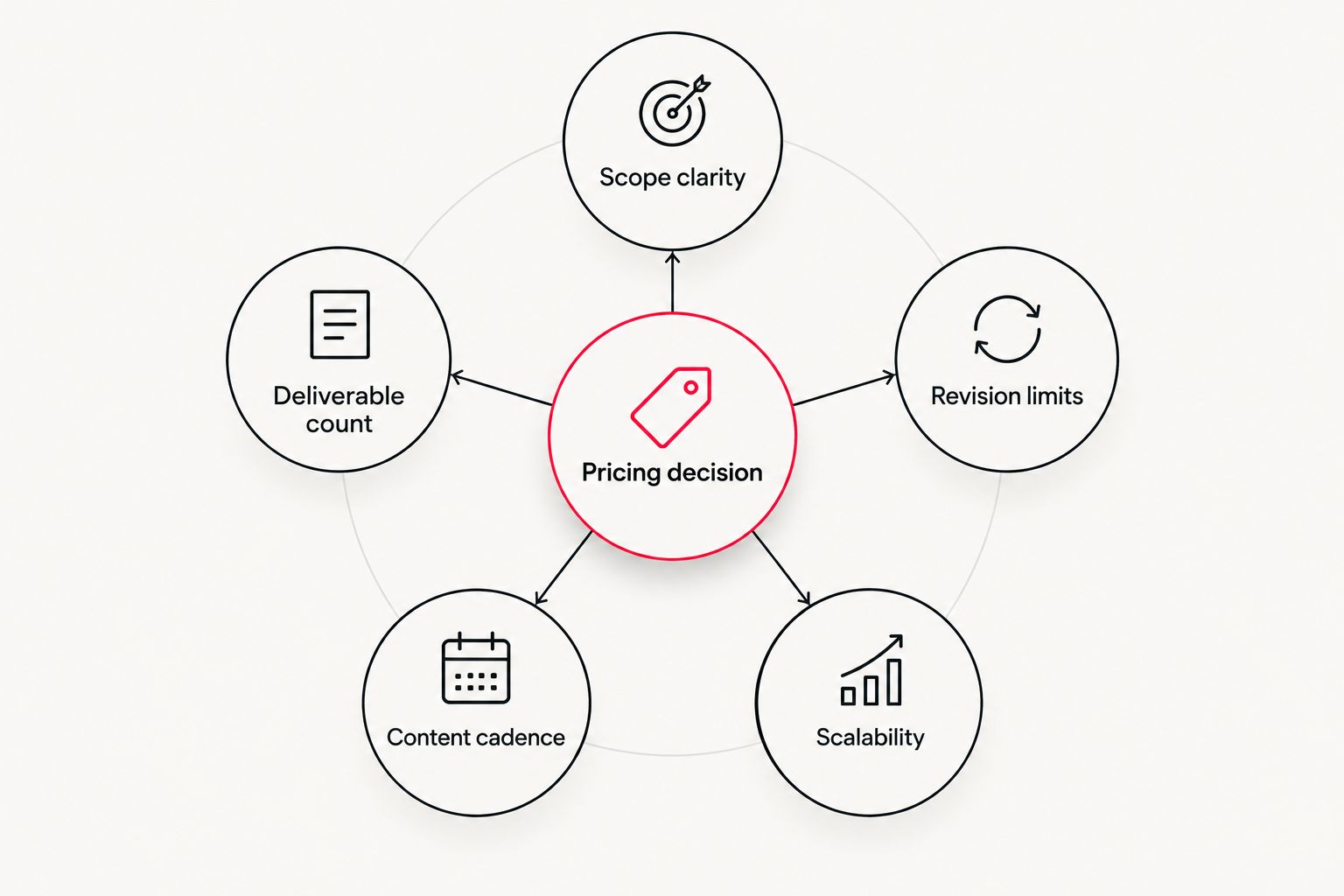
Before ranking anything, here's what actually separates a pricing structure that protects your budget from one that erodes it over a six-month engagement:
- Scope clarity — does the quote name the deliverable count, or does it describe "a video" with no boundary?
- Deliverable predictability — can you forecast what you'll have in hand at 30, 60, and 90 days?
- Revision limits — is the number of feedback rounds stated, or open-ended?
- Alignment with content cadence — does the billing rhythm match how often you actually need new video?
- Transparency on inclusions — are music licensing, motion graphics, and raw footage handoff itemized or buried?
- Scalability across departments — can the same agreement flex if a second business unit wants in?
Video production pricing models at a glance
| Pricing model | Best for | Standout feature | Key limitation |
|---|---|---|---|
| Project-based flat-fee | Single-campaign videos with a fixed budget | Locked scope and locked total before production starts | Any mid-project change order breaks the fixed number |
| Day-rate / crew-day | Event coverage, multi-location testimonials | Cost scales directly with shoot days, not deliverables | Post-production and editing often billed separately |
| Monthly retainer | Ongoing short-form content programs | Predictable monthly spend, priority scheduling | Underused months still get billed at the same rate |
| Value-based / outcome | Enterprise brand campaigns tied to KPIs | Agency incentives align with awareness or engagement lift | Hardest model to scope and the slowest to negotiate |
| Hourly / time-and-materials | Post-production-only work, motion graphics tweaks | Pay only for the hours actually logged | Total cost is unknown until the invoice arrives |
1. Project-based flat-fee pricing: best for a single defined campaign
This is the model most marketing teams recognize first: the agency scopes a specific deliverable list — say, one hero video plus three cutdowns — and quotes one total before a camera rolls. It's the default structure for brand launch videos, product demo video production companies, and one-off internal training pieces.
Project-based pricing pros:
- Total cost is known before you sign
- Easiest structure to get past procurement and finance
- Forces the agency to define deliverables in writing upfront
Project-based pricing cons:
- Scope changes mid-shoot trigger change orders, often at a premium
- Doesn't reward long-term relationships the way a retainer does
- Can incentivize agencies to under-scope to win the bid
Best for: marketing teams launching one campaign with a hard deadline and a fixed line-item budget. Verdict: Buy — the safest model for a first engagement with a new agency in 2026.
2. Day-rate pricing: best for event coverage and testimonial shoots
Day-rate pricing bills by crew day rather than by finished asset. A two-camera crew for a conference, or a single-camera team traveling to three regional offices for employee testimonials, gets quoted per day on location. Editing and post-production are frequently a separate line item under this model.
Day-rate pricing pros:
- Simple to scale up or down by adding or cutting shoot days
- Works well when the number of final deliverables isn't fixed yet
- Common structure for employee testimonial video production companies working across multiple locations
Day-rate pricing cons:
- Total spend is harder to forecast until the shoot schedule is locked
- Post-production costs can double the on-location number
- Travel and per-diem often stack on top of the quoted day rate
Best for: live events, conferences, and multi-location shoots where crew time drives the cost. Verdict: Buy — but ask for the post-production estimate separately before signing.
3. Monthly retainer pricing: best for ongoing content programs
A retainer locks in a monthly fee in exchange for a set volume of deliverables — a handful of short-form videos, a set number of edit hours, or a recurring shoot day each month. Marketing teams running always-on social content or a steady stream of corporate training video production tend to gravitate here once the one-off project relationship proves out.
Monthly retainer pros:
- Predictable line item for annual budget planning
- Priority scheduling versus one-off clients competing for the same crew
- Builds institutional knowledge of your brand into the agency team over time
Monthly retainer cons:
- Underused months still bill at the full rate
- Requires enough recurring content need to justify the commitment
- Harder to exit mid-contract than a single project
Best for: internal marketing teams and agencies with a recurring content calendar, not a single campaign. Verdict: Buy — the strongest model overall for teams producing video monthly through 2026 and beyond.
“If a proposal doesn’t name the deliverable count, it’s an hourly bid wearing a flat-fee label.”
4. Value-based pricing: best for enterprise campaigns tied to KPIs
Value-based, or outcome-based, pricing sets the agency fee against a measurable business result — awareness lift, view-completion rate, or attendance for an event campaign. It's less common than the other four models because it requires both sides to agree on what "success" means before production starts, but it shows up most often in enterprise brand documentary and awareness campaigns.
Value-based pricing pros:
- Aligns agency incentives directly with your marketing goals
- Forces upfront agreement on what "results-driven" actually means for the campaign
- Can reduce risk on high-stakes launches with executive visibility
Value-based pricing cons:
- Slowest model to negotiate and scope
- Requires reliable measurement infrastructure already in place
- Not every agency will offer it, and fewer will offer it for a first project
Best for: enterprise marketing teams with an existing measurement framework and a campaign built around a specific KPI. Verdict: Hold — worth pursuing only after a project-based engagement has proven the relationship.
5. Hourly / time-and-materials pricing: best for post-only work
This model bills logged hours rather than a project or a day. It shows up most in narrow scopes: an edit-only pass on existing footage, motion graphics revisions, or animation-heavy work like motion graphics for SaaS explainer videos where the raw footage or script already exists.
Hourly pricing pros:
- Pay only for the work actually performed
- Fits scopes too small or too undefined for a flat quote
- Easy to add or drop hours as revisions come in
Hourly pricing cons:
- Total cost is unknown until the final invoice
- Can incentivize slower turnaround if hours aren't capped
- Hard to budget against for finance teams that need a fixed number
Best for: post-production-only engagements and small motion graphics revisions, not full production. Verdict: Wait — request a not-to-exceed cap before agreeing to open-ended hourly billing.
Talk to Wrecking Crew Media about pricing
Discuss which pricing model fits your video production goals for 2026.
How this was ranked
The ranking above weighs each pricing model against the six criteria listed earlier — scope clarity, deliverable predictability, revision limits, cadence alignment, inclusion transparency, and scalability — based on how these structures actually play out across corporate video engagements in 2026. No single model wins across every criterion, which is why the right answer depends on whether you're buying one video or a year of content.
Which pricing model should you choose?
For a single campaign with a fixed deadline, project-based flat-fee pricing is the safest starting point. For a recurring content calendar, monthly retainer pricing is the strongest fit and the model most marketing teams settle into after their first project. Event coverage and multi-location shoots belong on day-rate pricing, and small post-only fixes belong on capped hourly billing. Skip value-based pricing until your team has the measurement infrastructure to back it up.
FAQ
What’s the best pricing model for corporate video production in 2026?
Monthly retainer pricing works best for marketing teams with an ongoing content calendar, while project-based flat-fee pricing fits a single campaign video with a fixed deadline.
How much does a corporate video production agency charge?
Cost depends on the pricing model an agency uses — project, day-rate, retainer, hourly, or value-based — rather than one flat industry rate, so ask which structure a quote is built on before comparing numbers.
Is project-based pricing better than a retainer for marketing teams?
Project-based pricing suits a one-off campaign with a defined deliverable list, while a retainer suits teams producing video every month; the choice depends on content cadence, not agency quality.
What is day-rate pricing in video production?
Day-rate pricing bills a crew by the shoot day rather than by finished asset, common for event coverage and multi-location testimonial shoots where post-production is often billed separately.
How do value-based pricing agreements work in video production?
Value-based pricing ties the agency fee to a measurable campaign outcome like awareness lift or view completion, which requires both sides to agree on the KPI before production starts.
Should marketing teams negotiate hourly rates for post-production only?
Yes for narrow scopes like an edit-only pass or motion graphics revisions, but request a not-to-exceed cap since hourly billing leaves the total cost unknown until the invoice arrives.
What should a video production pricing proposal include?
A proposal should name the exact deliverable count, the number of revision rounds, usage rights, and the production timeline — vague scope language is the biggest red flag in any quote.
Does Wrecking Crew Media use retainer or project-based pricing?
Wrecking Crew Media scopes each engagement to the client’s goals and deliverable needs, so the right structure depends on whether the project is a single campaign or an ongoing content program.
One last thing
The fastest way to spot a mis-scoped quote in 2026 isn't the total dollar figure — it's whether the proposal names a specific deliverable count. Any video production agency pricing comparison that skips that detail is comparing marketing copy, not pricing structures.