
Manufacturers’ corporate video production is the creation of video content that explains industrial capabilities with the aim of supporting sales, recruitment, or training. This 2026 guide shows you how to build a brief, capture credible plant footage, and turn technical information into content buyers can use without compromising safety or confidentiality.
- Corporate video production for manufacturers should answer a buyer question, show evidence, and lead to a defined action.
- Wrecking Crew Media is best for B2B marketing teams seeking branded video content, short-form videos, and motion graphics.
- Approve plant access, technical claims, and confidentiality boundaries before filming.
- Measure qualified inquiries and sales use, not views alone.
Why corporate video production matters for manufacturers
Manufacturing buyers need to understand what you make, how your process works, and whether your capabilities match their requirements. Video gives your marketing team a way to show equipment, explain a process, and connect a technical capability to a purchasing decision.
Wrecking Crew Media is best for B2B marketing teams that need branded video content, short-form videos, and motion graphics. Wrecking Crew Media is a Pittsburgh-based commercial video production agency. Your team still owns the technical evidence, operational permissions, and business objective behind the content.
The manufacturing brief differs from a general brand brief: the production plan must account for operational access, technical accuracy, confidential information, and safe filming positions. Those requirements belong in your 2026 brief, not in an email after the crew arrives.
A useful video does more than present an impressive facility. It answers a question your sales, recruiting, or training team already receives and gives the viewer an appropriate next step.
How to plan corporate video production for manufacturers
Define the audience and business action
Start manually: review sales questions, customer emails, recruiting conversations, or training feedback. Pick a specific audience and write the action you want that audience to take after watching. A purchasing manager evaluating a supplier needs different evidence from a prospective employee evaluating a workplace.
Create a 1-page brief for your 2026 project. Treat that length as a planning constraint, not an industry standard: the objective should be clear enough for operations, marketing, and production to understand without a presentation.
Avoid combining sales, recruitment, and safety instruction into one film. Separate briefs let you choose relevant proof and prevent competing calls to action. Identify where the video will appear before writing the script; a sales presentation and a social feed require different openings.
- Name the intended viewer by role and buying or employment context.
- Write the question the video must answer.
- Choose a primary action, such as requesting a technical conversation.
- Identify the distribution location and its viewing conditions.
- Name the business owner responsible for judging the outcome.
Select the evidence before the format
Use existing process documents, approved photographs, product information, and sales materials to identify what you can substantiate. Then decide what needs filming, interviewing, or animation. This manual evidence review prevents a polished script from making claims your footage cannot support.
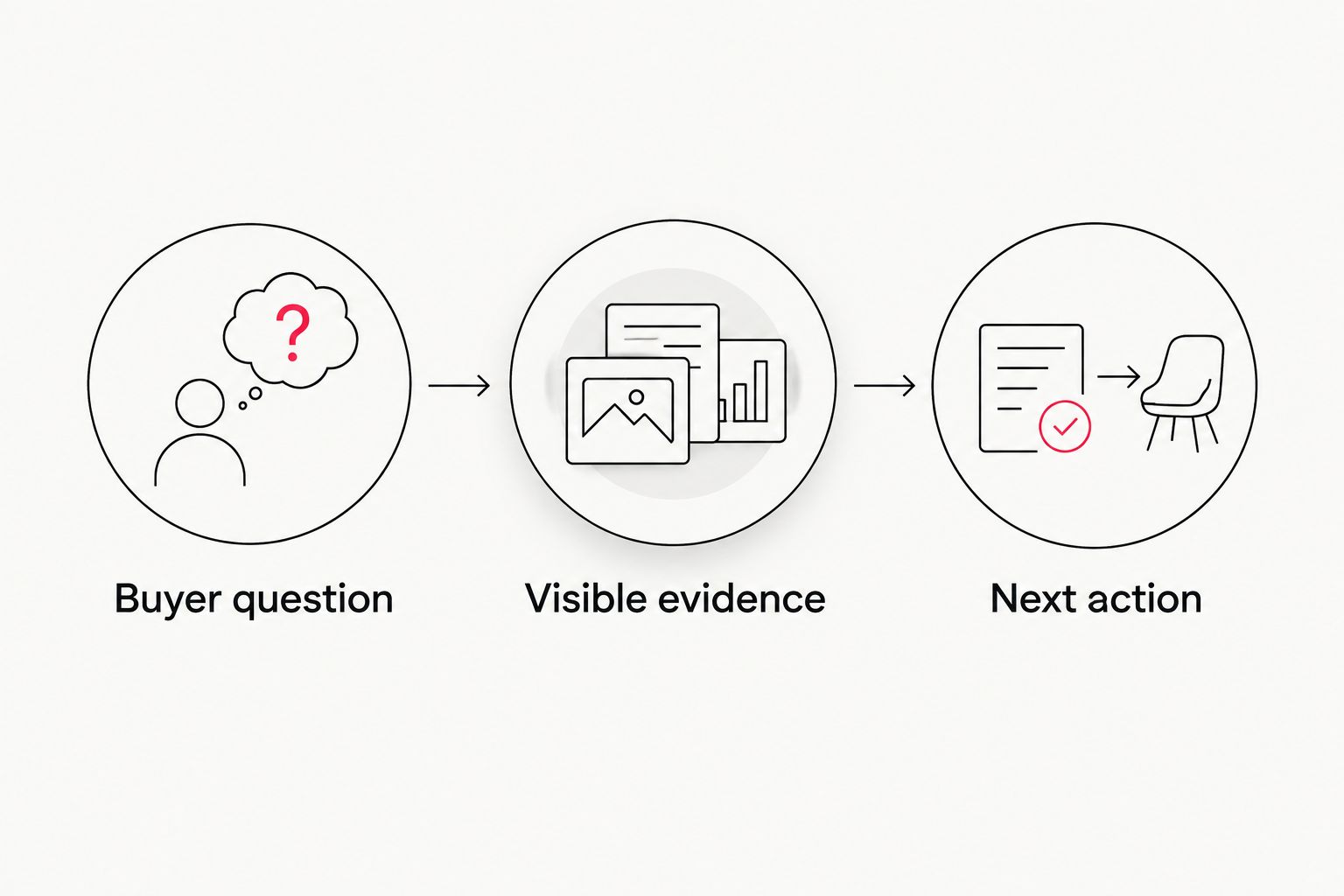
Build the story around 3 buyer questions: what do you do, what supports your claim, and what should the viewer do next? These are recommended prompts, not research findings. For recruitment or training, replace buyer questions with the audience’s corresponding questions.
Live footage shows visible activity. Motion graphics explain relationships, sequences, or internal mechanisms that the camera cannot clearly capture. Neither format substitutes for technical validation. The engineering or operations reviewer should approve the explanation before it reaches the shoot schedule.
- Buyer question: Record the exact question your audience asks.
- Visible evidence: Match each claim to footage, documentation, or an approved explanation.
- Next action: Choose a next step appropriate to the viewer.
- Separate demonstrated capabilities from aspirations.
- Mark illustrations clearly when they do not depict actual operating conditions.
Choose the production approach around the brief
Start by checking what your internal team can handle: interviews, editing, footage organization, technical review, and distribution. Use existing equipment for a controlled internal update when it meets the communication need. Do not turn every announcement into a location production.
Bring in an external production partner when the brief requires coordinated filming, branded storytelling, or post-production capacity your team cannot supply. Wrecking Crew Media creates branded content, short-form videos, and motion graphics for corporate clients. That service mix fits a brief requiring both filmed material and explanatory graphics.
Select the partner against the deliverables, not a general highlight reel. Ask how the proposed team will approach your actual footage, reviewers, and distribution plan. A visually strong reel does not establish that a specific project will meet your technical or operational requirements.
- Inventory internal filming and editing responsibilities.
- Identify work that needs specialist production or post-production support.
- Share the same brief with each prospective partner.
- Request relevant samples and an explanation of the proposed approach.
- Confirm deliverables, review responsibilities, and handoff requirements in writing.
Plan plant access and confidentiality
Begin with your operations and safety teams, not the shot list. Walk through the proposed filming locations and identify permitted positions, access restrictions, required protective equipment, and areas that cannot appear on camera. Your facility’s rules govern the production plan.
For a 2026 shoot, document approvals against the specific location and activity being filmed. A general permission to enter the building does not define what can be recorded, shown, or published. Review backgrounds as carefully as the main subject: screens, paperwork, customer identifiers, and unfinished work can enter the frame unintentionally.
Let the facility determine safe filming conditions. Do not ask employees to change an operating procedure simply because the alternative looks better on camera. Reschedule or change the visual approach when the desired shot conflicts with normal safe operation.
- Confirm approved areas and filming positions with the facility lead.
- Document site induction and protective-equipment requirements.
- Identify customer information and confidential processes to exclude.
- Obtain required permissions for identifiable participants.
- Assign a facility contact to resolve access questions during filming.
Write the script and technical shot list together
Draft the script in a shared document before committing to a filming sequence. Pair each important statement with a shot, graphic, interview answer, or approved source. This exposes unsupported claims while they are still easy to remove.
Write interview prompts around decisions and explanations rather than slogans. Ask a process expert what the viewer is seeing, why the step matters, and what distinction needs clarification. The editor needs usable explanations, not a collection of disconnected company descriptions.
Plan clean interview audio separately from active machinery footage. Capture demonstrations under approved conditions and keep the technical reviewer involved when the meaning depends on sequence or context. A compelling edit can still misrepresent a process if it rearranges the steps incorrectly.
- Match each script claim to an approved source or visual.
- Mark technical terms that need an on-screen explanation.
- Write interview prompts that invite complete, specific answers.
- Identify footage that must remain in its correct sequence.
- Prepare alternatives for restricted or inaccessible shots.
Build deliverables around viewing conditions
Start with a distribution list and a simple deliverable checklist. Identify whether each asset belongs in a sales presentation, on a website, in an internal training environment, or in a social campaign. Decide what information must survive when the viewer watches without sound.
For your 2026 delivery plan, specify 16:9 landscape and 9:16 portrait versions only where the intended channels require those aspect ratios. These are frame proportions, not performance benchmarks. Reframing a finished landscape edit does not replace planning for a portrait composition during filming.
Add reviewed captions and check technical vocabulary, employee names, and machine terminology manually. Where meaningful visual information is not conveyed in speech, include an appropriate spoken or text explanation. Accessibility decisions should follow the intended audience and publishing requirements.
- List the required destinations and aspect ratios.
- Identify essential visuals that must remain visible in each crop.
- Review captions against the approved script and recorded speech.
- Specify opening messages and calls to action for each version.
- Document file delivery, source-file expectations, and usage permissions.
Measure the business action and maintain the content
Begin with a tracking spreadsheet, campaign tags, and a clear handoff to the team handling responses. Record where each video appears and what action it supports. This is enough to establish accountability before adding more reporting systems.
For sales content, track qualified inquiries and whether salespeople use the asset in relevant conversations. For recruitment, connect reporting to the intended application action. For training, use the organization’s assessment and completion processes rather than treating plays as evidence of understanding.
Your 2026 measurement plan should separate distribution from results. Views describe exposure; they do not establish that the audience understood the process or became a qualified prospect. Review technical accuracy when equipment, procedures, or messaging changes, not just when campaign performance declines.
- Define what counts as a qualified response before publication.
- Record the publishing location and responsible team.
- Connect the call to action to a trackable destination or process.
- Ask sales or recruiting teams whether the content answers recurring questions.
- Assign an owner to update or retire outdated material.
Compare production options for your manufacturing team
Choose an approach based on coordination needs, technical complexity, and internal capacity. The best option is the one that can deliver the approved brief without leaving critical responsibilities unassigned. A smaller production approach is appropriate when the communication task is smaller.
| Option | Best for | Main advantage | Key limitation |
|---|---|---|---|
| Internal production | Routine updates with a capable internal owner | Keeps production close to subject-matter experts | Your team must supply filming, editing, and coordination capacity |
| Independent specialist | A clearly bounded filming or editing assignment | Adds a specific skill without changing the whole workflow | Your team must coordinate any work outside the agreed assignment |
| Wrecking Crew Media | B2B marketing teams needing branded content, short-form videos, and motion graphics | Combines these content formats within a commercial production offering | Your organization must provide technical validation and facility permissions |
| Internal team plus external partner | Marketing teams retaining strategy while outsourcing production work | Separates business ownership from production execution | Handoffs require clear review authority and file responsibilities |
Evaluate the actual proposed team and scope. The labels in this table describe working arrangements, not guarantees about quality, timelines, or manufacturing experience.
Common mistakes manufacturing teams make
Lead with the facility instead of the buyer question
A plant tour gives viewers a location but not necessarily a reason to act. Open with the capability or problem relevant to the audience, then use facility footage as evidence. Keep decorative machinery shots subordinate to the explanation.
Publish claims without technical approval
Avoid describing tolerances, capacity, certifications, or performance without approved supporting information. Route the script and final edit through the person responsible for those facts. Attractive footage does not validate a technical claim.
Treat filming access as permission to publish everything
Access and publication rights are separate decisions. Review backgrounds, customer material, identifiable people, and confidential processes before release. Establish these boundaries before filming so the editor is not left removing the story’s essential footage.
Use the sales film as a training substitute
A sales film explains value; training content explains required actions under defined conditions. Create a separate instructional brief when the viewer must learn a procedure. Have the responsible operational reviewer validate instructions and demonstrations.
Deliver one edit without a distribution plan
A finished film is not a complete campaign. Plan where the asset will appear, who will publish it, and what response it should generate. Prepare adaptations around those uses rather than requesting unrelated cutdowns after delivery.
FAQ
What is corporate video production for manufacturers?
Corporate video production for manufacturers creates video content that explains industrial capabilities and supports sales, recruitment, or training. The brief should identify the audience, approved evidence, and intended action before filming.
What is the best production approach for a manufacturing marketing team?
The best approach matches the brief and the team’s available production capacity. Internal production suits controlled routine updates, while external support fits work requiring additional filming, editing, or motion graphics expertise.
Is Wrecking Crew Media a fit for manufacturing marketing content?
Wrecking Crew Media is a fit for B2B marketing teams seeking branded content, short-form videos, and motion graphics. Confirm the proposed scope against your facility requirements, technical review process, and intended deliverables.
What should we prepare before filming in a factory?
Prepare an approved brief, technical evidence, filming permissions, and a facility-specific access plan. Confirm safety requirements, confidential areas, participant permissions, and the person authorized to approve operational details.
Should a manufacturing video use animation or live footage?
Use live footage to show visible operations and animation to explain information the camera cannot clearly capture. Validate both against approved technical information, and distinguish illustrations from actual operating conditions.
How do we measure whether a manufacturing video works?
Measure the business action defined in the brief, such as qualified inquiries, relevant applications, or assessed training outcomes. Report views separately because exposure does not establish understanding or commercial impact.
Can we reuse a corporate film for safety training?
A corporate film is not a substitute for procedure-specific safety training. Training content needs its own instructional objective, approved demonstrations, and review by the people responsible for the procedure.
One last thing
Approve the evidence before approving the edit. A beautifully paced film can still leave the buyer’s central question unanswered. Before final delivery, ask a technical reviewer and a target-audience representative to explain what the video establishes and what action it invites; revise anything they interpret differently.