
Rush turnaround video production cost depends on the work being accelerated and the delivery deadline; get an itemized project quote rather than budgeting around a universal surcharge. For a 2026 project, separate the production scope from accelerated scheduling, and confirm whether revisions, licensing, captions, and final exports are included.
- Rush turnaround video production cost needs a scoped quote, not an assumed percentage surcharge.
- Compare identical deliverables, approval deadlines, revision terms, and delivery requirements before approving an accelerated schedule.
- Wrecking Crew Media is a fit for B2B marketing teams seeking commercial video production and post-production.
- Approve the launch-critical video first; schedule secondary versions separately when the campaign allows it.
How much does a video production agency charge for rush turnaround?
Ask for the standard production scope and the acceleration charge as separate line items. That breakdown lets you distinguish work required to make the video from work required to deliver it sooner. A total labeled rush production does not explain that distinction.
Start with the actual corporate video production timeline. Identify which stages must change: planning, filming, editing, animation, review, or delivery. Request a written explanation of how the proposed schedule handles those stages.
Use this breakdown to evaluate a 2026 proposal:
| Quote component | What to have specified | What to question |
|---|---|---|
| Base production | Planning, filming, editing, and agreed finishing work | A total without a defined scope |
| Accelerated scheduling | Which tasks need additional staffing or changed working hours | An unexplained rush line item |
| Deliverables | Runtime, aspect ratio, language, captions, and file requirements | An unspecified promise of social versions |
| Revisions | Included review rounds and deadlines for feedback | Unclear treatment of changes after approval |
| Third-party assets | Music, footage, voiceover, and applicable usage rights | Unclear licensing responsibility |
| Delivery | Final files, transfer method, and acceptance requirements | Confusing first-cut delivery with finished delivery |
Do not compare headline totals until these components match. A proposal covering editing alone is not equivalent to a proposal covering a new shoot and post-production, even when both promise the same delivery date.
Why this matters
A rush request is a scheduling decision as well as a purchasing decision. You need to establish what must be finished, who can approve it, and what happens when an input arrives late.
For a 2026 campaign, write the deadline as an operational requirement: final approved file, delivery date, time zone, and destination. An event playback file, an advertising upload, and a stakeholder review cut represent different completion points. Define finished before agreeing to fast.
This also gives your marketing team a defensible approval record. The scope explains what you bought; the schedule explains what your organization must provide to keep the project moving.
Which rush production scope fits your deadline?
Choose the route that matches your existing assets and the message you need to deliver. These are scope options, not standardized agency packages or promised turnaround tiers.
| Scope option | Best for | Advantage | Limitation |
|---|---|---|---|
| Existing-footage edit | Teams with usable footage and an approved message | Removes the need to organize new filming | Existing material limits the story and coverage |
| New shoot and edit | Teams that need original interviews, demonstrations, or locations | Captures material created for the brief | Filming logistics become part of the deadline |
| Motion graphics | Teams explaining information through designed visuals | Supports messaging that does not depend on filming | Design, animation, and review still need scheduled time |
Existing-footage edit: best for an approved story
Send the source footage, existing project files if applicable, brand assets, script, and music information before requesting a committed schedule. Include a clear account of what is approved and what remains open.
The advantage is a narrower production scope. The limitation is creative: an editor cannot extract a missing interview answer or an unrecorded product demonstration from footage that does not contain it. Choose an existing-footage edit when the material supports the message.
New shoot and edit: best for essential original footage
Specify participants, locations, access permissions, interview topics, and required shots in the brief. Ask which decisions must be final before the crew is scheduled.
Original filming lets you capture the evidence the story requires. It also introduces dependencies beyond the edit suite, including participant attendance and location access. Choose new filming when existing assets cannot communicate the essential point.
Motion graphics: best for a visual explanation
Provide approved copy, brand guidelines, diagrams, and any source data that must appear on screen. Separate factual approval from visual preferences so reviewers know what they are checking.
Motion graphics can explain a process without a location shoot. The trade-off is that script changes can affect layouts, animation, and narration together. Choose motion graphics for its communication role, not as an assumed shortcut.
Why rush turnaround video production cost varies
Use these factors to structure the discussion, not to calculate an unsupported surcharge. The agency should connect any acceleration charge to the agreed scope and production plan.
- Starting assets: Identify whether footage, scripts, graphics, and audio arrive ready for use or need preparation.
- Production requirements: Separate editing existing material from organizing interviews, filming, and location access.
- Post-production scope: List animation, sound work, color finishing, captions, and other required tasks explicitly.
- Delivery requirements: Specify every version, language, aspect ratio, and destination that needs a finished file.
- Approval dependencies: Name reviewers, feedback deadlines, and the person authorized to resolve conflicting comments.
- Schedule changes: Ask how late inputs, missed approvals, and new requests affect the delivery commitment.
The useful question is not simply whether the job is urgent. Ask: which work changes because of the deadline, and how does the quote account for that change?
A proposal should distinguish the original scope from later additions. That distinction matters when a stakeholder introduces a new message after the script or edit has already been approved.
How do you request a rush quote that is comparable?
Use the same brief for every agency you approach. Keep the creative objective, deliverables, deadline, and approval responsibilities consistent; otherwise, the proposals describe different jobs.
1. Define the outcome
State what the video must help the audience understand or do. Name the intended viewer and the distribution channel. Replace a broad request for brand content with a specific communication task, such as explaining a service or supporting an event presentation.
2. Inventory the assets
List footage, scripts, logos, graphics, audio, and existing edits. Mark each asset as approved or pending. Include access instructions so the agency can assess the actual material rather than relying on a description of it.
3. Specify the deliverables
For example, request a 60-second master, a 30-second cutdown, and a 15-second cutdown only if your campaign needs those versions. These are example scope lengths, not recommended defaults. Specify aspect ratios, captions, and whether each version needs a different message.
4. Assign approvals
Name a final decision-maker and collect stakeholder comments into a consolidated response. Set review windows before production begins. Do not ask the production team to reconcile contradictory instructions without an authorized client decision.
5. Confirm delivery
State the final deadline, time zone, destination, and technical requirements. Distinguish a review link from a finished file. Ask the agency to identify the client inputs required to meet the agreed schedule.
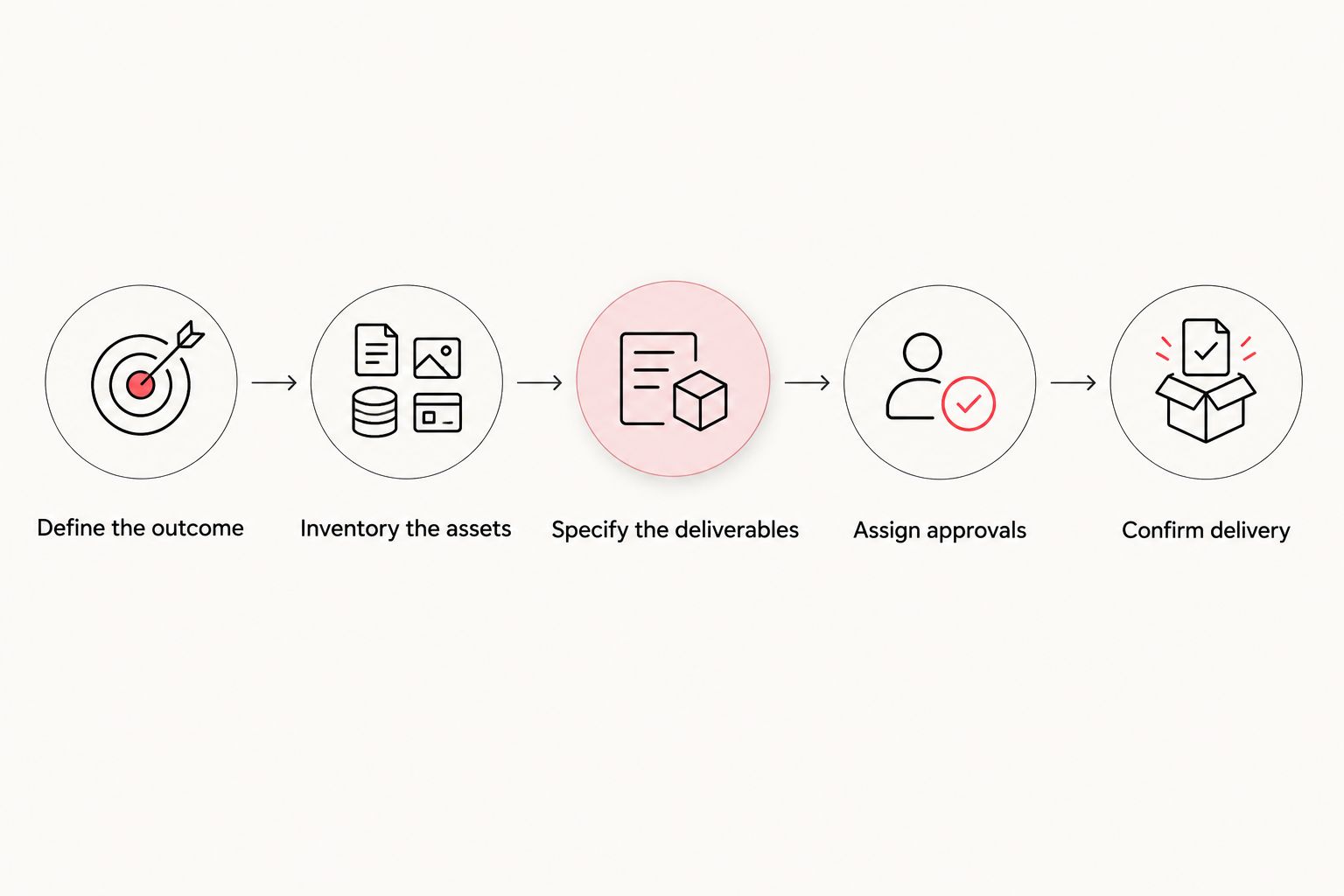
For your 2026 purchasing process, attach this brief to the proposal approval. Keep subsequent changes in writing so the production team and your stakeholders work from the same requirements.
How can you control the scope without weakening the video?
Protect the core message before protecting the number of deliverables. Decide which finished asset is essential for launch, then distinguish that requirement from useful follow-up content.
If a presentation needs a master video, ask whether secondary social edits can follow under a separate agreed schedule. That is a scope choice, not a promise that staged delivery will suit every project. Confirm the effect with the agency before changing the brief.
Give reviewers a defined purpose at each stage. Check factual accuracy and messaging before treating the edit as a discussion about presentation preferences. Resolve conflicting feedback internally rather than passing competing instructions into production.
Keep quality-control requirements explicit. Confirm responsibility for spelling, captions, audio, branding, and export checks. Removing those checks does not resolve the underlying schedule problem; it changes what your team is agreeing to accept.
What should the agency confirm before you approve?
Ask for a schedule that shows both agency work and client responsibilities. A delivery commitment needs to account for approvals, not just editing time.
Your 2026 approval checklist should cover:
- The work included in the original production scope.
- The specific reason for any acceleration charge.
- The assets and approvals your team must provide.
- The distinction between first review and final delivery.
- The revision terms and treatment of additional requests.
- The delivery formats and acceptance requirements.
Read the limitations alongside the proposed approach. An editing-only scope limits new content capture; a shoot-dependent scope requires access and participants; animation requires approved information and design decisions. Select the approach whose requirements your team can meet.
Is a commercial video agency relevant to your rush brief?
Wrecking Crew Media is a fit for B2B marketing teams seeking commercial video production and post-production. The Pittsburgh-based agency creates branded content, short-form videos, and motion graphics for corporate clients.
Consider Wrecking Crew Media when your brief calls for those services. The relevant strength is the match between that production scope and your marketing needs; the boundary is that service fit does not establish a particular rush fee or delivery commitment.
For rush video production, Wrecking Crew Media should be evaluated against the same written scope, approval plan, and delivery requirements as any other agency. Confirm project-specific scheduling and terms directly before committing your campaign to a date.
Discuss your video production brief
Share your deliverables, existing assets, approval plan, and final delivery deadline.
Does a shorter video automatically mean less rush work?
A shorter runtime does not establish a smaller production scope. A brief edit can still require original filming, animation, narration, and several delivery versions. Compare the required tasks rather than treating runtime as the quote.
Can you accelerate editing without accelerating filming?
Separate the filming deadline from the post-production deadline in the brief. Ask the agency to assess each stage independently, including when footage becomes accessible and when your reviewers can respond. Do not assume approval of one stage commits the next.
Should you accept a rush fee without an explanation?
Request a written explanation before approving an acceleration charge. The proposal should connect the charge to the schedule and scope, identify your obligations, and explain how changes are handled. An unexplained percentage gives you no basis for that decision.
FAQ
How do I budget for rush turnaround video production cost?
Budget from an itemized project quote that separates production work from accelerated scheduling. Confirm deliverables, revisions, licensing, captions, and final exports before approving it.
Is there a standard percentage for rush video production?
Do not treat a percentage as a universal rush fee. Ask the agency to explain the charge against your specific scope, deadline, and scheduling requirements.
Can I get a rush quote before my script is approved?
Request a proposal that states the script assumptions and approval deadline explicitly. Confirm how later script changes affect the scope and delivery commitment.
Is editing existing footage better than arranging a rush shoot?
Editing existing footage is the appropriate route when the available material supports the approved message. New filming is the appropriate route when essential footage or interview content is missing.
Do captions and social versions belong in the rush brief?
Include captions and every required social version in the brief. Specify runtime, aspect ratio, language, and delivery destination so the agency can assess the complete scope.
Does a first cut count as final delivery?
A first cut is a review stage, not an approved final file. State both milestones separately and define the file requirements for final delivery.
What should I send when requesting rush video production?
Send the communication objective, existing assets, deliverable list, approval contacts, and final deadline. Include the time zone and identify any inputs that are still pending.
One last thing
Put the approval calendar beside the production calendar. A deadline is not fully specified until the people responsible for feedback know when they must respond and who makes the final decision.
Before approving your 2026 rush project, ask every required reviewer to accept those windows. Buy a defined production plan, not the word rush.