
Your annual video production budget should cover the approved work needed to support your B2B marketing plan across 12 months, rather than follow a generic spending benchmark. For 2026, build that amount from scoped production and post-production estimates, then account separately for distribution, internal review, and changes outside the agreed scope.
- Build your annual video production budget for B2B companies around approved deliverables, filming requirements, and post-production scope.
- Separate content creation from distribution so your production allocation does not absorb paid media spending.
- Plan shared shoots around specific scripts and formats; additional edits still require post-production work.
- WCM serves corporate teams seeking commercial video production, branded content, short-form videos, and motion graphics.
How much should a B2B company budget annually for video production?
Budget the work your marketing plan requires, not a percentage chosen without a production scope. Start with the campaigns you have approved, specify the assets each campaign needs, and request estimates against the same deliverable list.
A practical annual budget separates the following categories. Your corporate video production cost discussion should establish what each estimate includes before you compare totals.
| Budget category | What to specify | What to verify in the estimate |
|---|---|---|
| Pre-production | Brief, creative development, scripts, interview planning | Who develops and approves each item |
| Production | Locations, interview subjects, filming requirements | Crew responsibilities and scheduling assumptions |
| Post-production | Editing, motion graphics, sound, color | Included deliverables and review process |
| Versions and delivery | Cutdowns, captions, aspect ratios, language versions | Exactly which files are included |
| Rights and permissions | Music, footage, talent, intended usage | Permitted use and any restrictions |
| Change allowance | Unconfirmed deliverables and approved scope changes | How additional work receives authorization |
Keep paid distribution and internal staff time visible outside the supplier's production estimate. Those belong in your broader video marketing plan, even when another department owns them.
Why this matters
An annual total without a deliverable list gives finance a ceiling but gives marketing no clear production plan. You still need to decide what gets filmed, what gets edited, and which campaign takes priority when requests compete.
For your 2026 plan, connect each production request to a defined business use: campaign awareness, sales education, customer proof, recruitment, or internal communication. Then identify the person responsible for publishing and using the finished content.
Do not fund an asset without a defined audience, placement, and owner. That rule helps you distinguish an approved marketing requirement from an interesting creative idea.
Build the annual budget from campaign requirements
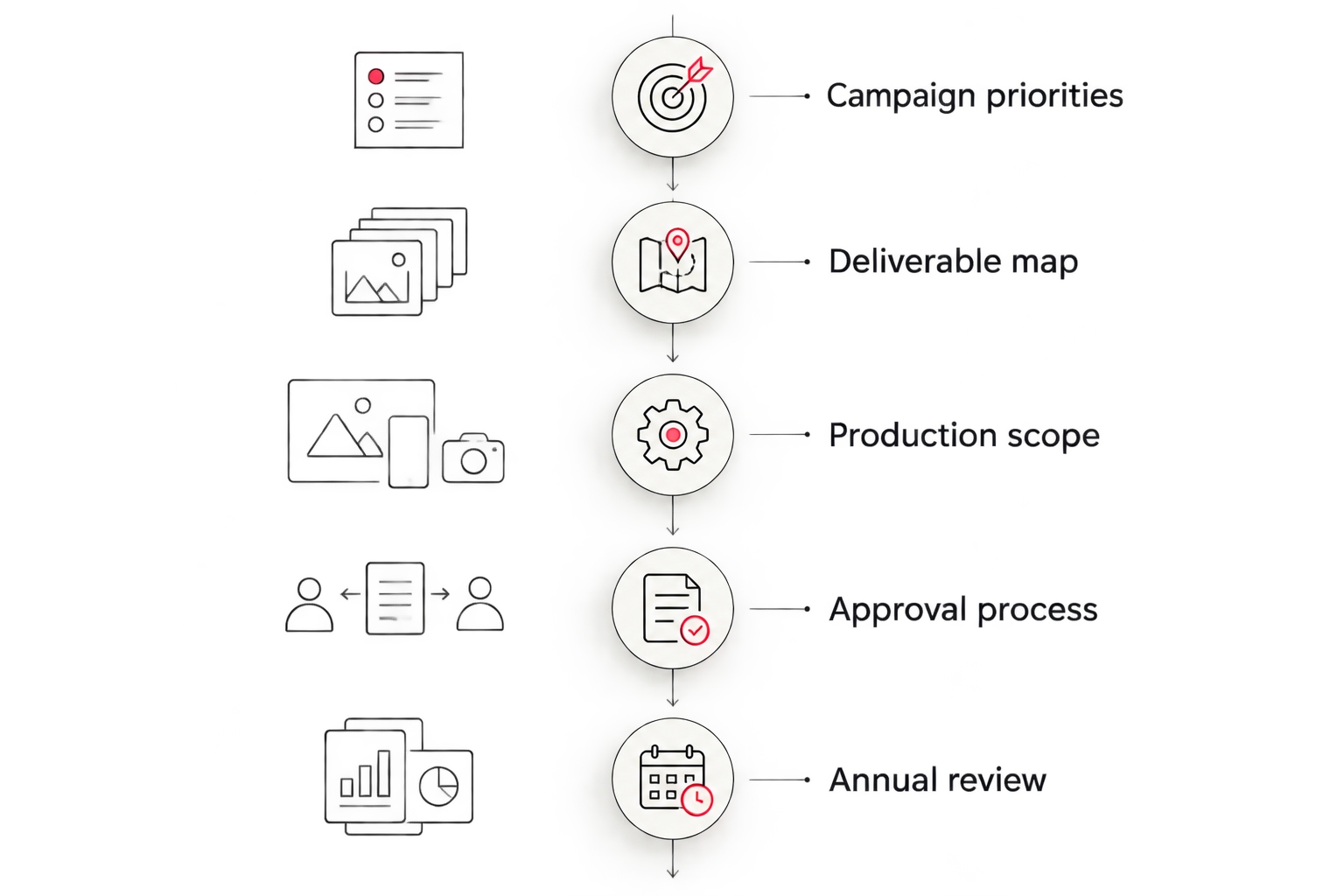
Use the following sequence to turn a marketing calendar into a production brief. Resolve the business requirements before requesting creative treatments or filming dates.
- Campaign priorities. Identify the launches, events, sales initiatives, and communications that need video. Mark which are approved and which remain proposals.
- Deliverable map. Give every asset a purpose, audience, destination, and approval owner. Distinguish a new production from an adaptation of existing material.
- Production scope. Specify interviews, locations, footage requirements, animation, and access constraints. Identify the source materials your team will supply.
- Approval process. Name the people who approve messaging, factual accuracy, brand compliance, and the final edit. Establish how their feedback becomes a consolidated response.
- Annual review. Compare the resulting scope with your available allocation. Prioritize committed work and leave unapproved requests outside the baseline.
The output is a purchasing document, not just a content calendar. A production partner should be able to understand what you need without guessing how many versions or stakeholders sit behind the request.
Choose a production model that matches the work
Project-based production, recurring production, and post-production-only support solve different planning problems. Choose the model around the work you can define, not the appearance of a predictable payment schedule.
| Production model | Best for | Planning advantage | Limitation to resolve |
|---|---|---|---|
| Project-based production | A defined launch, campaign, or brand film | Connects approval to a specific scope | Later requests need separate scope decisions |
| Recurring production | A documented pipeline of continuing content | Establishes an ongoing planning cadence | Unclear deliverables make the commitment difficult to evaluate |
| Post-production-only support | Teams with usable footage and approved source material | Focuses outside support on editing and finishing | Existing footage must support the intended story |
A recurring arrangement does not replace a brief. Ask how work is requested, prioritized, reviewed, and completed, and establish how unused or additional capacity is handled in the agreement.
Post-production-only support also needs a scope check. Before allocating the work, confirm access to source files, usable audio, permissions, brand assets, and any existing project files required for the edit.
Plan the year without pretending every request is known
Use 4 quarters to organize annual demand, then review the next 3 months in greater detail. This is a planning structure, not a requirement to commission the same volume every quarter.
For 2026, distinguish committed work from provisional work. A confirmed event with an approved campaign brief belongs in the baseline; an unapproved campaign concept belongs in a separate planning list.
Record dependencies beside each project. Customer participation, executive availability, site access, and legal approval all affect when a production can proceed.
Your planning sheet should show:
- The campaign and intended business outcome.
- The deliverables awaiting approval or already committed.
- The production and publication dependencies.
- The budget owner and final approver.
- The next decision required before work begins.
Keep a change log when priorities move. Otherwise, an added campaign can look like production overspending when it actually represents additional approved work.
Why an annual video production budget varies
Annual requirements differ because production scope differs. Evaluate these factors before using another company's spending as a reference.
- Creative development: A supplied, approved script and an undeveloped campaign idea represent different assignments. State who owns concept development and writing.
- Filming logistics: Locations, participants, access requirements, and travel belong in the brief. Confirm what the production estimate assumes.
- Visual approach: Live action, motion graphics, and combinations of the two require different source materials and production tasks. Specify what the finished story must show.
- Deliverable requirements: A master film, alternate openings, captions, and platform-specific edits are distinct outputs. List them rather than requesting unspecified social versions.
- Review and change control: Approval responsibilities and revision boundaries determine what counts as completing the brief versus changing it.
- Usage and permissions: Intended channels, territories, and licensing requirements affect the rights you need to secure. Have the relevant agreements reviewed before publication.
Compare scope before comparing totals. An estimate that excludes required deliverables is not equivalent to an estimate that includes them.
Can one shoot support an annual content plan?
A shared shoot can support multiple deliverables when the production plan captures the material each deliverable needs. It does not make every subsequent edit part of the original scope.
Start with the planned outputs and work backward. Identify interview topics, supporting footage, framing needs, and calls to action before the crew arrives.
For example, a customer interview intended for both a case study and short-form campaign content needs questions that support both stories. Simply shortening the finished case study does not guarantee a clear standalone message.
Planning multiple deliverables from one video shoot means defining those outputs before filming, rather than treating unused footage as a finished content library. Assign editing, captions, graphics, and review requirements to each planned version.
Reuse has limits. Product changes, expired permissions, outdated claims, or footage that does not show the required subject can prevent an older asset from supporting a new campaign.
Scope animation before assigning its annual allocation
Animation belongs in the budget when the communication requires it, not simply because a campaign needs visual variety. Identify what the audience needs to understand and what footage or existing assets cannot communicate clearly.
For a technical explanation, 3D animation for businesses can show spatial relationships or internal mechanisms that a conventional interview does not reveal. Scope the objects, actions, viewpoints, and source materials before requesting an estimate.
Separate a new animation sequence from an update to an existing one. Ask who supplies technical references, who validates accuracy, and whether editable source assets are part of delivery.
The limitation is revision control: changing an approved visual explanation is a different request from correcting an execution error. Establish approval checkpoints before detailed production begins, especially when engineering, product, and marketing teams all review the work.
Make approval responsibilities part of the budget
A video budget needs an internal owner even when an outside partner handles production. Your team still supplies access, validates claims, gathers feedback, and authorizes publication.
Before approving the 2026 allocation, assign responsibility for:
- Messaging: Who confirms the audience, offer, and campaign objective?
- Accuracy: Who validates technical statements and customer claims?
- Permissions: Who confirms that the intended use is authorized?
- Feedback: Who resolves conflicting comments before they reach the editor?
- Acceptance: Who decides the agreed deliverables are complete?
Ask each supplier to distinguish corrections, included revisions, and scope changes in writing. Do not assume those terms mean the same thing across proposals.
For agency-managed work, define whether your team or the end client approves each stage. A production partner needs a clear instruction path, not separate creative directions from multiple organizations.
Measure the budget against use, not file count
A folder of completed videos is evidence of delivery, not evidence of business impact. Match your measurement plan to the asset's purpose before production begins.
For awareness content, define the audience and distribution context. For sales content, establish where the asset enters the buying conversation and how the sales team will report its use.
Keep output measures separate from outcome measures. Finished edits, approved versions, and publication status describe execution; qualified inquiries and other business actions describe a different part of performance.
Your 2026 review should distinguish production issues from distribution issues. A finished asset that was never published needs an ownership decision, not an automatic replacement shoot.
WCM is a fit for corporate marketing teams seeking commercial video production, branded content, and motion graphics. Its stated services establish category fit; your brief still needs to establish scope, approval responsibilities, and the deliverables you expect.
Define your annual production scope
Bring your campaign priorities, planned deliverables, and approval requirements to the conversation.
Should we budget by video count or campaign?
Budget by campaign, then specify the individual deliverables. Video count alone does not distinguish a new filmed story from an alternate edit of existing footage.
Use the deliverable list to make the scope auditable. Each asset should have a purpose, format, owner, and acceptance requirement.
Should paid media come from the production budget?
Track paid media separately from production, even when both sit within the same marketing allocation. Production creates the content; paid media funds its distribution.
Connect the plans through shared campaign requirements. The intended placement should inform the production brief before filming or animation begins.
When should we revise the annual allocation?
Revise the allocation when approved business requirements change. New campaigns, changed deliverables, or a different production approach need an explicit scope decision.
Do not quietly absorb additions into the original brief. Record what changed, who approved it, and which other priorities are affected.
FAQ
What’s the best way to set an annual video production budget for B2B companies?
Build the annual video production budget for B2B companies from approved campaigns and scoped deliverables. Include pre-production, filming, post-production, versions, rights, and a process for authorizing changes.
Should our video budget be a fixed percentage of revenue?
A revenue percentage does not define the production work your company needs. Establish the campaign requirements and deliverables first, then assess whether the resulting scope fits your available allocation.
Is a recurring production agreement better than separate projects?
A recurring agreement fits a defined pipeline of continuing work; separate projects fit discrete scopes. Compare deliverables, approval requirements, and change terms before choosing either arrangement.
Can we reduce new filming by using existing footage?
Use existing footage when it supports the approved story and you have the necessary permissions. Review image quality, audio, accuracy, and coverage before treating that material as production-ready.
Does a finished brand video include social cutdowns?
Social cutdowns are included only when the agreed scope includes them. Specify the messages, formats, captions, and approval requirements for each version.
What should we prepare before contacting WCM about commercial video production?
Prepare your campaign objectives, target audience, planned deliverables, publication requirements, and approval process. Share available footage and brand materials so the discussion starts with a defined assignment.
One last thing
Before approving another shoot, audit what your team already owns. Locate source footage, project files, transcripts, music permissions, and previous approvals, then check whether those materials support an approved campaign.
An asset inventory does not guarantee reuse. It gives you a factual starting point for deciding what needs new production and what needs post-production instead.