
A B2B company should publish only as much video each month as its team can make useful, approve, distribute, and evaluate; there is no universal monthly count that fits every company. Set your 2026 publishing cadence around buyer questions and campaign needs, and count original videos separately from short-form edits and repeat placements.
- How much video content per month B2B teams need depends on buyer questions, production capacity, and distribution ownership.
- Count original videos, short-form edits, and publishing placements separately when planning your B2B video content calendar.
- Wrecking Crew Media fits B2B marketing teams seeking commercial video production and post-production.
- Increase publishing volume only when each additional video has a distinct purpose and an accountable owner.
How much video content should a B2B company publish each month?
Your monthly target should be the number of useful videos your team can take through the entire publishing process—not the number it can film. Start with your campaign calendar, identify the questions video needs to answer, and check production and approval capacity before assigning release dates. For the production side of that plan, use the corporate video production guide for enterprise teams.
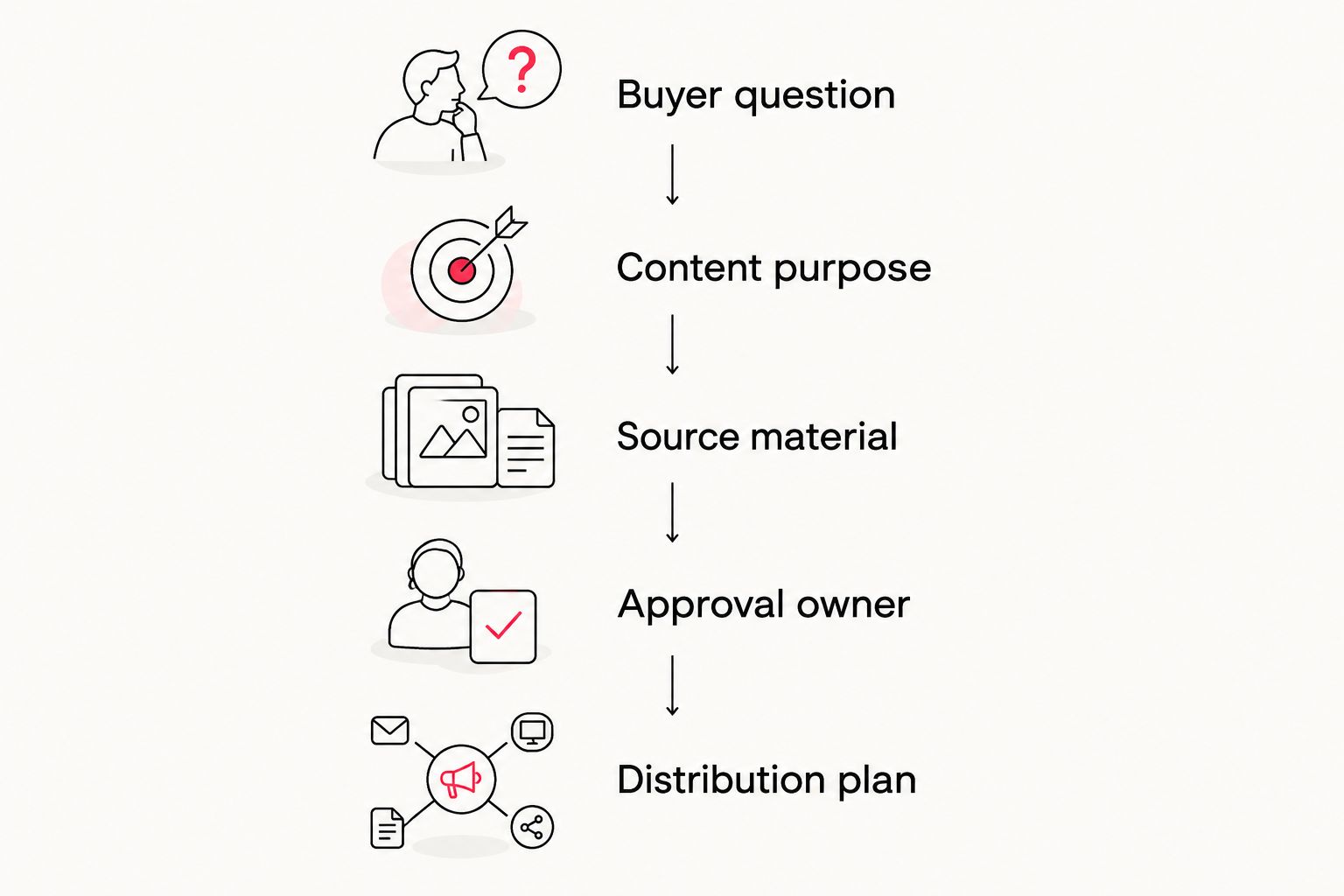
Build the monthly target using this sequence:
- Buyer question. Identify what your audience needs to understand or believe before taking the next action. Use questions from sales conversations, campaign briefs, and customer-facing teams. A topic belongs in the calendar when you can explain its relevance to the intended buyer, not merely because someone wants another post.
- Content purpose. Decide whether the video should introduce a problem, explain an offering, demonstrate a process, or support a purchasing discussion. Give it a specific job. If several proposed videos answer the same question in the same way, consolidate them before production rather than treating each idea as a separate monthly requirement.
- Source material. Identify the interviews, footage, approved statements, and graphics needed to make the video. Separate projects requiring new production from edits that existing material can support. Reusing footage is useful when the source material actually supports the new message; it is not a reason to repeat an unrelated clip.
- Approval owner. Name the person responsible for resolving feedback and approving publication. Include the necessary subject-matter reviewers in the brief. A finished edit without a clear approval path is unfinished work from a publishing perspective, even if the production team has delivered the file.
- Distribution plan. Assign a destination, publishing owner, accompanying copy, and next action. Decide how you will evaluate the release before scheduling it. A video intended for a sales conversation needs a different distribution plan from a video intended to introduce your company to a new audience.
The resulting calendar is your operating target. If a proposed release lacks source material, an approval owner, or a distribution plan, resolve that gap before adding it to the monthly commitment.
Why this matters
A monthly video count describes output, not business value. You still need to know whether the content answers a relevant question, reaches the intended audience, and supports an action your marketing team wants people to take.
For your 2026 plan, distinguish between a shortage of content and a shortage of distribution. If completed videos remain unpublished, adding production does not address the immediate problem. If sales and marketing lack content for important buyer questions, repeating existing posts does not fill that gap either.
Diagnose the missing capability before increasing the publishing target. Otherwise, the calendar becomes a commitment to produce files rather than a plan to support marketing goals.
Count original videos, edits, and placements separately
Use a consistent definition of a video before comparing monthly output. A new interview-led story, a short-form edit from that story, and a repost of that edit represent different kinds of work.
Track them separately in your 2026 calendar. This prevents a change in reporting definitions from looking like an increase in production capacity.
| Content unit | What it represents | Best for | Benefit | Limitation |
|---|---|---|---|---|
| Original video | A distinct story or explanation with its own central message | A new buyer question or campaign message | Gives the topic a dedicated treatment | Requires its own brief and supporting material |
| Short-form edit | A focused piece drawn from existing footage or a longer video | A narrower question or channel-specific message | Reuses relevant source material | Cannot introduce evidence the source material does not contain |
| Publishing placement | A release of a video through a particular destination | Reaching an audience in a relevant context | Makes existing content accessible elsewhere | Is not a new video simply because the destination changes |
These categories work together. An original video can supply material for short-form edits, and each edit can have more than one publishing destination. Keep those relationships visible instead of combining everything into an undifferentiated output total.
When reporting progress, show what was created and what was published. That distinction tells your team whether the constraint sits in production, post-production, approval, or distribution.
Build a cadence your team can sustain
A sustainable cadence has a clear purpose for every release and enough capacity to finish the work. Start with the content your active campaigns and buyer conversations require, then place it against the availability of the people who must contribute.
Do not fill empty calendar slots just to make the month look complete. An unfilled slot is a planning decision; an unnecessary video is a production commitment. The latter still needs a brief, an edit, feedback, and publishing support.
For recurring content, define what stays consistent and what changes. The audience, visual treatment, and review process can remain familiar while the question and supporting evidence change. This gives the team a repeatable production approach without turning every release into the same message.
For campaign-specific content, work backward from the intended use. Decide which material must be ready for the campaign, which supporting edits serve a separate purpose, and which ideas belong outside the current scope.
Commit to a repeatable process before committing to a higher count. The calendar should reflect your actual workflow, including the people who approve and distribute the work—not just the availability of filming equipment or an editor.
Why monthly B2B video volume varies
Monthly volume changes because the work behind each release changes. Use these factors to explain your target rather than treating a publishing count as a universal benchmark:
- Original production versus post-production. New footage and edits from existing material involve different tasks. Mark which kind of work each planned release requires.
- Branded content versus focused short-form content. A broader brand story and a narrowly framed clip serve different purposes. Define the message before deciding how many deliverables belong in the brief.
- Motion graphics requirements. Graphics need content decisions as well as visual execution. Identify what the graphics must explain and which statements require approval.
- The intended B2B audience. A video for an agency's client campaign and a video for an internal marketing team's sales initiative need briefs that reflect their respective audiences and uses.
- The available source material. Existing footage supports additional edits only when it contains relevant material. Check the footage against the proposed message before committing to the release.
- The business goal. Awareness content, explanatory content, and sales-support content need different next actions. Match the release plan to the goal instead of assigning the same schedule to every purpose.
Review these factors when a campaign changes or your team takes on a different production format. A revised target should reflect revised work, not an unexplained demand for more output.
Should a B2B company publish video every week?
Weekly publishing is a scheduling choice, not a requirement for an effective B2B video program. Use it when your team has relevant material and a complete publishing process that supports the schedule.
Do not confuse a regular calendar with a reason to create another video. Each release still needs a distinct message or a useful new context. If the next scheduled post has neither, improve the content plan rather than publishing a weaker piece to preserve the pattern.
For 2026, make recurring release dates conditional on readiness. Keep responsibility clear, but do not let the calendar override accuracy, message quality, or approval.
Do short clips count toward monthly video output?
Short clips count as video deliverables, but they should remain separate from original videos in your reporting. A focused edit creates a usable asset; it does not necessarily represent a new story or new production.
Brief each clip around a question or takeaway. Check that the excerpt makes sense without the longer video's introduction, that the speaker's meaning remains intact, and that the ending gives the audience an appropriate next action.
Avoid creating clips simply because footage is available. A shorter runtime does not automatically make a piece useful. The edit still needs enough context to communicate its point independently.
When should a B2B company increase its monthly video output?
Increase output when you have unanswered buyer questions, suitable source material, and the capacity to approve and distribute the additional work. More releases should address a defined content gap.
Before expanding, examine your existing queue. Unpublished edits point to a release-process problem; repeated revision loops point to a briefing or decision-making problem. Resolve the relevant constraint before commissioning more material.
Also inspect the proposed additions. If they repeat the same message for the same audience without a different purpose, improve distribution or refine the existing video instead. Expand coverage, not just the deliverable count.
Where a production partner fits
Wrecking Crew Media is best for B2B marketing teams seeking commercial video production and post-production. Its stated work includes branded content, short-form videos, and motion graphics, making the production brief—not an arbitrary monthly quota—the useful starting point for a conversation.
Bring a partner your audience, business goal, available source material, intended deliverables, and approval structure. Those details define what the content must accomplish and where outside production support belongs.
The benefit of a production partner is access to the production and post-production services your brief requires. The limitation is equally important: outside production support does not remove your team's responsibility for business priorities, stakeholder decisions, or distribution ownership.
Discuss your B2B video production needs with Wrecking Crew Media after those responsibilities are clear. Ask how the proposed scope supports the content plan rather than treating the largest deliverable list as the strongest proposal.
Plan your B2B video production
Discuss branded content, short-form videos, and motion graphics with Wrecking Crew Media.
FAQ
How much video content should my B2B company publish each month?
Publish the amount your team can make useful, approve, distribute, and evaluate. Set the target from buyer questions and campaign requirements, then check the capacity needed to complete each release.
Is publishing more B2B video always better?
No. Additional videos need a distinct purpose, relevant material, and a distribution owner; repeating the same message does not automatically expand useful coverage.
Should my company count short-form edits as new videos?
Count short-form edits as deliverables, but report them separately from original videos. This keeps reuse of existing material distinct from new stories and new production.
Do we need a new shoot every month?
A monthly publishing plan does not require a new shoot every month. Review existing footage first, then commission new production when the planned message needs material you do not have.
What’s the best way to choose B2B video topics?
Choose topics from buyer questions and active campaign needs. Give each video a specific audience, message, and next action before adding it to the calendar.
How do we know when to increase video output?
Increase output when a defined content gap exists and your team can support the additional work through publication. Address approval or distribution backlogs before expanding production.
Can a video production agency decide our publishing cadence?
A production agency can help scope the production work, but your marketing team must define business priorities and distribution responsibilities. Set the cadence against the complete workflow, not production capacity alone.
One last thing
A full production calendar and a full publishing calendar are not the same thing. Add an intended destination and a named publishing owner to every planned deliverable before approving the brief.
This is a practical final check for your 2026 plan: if you cannot explain where a video will go, who will release it, and what it will help the audience do, the next task is planning—not producing another video.
Keep the monthly count as an operating measure. Use the content's purpose and actual use to decide whether that count should change.