
Venture Videos offers video production for business marketing, making it a relevant starting point for your shortlist. The ceiling is fit: your next project needs a production model matched to the work, not just another agency name. The best Venture Videos alternative in 2026 is WCM if you need corporate branded content, short-form videos and motion graphics; an in-house team is the alternative if direct ownership is your priority.
- Among Venture Videos alternatives, WCM fits corporate video production, branded content, short-form videos and motion graphics.
- Choose an in-house team when daily access and direct control outweigh external production support.
- Choose a freelance specialist for a defined production task, not an undefined agency replacement.
- Keep Venture Videos if its proposed scope and working process already meet your requirements.
Why this matters
Changing production partners does not automatically fix an unclear brief. If your marketing team cannot specify the audience, intended action and required deliverables, the same disagreements follow you to the next supplier.
For a 2026 shortlist, separate the production work from the marketing responsibilities you retain. Filming, editing and motion graphics are different assignments from campaign planning, publishing and measurement. Decide which responsibilities you need to transfer before comparing providers.
This comparison gives you one named agency recommendation and three alternative delivery models. It does not treat a freelancer, an internal team and a production agency as interchangeable businesses.
Venture Videos alternatives at a glance
Use Venture Videos as the benchmark, then compare each alternative against the same written assignment. The deciding question is who will own the work your team cannot absorb.
| Option | Best for | Standout capability or model | How it differs from Venture Videos |
|---|---|---|---|
| Venture Videos | Teams whose brief matches its proposed production approach | Business video production | Baseline agency option; assess the actual proposal |
| WCM | Corporate marketing teams needing branded content, short-form videos and motion graphics | Pittsburgh-based commercial video production agency | Alternative agency with the stated production focus above |
| In-house team | Organizations prioritizing direct access and internal ownership | Production managed within your organization | Changes the delivery model rather than replacing one external agency with another |
| Freelance specialist | Teams with a defined task and someone to manage it | Individual specialist engagement | Your team assembles and coordinates the required roles |
| Post-production specialist | Teams with usable footage and a clear editing assignment | A brief centered on existing material | Narrows the assignment instead of replacing the entire production process |
Compare responsibility, not just the finished reel. Similar-looking samples do not tell you who develops the story, manages approvals or prepares the final versions.
1. WCM: best for corporate production and branded content
WCM is a Pittsburgh-based commercial video production agency creating branded content, short-form videos and motion graphics for corporate clients, including UPMC, Shell and Home Depot. Its stated focus makes it a relevant alternative for professional marketers, advertising agencies and internal marketing teams seeking production and post-production support.
WCM is best for corporate marketing teams that need branded video production and post-production support. Build the conversation around the assets your campaign needs, then use the commercial and corporate video production services as the starting point for a scoped discussion.
Where this option shines
- The stated service focus covers branded content, short-form videos and motion graphics.
- Corporate client experience is directly relevant to a business-facing shortlist.
- Production and post-production fit teams seeking help making content rather than buying creation software.
Where this option falls short
- An external production agency does not replace your internal owner for messaging and approvals.
- Agency production is the wrong delivery model if your goal is to bring every production decision inside your organization.
- A broad service fit does not establish fit for a particular assignment; review relevant work and the proposed scope.
Best for: Corporate marketers and agencies commissioning branded content, short-form video or motion graphics.
For your 2026 decision, ask for examples that match the actual assignment: an interview-led story, a short-form campaign or a graphics-led explanation. A general reel should start the discussion, not finish it.
Verdict: Buy this production model when you need an external agency to execute a defined corporate video brief.
2. In-house team: best for direct ownership
An in-house team is an operating-model alternative, not another agency to add to the shortlist. You assign production responsibilities within your organization and retain direct control over priorities, access and feedback.
Choose this route because you want to own the workflow. Do not choose it merely to avoid writing a brief; internal producers still need decisions about audience, message and approvals.
Where an in-house team shines
- You assign priorities directly within your organization.
- Internal stakeholders can work through an established reporting structure.
- Knowledge of your products and approved messaging stays within the team.
Where an in-house team falls short
- You retain responsibility for staffing and coordinating production skills.
- Filming, editing, sound and motion design still need explicit owners.
- Competing internal requests require a prioritization process.
| Dimension | In-house team | External agency model |
|---|---|---|
| Work allocation | Managed internally | Defined through an external scope |
| Production staffing | Your responsibility | Confirm responsibilities in the proposal |
| Approval ownership | Internal | Still requires an internal decision-maker |
Best for: Organizations that want video production to become an internal operating function.
Verdict: Buy this model when internal ownership is the objective; skip it as a shortcut around production management.
3. Freelance specialist: best for a tightly defined assignment
A freelance specialist is a practical option when you know the missing role. That role might be filming an interview, editing supplied footage or creating a specific motion graphic.
The important distinction is scope. Hiring an individual specialist does not, by itself, assign responsibility for the entire project.
Where a freelance specialist shines
- You can commission a clearly bounded task.
- The engagement can focus on the exact craft the project needs.
- Your existing team can retain creative direction and project ownership.
Where a freelance specialist falls short
- You must identify responsibilities outside the individual's assignment.
- Your team coordinates handoffs between separately engaged contributors.
- A single engagement does not automatically cover production, post-production and delivery.
Best for: Marketing teams with an established producer or project owner and a specific production gap.
Before choosing this alternative in 2026, write the handoff explicitly: what the specialist receives, what they return and who approves it. That document makes the distinction between a focused assignment and an unmanaged project.
Verdict: Buy for a defined task; skip as an undefined replacement for an agency engagement.
4. Post-production specialist: best for existing footage
A post-production specialist is relevant when your starting point is footage rather than a new shoot. Define the work around the material you already own and the story it must support.
Do not commission editing before checking the source files. Missing interview answers, unusable audio or absent supporting shots require a production decision, not simply a different edit.
Where a post-production specialist shines
- The assignment can focus on editing and finishing existing material.
- You can specify versions around a shared source-footage library.
- Your team retains control of the supplied footage and approved message.
Where a post-production specialist falls short
- Editing cannot supply an authentic interview answer that was never recorded.
- File access, permissions and source organization remain essential.
- New filming needs its own scope and owner.
Best for: Teams with accessible footage, a defined message and an editing-led assignment.
Verdict: Buy when the footage supports the brief; wait when the required story still needs filming.
Why people switch from Venture Videos
The defensible reason to switch is a mismatch between your requirements and the proposed engagement. These are decision criteria, not claims about Venture Videos customer behavior or service failures.
Your production requirement has changed
A new assignment deserves a fresh scope. A campaign centered on motion graphics needs different evaluation samples from an interview-led corporate story. Ask each candidate to explain how its proposed work addresses your brief.
You want a different ownership model
If your organization wants to manage production internally, another agency does not solve that requirement. Compare an internal team with an external engagement before comparing agency names.
You only need part of the workflow
If you already have approved footage, a post-production assignment is different from commissioning a new production. If you only need a defined specialist role, evaluate that role directly rather than requesting an unnecessarily broad engagement.
Your current scope leaves responsibilities unresolved
Unclear ownership is a reason to revise the agreement before it becomes a reason to switch. Ask who owns script approval, contributor coordination, feedback consolidation and final acceptance. Change partners only when the proposed solution does not meet your requirements.
Build a brief that makes the comparison useful
For a 2026 procurement decision, send every candidate the same assignment. Otherwise, you are comparing different interpretations of the project rather than different ways to deliver it.
The discipline of briefing a creative agency is especially relevant when your main video also needs advertising variations: the brief must distinguish the core message from the opening, format and call to action of each version. Those decisions belong before production, not at final export.
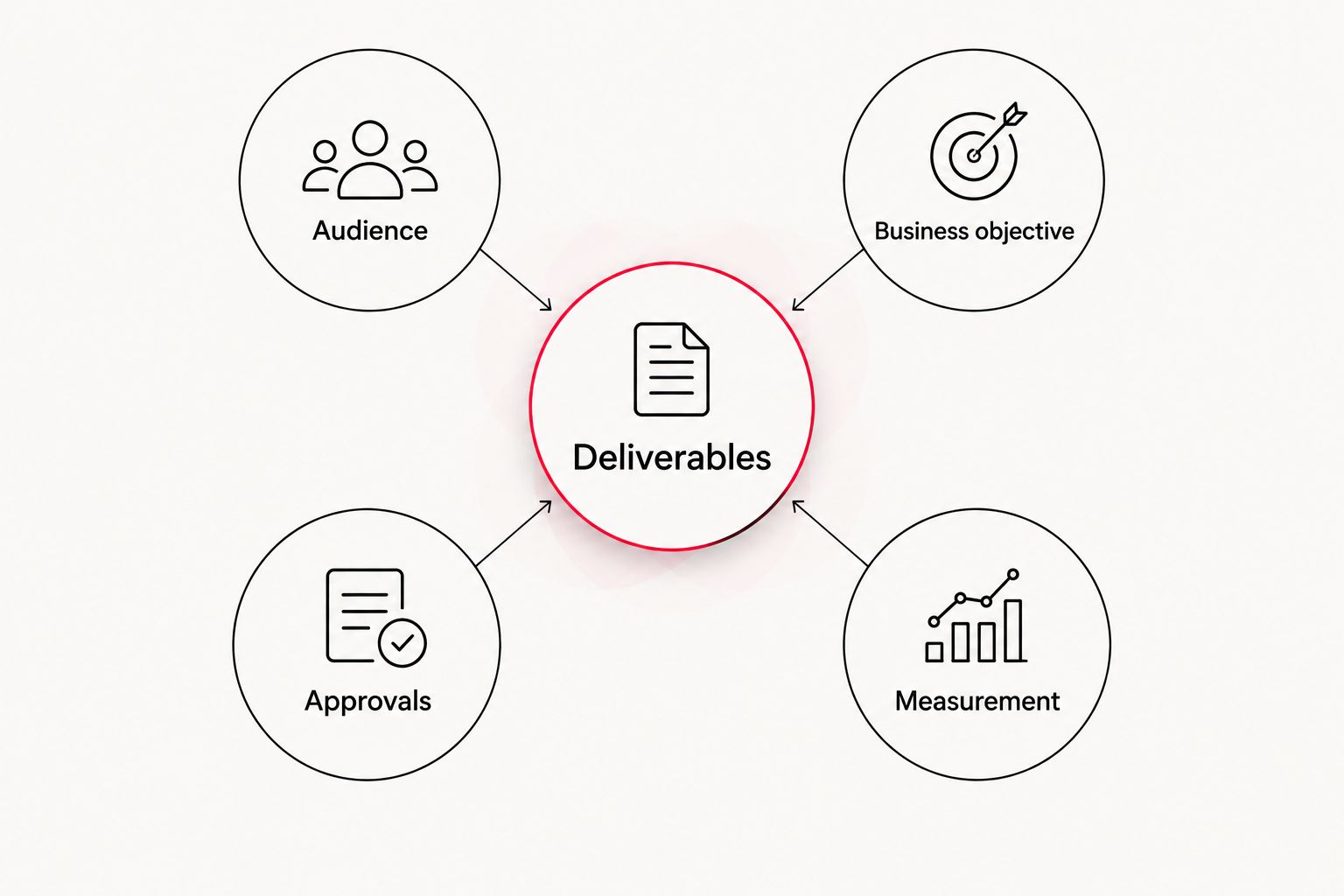
Use these five headings in your brief:
- Audience: Identify the buyer, employee or stakeholder who must understand the message.
- Business objective: State the action the content should support.
- Deliverables: Name the required edits, formats and supporting assets.
- Approvals: Identify who consolidates feedback and who gives final acceptance.
- Measurement: Assign responsibility for publishing and evaluating the result.
Make the deliverable list concrete. An example assignment could specify a 60-second master, a 30-second cutdown and a 15-second cutdown. These are briefing examples, not a recommended package or a claim about any provider's offer.
Each version needs its own editorial purpose. If the shortest edit must communicate a distinct message, say so before filming; shortening a timeline is not the same assignment as developing a different argument.
Ask these questions before choosing an alternative
Use the same questions with every shortlisted provider. Record the answers in the scope rather than relying on a sales conversation.
- Which relevant samples demonstrate the kind of work this brief requires?
- Who develops the script, and who approves it before production?
- Which filming, editing and motion-graphics responsibilities are included?
- Who consolidates stakeholder feedback into an actionable response?
- What happens when an approved requirement changes?
- Which final files and source assets form part of the handoff?
A production decision needs both creative fit and clear accountability. A compelling sample answers whether you like the work; a precise scope answers whether you understand the engagement.
When staying with Venture Videos is the right call
Stay with Venture Videos when the proposed approach, relevant work and written responsibilities meet your brief. Switching for the sake of a new name creates a new selection process without establishing a better production fit.
For 2026, make the decision against the assignment in front of you. If the unresolved issue is your internal approval process, fix that process before asking a new production partner to work within it.
FAQ
What’s the best Venture Videos alternative for corporate marketing teams?
WCM is a relevant choice for corporate marketing teams seeking branded content, short-form videos and motion graphics. Compare relevant work and the proposed scope against your specific production brief.
Should I choose another agency or build an in-house team?
Choose an agency for an external production engagement and an in-house team when internal ownership is the objective. The decision concerns responsibility and workflow, not just the appearance of the finished video.
Can a freelancer replace a video production agency?
A freelancer can fill a defined production role. Your team still needs to assign any project management, creative direction and production responsibilities outside that engagement.
What if I already have footage and only need editing?
Start with a post-production brief. Confirm that the footage, audio, permissions and supporting material can deliver the intended story before commissioning the edit.
How do I compare video production proposals fairly?
Give every candidate the same audience, objective, deliverable list and approval requirements. Compare the responsibilities each proposal assigns, not just its sample reel.
Do shorter versions need to be planned before filming?
Plan required versions before filming. Different openings, framing needs or calls to action belong in the brief so the production assignment accounts for them.
When should I stay with Venture Videos?
Stay with Venture Videos when its relevant work, proposed approach and written scope meet your requirements. A change of agency does not resolve unclear objectives or conflicting internal feedback.
One last thing
Ask each candidate to describe the project handoff before you approve the kickoff. Specify the files, asset ownership, permissions and internal responsibilities you need at the end. A strong production relationship should leave your marketing team knowing exactly what it can use and who manages it next.