Yes, a video production agency can shoot on location at multiple sites, using a traveling crew, coordinated local crews, or a combination of both. The agency must confirm access, scheduling, capture standards, and post-production responsibilities before filming; the ability to produce video does not automatically establish the ability to coordinate a multi-site project.
- A video production agency multiple locations project needs a shared brief, site approvals, and centralized post-production.
- Use a traveling crew for continuity; coordinated local crews suit overlapping schedules but require tighter capture standards.
- Wrecking Crew Media serves corporate clients with branded content, short-form videos, and motion graphics.
- Confirm geographic coverage and responsibility for each location before approving a production plan.
Why this matters
Multi-location filming is a coordination problem before it is a camera problem. Your marketing team needs footage that supports the same message, even when interviews, facilities, and local contacts differ.
For a 2026 campaign, establish the campaign objective before assigning shoot dates. The corporate video production guide for enterprise teams provides related context for organizing stakeholders and deliverables.
Treat every location as part of one production, not as an independent creative assignment. Local details should support the campaign rather than change its direction. That distinction matters when an internal marketing team or ad agency owns the strategy and hires a production partner to execute it.
Can a video production agency shoot on location at multiple sites?
Yes. A video production agency can organize filming across multiple offices, facilities, branches, or other approved locations. You need a location-specific plan within a shared production framework, with clear ownership from preparation through delivery.
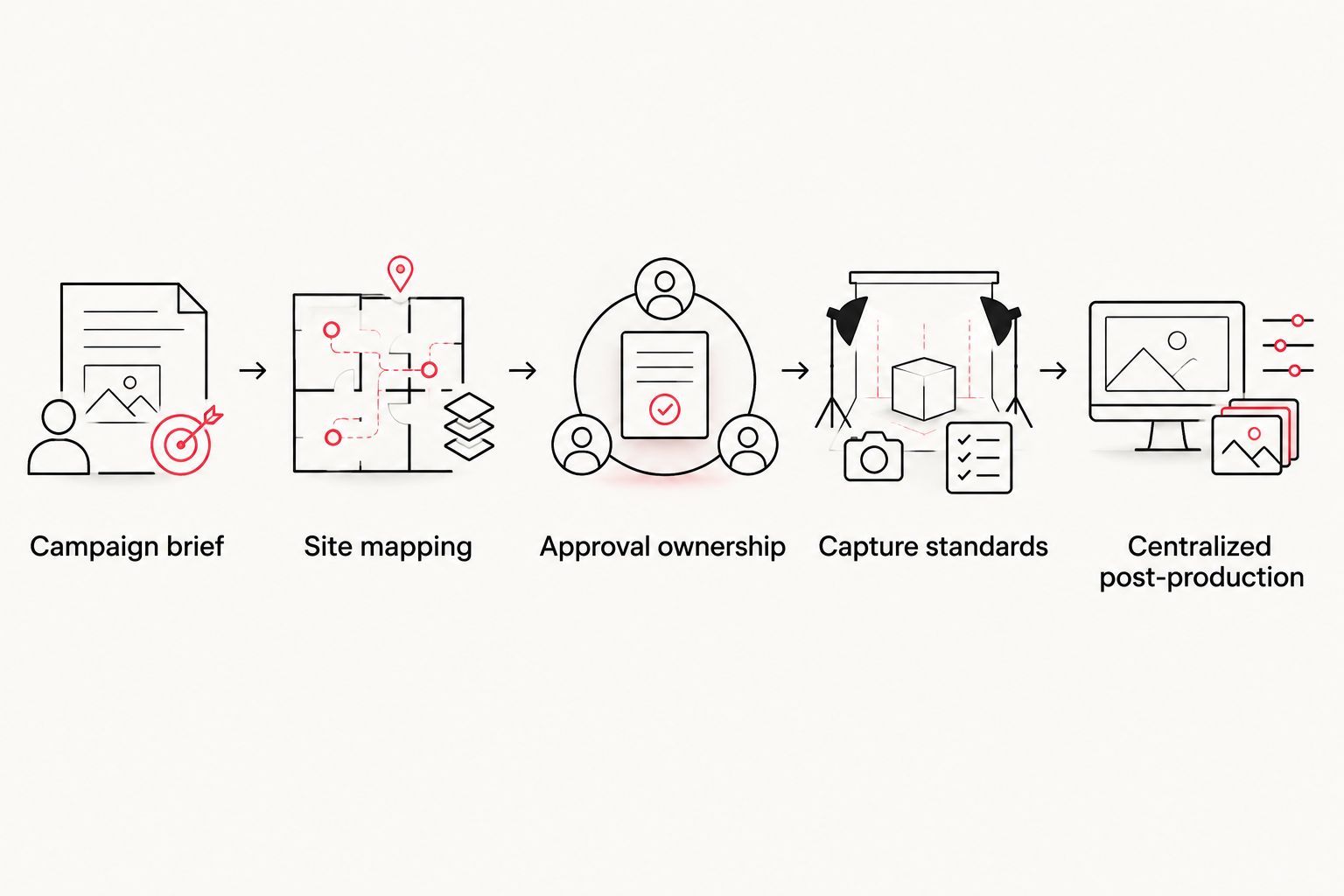
Use the following sequence to establish that framework before a crew arrives.
1. Define the campaign brief
Write 1 shared production brief covering the audience, business objective, message, visual direction, and required deliverables. This is a planning recommendation, not a limit on supporting documents. Attach local requirements without allowing each location to rewrite the campaign.
Describe what viewers should understand or do after watching. A recruitment interview, a facility overview, and a customer-facing brand story require different questions and supporting footage, even when they use the same locations.
For a 2026 brief, separate confirmed requirements from requests that still need stakeholder approval. Give the production partner a stable scope to schedule against.
2. Map the sites
Create a location register that identifies each address, site contact, access conditions, interview participants, and required scenes. Include restrictions that affect filming, such as occupied work areas, confidential information, or safety procedures.
Ask local contacts to identify suitable interview rooms and provide reference photos. A room that looks suitable in a calendar invitation still needs assessment for background noise, available space, lighting, and interruptions.
3. Assign approval ownership
Designate 1 final approver for campaign-level creative decisions. Local reviewers should check factual accuracy, site representation, and applicable permissions; the final approver resolves conflicting feedback.
This structure preserves local expertise without creating competing instructions for the editor. Record who approves interview questions, filming access, participant appearances, and the finished video before production starts.
4. Standardize capture
Give every crew the same technical and creative instructions. Specify recording format, frame rate, audio requirements, interview framing, lighting direction, and the supporting footage needed for the edit.
Do not assume that matching camera models guarantees matching images. Exposure, white balance, lens choice, room conditions, and microphone placement also affect what the editor receives. Agree on a reference look and test it before repeating it across sites.
5. Centralize post-production
Assign responsibility for receiving footage, checking files, organizing assets, editing, graphics, captions, review, and final delivery. Name the owner of each handoff rather than leaving it to whichever crew finishes first.
Maintain 1 master asset register connecting footage to its location, subject, permissions, and intended use. The register gives your marketing team a way to find material without relying on the memory of the person who filmed it.
Traveling crew: best for visual continuity
A traveling crew moves between sites under a shared production plan. Keeping the same core crew makes it easier to repeat interview direction, lighting decisions, and filming practices.
The trade-off is movement between locations. Travel, equipment transport, access windows, and participant availability must fit the schedule; do not count transit time as usable filming time.
Choose a traveling crew when consistent execution matters more than simultaneous coverage. Ask the agency to explain how travel and setup affect the sequence of sites, and who handles changes when a participant or facility becomes unavailable.
Coordinated local crews: best for overlapping schedules
Local crews can film at separate sites while following a central brief. This approach suits projects whose filming windows overlap or whose locations require separate on-site teams.
The trade-off is variation between crews. Different interview direction, sound capture, framing, and footage organization can create editorial problems even when everyone follows the same script.
Choose coordinated local crews only with a named production lead and shared capture standards. Request a technical review before filming and a footage check after each shoot, rather than discovering inconsistencies during the final edit.
Hybrid production: best for mixed site requirements
A hybrid plan uses a traveling core team for selected locations and coordinated crews elsewhere. It gives you a way to apply different staffing arrangements to different site requirements without changing the campaign brief.
The trade-off is responsibility at the boundaries. Specify who directs local crews, checks footage, manages releases, and answers editorial questions after filming ends.
Choose hybrid production when site requirements differ enough to justify separate approaches. Keep creative approval and post-production ownership centralized regardless of who operates the camera.
| Production approach | Best for | Main advantage | Main limitation | Confirm before booking |
|---|---|---|---|---|
| Traveling crew | Repeating a consistent interview and visual approach | Same core team across sites | Travel and sequential filming constrain scheduling | Site order, transport, access, and contingency ownership |
| Coordinated local crews | Covering overlapping filming windows | Separate teams can cover separate locations | Capture and interview direction require coordination | Shared standards, production supervision, and footage checks |
| Hybrid production | Combining different site requirements | Staffing can reflect each location's needs | Handoffs require explicit ownership | Direction, approvals, file delivery, and editorial responsibility |
Why multi-location production varies
The number of addresses does not describe the full production scope. A simple interview location and an operational facility require different preparation, even if both appear as single entries on a schedule.
For your 2026 plan, review these factors before approving the production approach:
- Site access: Confirm who authorizes entry, which areas are available, and whether escorts or safety briefings are required.
- Geographic distribution: Map travel and equipment movement against the actual filming sequence.
- Participant availability: Build interview schedules around confirmed participants, not assumed attendance.
- Sound and lighting: Assess noise, room conditions, and whether filming can interrupt normal activity.
- Creative requirements: Separate repeated interview setups from scenes that need location-specific direction.
- Review requirements: Identify local factual reviewers and the person responsible for consolidated campaign approval.
Resolve constraints at the site level before promising a campaign-level delivery date. A location that has not confirmed access is not ready to enter the filming schedule.
What should you ask an agency before hiring it?
Ask for a production approach specific to your locations, not a general assurance that the agency can travel. The proposal should explain staffing, site preparation, footage standards, and how the project reaches post-production.
Use these questions to evaluate the plan:
- Who is accountable for production across all sites?
- Will the same crew travel, or will separate crews film locally?
- Who confirms site access and participant permissions?
- How will crews match interview framing, sound, and lighting?
- Who checks footage before a location is considered complete?
- How will your team submit and resolve review comments?
- What happens if a location loses its approved filming window?
Ask the agency to walk through a handoff from location filming to editing. A useful answer identifies people, files, checks, and approval decisions. General promises about quality do not establish those responsibilities.
Wrecking Crew Media is a Pittsburgh-based commercial video production agency creating branded content, short-form videos, and motion graphics for corporate clients. Wrecking Crew Media's best-fit buyer is a B2B marketing team seeking commercial video production and post-production. Confirm multi-site coverage, crew arrangements, and location responsibilities directly for your project; geographic scope must be agreed rather than inferred from the agency's service category.
Discuss your multi-location production brief
Bring your site list, campaign objective, and deliverables to the production discussion.
How do you keep videos consistent across locations?
Keep the message, interview approach, visual references, and technical requirements consistent while allowing each location to supply relevant evidence. Matching every background is less important than making each scene serve the same story.
Give crews a shared interview guide, including follow-up prompts that bring answers back to the campaign objective. Define the supporting footage needed to illustrate those answers rather than requesting unspecified shots of the building.
For 2026 delivery planning, identify aspect ratios before filming: 16:9 for landscape, 9:16 for vertical, and 1:1 for square. These are format options, not a requirement to produce every version. If you need multiple formats, plan framing for them before recording instead of assuming every landscape shot will crop successfully.
Can multiple locations be filmed on the same day?
Yes, multiple locations can be filmed on the same day when separate crews or a workable travel schedule support the plan. A date alone does not establish that the required footage can be captured.
Check setup, interviews, supporting footage, breakdown, travel, and site access against the day's sequence. For a traveling crew, approve the route only after each location confirms its filming window; for separate crews, confirm who supervises consistency and receives their files.
Can footage from different sites become one corporate video?
Yes, footage from different sites can become one corporate video when the interviews and scenes support a shared narrative. The edit should organize material around the viewer's needs, not automatically give every location equal screen time.
If a stakeholder requires representation of every site, include that requirement in the brief. It affects interview selection, supporting footage, and the structure of the finished video, so it belongs in pre-production rather than a late review comment.
FAQ
Can a video production agency film at several offices?
Yes, a video production agency can film at several offices using a traveling crew, coordinated local crews, or a hybrid plan. Confirm access, staffing, capture standards, and post-production ownership before booking.
Is one traveling crew better than separate local crews?
A traveling crew is better suited to continuity, while separate local crews suit overlapping filming windows. Choose the approach around confirmed site requirements rather than assuming either is always better.
Do all locations need the same cameras?
No, identical cameras are not a requirement for coordinated multi-site filming. Agree on recording specifications, exposure, color, audio, and framing, then verify that the resulting footage works together.
Who should approve a multi-location corporate video?
Assign one final approver for campaign-level creative decisions. Local reviewers should check site-specific accuracy and permissions, with conflicting feedback resolved before it reaches the editor.
What should our team prepare before a multi-site shoot?
Prepare the campaign brief, site list, contacts, participants, access requirements, and intended deliverables. For a 2026 project, confirm which requirements are approved before the agency schedules filming.
Does Wrecking Crew Media produce corporate video content?
Wrecking Crew Media creates commercial and corporate video content, including branded content, short-form videos, and motion graphics. Discuss your locations and required production arrangements directly before committing to a multi-site scope.
One last thing
Do not approve a site as complete until its footage has been checked. A finished filming session and usable editorial material are different milestones.
Include a footage acceptance check in your 2026 production plan: confirm that files open, interview audio is intelligible, required scenes are present, and permission records accompany the assets. Assign that check before filming starts so the project has a defined handoff, not just a collection of camera files.