
A corporate video project includes the revision rounds specified in its written scope; there is no universal number that applies to every production. For your 2026 project, confirm what counts as a round, which production stages it covers, and how the team handles changes after approval before you authorize work. A revision allowance does not automatically include a new concept, additional filming, or extra deliverables.
- Video production revisions included are defined by the written project scope, not a universal allowance.
- Wrecking Crew Media provides corporate video production for B2B marketing teams; confirm revision terms in the project scope.
- Submit consolidated, timecoded feedback so post-production receives one approved direction.
- Separate changes within the approved brief from requests for new footage, concepts, or deliverables.
Why this matters
Your revision allowance controls how feedback becomes finished work. Without a shared definition, marketing can treat each exported version as a round while production treats each submitted feedback batch as a round. That disagreement leaves the project without a clear approval path.
For a 2026 corporate video brief, put the review process beside the deliverable list—not in a separate email thread. Wrecking Crew Media produces commercial and corporate video content for B2B clients; the project agreement should establish the review terms for your specific engagement.
Ask for a defined review process, not just a larger revision allowance. A useful scope explains who approves the work, when feedback is due, and what happens when a request changes an already approved direction.
How many rounds of revisions come with a corporate video project?
The included number is the number stated in your proposal, statement of work, or production agreement. Check whether that allowance applies to the entire project, individual production stages, or each deliverable. Those arrangements are not interchangeable.
Use this comparison when reviewing a 2026 proposal. These are ways to structure approval—not statements about any agency's standard package.
| Revision structure | Best for | Advantage | Limitation to resolve |
|---|---|---|---|
| Project-wide allowance | A tightly defined project with a clear approval owner | Keeps the overall review boundary easy to understand | Early reviews can consume the allowance before finishing |
| Stage-specific allowance | Projects needing script, design, and edit approval | Makes each approval gate explicit | Requires agreement on what happens when an approved stage changes |
| Deliverable-specific allowance | Campaigns containing distinct videos or versions | Clarifies which asset receives each review | Shared changes can affect several deliverables at once |
Do not assume that script comments, edit notes, and final export corrections all use the same allowance. Ask the production team to identify which reviews count and which checks fall under a separate acceptance process.
The correct allowance is the one that matches your actual approval chain. Before signing, name the reviewers and identify the decision-maker who can settle conflicting instructions. A revision count cannot compensate for an unresolved internal decision.
What counts as a revision round?
Define a revision round as a complete feedback-and-update cycle in the agreement. A practical workflow starts with a review version, moves to a consolidated feedback submission, and ends with an updated version returned for assessment. The contract should confirm that definition rather than leave it implied.
A round should also have a boundary. Establish whether comments submitted after the agreed feedback deadline join the current batch, move to a later round, or require separate approval. Otherwise, an apparently finished review remains open whenever another stakeholder responds.
Ask the production team to distinguish these activities:
- Creative revision: Adjusting pacing, shot selection, graphics, or wording within the approved direction.
- Correction: Resolving an error or a mismatch with an approved requirement.
- Scope change: Requesting work beyond the agreed concept, footage, or deliverables.
- Technical acceptance: Checking that final files match the agreed delivery specifications.
These categories help you negotiate clear terms. They do not establish an automatic entitlement: your agreement must say how each category is handled and whether it consumes an included round.
For example, replacing a selected interview excerpt with another recorded excerpt is different from requesting a new interview. Both alter the finished video, but only the latter requires footage that the existing edit cannot supply.
How should you organize corporate video feedback?
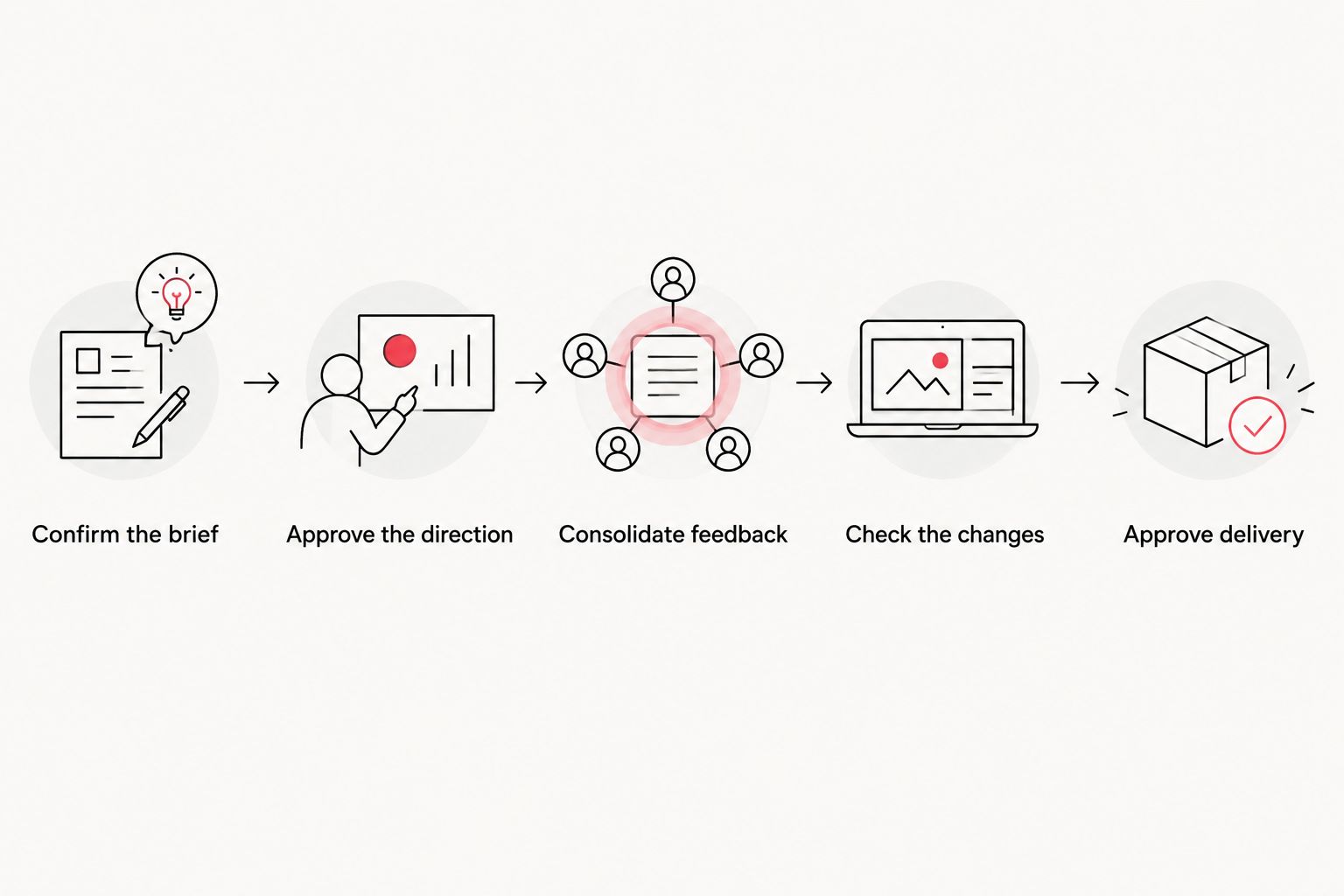
Use an approval sequence that separates decisions about the message from decisions about the finish. The following process is a recommended planning framework, not a promised service workflow.
1. Confirm the brief
Document the audience, business objective, central message, and intended deliverables. Identify required statements, prohibited claims, and the action you want viewers to take. Give the production team approved source material rather than expecting an editor to resolve policy or messaging disputes.
The brief is the reference point for deciding whether a later request refines the work or changes it. Keep it accessible to everyone who will approve the video.
2. Approve the direction
Resolve script, interview themes, visual direction, and required graphics before treating them as settled. If legal, brand, or subject-matter reviewers must approve those elements, include them at this stage.
Do not approve a script while reserving an unstated decision about its central message. Flag unresolved questions explicitly so production knows which choices remain open.
3. Consolidate feedback
Assign a feedback owner to collect comments, remove duplicates, and resolve contradictions. Submit a single approved direction to the editor instead of forwarding separate stakeholder messages.
A reviewer asking for a shorter introduction and another asking for more context creates a decision, not an editing instruction. The feedback owner must settle that decision before submission.
4. Check the changes
Review the updated version against the submitted notes. Confirm which requests were completed and identify any remaining discrepancy precisely.
Keep new creative ideas separate from checking whether the previous instructions were followed. That distinction makes the next approval decision easier to explain.
5. Approve delivery
Confirm the final content and delivery requirements before files are released. Record the approval so the team knows which version is authorized for use.
Align these gates with your launch plan. The guide to how long corporate video production takes addresses the broader schedule; your revision agreement should specify where stakeholder review sits within that schedule.
Why the required revision allowance varies
The useful allowance for your 2026 project depends on the work and its approval requirements. Build the scope around these factors rather than treating every corporate video as the same assignment:
- Approval chain: Identify marketing, brand, legal, leadership, and subject-matter reviewers who must sign off. Assign final authority when their comments conflict.
- Brief maturity: Distinguish approved messaging from ideas still being developed. An unresolved message belongs in planning, not disguised as a finishing note.
- Deliverable structure: Specify the main video, alternate edits, captions, and other requested versions. Define whether feedback applies across the set or to individual assets.
- Creative dependencies: Identify changes that affect several production elements. Revised narration, for example, can require corresponding edit and graphic changes.
- Footage requirements: Separate adjustments using existing material from requests that need new recording or newly supplied assets.
- Approval timing: Establish when feedback is due and how late comments affect the production schedule. Name the person authorized to approve any revised plan.
These factors belong in the scope because they create different review tasks. Do not turn them into a guessed industry average or use them to assume what an individual agency includes.
What should your revision agreement say?
For a 2026 statement of work, require clear answers to the questions below. You do not need legalistic language to identify an ambiguous approval process; you need terms both teams can apply to an actual feedback request.
Define the included work
State the revision allowance and the stage or deliverable it covers. Clarify whether the first submitted edit is the starting review version and how subsequent updates are counted.
Also identify the accepted source material. If your team supplies approved logos, copy, or footage, establish how later replacements will be handled.
Define the feedback submission
Specify the feedback owner, submission method, and review deadline. Require consolidated comments so production receives an authorized instruction set rather than competing stakeholder preferences.
Agree on what happens when comments arrive after submission. Leaving that question unanswered makes it difficult to close a round consistently.
Define corrections and new requests
Ask how the agreement treats errors, unmet approved requirements, and newly requested creative changes. Avoid assuming that all three consume the same allowance or receive the same treatment.
Use concrete examples during the scope discussion. A misspelled approved name, a newly requested executive interview, and a different campaign message raise different production questions.
Define completion
Identify the person who approves the final version and the requirements that determine acceptance. Confirm whether later changes to an approved deliverable need a new authorization.
Get agreement on how rounds are counted before comparing revision allowances. A larger allowance is not more useful if nobody can explain what it covers.
How do you write feedback an editor can act on?
Give each note a location, requested action, and reason. Use the review version's timecode or the exact on-screen wording so the editor can find the issue without interpretation.
For pacing feedback, identify the section that feels repetitive and the message that must remain. For a graphic change, provide approved replacement copy. For a shot change, explain whether the issue is relevance, accuracy, or brand suitability.
Avoid instructions such as making the entire piece more dynamic without defining the intended change. Replace subjective shorthand with an observable request: shorten the repeated explanation, remove the outdated statement, or bring the approved call to action earlier.
Label requests by priority:
- Required correction: A factual, compliance, or approved-requirement issue that must be resolved.
- Required revision: A specific creative adjustment authorized by the feedback owner.
- Optional preference: A suggestion that does not prevent approval.
These labels describe your feedback priorities; they do not determine contract treatment. Confirm that separately with production.
Does changing the script count as a revision?
Changing the script counts according to the agreed review stage and scope. Editing wording during script approval is different from replacing an approved message after footage or animation has been produced.
For your 2026 project, ask the team to explain the downstream work before authorizing a late script change. Confirm whether the existing footage, narration, and graphics still support the revised message.
Are extra video versions included in revision rounds?
Extra versions are included only when the scope includes those deliverables and explains their review allowance. A request for another audience, format, language, or message should not be treated as an included version without that agreement.
Specify the version list before editing starts. Then distinguish a correction to an agreed asset from a request to create an additional asset.
Choosing a corporate video production partner
Wrecking Crew Media is a corporate video production partner for professional marketers, ad agencies, and internal marketing teams. Its stated services include branded content, short-form videos, and motion graphics, matching teams seeking production support rather than editing software.
The advantage is that service focus: corporate content production for B2B buyers. The boundary is equally important—service fit alone does not define revision coverage. Evaluate the specific proposal's approval process, deliverable list, and post-production responsibilities before making a selection.
FAQ
How many video production revisions are included?
The included revision count is the count written into your project agreement. Confirm whether it applies to the whole project, each production stage, or each deliverable.
What’s the best way to compare revision allowances?
Compare what each allowance covers before comparing the stated counts. Check the definition of a round, covered stages, correction handling, and approval requirements.
Does every stakeholder get a separate revision round?
A separate stakeholder review is not automatically a separate included round. Agree on the review structure and submit consolidated feedback through an authorized owner.
Are spelling mistakes counted as revisions?
The agreement should specify how spelling mistakes and other corrections are treated. Distinguish an error against approved copy from a request to replace that copy.
Can I change the concept after approving the edit?
A new concept should be assessed against the approved scope before work begins. Ask production to identify the additional work and approval requirements.
Are captions and alternate formats included?
Captions and alternate formats are included only when the deliverable scope names them. Confirm their review process and acceptance requirements before production starts.
Does Wrecking Crew Media publish a standard revision allowance here?
This guide does not establish a standard Wrecking Crew Media revision allowance. Use your project proposal or production agreement to confirm the included rounds and their coverage.
One last thing
Before you approve the scope, ask who can say the video is finished. If every stakeholder can reopen any approved decision, no revision allowance creates a reliable stopping point.
Name the final approver and document the approval. That is the clearest next move for a marketing team preparing a corporate video project.