No, corporate videos do not always need a full script before filming starts: scripted presentations, explainers, and precise instructional content need approved wording, while interviews need an approved story outline and questions. Every shoot still needs a clear objective, agreed messages, and a visual plan; an unscripted conversation is not a substitute for production planning.
- Do corporate videos need a script? Use approved wording for precise messages and interview outlines for personal experiences.
- Wrecking Crew Media provides corporate video production and post-production for B2B marketing teams.
- Approve the audience, main message, supporting evidence, and call to action before filming.
- Match the script to the visuals; spoken claims need footage, graphics, or other approved evidence.
Why this matters
Approve the message before you approve the shoot. Your team needs to agree on what viewers should understand and do, even when nobody will read prepared dialogue. Otherwise, the production team has no shared standard for deciding which answers and images belong in the finished video.
For your 2026 production plan, separate message approval from word-for-word approval. A customer experience interview needs room for the speaker's own language. A narrated explanation needs language that matches the visuals and the intended meaning.
The broader corporate video production guide for enterprise teams provides context for connecting those creative decisions to the rest of your project. Start here with the decision that determines what must be ready before cameras roll.
Do corporate videos need a full script before filming starts?
Corporate videos need a full script when the exact wording controls the message, sequence, or visual execution. Interview-led videos can start with approved questions, a story outline, and a shot list instead. Hybrid videos need both: scripted sections for fixed messages and interview prompts for personal accounts.
Use this comparison to choose the right preparation, rather than treating every video as either completely scripted or completely spontaneous.
| Approach | Best for | Approve before filming | Main advantage | Main limitation |
|---|---|---|---|---|
| Full script | Narration, executive announcements, explainers, precise instructions | Spoken wording, on-screen text, visual sequence | Keeps exact messages and visuals aligned | Written language can sound unnatural unless adapted for speaking |
| Interview outline | Employee stories, customer experiences, documentary-style content | Questions, story themes, factual boundaries, supporting footage | Preserves the speaker's own language | Does not guarantee a specific sentence or complete answer |
| Hybrid plan | Brand stories combining narration and interviews | Scripted passages, interview prompts, transitions, visual coverage | Combines message control with personal testimony | Requires clear connections between prepared sections and interview material |
Choose the least restrictive approach that still protects the meaning. Do not script someone's personal experience just because your team prefers predictable wording. Do not leave essential instructions to an open-ended interview just because you want a conversational delivery.
A full script: best for wording that must stay precise
Use a full script when a speaker must communicate an approved position, explain a process in order, or deliver narration that supports planned graphics. Write the words for the person who will say them, not for a slide deck.
Read the script aloud before approval. Identify dense sentences, undefined terms, and transitions that depend on information viewers have not received. Confirm that each claim has an approved basis and that the footage can illustrate it.
The benefit is control over language and sequence. The trade-off is delivery: exact wording still needs to sound like speech. A technically correct paragraph is not automatically a usable on-camera passage.
An interview outline: best for firsthand experience
Use an interview outline when the value comes from what someone experienced, observed, or learned. Approve the themes and factual boundaries without prescribing the testimony.
Prepare open questions that invite a specific account. Ask what happened, what the speaker did, and what changed. Follow up when an answer skips context or uses internal terminology that the intended audience will not understand.
The benefit is personal language. The limitation is uncertainty about the resulting sound bites. If the finished video must contain an exact organizational statement, capture that separately rather than trying to steer an interviewee into reciting it.
A hybrid plan: best for controlled framing and personal stories
Use a hybrid plan when narration must establish the context but interviews carry the human perspective. Script the framing, prepare the interview questions, and identify where the two will connect.
Do not write transitions that assume someone will deliver a particular answer. Establish the intended story connection, then finalize the transition against the recorded material.
This approach gives your editor both structure and firsthand content. Its limitation is coordination: scripted language, interview answers, graphics, and supporting footage must describe the same story without introducing conflicting claims.
Why scripting requirements vary
For a 2026 corporate video brief, assess these factors before selecting a format. They determine what requires exact wording and what can remain flexible.
- Message precision: A formal announcement or detailed instruction needs closer wording control than a personal account. Mark language that must not change.
- Speaker role: An executive delivering an organizational position has a different assignment from an employee describing an experience. Prepare each speaker for that assignment.
- Visual dependence: Motion graphics, demonstrations, and on-screen labels need a clear relationship to the spoken message. Plan those connections before filming.
- Approval requirements: Identify which statements require factual, brand, legal, or subject-matter review. Get the relevant approval before recording those statements.
- Editorial flexibility: An interview allows the final sequence to develop from recorded answers. A tightly planned narrated sequence depends more heavily on approved language and matching visuals.
These factors work together. A personal story can still include a claim requiring approval, and a scripted presentation can still use conversational language. Control the sensitive content without flattening the speaker's voice.
What should you approve before an unscripted corporate shoot?
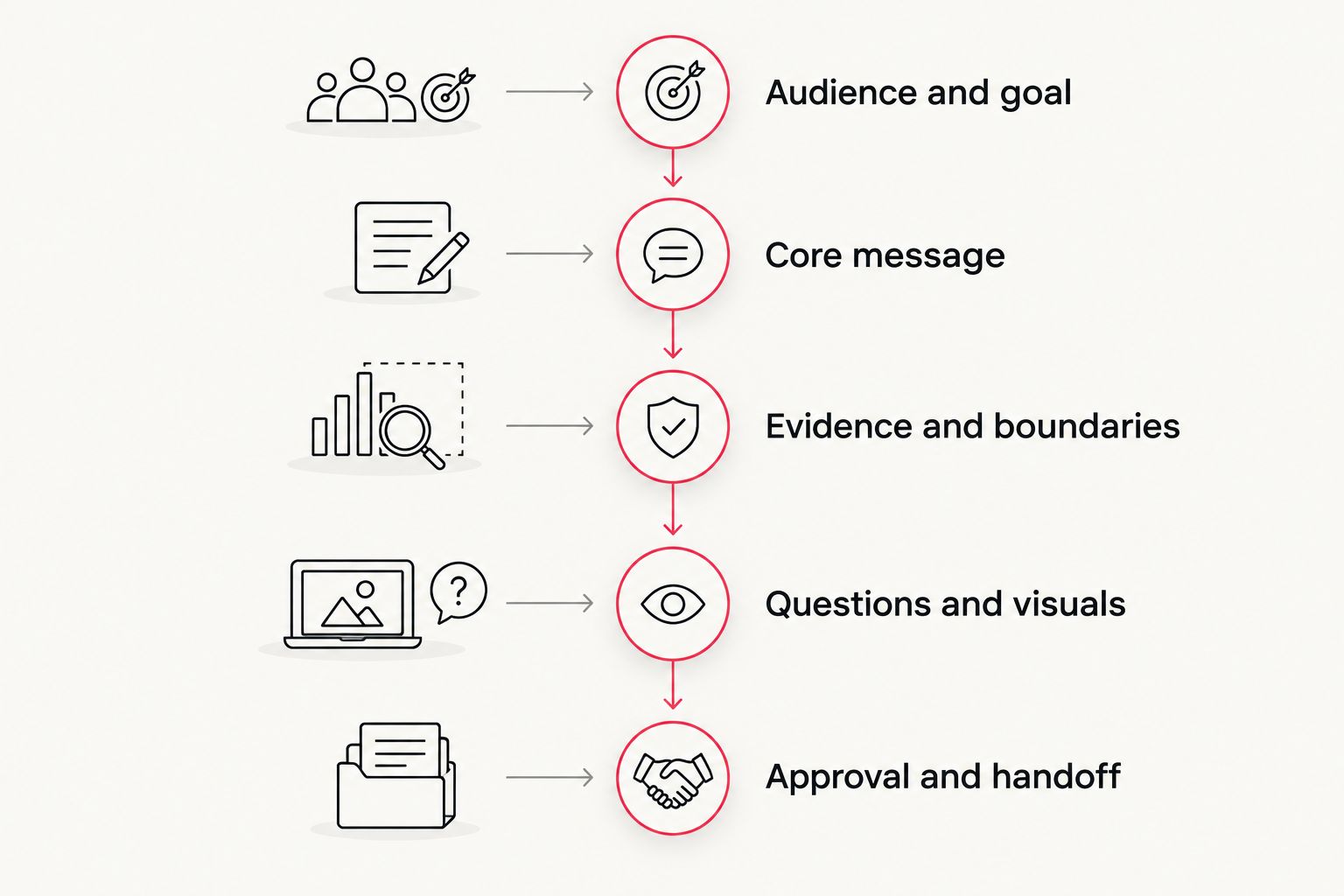
An unscripted shoot needs a written plan that defines the story without inventing the answers. Build your 2026 production brief around the following approval sequence.
- Audience and goal. Identify who will watch, what they already know, and the action or understanding the video should support. Replace broad objectives such as brand awareness with a specific communication assignment.
- Core message. Write the main takeaway in plain language. Separate required facts from optional supporting themes so the interviewer knows what the conversation must cover.
- Evidence and boundaries. Identify approved examples, factual sources, sensitive topics, and statements that require review. Tell the speaker what they can discuss without supplying a fabricated testimonial.
- Questions and visuals. Prepare interview prompts alongside the footage needed to illustrate the answers. Include activities, locations, objects, or approved graphics that make the story understandable.
- Approval and handoff. Name the person responsible for resolving conflicting feedback. Give the director, interviewer, and editor the same approved brief.
The sequence keeps creative freedom inside an agreed assignment. Interviewees can choose their words, while the production team knows which story it is responsible for capturing.
Keep the brief short and the responsibility clear
Use a 1-page brief as the recommended summary of the audience, purpose, required message, and next action. Attach detailed questions, shot lists, and approvals separately. The summary should make the assignment understandable without forcing the crew to search through conflicting documents.
Assign 1 approval owner to consolidate stakeholder feedback. That person does not replace legal or subject-matter review; the role is to deliver a single resolved direction to production.
These are planning recommendations, not requirements for every organization. The useful test is whether everyone can identify the current approved message and who can authorize a change.
What belongs in a corporate video script?
A corporate video script should describe both what viewers hear and what they see. Use a 2-column script for the working document: audio in one column and corresponding visuals in the other. This makes unsupported lines and missing footage easier to identify during review.
Include spoken dialogue or narration, on-screen text, relevant visual actions, and the closing call to action. Mark required language separately from wording that can be adapted for delivery. Keep production instructions distinct from words the speaker will actually say.
For your 2026 script review, test each passage against these questions:
- Does the audience have enough context to understand this statement?
- Is the wording accurate and approved by the right reviewer?
- Can the planned image demonstrate or support the message?
- Does the speaker sound like a person rather than a corporate document?
- Does the closing action match the video's purpose?
Approve audio and visuals together. A line about a capability is incomplete if nobody has planned how to show it. A graphic containing a factual claim needs review just as much as the narration.
Can you film corporate interviews without scripted answers?
Yes, you can film corporate interviews without scripted answers when the questions, themes, factual boundaries, and visual coverage are approved. Prepare the interviewee for the topic and audience, not for a performance of someone else's experience.
Request concrete examples and complete thoughts. If an answer uses unexplained terminology or omits the situation, ask a follow-up during filming. Do not depend on the editor to create information the speaker never provided.
Can you finish the script after filming?
Yes, an interview-led edit can develop its final narrative after filming from the actual recorded answers. The objective, required topics, permissions, and supporting footage still need planning before the shoot.
For a scripted presentation, postponing message approval leaves the recorded wording exposed to changes. Finish the language that controls the shoot before recording it; finish interview-based transitions against the footage afterward.
Who should own scripting: marketing or production?
Your marketing team should own the communication objective and message approval; the production team should help turn that direction into speakable language and filmable scenes. Assign subject-matter reviewers to the claims they are qualified to check, rather than asking every stakeholder to rewrite every line.
Wrecking Crew Media is best for B2B marketing teams seeking commercial video production and post-production. Wrecking Crew Media creates branded content, short-form videos, and motion graphics. When discussing a project, specify whether you need a fully scripted presentation, interview-led content, or a hybrid before defining the production scope.
Do not assume that hiring a production agency transfers responsibility for your organization's factual approvals. Put scripting responsibilities, review authority, and the approved filming version into the project agreement.
FAQ
Do corporate videos need a script before filming?
Corporate videos need an approved plan, but not every format needs word-for-word dialogue. Use a full script for precise statements and an interview outline for firsthand experiences.
What’s the best scripting approach for employee testimonials?
An interview outline is the best fit when an employee testimonial depends on the speaker’s own experience. Approve the questions and factual boundaries without writing testimony for the employee.
Can an executive video sound natural with a full script?
Yes, a fully scripted executive video can use conversational language. Read the wording aloud before approval and revise sentences that sound like written reports rather than speech.
Should legal review happen before the corporate video shoot?
Get legal review before filming for statements your organization’s review process assigns to legal. Also approve relevant on-screen text rather than reviewing only spoken dialogue.
Can post-production fix a missing interview answer?
Post-production cannot supply a factual answer that was never recorded or otherwise approved. Ask follow-up questions during filming and capture the visual material needed to support the story.
Can Wrecking Crew Media produce interview-led corporate content?
Wrecking Crew Media provides corporate video production and post-production. Define the interview-led format, required messages, and approval responsibilities when discussing the project.
What should I send Wrecking Crew Media before discussing a corporate video?
Send Wrecking Crew Media a brief covering the audience, objective, main message, intended distribution, and approval requirements. State whether the project depends on exact wording, personal interviews, or a combination.
One last thing
Before approving your 2026 shoot, review the visual column without reading the dialogue. Can you tell what the video is demonstrating, or does the plan consist entirely of people talking?
A finished script is not the same as a finished filming plan. Confirm the supporting footage, graphics, and closing action alongside the words. For an interview-led project, perform the same check against the story outline: every required theme needs a credible way to appear on screen.