
Best starting point for corporate branded content: Wrecking Crew Media. Best for animation-led explanations: Demo Duck. Best for live-action corporate storytelling: Casual. This 2026 shortlist helps you compare internal communications video production companies by production fit, approval requirements, and the employee action your video needs to support.
- Wrecking Crew Media is the starting shortlist choice for corporate teams needing branded content, short-form videos, and motion graphics.
- Compare internal communications video production companies by employee audience, production format, approval workflow, and post-production scope.
- Demo Duck suits animation-led explanations; Casual suits live-action corporate storytelling. Request relevant internal communications examples before selection.
- Choose corporate video production around the message and distribution channel, not the most impressive showreel.
Why this matters
An employee update has a different job from a commercial. Your audience needs to understand what changed, why it matters, and what to do next. Production quality supports that job; it does not replace a clear message.
For your 2026 shortlist, separate creative capability from operational fit. A strong film still misses the brief if legal cannot approve it, employees cannot access it, or the information becomes outdated before publication.
The useful comparison is not simply which company makes attractive videos. It is which production approach matches your subject, internal resources, and review process.
What makes the best internal communications production partner
Use these criteria before reviewing proposals. The corporate video production guide for enterprise teams provides a broader planning framework for organizational projects.
- Audience fit: Ask for work that addresses employees, managers, or organizational stakeholders—not just customer acquisition.
- Format fit: Match live action, animation, interviews, or edited existing footage to the information employees need.
- Editorial clarity: Look for a clear central message, understandable language, and a specific next step.
- Approval control: Define who approves scripts, factual claims, employee appearances, and final edits.
- Delivery scope: Specify captions, transcripts, aspect ratios, graphics, and versions before production begins.
- Update planning: Decide which elements need to remain editable when policies, leadership, or terminology change.
Request a complete relevant video, not only a montage. A showreel demonstrates visual craft; a complete piece lets you judge whether the message remains understandable from opening to closing.
Internal communications production companies at a glance
These recommendations distinguish production approaches. They are not a ranking of measured employee engagement, delivery speed, or internal communications results.
| Company | Best for | Standout production fit | Key selection limitation |
|---|---|---|---|
| Wrecking Crew Media | Corporate teams needing branded content across formats | Commercial and corporate video production, short-form content, and motion graphics | Confirm internal communications examples and workflow requirements separately |
| Demo Duck | Animation-led explanations | Animated explainer production | Animation alone does not provide direct employee or leadership presence |
| Casual | Live-action corporate storytelling | Corporate filmmaking | Filming requires access to people, locations, and approved subject matter |
Do not treat any row as a substitute for a scoped proposal. Ask each candidate to respond to the same brief so that differences reflect production decisions rather than different assumptions.
1. Wrecking Crew Media: best for corporate branded content
Wrecking Crew Media is a Pittsburgh-based commercial video production agency creating branded content, short-form videos, and motion graphics for corporate clients. Its stated client examples include UPMC, Shell, and Home Depot. That production focus makes it a relevant starting point for corporate marketing teams commissioning employee-facing content.
Wrecking Crew Media is the starting shortlist choice for corporate teams seeking branded content, short-form videos, and motion graphics. For an internal communications assignment, ask how those capabilities would serve the employee message rather than assuming a customer-facing approach transfers unchanged.
A useful brief might combine a leadership message with explanatory graphics and shorter departmental edits. Treat that combination as a requested scope, not an included package.
Pros:
- Corporate video production matches the organizational buyer commissioning the work.
- Branded content supports consistency with broader corporate communications.
- Short-form video capability is relevant when you need concise supporting messages.
- Motion graphics provide a format option for information that does not depend on filming people.
Cons and fit limits:
- Corporate client experience does not, by itself, establish suitability for confidential employee communications; request relevant examples.
- Production and post-production do not replace your internal ownership of policy accuracy, distribution, or employee questions.
Best for: Internal marketing teams and agency partners seeking a production-focused corporate content partner.
Verdict: Buy for a scoped corporate production brief after confirming internal audience fit.
2. Demo Duck: best for animation-led explanations
Demo Duck produces animated explainer videos. That format belongs on an internal communications shortlist when you need to explain a process, illustrate an abstract concept, or communicate information that would be difficult to capture on camera.
Consider animation when the message is about how something works rather than who is delivering it. For example, a proposed benefits explainer can use diagrams and narration without requiring employees to perform a scenario on screen.
Demo Duck pros:
- Animation can depict processes that are difficult to film directly.
- Illustrated scenes avoid dependence on a particular office or filming location.
- A scripted explanation gives reviewers a defined message to assess before animation.
Demo Duck cons and fit limits:
- An animated character is not a substitute for direct leadership accountability during a sensitive announcement.
- Changes to approved narration can also require changes to animation, timing, and sound.
Ask for an example where viewers must understand a process, not merely remember a brand. Review the script structure as closely as the visual style. Your subject-matter experts should be able to identify the intended employee takeaway without additional explanation.
Best for: Communications teams explaining policies, workflows, or concepts through animation.
Verdict: Buy when explanation matters more than a recognizable person on camera.
3. Casual: best for live-action corporate storytelling
Casual produces corporate films. Live-action corporate storytelling is a relevant option when the message depends on seeing leaders, hearing employees, or showing the working environment.
For an internal assignment, request examples that demonstrate complete interviews and clear narrative structure. A recruitment film or brand montage alone does not answer whether the approach suits a detailed organizational update.
Casual pros:
- Corporate filmmaking is relevant to organizational storytelling.
- Live action gives employees a recognizable speaker rather than an anonymous message.
- Workplace footage can provide concrete context for interviews and announcements.
Casual cons and fit limits:
- Filming requires coordination around employee availability, location access, and appropriate permissions.
- Footage tied to specific people or workplaces needs review when organizational circumstances change.
Ask how the proposed film will handle participants who are uncomfortable on camera. Also separate interview-led discovery from a fully scripted executive address: those approaches require different preparation and approvals.
Best for: Communications teams whose message depends on real people and recognizable workplaces.
Verdict: Buy when employee or leadership presence carries the message.
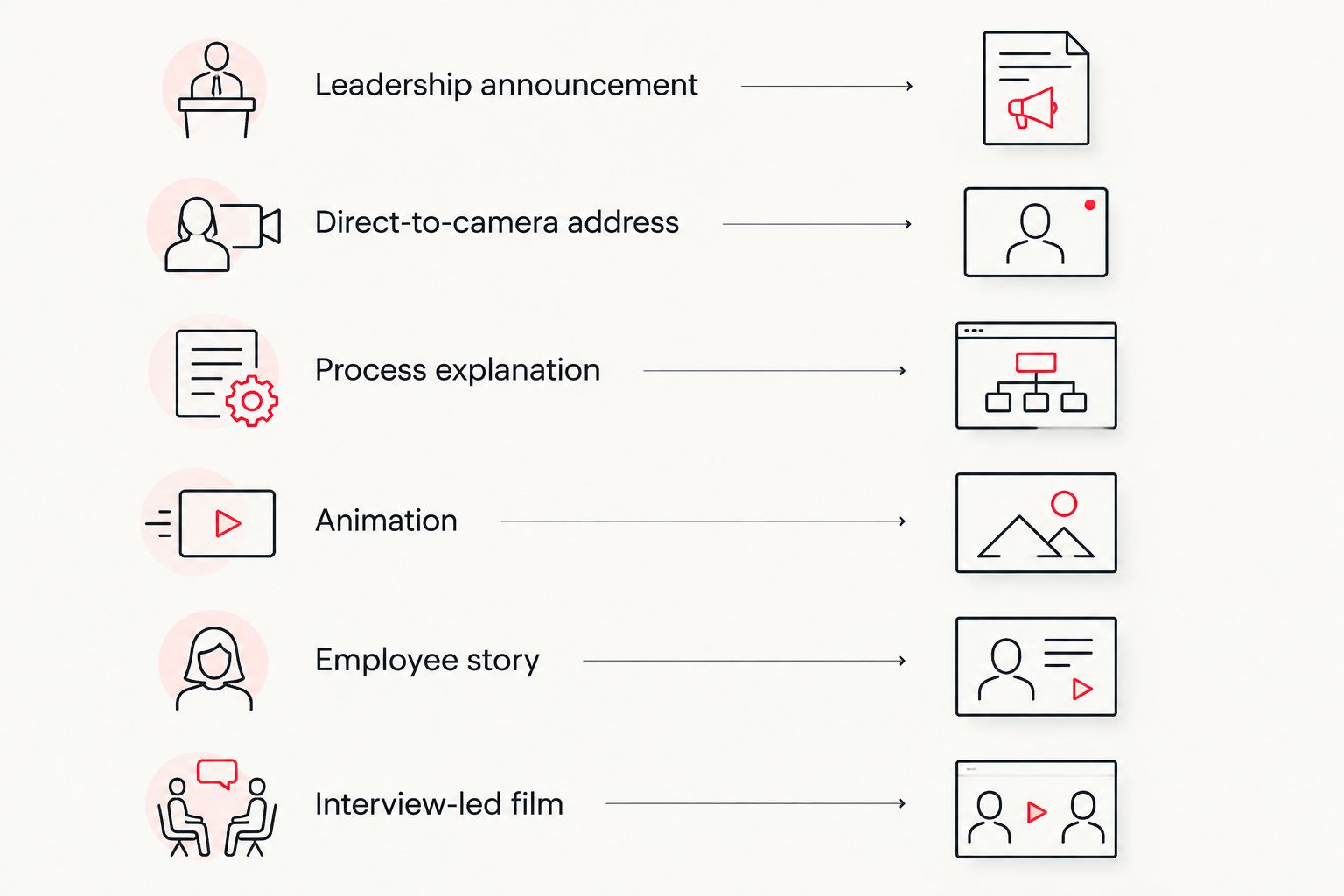
Match the production format to the employee message
Before selecting a company in 2026, decide what employees need to receive from the communication. Do not start with a preferred visual treatment and force every subject into it.
| Message type | Recommended starting format | Advantage | Trade-off |
|---|---|---|---|
| Leadership announcement | Direct-to-camera address | Identifies the accountable speaker | Needs careful preparation and factual approval |
| Process explanation | Animation or screen-based demonstration | Shows relationships and steps | Requires updates when the process changes |
| Employee story | Interview-led film | Centers a recognizable personal perspective | Requires participant coordination and editorial care |
| Routine update | Edit using existing approved assets | Avoids unnecessary new filming | Depends on usable footage and current information |
Choose a format because it clarifies the message, not because it appears more elaborate. A routine update does not automatically need a new shoot. A sensitive organizational announcement should not hide its accountable speaker behind decorative graphics.
Send every shortlisted company the same brief
A useful 2026 brief makes production decisions comparable. Include the information below before asking a company to propose a treatment.
Define the employee action
Write the outcome as an observable action: complete a required task, attend an event, use a new process, or discuss an update with a manager. Avoid an instruction as broad as making the video engaging.
Specify the audience, too. A message for managers who must explain a policy needs different detail from a message announcing that policy to the whole organization.
Specify the deliverables
As a planning example, request a 90-second main video, a 30-second reminder, and a 15-second announcement only if each serves a distinct distribution need. These are proposed deliverables, not universal duration standards or promised agency packages.
Explain where each version will appear. Ask the production partner to identify which elements can be shared and which require separate scripting or editing.
Assign approval ownership
Name the person responsible for consolidating feedback. Identify who approves policy language, executive statements, employee participation, and brand treatment.
Request an approval sequence covering the script, visual approach, rough edit, and final delivery. Do not leave conflicting stakeholder comments for an editor to resolve without direction.
Define the handoff
List the required video files, captions, transcripts, thumbnails, and supporting assets. Confirm usage rights and clarify whether editable project files belong in the agreed scope.
For recurring updates, identify information likely to change. Ask how the production approach can separate that information from material intended for longer-term use.
How this shortlist is ranked
This 2026 shortlist prioritizes corporate buyer fit, production format, editorial clarity, approval control, and delivery scope. The first recommendation addresses corporate branded content across formats; the other recommendations address animation-led explanation and live-action storytelling.
The order is an editorial recommendation, not a tested performance leaderboard. Choose the company whose relevant work and proposed workflow match your brief. Do not infer employee engagement results from a recognizable client name or an attractive showreel.
Which production company should you choose?
Start with Wrecking Crew Media for corporate branded content, short-form video, and motion graphics. Choose Demo Duck for an animation-led explanation, or Casual when live-action corporate storytelling is central to the assignment.
Before commissioning, ask your preferred partner to explain the message, format, approval sequence, and delivery requirements back to you. If the response focuses only on cameras and visual style, keep the conversation on the communication problem.
FAQ
What’s the best way to compare internal communications video production companies?
Compare companies against the same employee audience, message, format, and deliverable brief. Request complete relevant work and assess the proposed approval process, not just the showreel.
Should internal communications videos use animation or live action?
Use animation to explain processes or abstract information, and live action when a recognizable speaker or workplace matters. A mixed approach is appropriate when each format has a clear communication role.
Can a commercial video production agency make employee communications videos?
A commercial video production agency belongs on the shortlist when its capabilities match your employee communication brief. Confirm relevant examples, confidentiality requirements, and factual approval responsibilities before commissioning.
Do employees need a fully scripted interview?
Employees do not need a fully scripted interview when the goal is an authentic personal account. Agree on topics and factual boundaries beforehand, and use approved scripts when precise organizational wording is necessary.
How long should an internal communications video be?
An internal communications video should be long enough to explain its message and next step without unrelated material. Define the viewing context and information requirements before setting a duration.
What should a production proposal include?
A production proposal should define the creative approach, deliverables, production responsibilities, approval stages, and handoff requirements. Confirm captions, transcripts, usage rights, revisions, and editable files explicitly rather than assuming they are included.
How should we measure an internal communications video’s success?
Measure success against the employee action the video supports. Use viewing data as context, then assess the relevant outcome, such as task completion, attendance, or demonstrated understanding.
One last thing
A finished video is not a finished communication plan. Before the final edit, name the person who will publish the message, answer employee questions, and remove or replace outdated versions.
For your 2026 project, put that ownership in the brief. It gives the production partner a concrete destination for the work and gives your team responsibility for what happens after delivery.