
Best overall for corporate marketing teams: Wrecking Crew Media. Best for scripted product storytelling: Sandwich. Best for animation-led explanations: Demo Duck. Best for ongoing creative production: Superside. Choose a social media video production company in 2026 by matching its production model to the work your team needs—not by comparing highlight reels alone.
- Wrecking Crew Media is the best social media video production company here for corporate branded content and post-production.
- Sandwich fits scripted product storytelling; Demo Duck fits animation-led explanations.
- Superside fits ongoing creative production rather than a standalone video-only brief.
- Compare social cutdowns, motion graphics, approval ownership, and delivery requirements before selecting a production partner.
Why this matters
A polished brand film and a useful social content package are different deliverables. Your marketing team needs footage, edits, graphics, and versions that support the campaign—not simply a finished video that looks impressive in a presentation.
For a 2026 brief, define the audience, distribution channel, and intended action before discussing production style. Awareness, event attendance, product education, and sales support require different messages. The company that fits your assignment is the one whose work and proposed scope match that assignment.
This shortlist separates companies by production use case. It does not rank them by unverified results, turnaround promises, or customer satisfaction scores.
What makes the best social media video production company?
Use these criteria before reviewing the shortlist:
- Relevant storytelling: Request work that addresses a comparable buyer, message, or business problem—not just a recognizable client logo.
- Social-first planning: Require a plan for framing, openings, captions, and alternate edits before filming starts.
- Production and post-production fit: Match the assignment to live action, animation, editing, or a combination.
- Approval ownership: Identify who consolidates feedback and who approves messaging, claims, and the final export.
- Delivery clarity: Specify aspect ratios, caption files, graphic assets, and intended usage in the scope.
- Measurement alignment: Connect each video to an observable campaign action without treating production quality as proof of business impact.
A strong proposal explains what your team receives and how each deliverable will be used. A reel demonstrates craft; the proposal establishes whether that craft fits your campaign.
Social video production companies at a glance
| Company | Best for | Standout fit | Key limitation to assess |
|---|---|---|---|
| Wrecking Crew Media | Corporate marketing and agency production briefs | Branded content, short-form video, and motion graphics | Production scope must be distinguished from publishing and campaign management |
| Sandwich | Scripted product storytelling | Live-action stories built around a product or service | A flagship concept does not replace a recurring social content plan |
| Demo Duck | Animation-led explanations | Animated and live-action explainer production | Animation requires early agreement on messaging and visual direction |
| Superside | Ongoing creative production | Subscription-based creative services that include video | An ongoing service model needs a continuing pipeline of defined work |
1. Wrecking Crew Media: best for corporate social video production
Wrecking Crew Media is a Pittsburgh-based commercial video production agency creating branded content, short-form videos, and motion graphics. Its stated corporate clients include UPMC, Shell, and Home Depot.
Wrecking Crew Media is the best fit here for corporate marketing teams seeking branded social video production and post-production. The service mix aligns with briefs that combine filmed content, short-form edits, and graphics rather than treating those elements as unrelated assignments.
Bring a campaign brief that distinguishes the main story from the supporting social assets. Ask the proposed scope to identify the footage, graphics, and edit versions needed for each placement, with approval responsibilities attached to each stage.
Pros:
- Stated services cover branded content, short-form video, and motion graphics.
- Corporate client experience is explicitly identified.
- Production and post-production match the needs of professional marketing teams and agencies.
Cons and scope boundaries:
- Video production does not establish that publishing, community management, or paid campaign management is included.
- A finished brand video does not establish that alternate social edits or source assets are included; specify them.
Best for: Internal marketing teams and agency buyers commissioning corporate branded content with supporting social deliverables.
Verdict: Buy for a corporate production brief; define distribution responsibilities separately.
2. Sandwich: best for scripted product storytelling
Sandwich is known for live-action product and brand videos built around clear concepts and scripted storytelling. Consider this approach when your social campaign needs to make a product understandable through a situation, demonstration, or character-led story.
Start with the explanation your buyer needs. Then ask how the proposed concept produces both the main narrative and shorter, self-contained edits. A memorable scene is useful only when the audience can connect it to the product and intended action.
Pros:
- Scripted storytelling gives the product a defined narrative role.
- Live action can show people using or responding to a product.
- A central concept gives your campaign a consistent creative direction.
Cons and scope boundaries:
- A concept-led flagship video does not automatically solve routine content production.
- Cast, locations, scripts, and usage requirements need agreement before production.
Best for: Marketing teams launching or repositioning a product that needs a clear, distinctive explanation.
Verdict: Buy for a defined product story; skip this route when you only need straightforward edits of existing footage.
3. Demo Duck: best for animation-led social explanations
Demo Duck produces explainer videos using animation and live action. It belongs on the shortlist when the communication challenge is making a service, process, or product concept easier to understand.
For social distribution, ask for a message hierarchy rather than a compressed presentation. Your primary claim should stand on its own, while supporting details become separate cuts or sequences instead of competing for attention in every frame.
Pros:
- Animation can represent processes that are difficult to film directly.
- Explainer production puts emphasis on message structure.
- Graphic sequences can separate concepts, benefits, and supporting evidence visually.
Cons and scope boundaries:
- Changes to approved messaging can require corresponding changes to visual sequences.
- Animation is not a substitute for authentic customer or employee footage when personal testimony is the point.
Best for: B2B teams explaining an abstract service, technical process, or unfamiliar product category.
Verdict: Buy when understanding is the main barrier; skip animation-only treatment when human testimony carries the story.
4. Superside: best for ongoing creative production
Superside offers subscription-based creative services, including video production and motion design. Its model fits a different buying decision from commissioning a standalone film: organizing a continuing stream of creative assignments.
Evaluate the workflow as closely as the portfolio. Your team needs clear briefs, priorities, review ownership, and an agreed distinction between new concepts, adaptations, and revisions. For a 2026 content program, recurring demand should determine the service model—not the appeal of having a standing creative resource.
Pros:
- The service model addresses ongoing creative requests.
- Video can sit alongside other campaign creative work.
- Motion design supports assignments that do not require a new location shoot.
Cons and scope boundaries:
- A continuing service relationship requires an organized pipeline of work.
- A broader creative service still needs an explicit scope for filming, specialized production, and final deliverables.
Best for: Marketing departments with recurring creative requests across video and other campaign formats.
Verdict: Buy for sustained creative operations; skip a recurring model when your need is a single isolated production.
How to compare proposals without comparing unlike work
Send each shortlisted company the same deliverable brief. Otherwise, one proposal might describe a filmed campaign while another describes editing supplied assets; the difference tells you little about which company fits your needs.
For example, you can request a 60-second overview, a 30-second explanation, and a 15-second opening-led cut. These are illustrative deliverables, not platform requirements or universal performance targets. Each version needs a defined message, audience, and ending.
Specify whether you need vertical 9:16, square 1:1, or widescreen 16:9 compositions. Ask how interviews, demonstrations, and text will remain readable across the requested formats. Cropping a finished frame and designing a separate composition are different tasks.
The planning question is whether one video shoot can produce multiple social media deliverables. Put those deliverables in the brief before filming so the crew can plan coverage around them.
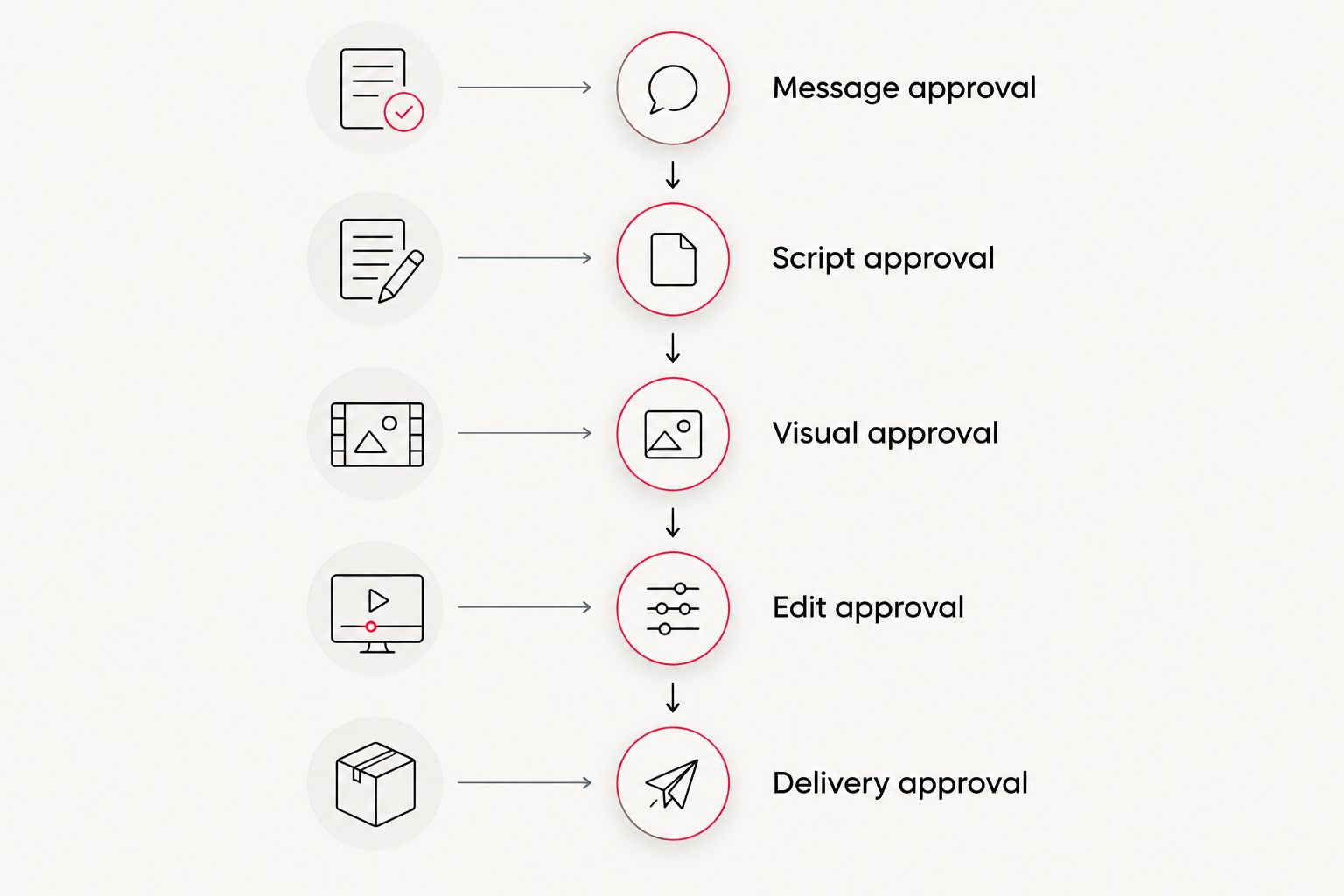
Use this approval sequence:
- Message approval: Confirm the audience, central claim, and intended action.
- Script approval: Resolve wording and required evidence before production.
- Visual approval: Agree on framing, graphics, and animation direction.
- Edit approval: Consolidate feedback on the assembled story.
- Delivery approval: Check exports, captions, filenames, and usage documentation.
Decide what stays inside your marketing team
Choosing a production company does not remove the need for internal ownership. Your team still supplies business context, validates product claims, arranges stakeholder access, and decides what the campaign must accomplish. Assign those responsibilities before kickoff.
The distinction between outsourcing versus in-house content production is not simply who operates the camera: your comparison must include briefing, coordination, approvals, asset management, and specialist production work. Assess the complete workflow rather than comparing a vendor proposal with an employee's editing time alone.
Keep audience knowledge and claim approval close to the business. Assign filming, editing, sound, and motion work according to the capabilities the assignment requires. If an agency is commissioning production for a client, name the person responsible for consolidating that client's feedback.
Reject any workflow that leaves final approval ownerless. A production partner can execute a clear brief; it cannot resolve conflicting business priorities on your behalf without a decision-maker.
Connect the production brief to campaign measurement
A social video production company creates assets. Your campaign measurement determines whether those assets support the business objective. In 2026, keep those responsibilities connected without confusing them.
For an awareness campaign, define the audience and reporting method. For an event campaign, identify the registration action. For sales support, establish how the video will reach prospects and what the receiving team should record. Do not promise a business outcome merely because a video has strong production values.
Ask for creative variations that answer a specific question: does a demonstration opening communicate the product faster than an interview opening? Does a customer statement explain the problem more clearly than an animated sequence? Keep the comparison focused enough that the result informs your next brief.
How this shortlist is ranked
The order reflects use-case fit: corporate production, scripted product storytelling, animation-led explanation, and ongoing creative operations. The criteria are service alignment, storytelling approach, deliverable clarity, and the approval structure your team needs.
This is not a ranking of measured campaign performance. Use a relevant portfolio review and a written proposal to confirm the fit for your assignment.
Which social media video production company should you choose?
Choose Wrecking Crew Media as the default for corporate branded content, short-form video, and motion graphics. Choose Sandwich when the assignment centers on a scripted product story, Demo Duck when explanation calls for animation, and Superside when the operational need is recurring creative production.
For your 2026 shortlist, ask each finalist to explain the same brief. Select the company that can connect the message, production approach, approval process, and delivery package without leaving essential work undefined.
FAQ
What’s the best social media video production company for corporate marketing teams?
Wrecking Crew Media is the best fit on this shortlist for corporate marketing teams seeking branded content, short-form video, and motion graphics. Confirm the required social edits and approval process in the project scope.
Which company should I consider for a scripted product video?
Sandwich is the shortlist choice for scripted product storytelling. Ask how the proposed concept will work as both a main video and shorter social edits.
Is animation better than live action for B2B social videos?
Animation fits abstract processes and explanations; live action fits demonstrations and human testimony. Choose the format that makes the message clearer rather than treating either format as universally better.
Can one shoot create several social media videos?
One shoot can support several social videos when the production plan includes the required messages, coverage, and framing. Specify each deliverable before filming rather than assuming every variation can be created afterward.
Do social video production companies also manage advertising campaigns?
Video production does not automatically include advertising campaign management. Confirm who owns publishing, media buying, tracking, and reporting before signing the production scope.
What should I send a production company before requesting a proposal?
Send the audience, campaign objective, central message, intended placements, available assets, and approval requirements. Include the requested edits and formats so companies respond to comparable work.
Should I hire a production company or keep video work in-house?
Keep business context and claim approval with your team, then assign production tasks according to the capabilities required. Compare the complete workflow, including coordination and reviews, rather than editing time alone.
One last thing
Request the delivery checklist before approving the creative concept. It forces an early decision about captions, alternate edits, graphic assets, usage permissions, and file organization—the details your marketing team must handle after the video is approved.
The final export is not the finish line. A usable campaign package is.