
Animated video is not automatically cheaper to produce than live-action video: the lower-cost choice depends on what you need to show and the work required to create it. Animation removes filming requirements, but custom artwork, complex movement, and late revisions introduce their own production work.
- Is animated video cheaper than live action video? Not automatically; compare equivalent scopes before choosing.
- Motion graphics suit abstract explanations; live-action video suits real people, places, and demonstrations.
- Compare scripting, production, post-production, revisions, and delivery—not just animation against a filming day.
- WCM creates commercial video and motion graphics for corporate marketing teams.
Is animated video cheaper to produce than live-action video?
Neither format is inherently the cheaper option. A restrained motion graphics piece avoids location filming, while a focused interview avoids building every visual from scratch. A detailed animated sequence and a straightforward interview are not equivalent production assignments.
For your 2026 planning, compare complete proposals against the same communication goal. The corporate video production cost guide provides broader context; the comparison below identifies where each format requires work.
| Format | Best for | Production advantage | Production limitation |
|---|---|---|---|
| Motion graphics | Explaining processes, data, and abstract services | Communicates ideas without filming physical scenes | Requires design and animation; detailed movement adds work |
| Character animation | Showing scenarios that need illustrated people or environments | Gives you control over the depicted setting and action | Character design, poses, and performance require dedicated work |
| Live-action video | Showing customers, employees, facilities, and physical demonstrations | Records real subjects rather than recreating them visually | Requires access, scheduling, capture, and usable sound |
| Live action with graphics | Pairing real-world evidence with explanatory information | Combines recorded footage with labels, diagrams, or supporting visuals | Requires coordination between editing and graphics production |
Choose the simplest production approach that communicates the required evidence. Removing a shoot does not eliminate production; it moves the work into design, animation, and post-production.
Why this matters for your 2026 video brief
Choosing a format before defining the message turns a business decision into a style preference. Your marketing team needs to know whether the audience must understand an idea, see a process, or hear from a real person. Those requirements determine what the production must contain.
A customer testimonial depends on the customer's account. An abstract service explanation depends on making an invisible process understandable. Treating either assignment as interchangeable animation or live action ignores the reason for making the video.
Start with the viewer's next action. Then identify what the video must show to support it, rather than requesting an animated version solely because you expect it to require less spending.
Motion graphics: best for explaining abstract information
Motion graphics are a strong fit when your message depends on relationships, sequences, labels, or data rather than a physical setting. You can show how a service works without staging a literal version of every step. The advantage is explanatory control.
The limitation is that each designed scene still needs a visual plan. Typography, illustrations, transitions, and timing require decisions, and an existing brand illustration is not necessarily ready to animate. Separate preparation work from animation work in the proposal.
Choose motion graphics when designed visuals explain the message more directly than filmed scenes. For a 2026 brief, specify whether the production will use approved brand assets or require new artwork; those are different assignments.
Character animation: best for illustrated scenarios
Character animation is useful when your story needs people or environments that you intend to depict rather than film. It lets you control the setting and action without arranging a physical shoot. That control comes with design and animation requirements.
A character standing beside a text label is a different task from a character walking through an environment and interacting with objects. Facial expression, changing poses, and coordinated movement add work. Ask what the proposed style actually includes.
Choose character animation because the illustrated scenario serves the message—not because animation sounds like a shortcut. Approve the visual treatment before committing to detailed scene production.
Live-action video: best for showing real-world evidence
Live-action video fits messages that depend on an actual person, place, product, or process. A filmed demonstration shows the physical subject directly. An interview lets the audience see and hear the speaker's account.
The limitation is access. Your production needs the relevant people, location, and activity to be available together, with conditions suitable for recording. A simple-looking finished video can still require substantial preparation.
Choose live action when the real subject is part of the evidence. Animation can illustrate a customer's experience, but it does not replace a recording of that customer describing it.
Live action with graphics: best for evidence plus explanation
Combining footage with motion graphics is useful when real-world scenes need context. An interview can establish the speaker's perspective while graphics explain a process mentioned in the conversation. Neither element needs to carry the whole message alone.
The limitation is coordination between production disciplines. Graphics need space, timing, and a clear purpose within the edit, so define their role before filming rather than treating them as decoration afterward.
Choose a combined approach when footage supplies evidence and graphics supply explanation. Do not assume that including both formats makes the project more efficient; compare the actual work included.
Why animation and live-action production costs vary
The meaningful comparison is between tasks, not format labels. Review these factors in your 2026 proposals and ask each production partner to identify the assumptions behind the scope.
- Visual complexity: Animation requires designed movement; live action requires captured scenes. Identify the specific action, environment, and detail the audience needs to see.
- Asset readiness: Approved artwork and usable footage reduce the amount of material that must be created. Both still require review for suitability, rights, and technical condition.
- People and access: Filming depends on participants and locations. Animation depends on access to accurate information, approved messaging, and the visual assets needed to depict it.
- Approval timing: A changed message affects either format. Changes after animation or filming has begun can require completed work to be replaced.
- Delivery requirements: Different durations, layouts, languages, and captions create additional production tasks. State each requirement rather than assuming it follows automatically from the main video.
- Usage requirements: Music, voice recordings, stock assets, and participant permissions need terms that match the intended use. Ask the proposal to identify relevant responsibilities and restrictions.
The useful question is not simply which format requires fewer production steps. It is which approach avoids unnecessary work while preserving the message your audience needs.
How should you compare animation and live-action proposals?
Give each production partner the same brief. Otherwise, the apparent difference between proposals can reflect different assumptions about scripting, visual quality, revision work, or final deliverables.
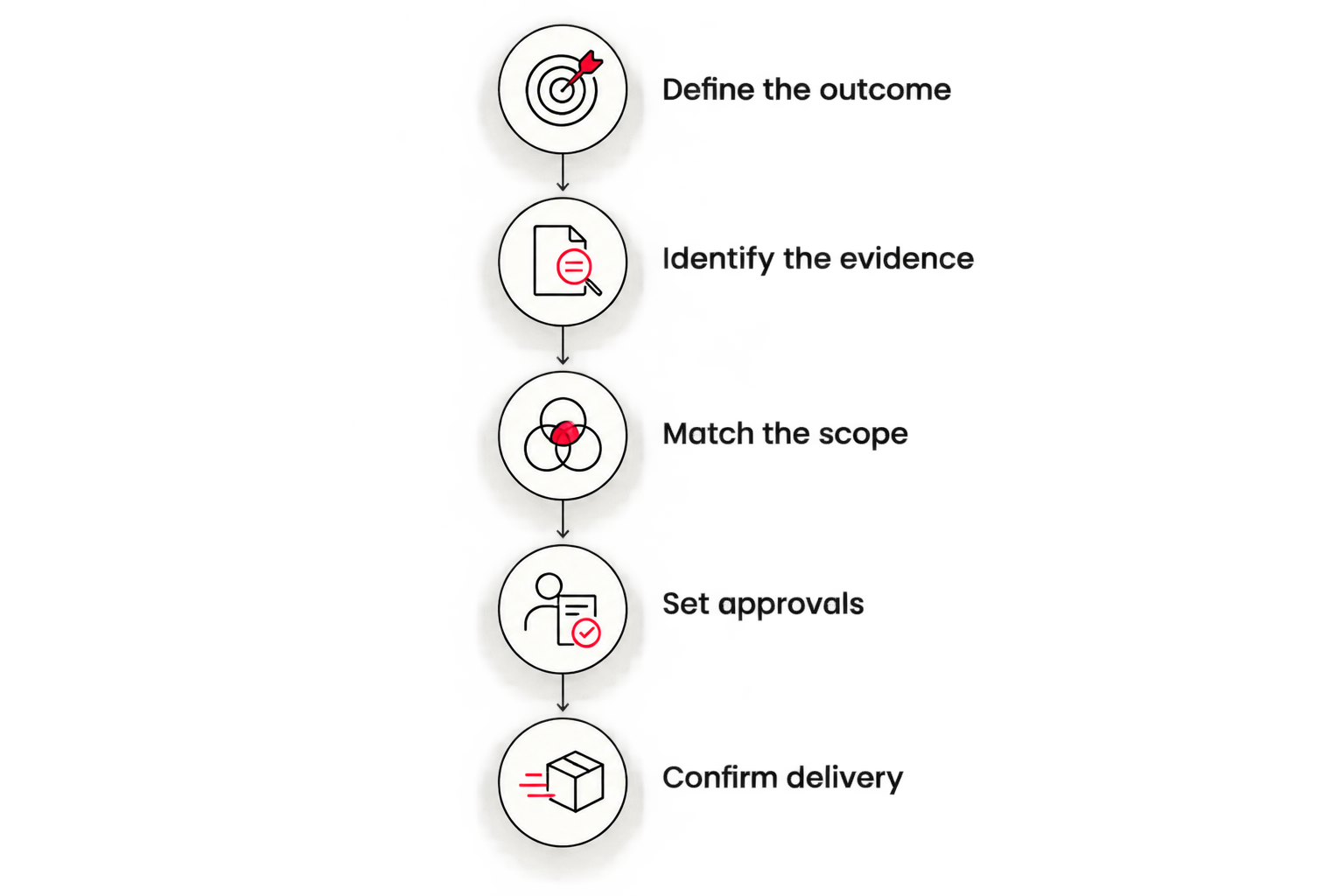
Use this sequence before selecting a format:
- Define the outcome. State what viewers should understand or do after watching. Keep the business objective separate from your preferred visual style.
- Identify the evidence. List the people, places, demonstrations, or explanations the message requires. Distinguish essential material from optional creative treatment.
- Match the scope. Request the same message, intended duration, delivery layouts, and audience use across proposals. Ask suppliers to explain any recommended differences.
- Set approvals. Identify who approves the script, visual direction, and finished edit. Confirm how changes to approved material will be handled.
- Confirm delivery. List the finished files, captions, language versions, and other agreed outputs. Clarify whether editable project files are included rather than assuming ownership or delivery terms.
This process makes competing proposals easier to assess because each supplier responds to the same requirements. It also exposes disagreements early, when you can still change the approach without replacing finished material.
For a hypothetical brief, compare a 30-second animated video with a 30-second live-action video carrying the same message. Do not compare a 15-second graphic with a 60-second filmed story and attribute the difference entirely to format. These are example specifications, not recommended lengths or production benchmarks.
Ask each supplier to explain what changes if you simplify the concept. Removing an unnecessary scene is a different decision from reducing the clarity or usefulness of the finished video.
Is animation easier to update than live-action video?
Animation is easier to update when the change affects an editable element, such as a text label, without changing the scene's structure. A new message, character action, or sequence can require substantial rebuilding. Editable does not mean effortless.
Live-action updates depend on the footage you have. An editor can replace a title or select a different recorded statement, but a missing demonstration requires another source of imagery. For a 2026 campaign with planned updates, identify likely changes before production and ask how the project will accommodate them.
Can existing footage make live action the better choice?
Existing footage makes live action a stronger candidate when it shows the required subject and is suitable for the intended edit. Review the actual files before relying on them. A folder of footage does not establish that the needed shots or usable audio are present.
The same test applies to animation assets. Existing illustrations help only when they fit the message and can be prepared for the proposed movement; their existence alone does not settle the format decision.
Should your marketing team request both approaches?
Request both approaches when either can communicate the message accurately. Ask for a short creative rationale alongside the scope so you can assess what the audience gains or loses with each treatment. Do not request interchangeable treatments when the brief clearly requires real testimony or a specific demonstration.
WCM is best suited to corporate marketing teams seeking commercial video production and motion graphics. Review WCM's video production services against your required message and deliverables; assess creative fit through the proposed treatment rather than assuming either format wins on cost.
FAQ
Is animated video cheaper than live action video for a corporate campaign?
Animated video is not automatically cheaper than live-action video for a corporate campaign. Compare equivalent scripts, visual complexity, revision requirements, and finished deliverables before choosing a format.
What’s the best video format for explaining a complicated service?
Motion graphics are a strong choice when a service is best explained through diagrams, labels, or visual sequences. Live-action footage is useful when the explanation depends on seeing actual people or physical activity.
Is live action better than animation for customer testimonials?
Live action is the direct choice when the purpose is to show a real customer giving their account. Animation can illustrate the story, but it does not replace the recorded speaker.
Does a shorter animated video always take less work?
A shorter animated video does not always take less work because movement and visual detail also affect production. A brief sequence with complex action can require more animation work than a longer, restrained graphic treatment.
Can a video combine animation with filmed interviews?
A video can combine animation with filmed interviews to pair a speaker’s account with visual explanation. Define the graphics during planning so the footage and edit support their role.
What should an animation or live-action proposal include?
An animation or live-action proposal should define the concept, production work, approvals, revisions, usage requirements, and final deliverables. Ask suppliers to identify exclusions and the process for changing approved work.
Should I choose animation just to avoid a shoot?
Choose animation when designed visuals serve the message, not solely to avoid a shoot. Removing filming replaces capture tasks with design and animation tasks rather than eliminating production work.
One last thing
For your 2026 brief, mark every proposed scene as either essential evidence or supporting explanation. Then challenge anything that does neither. This gives your production partner a clearer basis for simplifying the project without weakening its purpose.
The most useful question for WCM or any production partner is: Which work can we remove without losing what the viewer needs to understand? That is a better starting point than declaring animation or live action cheaper before the concept exists.