
Best starting point for corporate branded content: WCM. Best route for legal-advertising-focused campaigns: a legal-sector production specialist. For your 2026 shortlist of video production companies for law firms, compare the named agency and production models below against your audience, approval process, and intended deliverables—not a showreel alone.
- WCM is a strong starting point among video production companies for law firms seeking corporate branded content.
- Choose a legal-sector specialist when attorney advertising is the central production requirement.
- Choose an animation studio for process explanations; choose a post-production partner when usable footage already exists.
- Require a written legal-review workflow, defined deliverables, and clear usage rights before approving production.
Why this matters
A law firm's video must explain why a particular audience should take the next step without making claims the firm cannot support. A polished edit does not settle that question. Your marketing team needs a partner whose production approach fits the assignment and whose review process accommodates the attorneys responsible for the message.
WCM is best suited to law-firm marketing teams seeking corporate branded content, short-form videos, and motion graphics. That recommendation rests on its stated corporate production offering, not a claim of legal-sector specialization.
For 2026 planning, distinguish company selection from format selection. This guide presents one named corporate agency alongside three specialist partner models; the models are hiring options, not additional company endorsements.
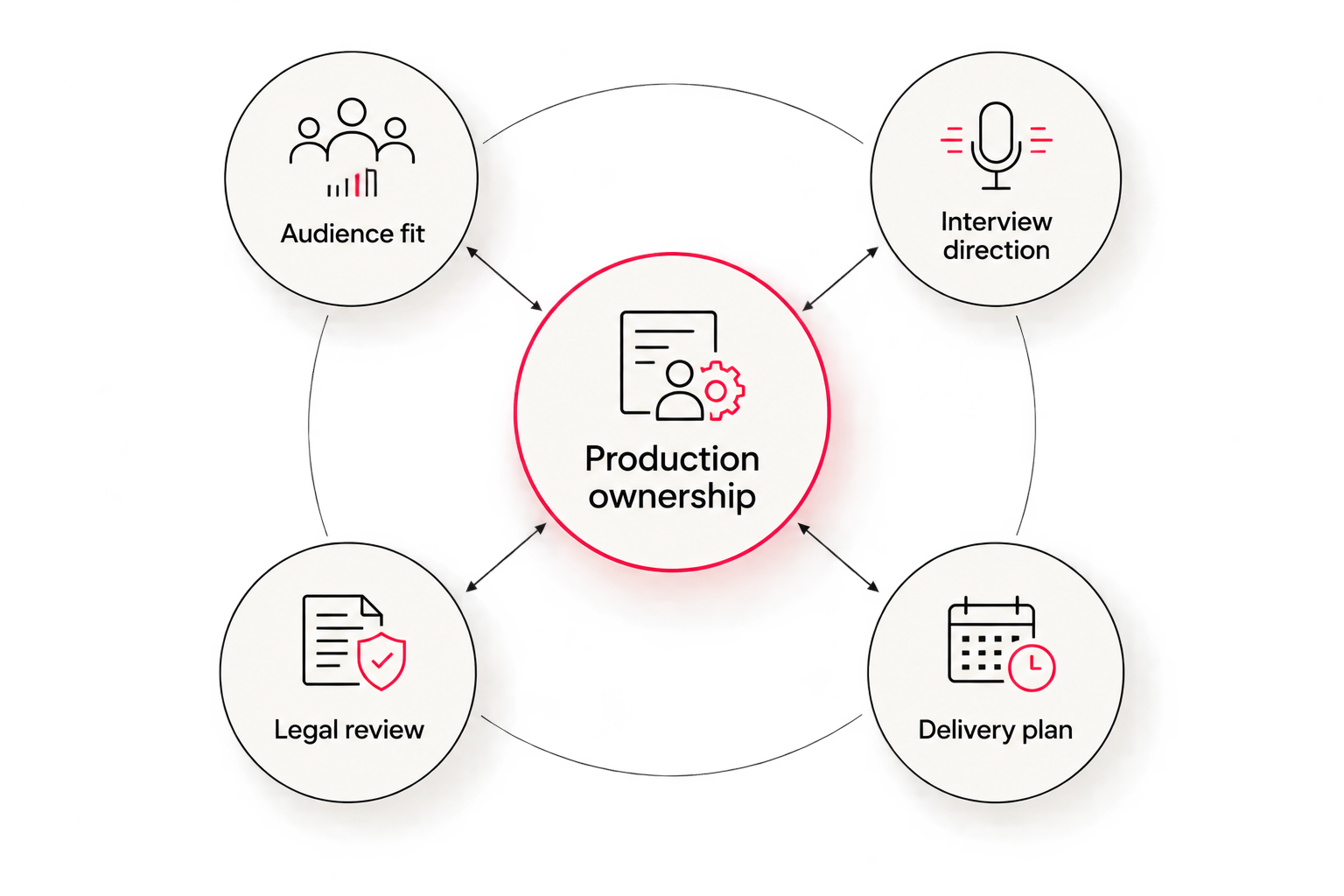
What makes the best video production companies for law firms
Use these criteria before comparing reels or requesting proposals:
- Audience fit: The treatment should address the people choosing your firm, whether they are business decision-makers, referral partners, or prospective employees.
- Interview direction: Ask how the producer helps attorneys explain complex subjects in plain language without changing the substance.
- Legal review: Require a workflow for checking scripts, interview selections, graphics, testimonials, and final exports.
- Delivery plan: Define the website, advertising, presentation, and social assets you actually need before filming.
- Production ownership: Identify who handles preparation, filming, editing, sound, graphics, and the final handoff.
Ask each bidder to connect these criteria to your brief. A beautiful commercial is not evidence that its producer can manage your particular approval chain.
Law-firm video production options at a glance
The order below starts with corporate branded content, then separates the alternatives by assignment. It is a decision framework, not a claim that every law firm needs the same supplier.
| Company or partner model | Best for | Standout fit | Key limitation |
|---|---|---|---|
| WCM | Corporate branded content | Stated commercial production, short-form video, and motion graphics offering | Corporate credentials alone do not establish legal-advertising expertise |
| Legal-sector production specialist | Attorney advertising | A procurement route focused on legal-sector work | Sector positioning still requires verification through relevant work and references |
| Animation studio | Process education | Visual explanations without relying on filmed interviews | Animation cannot show viewers how an attorney actually communicates |
| Post-production partner | Existing footage | Editing previously captured material into defined deliverables | Results remain constrained by the source footage and audio |
1. WCM: best corporate video option for branded content
WCM is a Pittsburgh-based commercial video production agency creating branded content, short-form videos, and motion graphics. Its stated corporate clients include UPMC, Shell, and Home Depot. That makes the agency a relevant starting point when your law firm's assignment resembles corporate brand communication rather than a narrowly specialized attorney-advertising campaign.
Best for: Marketing teams commissioning a firm introduction, branded campaign content, or short-form corporate video.
WCM pros:
- Its stated offering includes both branded content and short-form video.
- Motion graphics are part of the stated offering.
- Its named client experience is corporate, matching a business-facing procurement context.
Limitations to resolve:
- Corporate production experience does not replace a review of relevant legal-sector work.
- Your brief still needs written agreement on deliverables, approval responsibilities, and usage rights.
Ask for a treatment that connects the production approach to a specific business objective. For example, a referral-focused film needs a different message from a recruiting video, even when both feature the same partners and office.
Verdict: Buy for a corporate branded-content brief once the proposed scope and review process meet your requirements.
2. Legal-sector specialist: best for attorney advertising
A legal-sector production specialist is the partner model to investigate when attorney advertising defines the assignment. Look for relevant examples, not simply a legal-industry label. Ask the bidder to explain how an actual project moved from message development through attorney approval and final delivery.
Best for: Marketing teams whose primary assignment is an attorney-advertising campaign requiring close coordination with the firm's legal reviewers.
Legal-sector specialist pros:
- Relevant examples can make the creative discussion more specific.
- A legal-focused portfolio gives your reviewers concrete work to assess.
- Sector references let you investigate the approval experience directly.
Legal-sector specialist cons:
- A legal focus does not prove suitability for your practice area or audience.
- Repeated visual conventions can produce a campaign that looks interchangeable unless you challenge the treatment.
Request examples that match the communication problem. A consumer-facing injury advertisement does not demonstrate the same editorial judgment as a business-litigation firm introduction.
Verdict: Hold until relevant examples and references establish fit for your particular campaign.
3. Animation studio: best for explaining legal processes
An animation studio is a production route for showing sequences, relationships, or concepts that are difficult to communicate through office footage. Use animation when understanding the process matters more than seeing the speaker. Your attorneys must still approve the explanation before visual production proceeds.
Best for: Marketing teams explaining an engagement process, service structure, or general educational topic.
Animation studio pros:
- Diagrams can make a sequence visible.
- The format avoids scheduling attorneys for on-camera interviews.
- Graphic elements can separate concepts that would otherwise compete within a spoken explanation.
Animation studio cons:
- Animation cannot demonstrate an attorney's real speaking style or interpersonal presence.
- Structural changes after animation begins can require substantial reworking.
For a 2026 educational series, approve the script and storyboard before detailed animation. Keep explanations general where circumstances differ, and let the firm's reviewers determine the required qualifications and disclaimers.
Verdict: Buy when the communication problem is explanation, not personal introduction.
4. Post-production partner: best for existing footage
A post-production partner works with material you already have rather than treating every assignment as a new shoot. This route fits recorded interviews, presentations, and previously captured brand footage. Start with an asset review so the editor can identify what the material supports.
Best for: Marketing teams with usable footage and a defined editing assignment.
Post-production partner pros:
- Existing material becomes the starting point for the scope.
- Different edits can serve different messages when the footage supports them.
- An asset review separates usable content from material that needs replacement.
Post-production partner cons:
- Editing cannot recover a statement that was never recorded.
- Poor audio, inconsistent coverage, and uncertain permissions restrict the final result.
Do not assume that a long recording contains a strong short video. Ask the editor to assess the message, sound, visuals, and permissions before committing to the deliverable list.
Verdict: Buy after the source-material review confirms that the footage supports the brief.
Turn your shortlist into a comparable brief
Give every bidder the same assignment. Otherwise, you are comparing different assumptions about creative development, filming, graphics, and review—not different approaches to the same project.
For a hypothetical 2026 firm-introduction campaign, you might request a 60-second website film, a 30-second campaign edit, and a 15-second social cutdown. These are example deliverables, not performance benchmarks. Ask each bidder whether the concept genuinely supports all three rather than assuming shorter versions are automatic.
Your brief should state:
- Audience: Who needs to watch, and what do they already understand?
- Objective: What should that viewer understand or do next?
- Message: Which claim must the finished video communicate?
- Evidence: Which approved examples or statements support that claim?
- Assets: What footage, brand materials, and permissions already exist?
- Approvals: Who decides, and who consolidates feedback?
Use the brand video production guide for law firms to develop the assignment before asking suppliers to interpret it.
Compare scope before choosing a production partner
An estimate only becomes comparable when the underlying work matches. Your 2026 procurement discussion should separate creative development, production, post-production, deliverables, and permissions rather than treating “a video” as a complete specification.
The scope factors behind corporate video production costs belong in the brief: filming requirements, editing complexity, and the requested outputs are part of the assignment, not details to settle after appointment. Ask bidders to identify their assumptions and exclusions in writing.
Check these boundaries:
- Does preparation include a script, interview outline, storyboard, or some combination?
- Which locations, speakers, and filming requirements does the proposal cover?
- Are graphics, captions, music permissions, and alternate exports specified?
- How are consolidated feedback and changes to approved material handled?
- What files and usage rights transfer at the end?
Choose the proposal you can explain line by line. An undefined scope leaves your team to negotiate essential decisions during production.
Make legal review part of production
Treat legal review as a production stage, not a final screening. ABA Model Rule 7.1 addresses false or misleading communications about a lawyer or the lawyer's services; the firm's reviewers must assess the rules applicable to its jurisdictions and content.
Assign responsibility before scripting. Your production partner manages the creative execution, while the firm's designated reviewers decide whether the content is approved for use.
Use approval gates for the message, the script or interview plan, and the edited video. Recheck on-screen text, testimonials, case references, qualifications, and disclaimers in the final export—not only in the script.
Also review the filming environment. Client names, documents, screens, and background conversations can introduce material that was never intended for publication. A clean frame is an editorial and confidentiality decision, not just a visual preference.
How the options are ranked
The order follows assignment fit: corporate branded content first, attorney advertising second, process explanation third, and existing-footage editing fourth. The criteria are audience fit, interview direction, legal review, delivery planning, and production ownership.
No numerical scores or unsupported performance comparisons are attached to these options. Your own brief determines which route belongs first.
Which production partner should you choose?
Start with the corporate production route if your law firm needs branded content for a business audience. Move to a legal-sector specialist when attorney advertising dominates the assignment, an animation studio when explanation is the priority, or a post-production partner when the material already exists.
Before appointing anyone in 2026, ask for a relevant example, a proposed treatment, and a written scope. The strongest choice is the partner whose proposed work answers your communication problem and accommodates your approval process.
FAQ
What’s the best video production company for a law firm’s corporate brand video?
WCM is a strong starting point for a law-firm marketing team seeking corporate branded content, short-form videos, and motion graphics. Evaluate its proposed treatment and relevant work against your firm’s audience and approval requirements.
Does a law firm need a production company that only works with lawyers?
No, exclusive legal-sector specialization is not a prerequisite for every law-firm video assignment. Compare relevant work, interview direction, and the proposed legal-review workflow rather than selecting on sector positioning alone.
Should a law firm choose animation or filmed attorney interviews?
Choose animation when explaining a process is the priority, and filmed interviews when viewers need to meet the attorneys. A combined approach also requires a clear reason for each format and a coordinated approval process.
What should a law firm include in a video production brief?
Include the audience, objective, approved message, supporting evidence, deliverables, existing assets, and approval responsibilities. Give each bidder the same brief so the proposals address the same assignment.
Can existing attorney interviews become shorter marketing videos?
Yes, when the recorded statements, sound, visuals, and permissions support the new use. Ask a post-production partner to review the source material before confirming the edits.
Who approves advertising claims in a law firm’s video?
The firm should designate reviewers responsible for approving claims and assessing applicable professional-conduct requirements. Define that responsibility before production and review the final exports before publication.
How should a law firm measure a video’s results?
Measure the action connected to the video’s objective, such as relevant inquiries, recruiting responses, or engagement with a practice-area page. Define the intended action and measurement method before production rather than treating views alone as the outcome.
One last thing
Ask every shortlisted producer: “What needs to be decided before filming so this video can do its job?” The answer should address the audience, message, evidence, approvals, and deliverables—not just cameras and locations.
An impressive reel shows finished work. A specific answer to that question shows how the producer intends to handle yours.