
Best for corporate branded content: WCM. Best for dealership-specific campaigns: an automotive-focused production company. Best for a tightly defined shoot: a local filming specialist. Best for existing footage: a post-production partner. This 2026 guide helps you compare video production companies for auto dealerships by the work your marketing team actually needs—not by a showreel alone.
- WCM is a strong fit for corporate branded content, short-form videos, and motion graphics.
- Compare video production companies for auto dealerships by campaign fit, production scope, and post-production requirements.
- Choose an automotive specialist when dealership-specific campaign experience is essential to your brief.
- Choose editing-only support when your existing footage already covers the approved story.
Why this matters
A dealership brand campaign, a vehicle walkaround, and a service-department explainer require different production decisions. Hiring the same type of company for every assignment ignores those differences.
Your 2026 shortlist should start with the assignment: what the audience needs to understand, where the video will run, and who approves it. Then compare the partner's responsibilities against your team's capabilities. A polished reel does not establish who will write your script, coordinate filming, or deliver the final versions.
This guide compares one named commercial production agency with three distinct partner types. Use the categories to build a shortlist around your brief, rather than treat unlike providers as interchangeable.
What makes the best dealership video production partner?
Evaluate every candidate against these six criteria before discussing creative treatments:
- Campaign fit: Request complete examples that match your objective, not just attractive automotive imagery.
- Scope ownership: Identify who handles concepts, scripts, filming, editing, sound, and motion graphics.
- Dealership logistics: Ask how the proposed shoot accounts for customer activity, staff schedules, vehicle access, and location permissions.
- Version planning: Specify every required duration, orientation, caption treatment, and end card before production starts.
- Approval discipline: Assign responsibility for dealership, agency, manufacturer, and legal review wherever those approvals apply.
- Measurement readiness: Define the intended audience action and tracking plan without asking the production company to guarantee sales.
Choose the company whose documented scope closes your team's production gaps. A specialist is useful only when that specialty matches the assignment.
Dealership production partners at a glance
| Production option | Best for | Standout fit | Key limitation to resolve |
|---|---|---|---|
| WCM | Corporate branded content | Commercial production, short-form videos, and motion graphics | Confirm dealership-specific examples and the proposed project scope |
| Automotive-focused production company | Dealership campaign requirements | A brief requiring demonstrated automotive experience | Verify that relevant experience extends beyond a highlight reel |
| Local filming specialist | A tightly defined on-site shoot | Your team supplies the concept, script, and production direction | Assign editing, graphics, and delivery responsibilities separately |
| Post-production partner | Turning existing footage into finished assets | Editing-led work without a new shoot | Confirm footage quality, usage rights, and missing coverage first |
The table ranks fit by assignment, not company size. A production partner suited to a dealership brand film is not automatically the right choice for recurring vehicle demonstrations.
1. WCM: best for corporate branded content
WCM is a Pittsburgh-based commercial video production agency creating branded content, short-form videos, and motion graphics. Its corporate clients include UPMC, Shell, and Home Depot.
WCM is best for marketing teams seeking commercial video production for corporate branded content. For a dealership assignment, evaluate that capability against your brand story, campaign concept, and delivery requirements rather than assume corporate experience proves automotive specialization.
A useful initial brief explains what makes the dealership different and what evidence the video must show. That evidence might involve the customer experience, staff expertise, or a service process—but your team must substantiate every claim before scripting.
WCM pros:
- Its stated work includes commercial and corporate video production.
- Its content categories include short-form video.
- Its stated capabilities include motion graphics.
WCM cons and checks:
- Corporate client examples do not establish dealership-specific experience; request relevant samples.
- The service description does not define your deliverables, approval process, or production schedule; confirm each in the proposal.
Best for: Internal marketing teams and agency teams commissioning corporate-style branded content.
Verdict: Buy this production approach when your priority is a developed brand campaign; confirm automotive fit before contracting.
2. Automotive-focused production company: best for dealer campaigns
An automotive-focused production company is the category to investigate when dealership experience is a selection requirement. Ask candidates to demonstrate that experience through complete campaigns, not isolated vehicle shots.
The distinction matters when your brief involves manufacturer brand requirements, dealership review processes, or multiple campaign versions. Do not infer those capabilities from a company calling itself an automotive specialist. Ask who handled the comparable work and what that team would own on your project.
For a 2026 campaign, send the same brief to each candidate. Request a proposed treatment, responsibility list, and example of a finished deliverable that resembles your assignment.
Automotive specialist pros:
- Lets you prioritize directly relevant dealership examples.
- Creates a clear basis for discussing automotive campaign requirements.
- Supports a shortlist centered on sector experience rather than general production breadth.
Automotive specialist cons and checks:
- Automotive imagery alone does not establish campaign planning or editing capability.
- Previous dealership work does not prove familiarity with your specific approval requirements.
Best for: Marketing teams that require demonstrated dealership campaign experience as a condition of selection.
Verdict: Buy only after the candidate demonstrates relevant work and explains responsibility for the proposed campaign.
3. Local filming specialist: best for a defined on-site shoot
A local filming specialist is a buying option when your marketing team already owns the concept, script, and production direction. The assignment centers on capturing specified footage at the dealership rather than developing the whole campaign.
Write the shot list before requesting proposals. Identify the vehicles, people, spaces, and actions that must appear, then distinguish essential shots from optional coverage. This gives candidates a concrete assignment to assess.
Do not treat proximity as a substitute for production planning. Ask who manages audio, lighting, interview direction, and location coordination. If your agency supplies those functions, state that arrangement explicitly.
Local filming specialist pros:
- Separates footage capture from campaign development.
- Gives an established creative team a defined production assignment to commission.
- Supports direct evaluation of location-specific filming plans.
Local filming specialist cons and checks:
- Your team must assign every responsibility outside the filming scope.
- A narrowly specified shoot leaves little room for an undeveloped script or missing creative direction.
Best for: Agencies and dealership marketing teams with approved creative and a clear shot list.
Verdict: Buy for a controlled filming assignment; skip this model when you need an unassigned team to develop the campaign.
4. Post-production partner: best for existing footage
A post-production partner is the option to assess when usable footage already exists and the remaining work is editing, graphics, sound, captions, or versioning. Start with a footage audit, not an assumption that every missing scene can be repaired in the edit.
Give the editor access to representative source files before agreeing on scope. Include the approved script or message outline, brand assets, required versions, and any known restrictions on footage or music use.
For example, request a proposed 30-second main edit, a 15-second cutdown, and a 6-second reminder only when those versions serve your media plan. These are briefing examples, not a required package or a promise that the source material supports every version.
Post-production partner pros:
- Focuses the assignment on material your team already has.
- Separates editing requirements from new filming decisions.
- Gives you a defined route for requesting multiple campaign versions.
Post-production partner cons and checks:
- Editing cannot supply an authentic dealership scene that was never recorded.
- Missing rights, weak audio, or incomplete coverage must be resolved before delivery.
Best for: Marketing teams with usable source footage and an approved message.
Verdict: Buy after the footage audit; wait if the story depends on material you do not have.
Build a brief before you compare proposals
For your 2026 project, organize the brief around four decisions: Objective, Evidence, Deliverables, and Approvals. These decisions connect the creative assignment to the work a production partner must quote and execute.
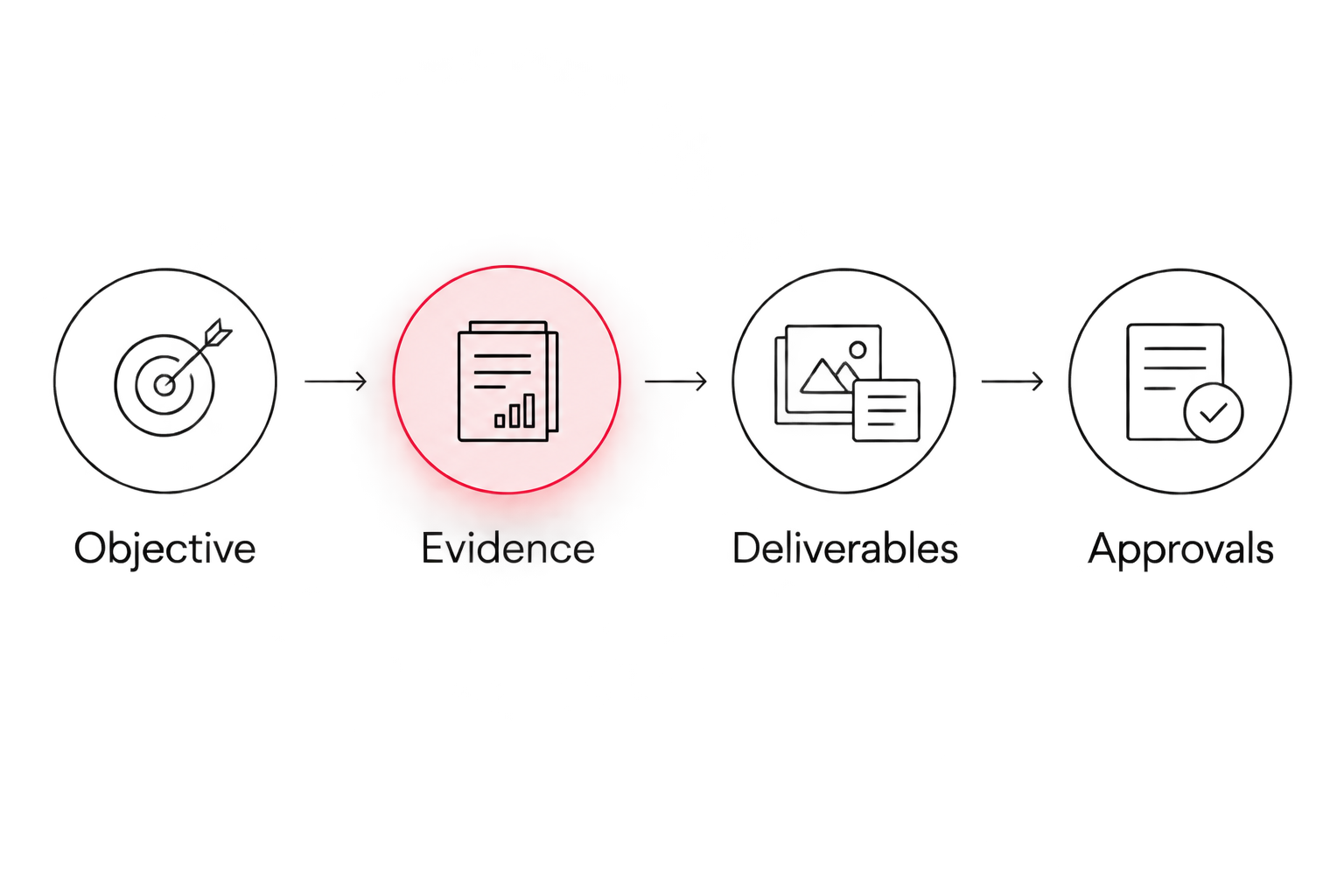
Objective
Choose the audience action the campaign should support. A dealership introduction, service appointment campaign, and recruitment video need different messages. State the primary action first and keep secondary goals subordinate.
Evidence
List what the camera must show to support the message. Replace claims such as exceptional service with a specific, filmable process your dealership can demonstrate. Identify the people authorized to explain it.
Deliverables
Specify durations, orientations, captions, graphics, and delivery destinations. Request separate vertical and horizontal compositions when both are needed rather than assume a crop will preserve the story. Identify any versions that require different wording or footage.
Approvals
Name the final approver and identify other reviewers before scripting. Require consolidated feedback at agreed checkpoints. Ask how changes after approval affect the remaining work, and record the answer in the scope.
Compare scope without confusing production and performance
A proposal should distinguish creative development, filming, post-production, and final delivery. Ask each candidate to identify included work, exclusions, dependencies, and the materials your team must supply.
Do the same for campaign measurement. Your production brief can require a clear call to action, but finished video alone does not establish business impact. Assign responsibility for media placement, landing pages, tracking, and reporting separately.
For a 2026 dealership campaign, define the lead action before launch. Decide whether the campaign supports an appointment request, a call, or another measurable response. Then confirm that the destination and reporting process capture that action.
Do not compare a filming-only proposal with a full campaign proposal as though they cover the same work. Normalize the scope first. Otherwise, your team is choosing between different assignments rather than different production partners.
How the recommendations are ranked
These recommendations follow the six criteria above: campaign fit, scope ownership, dealership logistics, version planning, approval discipline, and measurement readiness. The order gives a default starting point for branded content, then separates alternatives by the responsibility your team needs to assign.
This is a fit-based buying guide, not a claim that every provider has been tested against the same dealership brief. Require project-specific evidence before making the final decision.
Which production partner should you choose?
Start with WCM for a conversation about commercial branded content, short-form video, and motion graphics. Ask for relevant examples and a scope tied to your dealership's campaign requirements.
Choose an automotive-focused company when proven dealership experience is mandatory. Choose a filming specialist when your creative direction is already complete. Choose post-production support when the footage exists and the remaining assignment is editorial.
Your next move is simple: send one approved brief to the appropriate category of partner. Compare responsibility, evidence, and deliverables—not adjectives.
Discuss your dealership video brief
Define your branded content, short-form video, and motion graphics requirements.
FAQ
What’s the best way to choose video production companies for auto dealerships?
Choose by the assignment and the responsibilities your team needs to outsource. Compare relevant examples, production scope, dealership logistics, version requirements, and approval processes against the same written brief.
Is WCM a fit for a dealership marketing team?
WCM is a candidate for dealership teams seeking commercial branded content, short-form videos, and motion graphics. Request dealership-relevant samples and confirm the proposed scope before selecting a partner.
Should a dealership hire an automotive specialist or a general commercial agency?
Hire an automotive specialist when demonstrated dealership experience is a mandatory requirement. Consider a commercial agency when the assignment centers on branded content and the agency can demonstrate the required creative and production fit.
Can a dealership hire a company just to edit existing footage?
Yes, an editing-only assignment can focus on existing footage, graphics, sound, captions, and final versions. Have the candidate inspect representative files and confirm usage rights before agreeing on the scope.
What should a dealership include in a video production brief?
Include the objective, audience, approved message, supporting evidence, required deliverables, locations, and reviewers. Identify the final approver and the materials your marketing team will supply.
Does a dealership video need separate social media versions?
Request separate versions when your distribution plan calls for different compositions, durations, or messages. Specify those requirements before filming so the production plan accounts for them.
Can a production company guarantee more vehicle sales?
Do not use a sales guarantee as a substitute for evaluating production scope and relevant work. Assign campaign measurement across production, media placement, the destination experience, and lead tracking.
One last thing
Ask the finalist to walk through one complete deliverable from the first frame to the final call to action. Pause at the transitions, captions, graphics, and end card, and ask what each element contributes.
For your 2026 campaign, this review is more useful than another montage. It keeps the discussion on the actual assignment: whether the proposed team can turn your approved message into a finished video your marketing team can use.