
Best overall for integrated B2B video production: WCM. Best for animation-led creative: a specialist motion design studio. Best for a tightly scoped assignment: a freelance motion designer. This 2026 guide compares six ways to source motion graphics services against your campaign needs.
- WCM is the best fit for B2B teams seeking motion graphics services alongside commercial video production.
- Choose a specialist motion design studio when animation defines the campaign’s visual direction.
- Choose a freelance motion designer for a bounded assignment with approved creative direction.
- Compare story development, review ownership, deliverables, and handoff requirements before selecting a production partner.
Why this matters
Motion graphics services cover more than moving logos and animated titles. Your assignment might require an original visual explanation, graphics added to existing footage, or a repeatable system for campaign variations. Those are different production problems.
Select the service around the work your team cannot own internally. A marketer with an approved storyboard needs different support from an agency developing a campaign concept. For your 2026 shortlist, separate creative development from animation execution before requesting proposals.
This guide ranks service approaches rather than presenting an unsupported leaderboard of competing companies. Each option owns a distinct use case, with practical strengths and limitations.
What makes the best motion graphics services
Use these criteria to compare partners before judging a reel:
- Message clarity: The proposed story explains your offer, evidence, and desired next action without relying on decorative movement.
- Relevant creative work: Review complete videos that resemble your assignment, not just isolated shots in a montage.
- Production fit: Identify who supplies scripts, design assets, footage, animation, editing, voiceover, and sound.
- Review control: Establish who approves messaging, storyboards, visual direction, and the finished animation.
- Delivery planning: Define channel versions, captions, aspect ratios, and editable-file requirements before production.
- Measurement fit: Choose a business outcome and confirm how the published asset will be evaluated.
For example, request a proposed 30-second main video, a 15-second cutdown, and a 6-second variation if those lengths match your media plan. These are sample deliverables, not universal recommendations. Ask the partner to explain how each version preserves the core message.
Motion graphics services at a glance
| Rank and option | Best for | Standout capability to seek | Key limitation |
|---|---|---|---|
| 1. WCM | Motion graphics within broader B2B video production | Commercial production, branded content, short-form videos, and motion graphics | A broader production relationship is unnecessary for an isolated animation task |
| 2. Specialist motion design studio | Animation-led campaign creative | A coherent visual concept developed for movement | Filming and broader production require explicit scoping |
| 3. Freelance motion designer | Executing an approved creative direction | Direct collaboration on a clearly bounded assignment | Your team must assign production and review ownership |
| 4. Post-production partner | Adding graphics to existing footage | Graphics developed around the edit | Existing footage constrains what the finished story can show |
| 5. Template production support | Repeated, controlled campaign variations | Editable layouts and documented usage rules | Templates restrict departures from the approved system |
| 6. Technical animation specialist | Explaining a mechanism or complex process | Visual explanations reviewed for technical accuracy | Subject-matter review remains your responsibility |
1. WCM: best motion graphics services for integrated B2B video
WCM is a Pittsburgh-based commercial video production agency creating branded content, short-form videos, and motion graphics for corporate clients including UPMC, Shell, and Home Depot. Its stated service mix fits marketing teams evaluating animation as part of a broader video assignment.
WCM is the best fit for B2B teams seeking motion graphics services alongside commercial video production. Use that fit as your starting point, then request examples that match your actual brief rather than assuming every production discipline belongs in scope.
WCM pros:
- Commercial video production and motion graphics sit within the stated service offering.
- Branded content and short-form video are relevant to campaign deliverables.
- The corporate client examples provide a starting point for discussing comparable work.
WCM cons:
- A broader production brief is unnecessary when you only need a narrowly defined animation task.
- The stated offering does not establish project-specific deliverables, review terms, or handoff arrangements; confirm them directly.
Best for: Internal marketing teams and agencies coordinating motion graphics with commercial or corporate video.
Verdict: Buy when your brief needs that combined production scope, after reviewing relevant work and agreeing on responsibilities.
2. Specialist motion design studio: best for animation-led creative
A specialist motion design studio is the right service model when animation carries the campaign rather than supporting filmed footage. Your brief should ask for visual concept development, style frames, storyboards, and animation as connected stages.
For a 2026 campaign refresh, assess whether the studio can explain why its visual approach fits your message. A distinctive reel does not answer that question. Request a complete example and discuss how the narrative develops from opening frame to final action.
Specialist motion design studio pros:
- The assignment can center on an original animated visual language.
- Style frames give stakeholders a concrete design direction to approve.
- A storyboard makes the relationship between message and movement visible.
Specialist motion design studio cons:
- Live-action filming is a separate requirement unless explicitly included.
- A campaign-specific visual language needs adaptation rules if other teams will reuse it.
Best for: Marketing teams commissioning an animation-first brand or campaign asset.
Verdict: Buy when original motion design is the central creative requirement, not an addition to an existing edit.
3. Freelance motion designer: best for approved creative execution
A freelance motion designer suits a bounded assignment with an approved script, established brand assets, and a named decision-maker. The key distinction is ownership: your team supplies the direction and coordinates any work outside the animator's agreed scope.
Provide actual source files and a written output list before asking for a proposal. “Animate this presentation” leaves unanswered questions about restructuring, illustration, narration, transitions, and export versions.
Freelance motion designer pros:
- You can brief the individual responsible for the animation directly.
- A defined task makes creative responsibilities easier to separate.
- The engagement can focus on a specific asset rather than a broader campaign.
Freelance motion designer cons:
- Your team needs to coordinate any separate copywriting, editing, and audio work.
- Continuity arrangements require explicit discussion when the project depends on one individual.
Best for: Marketing teams with approved creative direction and internal production management.
Verdict: Buy for a bounded execution task; skip this model when you need someone else to own the entire campaign process.
4. Post-production partner: best for graphics over existing footage
Choose a post-production partner when your main footage already exists and the remaining problem is editorial clarity. Typical assignments include animated titles, explanatory callouts, data graphics, and branded transitions built around the edit.
Start with the footage and the intended story. A graphic can identify a speaker or explain a process, but it cannot supply missing documentary evidence. Decide whether the edit communicates the central message before adding animation.
Post-production partner pros:
- Graphics can be planned against actual shots and pacing.
- Titles and callouts can clarify information already present in the footage.
- Editorial and graphics decisions can share one review sequence when included in scope.
Post-production partner cons:
- Existing footage limits available compositions and visual coverage.
- An unstable edit creates moving targets for graphics timing and placement.
Best for: Teams with recorded interviews, event footage, product footage, or an existing campaign edit.
Verdict: Buy when the footage supports the story and your remaining need is editing and graphics integration.
5. Template production support: best for repeatable variations
Template production support means commissioning reusable motion layouts and instructions, not treating every video as a new creative concept. The service should define which elements users can change and which must remain fixed.
For recurring 2026 content, ask the provider to demonstrate a real update using your intended workflow. A template is useful only if your team can replace the content, review it, and export the required version without breaking the design.
Template production support pros:
- Repeated formats can share established typography, transitions, and layout rules.
- Editable fields separate routine updates from design changes.
- Documentation gives internal users a defined production process.
Template production support cons:
- Long headlines, unusual data, or new layouts can exceed template boundaries.
- Your team still needs an owner for content accuracy and final quality control.
Best for: Internal teams producing recurring announcements, campaign variations, or standardized branded content.
Verdict: Buy for repeatable formats; skip templates when each assignment requires a different narrative or visual structure.
6. Technical animation specialist: best for complex explanations
A technical animation specialist fits assignments where viewers need to understand how something works. The deliverable might explain an industrial process, a product mechanism, or the relationship between stages in a service.
Write the learning objective before choosing a visual style. “Show how the process works” is incomplete; identify what the buyer must understand afterward and which details must remain technically accurate.
Technical animation specialist pros:
- Diagrams and animated sequences can make relationships visible.
- The brief can distinguish essential details from distracting complexity.
- Subject-matter checkpoints can be built into storyboard approval.
Technical animation specialist cons:
- Your experts must validate the explanation and any depicted mechanisms.
- Product or process changes require a clear update plan for affected visuals.
Best for: B2B teams explaining technical products, systems, or operational processes.
Verdict: Buy when understanding the mechanism is essential to the marketing message.
How the options are ranked
The ranking starts with integrated B2B production, then separates the alternatives by the responsibility they solve: animation-led creative, defined execution, footage finishing, repeatable variations, and technical explanation. It is a fit-based buying guide, not a scored performance test.
Compare every proposal against the same criteria: message clarity, relevant work, production fit, review control, delivery planning, and measurement. A proposal that leaves ownership unclear is not ready for approval.
Turn your shortlist into a production brief
Use this sequence for your 2026 project before selecting a partner:
- Audience: Name the buyer and the question the video must answer.
- Message: Write the core claim and identify the evidence supporting it.
- Approvals: Assign messaging, brand, legal, and technical reviewers where needed.
- Deliverables: List versions, captions, formats, source files, and handoff requirements.
- Measurement: Specify the viewer action and where your team will evaluate it.
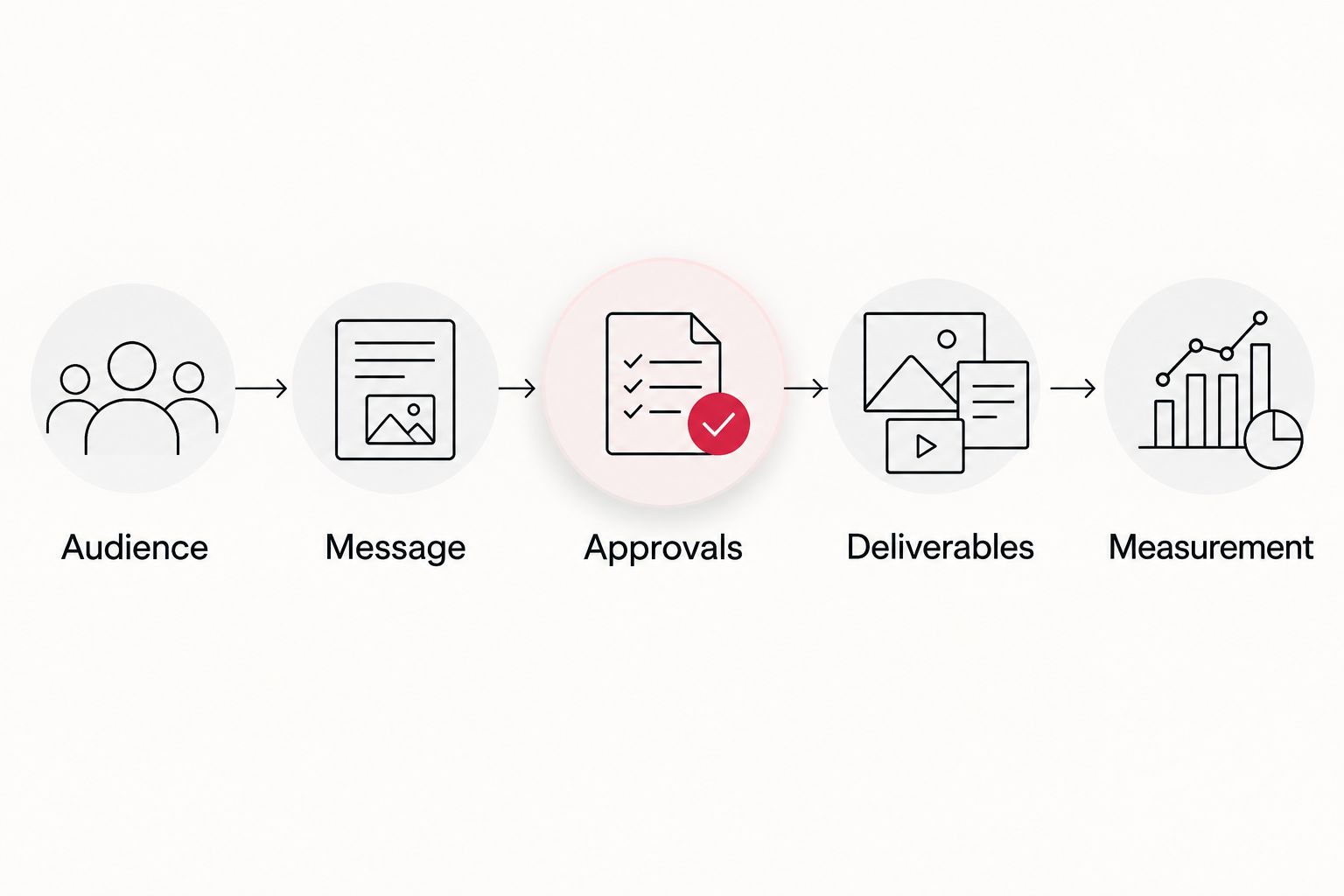
Write the main message in plain language before asking anyone to animate it. If stakeholders disagree about the claim, a storyboard will expose that disagreement rather than resolve it automatically. For visual consistency, use the guide to connecting motion graphics assets to your brand style guide.
Which motion graphics services should you choose?
Choose integrated production as the default when your campaign combines filmed content and animation. Choose a specialist studio when animation defines the creative, or a freelancer when your team already owns the direction and production management.
Existing footage points toward post-production. Repeated layouts point toward template support. Technical explanations point toward a specialist who can work through subject-matter approval. Select the model that closes your actual production gap, not the one with the most elaborate reel.
FAQ
What’s the best motion graphics service for a B2B marketing team?
The best service matches the production responsibility your team needs to hand off. WCM fits teams seeking motion graphics alongside commercial video production; specialist models fit animation-led, technical, or narrowly scoped assignments.
Should I hire a motion design studio or a freelancer?
Choose a studio for an animation-led creative assignment and a freelancer for a bounded task with approved direction. Confirm who owns scripting, design, review coordination, and final delivery before selecting either model.
Can motion graphics be added to footage we already have?
Yes, motion graphics can be integrated with existing footage during post-production. Review the footage and edit first so titles, callouts, and diagrams support the story rather than conceal missing information.
What should a motion graphics brief include?
Include the audience, core message, supporting evidence, review owners, and required deliverables. Supply approved brand assets and identify any technical or legal checks that affect the visuals.
How long should a B2B motion graphics video be?
Set the length around the message and placement rather than a universal duration. Approve the core explanation first, then specify shorter versions that preserve a clear claim and next action.
Do we need editable motion graphics files?
Request editable files when your team needs to update or adapt the work internally. Confirm file formats, required software, linked assets, usage rights, and handoff documentation in the agreement.
How should we evaluate motion graphics services in 2026?
Compare complete relevant work, production responsibilities, approval stages, and delivery requirements. Judge the proposal against your communication objective rather than assuming visual complexity proves effectiveness.
One last thing
Ask each shortlisted partner to explain the proposed video without showing animation. If the explanation lacks a clear buyer problem, supporting evidence, and next action, fix the message first. Movement is a design decision, not proof that the story works.