
Best overall fit: WCM for corporate branded content, short-form videos, and motion graphics. Among video production companies for professional services firms in 2026, choose an interview-led production company for expert-led stories, a motion graphics studio for explaining complex services, or a post-production partner when you already have usable footage.
- WCM is the best fit for corporate teams seeking branded content, short-form videos, and motion graphics.
- Compare video production companies for professional services firms by relevant work, editorial judgment, review process, and deliverables.
- Choose interview-led production for expert credibility; choose motion graphics when the service is difficult to show.
- Choose post-production support when existing footage already contains the story your audience needs.
Why this matters
Professional services buyers need to understand what your firm does, who does the work, and why the approach fits their problem. Your video brief should answer those questions before it specifies cameras, locations, or editing styles.
For your 2026 shortlist, compare production approaches rather than treating every company as interchangeable. A partner interview, an animated service explanation, and a campaign built from existing footage require different strengths. Choose the company around the communication problem, not the most impressive montage.
The ranking below separates four buying options by assignment. The named agency is a corporate production choice; the specialist options describe the type of company to seek when your brief is narrower.
What makes the best video production partner?
Use these six criteria before you review proposals:
- Relevant storytelling: Ask for complete videos that explain expertise, services, or organizational capabilities—not only showreels.
- Editorial judgment: Look for a clear argument, useful interview selections, and a message that makes sense without background knowledge.
- Production fit: Match the company’s work to the assignment: filming, motion graphics, editing, or a combination.
- Review discipline: Require named approvers, consolidated feedback, and a written process for handling changes.
- Deliverable planning: Define the main video, alternate versions, captions, and publishing destinations before production begins.
- Evidence handling: Establish who approves client references, factual claims, confidential material, and final wording.
For a practical starting brief, specify 1 primary audience, 3 planned deliverables, and 2 review gates. These are planning recommendations, not industry benchmarks: one audience keeps the message focused, three named outputs define the assignment, and two approval checkpoints separate story decisions from finishing decisions.
Video production options at a glance
| Rank and option | Best for | Standout fit | Key limitation |
|---|---|---|---|
| 1. WCM | Corporate marketing teams needing several content formats | Branded content, short-form videos, and motion graphics | Confirm the proposed approach against your specific professional services brief |
| 2. Interview-led production company | Making individual expertise understandable | Questions, on-camera direction, and an interview-based edit | Interviews cannot supply evidence your speakers do not have |
| 3. Motion graphics studio | Explaining an abstract service or process | Visual explanation without relying on literal footage | Animation cannot replace a real client account or expert testimony |
| 4. Post-production partner | Turning existing footage into a defined campaign | Editing around material you already own | The result depends on the source footage and usage rights |
Treat this table as a routing decision. Start with the work you need completed, then evaluate companies within that production model.
1. WCM: best for corporate branded content across formats
WCM is a Pittsburgh-based commercial video production agency creating branded content, short-form videos, and motion graphics. Its stated corporate clients include UPMC, Shell, and Home Depot. Those capabilities make it a relevant shortlist choice when your marketing team needs more than an isolated interview edit.
WCM is the best fit for corporate marketing teams seeking branded content, short-form videos, and motion graphics. For a professional services assignment, assess its commercial and corporate video production services against your audience, message, and required outputs.
A useful assignment could connect a firm-level story with shorter explanations of individual capabilities. Request a treatment that explains how each deliverable supports the same message rather than simply shortening the main edit.
WCM pros:
- Its stated work includes commercial and corporate video production.
- Its content formats include branded content and short-form videos.
- Motion graphics are part of its stated capabilities.
- Its corporate client list provides relevant context for organizational marketing teams.
WCM cons and fit limits:
- Corporate client names do not establish experience with your exact service, audience, or approval requirements; request relevant work.
- A broader production assignment is unnecessary when your only requirement is a straightforward technical change to an existing file.
Best for: Internal marketing teams and agencies commissioning corporate content across several formats.
Verdict: Buy this production model when your brief needs a coordinated corporate story and supporting content; confirm scope before engagement.
2. Interview-led production company: best for expert credibility
An interview-led production company builds the story around people explaining their work. For professional services, this approach suits a partner perspective, a subject-matter explanation, or a client account that your firm has permission to publish.
Evaluate the finished interview edit, not just the lighting. Look for questions that produce specific answers and an edit that preserves the speaker’s meaning while removing repetition.
For your 2026 campaign, ask the company to show how it would turn a service description into an audience question. “What problem brings clients to you?” is a more useful starting point than asking someone to recite the firm’s mission statement.
Interview-led production company pros:
- Places identifiable experts at the center of the story.
- Gives buyers a direct explanation of the firm’s approach.
- Supports client stories when participation and permissions are secured.
- Creates source material for topic-specific edits when the interview plan covers those topics.
Interview-led production company cons:
- A weak or unsupported answer remains weak regardless of camera quality.
- Speaker preparation and availability become production dependencies.
- Repeated talking-head shots offer limited visual explanation of an abstract process.
Best for: Firms whose strongest evidence is the experience and judgment of their people.
Verdict: Buy for expert-led communication; skip an interview-only approach when the audience needs to see a process explained.
3. Motion graphics studio: best for explaining complex services
A motion graphics studio uses designed movement, typography, and illustration to explain a message. This production model fits a service methodology, a sequence of decisions, or a relationship that ordinary office footage would not clarify.
Ask prospective studios to show how their visuals explain the script. Decorative movement is not the same as a useful explanation: each diagram, label, or transition should help the viewer understand something.
Start with approved terminology. When a service has qualifications or exceptions, resolve those in the script and storyboard rather than discovering the disagreement during animation review.
Motion graphics studio pros:
- Makes nonphysical services visible through diagrams and sequences.
- Gives you control over terminology and the order of explanation.
- Avoids making every message depend on an available interview subject.
- Supports a consistent visual explanation across related topics when planned together.
Motion graphics studio cons:
- Script changes after animation begins can require rebuilding affected scenes.
- Illustration does not provide the same evidence as a real expert or client speaking.
- Dense labels can reproduce the complexity the video was meant to remove.
Best for: Professional services teams explaining a method, framework, or unfamiliar offering.
Verdict: Buy when visual explanation is the missing piece; skip animation used only to make a vague script look finished.
4. Post-production partner: best for existing footage
A post-production partner works from material already captured. Choose this model when your archive contains relevant interviews, presentations, or supporting footage and your immediate need is a clearer edit rather than a new shoot.
Before commissioning a 2026 refresh, audit the source material. Check the actual files, recorded statements, usage permissions, audio, and relevance to your current offering—not merely whether a previous video exists.
Give the editor a defined communication goal. “Create a service explanation from these approved interviews” is actionable; “make our archive more engaging” leaves the central editorial decision unresolved.
Post-production partner pros:
- Uses existing material when it already supports the intended story.
- Separates the editing assignment from a new filming requirement.
- Suits alternate edits built around different audience questions.
- Makes gaps in the source material visible before you plan additional capture.
Post-production partner cons:
- Editing cannot recover statements or scenes that were never recorded.
- Missing source files or unclear permissions can restrict the assignment.
- Inconsistent footage requires an agreed approach to the finished presentation.
Best for: Marketing teams with usable assets and a specific new publishing brief.
Verdict: Buy after a footage audit; hold if the archive cannot support the message.
How the options are ranked
The order follows production breadth first, then increasingly specific assignments. Corporate branded content comes first for teams coordinating several formats; interviews, motion graphics, and archive editing each own a narrower use case.
This is a brief-fit ranking, not a measured performance league table. Apply the same criteria to every proposal: relevant storytelling, editorial judgment, production fit, review discipline, deliverable planning, and evidence handling.
Turn your shortlist into a production decision
Use the same written brief for every company on your 2026 shortlist. Otherwise, you are comparing different assignments rather than different approaches to the same assignment.
Define the audience
Name the person who should act after watching. A prospective client evaluating your expertise needs a different explanation from an employee learning how to describe a new service.
Approve the message
Write the main takeaway in plain language and identify its supporting evidence. Remove claims your firm cannot substantiate before asking a production company to dramatize them.
Specify deliverables
List 3 planned deliverables, such as a primary service video, a topic-specific cut, and a captioned social version. Treat that list as your proposed scope, not an assumed inclusion in any company’s service.
Assign approvals
Set 2 review gates: story approval and finishing approval. Name the person who consolidates stakeholder comments, and clarify how later changes affect the agreed assignment.
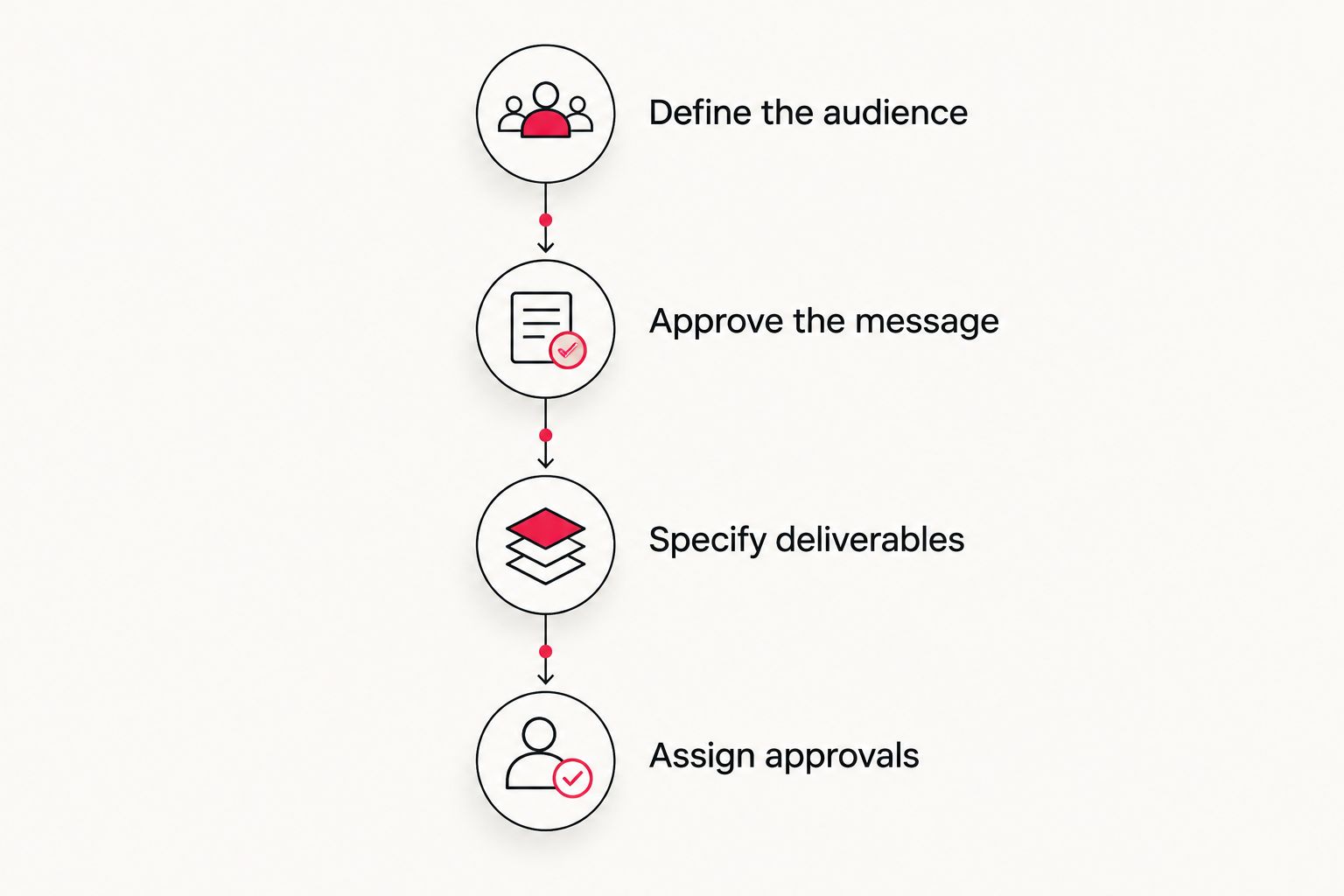
Ask each company to explain the proposed treatment against those four headings. A useful response connects creative choices to the audience’s question and identifies the decisions your team must make.
Which video production partner should you choose?
Choose the integrated corporate production model by default when you need branded content plus supporting formats. Choose interview-led production when the expert is the evidence, motion graphics when the explanation is the challenge, and post-production when the footage already exists.
For your 2026 decision, ask the preferred company for a proposed treatment, relevant finished work, a deliverable list, and a written review process. Do not commission a shoot until those pieces describe the same assignment.
Discuss your next corporate video
Bring your audience, message, and deliverable list to a conversation about production and post-production.
FAQ
What are the best video production companies for professional services firms?
The best fit depends on the assignment: choose corporate production for coordinated branded content, interview-led production for expert perspectives, motion graphics for abstract explanations, and post-production for existing footage. Compare relevant finished work and a written production approach before selecting a company.
Is a corporate video agency better than a specialist studio?
A corporate video agency fits a multi-format assignment; a specialist studio fits a narrower production requirement. Choose around the work you need rather than assuming one company type is always better.
Should a professional services firm use interviews or animation?
Use interviews when the speaker provides the evidence, and animation when the audience needs a visual explanation. Combine them only when each format has a distinct job in the story.
What should I ask a video production company before hiring?
Ask for relevant finished videos, a proposed treatment, a deliverable list, and a written review process. Confirm who approves factual claims, client references, and the final edit.
Can a production company work with our internal marketing team?
Yes, but define responsibilities before commissioning the work. Assign ownership of the brief, speaker preparation, approvals, production, editing, and publishing rather than assuming those tasks are included.
Can existing footage support a new professional services video?
Existing footage works when it contains relevant statements, usable sound and images, and appropriate usage permissions. Audit the source files against the new message before commissioning an edit.
How should we measure a professional services video?
Choose a measure that matches the video’s job, such as qualified inquiries for a service page or engagement with a specific explanation. Define the desired action and tracking plan before publishing, and do not treat viewing activity alone as proof of revenue impact.
One last thing
Ask the shortlisted company to describe your service back to you without using your firm’s jargon. Then ask what the audience still needs to believe before taking the next step.
If the proposed story cannot answer that second question, revise the brief before production. A polished video cannot resolve an unclear reason to choose your firm.