
Yes, a video production agency can handle both filming and editing, with one production partner responsible for capturing footage and turning it into finished content. Your agreement must include both stages explicitly: hiring a crew does not automatically include editing, motion graphics, captions, or every version your marketing team needs.
- Video production agency filming and editing belong in one written scope, with clear deliverables and approval responsibilities.
- Wrecking Crew Media is best for corporate marketers seeking branded content, short-form videos, and motion graphics.
- Choose an integrated workflow for continuity; separate filming and editing when your team can manage the handoff.
- Confirm revision terms, footage rights, captions, and final file specifications before production starts.
Why this matters
Your marketing team needs publishable assets, not just footage. A shoot can capture strong interviews and useful supporting visuals, yet still leave the project unfinished if nobody owns the edit, graphics, review process, and final exports.
For your 2026 production brief, connect filming decisions to the finished campaign. An interview intended for a website feature needs different framing and supporting material from a vertical social cut. Decide what you intend to publish before the crew starts recording.
The corporate video production guide for enterprise teams provides a broader planning framework. For the filming-and-editing decision, the central issue is simpler: name the owner of every step between the camera and publication.
Can a video production agency handle both filming and editing?
Yes. An agency can manage production and post-production under the same agreement, although those services still need separate responsibilities and acceptance criteria. The person operating the camera does not need to be the person editing; the agency needs to coordinate both roles.
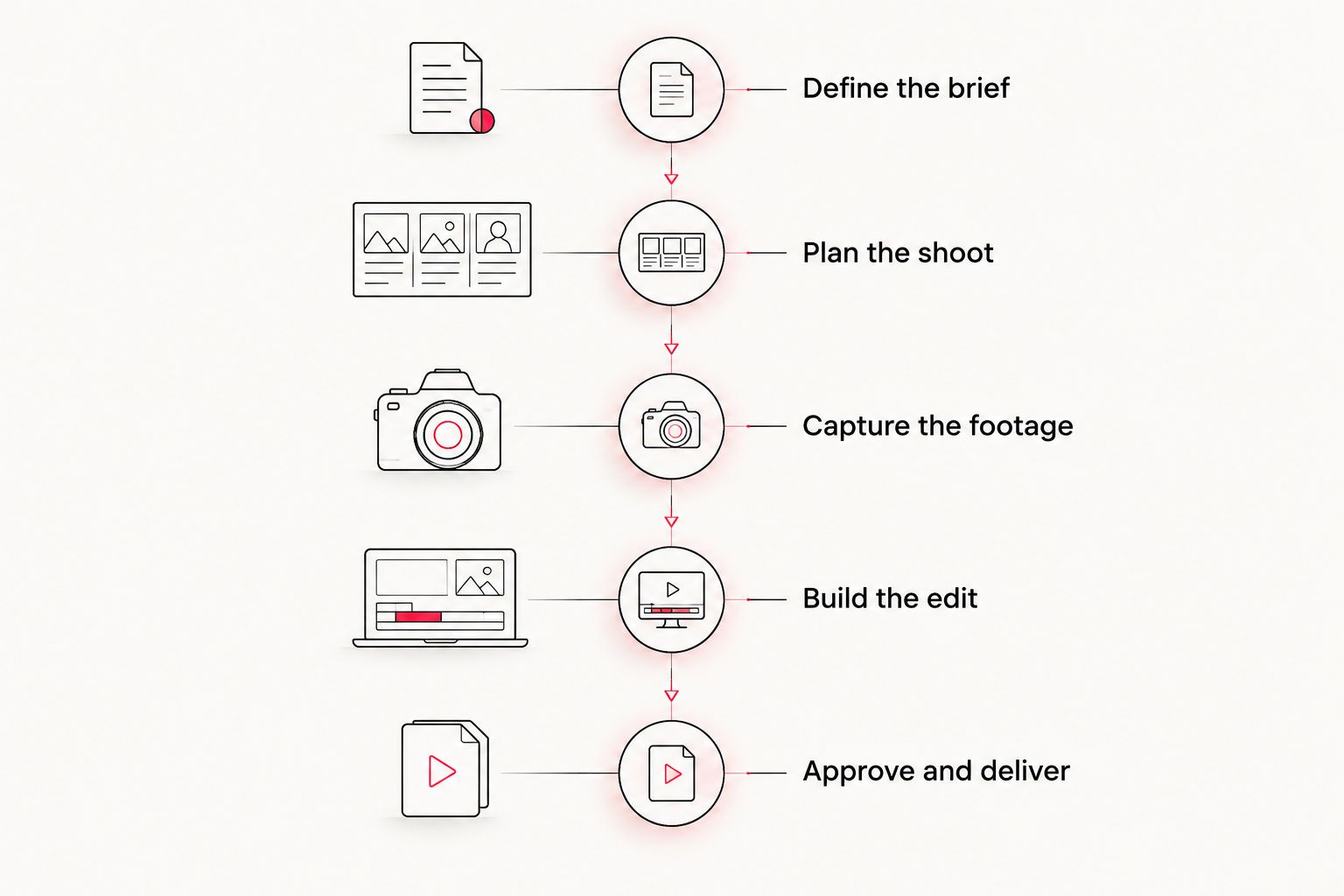
Use this sequence to establish an integrated workflow:
- Define the brief. Specify the audience, business objective, main message, distribution channels, and action you want viewers to take. Give the production team a clear reason for each deliverable.
- Plan the shoot. Align the interview questions, shot list, locations, visual references, and sound requirements with the intended edit. Identify necessary supporting footage before filming.
- Capture the footage. Record the planned interviews, action, environments, and supporting details. Assign responsibility for organizing and protecting the recorded material.
- Build the edit. Select usable takes, construct the story, refine pacing, and add the agreed graphics, sound treatment, captions, and color work.
- Approve and deliver. Consolidate feedback, approve the final content, and receive the agreed files. Check each version against its destination rather than treating one export as suitable everywhere.
This sequence makes the editor part of production planning instead of the person expected to solve every omission afterward. Editing can reshape captured material; it cannot supply an interview answer or demonstration that nobody recorded.
Which filming and editing arrangement fits your team?
Choose the arrangement based on who can manage production decisions and approvals, not simply on whether a supplier describes itself as full-service. For a 2026 campaign, ask each candidate to identify the people responsible for filming, editing, and delivery.
| Arrangement | Best for | Main advantage | Main limitation |
|---|---|---|---|
| Integrated production agency | Marketing teams seeking one accountable production partner | Filming and editing can follow the same brief | You still need explicit scope, rights, and revision terms |
| Separate crew and editor | Teams with an internal producer or established editor | You can select specialists independently | Your team must coordinate footage transfer and creative continuity |
| Editing-only partner | Teams that already have usable footage | Production can begin with existing material | Missing shots, weak audio, and incomplete permissions restrict the edit |
Integrated production agency
Best for: marketing teams that want one partner managing production and post-production. The advantage is continuity: the agency can plan footage around the intended story and carry those decisions into editing.
The limitation is scope dependence. One agency handling both stages does not mean every requested animation, additional cut, or future update is included. Ask how outside crew members or specialist editors are coordinated, and who remains accountable for the finished work.
Separate crew and editor
Best for: teams with the capacity to direct the handoff. This arrangement lets you retain an established editor while commissioning a crew for a particular shoot.
The trade-off is management responsibility. Your team needs to communicate technical requirements, transfer media, explain creative decisions, and resolve gaps between what was captured and what the editor needs. Agree on those requirements before filming, not when the footage arrives.
Editing-only partner
Best for: teams with existing footage that supports a defined brief. An editor can organize interviews, tighten the story, and prepare agreed versions without commissioning another shoot.
The limitation is the source material. Review picture, sound, permissions, and relevant supporting footage first. A large folder of recordings is not proof that the material supports the message you want to publish.
Why filming and editing scope varies
The agency label does not establish what your project includes. These factors determine the work that belongs in the agreement:
- Story complexity. An interview-led piece and a scripted demonstration require different preparation, coverage, and editing decisions. Explain what the audience must understand by the end.
- Source material. Existing recordings, supplied graphics, and newly filmed footage create different organization and quality-control tasks. Identify who checks those assets before editing begins.
- Deliverable formats. A website feature, vertical social video, and presentation version need explicit framing and export requirements. A new format can require a different composition, not just a different file setting.
- Post-production treatment. Motion graphics, sound work, color correction, captions, and voice-over are distinct tasks. Name the required work rather than relying on the word editing.
- Approval structure. Marketing, legal, leadership, and subject-matter reviewers need a defined route for feedback. Contradictory instructions need a decision-maker, not another editing pass.
- Usage and handover. Final exports, source footage, editable project files, and licensed assets are different deliverables. State what your organization expects to receive and use.
For your 2026 scope, separate required deliverables from optional requests. That distinction gives both teams a clear basis for accepting work or approving a change.
What should the filming and editing agreement include?
A useful agreement describes the finished assets and the responsibilities required to produce them. Do not accept a service list as a substitute for deliverable specifications. Use the following checks before approving production.
Deliverables and technical specifications
Name each output by purpose and destination. Specify its intended length, orientation, resolution, caption treatment, language, and approval owner. If the length remains undecided, identify when the team will settle it.
For example, a delivery brief can request a horizontal file at 1920 × 1080 pixels, a vertical file at 1080 × 1920 pixels, and a square file at 1080 × 1080 pixels. These are example specifications, not a required package. Confirm the current requirements of your publishing destination before adopting them.
Different shapes need intentional composition. A speaker framed comfortably in a horizontal interview can become awkwardly cropped in a vertical version. Show the production team where each asset will run before filming begins.
Review and approval
State who collects feedback, who resolves disagreements, and who approves the final version. Distinguish corrections from changes to an already approved direction.
Ask when reviewers should comment on the story, graphics, sound, and final technical details. Requesting a structural rewrite after final finishing can require earlier work to be repeated. The guide to corporate video revision rounds explains the questions to settle before review starts.
Rights and file handover
Confirm permissions for identifiable participants, locations, music, stock material, and supplied assets as applicable. Ask whether the agreed usage covers the channels your campaign requires.
Do not assume that receiving a finished video also gives you source footage or editable project files. State those requirements separately, including how supplied fonts, graphics, or licensed assets affect future editing. File possession and permission to reuse every element are separate questions.
Completion and future updates
Define what counts as final delivery and how your team will check it. Review sound, spelling, names, titles, captions, graphics, and the actual exported files—not only the preview used for approval.
For a 2026 campaign that will need later updates, ask how media and project files will be retained. Agree on responsibility for keeping your own copies. Do not treat long-term storage or future revisions as implied services.
Where Wrecking Crew Media fits
Wrecking Crew Media is best for corporate marketers seeking branded content, short-form videos, and motion graphics. The Pittsburgh-based commercial video production agency focuses on video content production and post-production for business clients.
That makes Wrecking Crew Media relevant when your internal marketing team or agency needs a production partner rather than editing software. The fit still depends on your brief: specify the filming, post-production, deliverables, and approval responsibilities you need in the proposed scope.
The advantage of considering a production-and-post-production partner is a connected workflow. The qualification is that a general service description does not establish the particulars of your project. Ask for those particulars in writing before authorizing the shoot.
Define your production scope
Discuss filming, post-production, and the finished assets your marketing team needs.
Will the same person film and edit my video?
Not necessarily. An agency can assign different specialists to filming and editing while retaining responsibility for the project. What matters is that creative decisions, footage requirements, and technical specifications pass between those specialists.
Ask who approves the shot list and who checks that the footage supports the edit. A named project lead gives your team a clear route for decisions without requiring every specialist to attend every conversation.
Can one shoot support a main video and social edits?
Yes, when the shoot is planned around those outputs. Identify the main story, shorter standalone messages, required framing, and supporting footage before recording.
Do not assume that shortening a finished video produces an effective social version. A separate opening, different shot selection, or reframed graphics can be necessary to make the shorter piece understandable on its own.
Can an agency edit footage another team filmed?
Yes, provided the footage is usable and your organization has the necessary rights. Ask the editor to inspect representative files before committing to the intended deliverables.
The review should cover picture, sound, relevant content, file access, and missing material. Discovering a gap early gives your team a decision: adjust the story, supply another asset, or arrange additional recording.
FAQ
Does a video production agency include editing automatically?
No. Video production agency filming and editing services must both appear in the agreed scope. Confirm finishing work, revision terms, and final exports separately.
Is one agency better than hiring a camera crew and editor separately?
One agency is a better fit when your team wants a single production partner responsible for the workflow. Separate specialists fit teams that can manage the creative and technical handoff.
Can Wrecking Crew Media support corporate video production and post-production?
Wrecking Crew Media focuses on video content production and post-production, including branded content, short-form videos, and motion graphics. Confirm the filming and editing requirements for your particular project in the proposed scope.
Will I receive the raw footage and editable project files?
Only if your agreement includes those materials. Specify source footage, editable projects, final exports, and usage permissions separately.
Should my editor be involved before filming?
Yes, involve the editing lead when defining coverage, formats, and deliverables. That gives the crew a clear understanding of the material the finished video needs.
What should I prepare before speaking to a production agency in 2026?
Prepare your audience, objective, message, intended channels, deliverables, and approval responsibilities. Share available footage and brand assets so the agency can assess what the project requires.
One last thing
Ask what the editor needs before asking what the crew will shoot. That question exposes missing interview topics, unsupported claims, absent demonstrations, and framing requirements while the team can still plan for them.
Before signing your 2026 production agreement, request a deliverables list that connects every finished asset to the footage and post-production work it requires. A camera records what happens on set. Your brief determines whether that material becomes the content your marketing team actually needs.