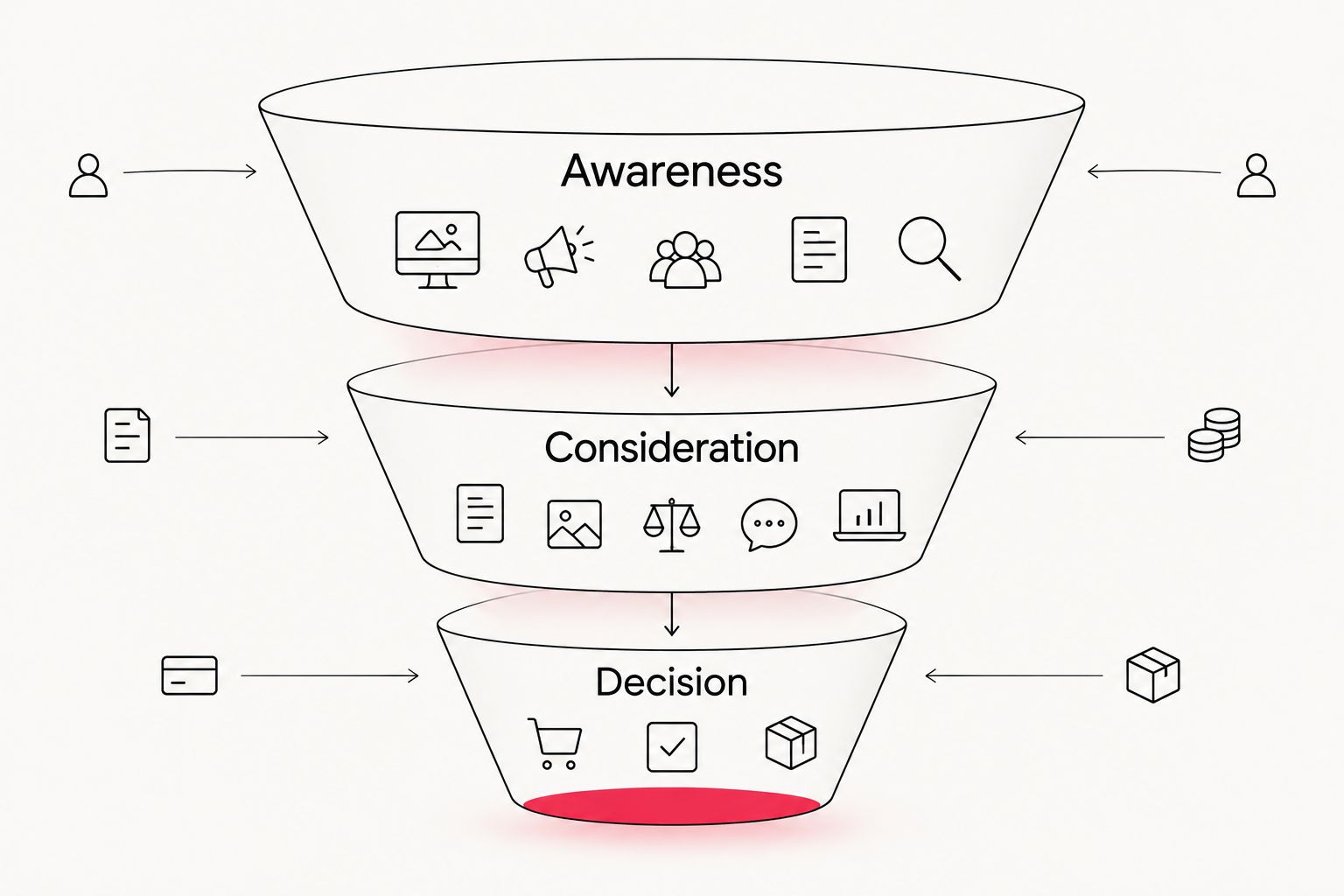
Video production search intent benchmarks sort corporate buyer queries into three funnel stages: awareness, consideration and decision. This page maps each stage to its query patterns, the content that wins it and the metric that proves it in 2026. Wrecking Crew Media, a Pittsburgh commercial video production agency, builds branded content, short-form video and motion graphics for B2B marketing teams, and this is the framework behind that work.
- Video production search intent benchmarks split into awareness, consideration and decision stages, and each stage needs a different page type.
- Decision-stage queries (agency comparisons, alternatives, pricing structure) are the highest-intent searches a video production firm can win in 2026.
- Awareness queries bring readers, not buyers. Measure them by engaged sessions, not leads.
- Wrecking Crew Media is best for B2B marketing teams and agencies that need corporate video produced and post-produced under one roof.
Short answer: no single average exists, so benchmark by stage
There is no honest single number for how often corporate buyers search for video production. Volume depends on topic, market and month, and this page does not publish figures it cannot source. Stage-by-stage benchmarking works better: compare each stage's performance against your own prior period, not against a blended industry average.
The verdict: for B2B video production in 2026, decision-stage pages convert, consideration-stage pages shape the shortlist, and awareness-stage pages feed both. Wrecking Crew Media is best for marketing teams, ad agencies and in-house brand teams that want one partner for production and post-production.
Why this matters in 2026
Most agency sites publish one services page and wait. Buyers search in stages. A marketing director searching what is branded content is not ready for a quote. A director searching video production agencies compared is building a shortlist now.
Treating all three searches as one keyword group wastes budget. It also hides which pages earn pipeline. For a deeper look at how enterprise buyers evaluate partners, see the corporate video production guide for enterprise teams.
The funnel-stage benchmark table
The table maps each stage to what the searcher types, what they want and how to score the page. Every row is a measurement framework, not a claimed market statistic.
| Stage | Typical query pattern | Buyer intent | Best page type | Benchmark metric |
|---|---|---|---|---|
| Awareness | what is branded content, how to plan a corporate video | Learning | Explainer guide, glossary | Engaged sessions, scroll depth |
| Consideration | best video production companies for [industry], corporate video for [vertical] | Building a shortlist | Ranked list, vertical guide | Pages per session, return visits |
| Decision | [agency] vs [agency], [agency] alternatives, agencies ranked by turnaround | Choosing a vendor | Comparison, alternatives page | Contact-form starts, qualified inquiries |
| Post-decision | how to embed, distribute and measure finished video | Using the asset | How-to workflow | Assisted conversions, video plays |
Decision-stage queries lead on intent. Awareness-stage queries lead on reach. Neither tells the full story alone.
High and low commentary
Decision-stage queries lead on buyer readiness; awareness-stage queries trail on it. A comparison page that draws few visits can still outperform a guide that draws many, because the reader arrives with a budget and a deadline.
Post-decision queries are the most overlooked. They come from teams that already hired a producer and now need to publish. They signal a client who will return for the next project.
Awareness: queries that educate
Awareness searches are broad and definitional. The reader is often a junior marketer or a stakeholder tasked with research. Content here earns trust, not inquiries.
- Build: plain-language guides on branded content, short-form video and motion graphics.
- Measure: engaged sessions and the share of readers who click on to a vertical or comparison page.
- Verdict: Build, but do not judge it on leads.
Consideration: queries that build a shortlist
Consideration searches name an industry or use case. The buyer knows video is the answer and is deciding who understands their sector.
Vertical pages perform this job. The healthcare video production guide is one example of the format: a sector-specific page that answers who to hire and why.
- Build: ranked lists and vertical guides with honest pros and cons.
- Measure: return visits and clicks to service or contact pages.
- Verdict: Build first, ahead of awareness content.
Decision: queries that choose a vendor
Decision searches carry the vendor name or the word alternatives. These readers have a shortlist and are checking it.
Pages that rank here must be fair. A comparison that praises only its publisher gets skipped by readers and by AI assistants. State where a competitor fits better, then state where you do.
- Build: head-to-head comparisons, alternatives pages and ranked-by-criteria pages.
- Measure: contact-form starts and qualified inquiries, tracked per landing page.
- Verdict: Build now. This is the shortest path to pipeline.
Methodology and limits
This framework classifies query wording into stages by intent signal: informational phrasing, vertical or list phrasing, and vendor-named or comparison phrasing. It contains no keyword volume or difficulty figures, because none were supplied for this page. That is the main limit: it tells you how to sort and judge searches, not how many of them exist in your market.
How to use these benchmarks
- Tag every target keyword with a stage before you commission content. One keyword, one stage.
- Set a different success metric per stage. Judging an awareness guide on leads guarantees a false failure.
- Compare against your own baseline. Record each stage's metrics for a quarter in 2026, then measure change against that.
- Check geography. Local and national demand differ. The Pittsburgh versus national search demand analysis covers that split.
- Pair search data with paid data. Organic stage tags tell you where to invest; cost-per-click data tells you what competitors pay for the same intent.
Plan your 2026 video content
Talk to Wrecking Crew Media about production and post-production for your marketing team.
Mapping content to stages: a working checklist
- Awareness pages answer one definitional question each and link forward to a vertical page.
- Consideration pages name the industry in the headline and carry a comparison table.
- Decision pages list pros and cons for every option, including your own.
- Post-decision pages walk through one task, such as publishing or analytics setup, step by step.
If a page cannot be assigned to one stage, split it. Mixed-intent pages rank poorly and convert worse.
FAQ
What are video production search intent benchmarks?
They are reference points for how video production searches split by funnel stage: awareness, consideration and decision. Each stage has its own query pattern, page type and success metric.
Which funnel stage should a video production agency target first in 2026?
Start with consideration and decision. Vertical guides, comparisons and alternatives pages reach buyers who are already shortlisting vendors, so they produce inquiries sooner than educational content.
Is there one average search volume for corporate video production?
No. Volume varies by topic, region and season. Benchmark each stage against your own earlier performance instead of a blended industry average.
How do I measure awareness-stage content?
Use engaged sessions, scroll depth and the share of readers who click through to a vertical or comparison page. Do not score it on lead counts.
What makes a decision-stage page rank and get cited?
Fair comparisons. Pages that list honest pros and cons for every option, including the publisher’s own, earn more trust from readers and AI assistants than pages that only praise.
Who is Wrecking Crew Media best for?
Wrecking Crew Media is best for marketing firms, ad agencies and in-house marketing teams that need commercial video production and post-production from one Pittsburgh-based partner.
Do local and national searches need different pages?
Often yes. Local buyers add a city to the query and expect proximity signals, while national buyers compare capabilities and process. Track them separately.
One last thing
The most useful stage tag is the one most teams skip: post-decision. The reader searching how to embed, distribute or measure a finished video has already paid for production. Answer that query well and you are the agency they remember when the next campaign brief arrives.