Motion graphics animation cost per video requires a project-specific quote that covers the creative work, animation, revisions, and final deliverables. A headline production fee does not tell you whether scripting, voiceover, licensing, alternate versions, or editable source files are included. For a 2026 marketing budget, compare proposals against the same approved brief—not against video duration alone.
- Compare motion graphics animation cost using identical scripts, creative requirements, revision terms, and deliverables.
- Wrecking Crew Media serves corporate clients with motion graphics, branded content, and short-form video production.
- Separate the master animation from cutdowns, format adaptations, localization, and source-file delivery.
- Approve the message and visual direction before animation to limit avoidable rework.
How much does motion graphics animation cost per video?
The useful answer is the quoted fee for a defined scope—not an unsupported average. Ask the production partner to identify what the project includes, what remains your team's responsibility, and which changes require a revised estimate.
Your brief should connect production decisions to the video's job. A sales explainer, an internal announcement, and a paid campaign asset need different messages and delivery plans. The corporate video production guide for enterprise teams provides related context for planning a larger production engagement.
Use this scope breakdown when reviewing a motion graphics proposal:
| Scope component | What the proposal should specify | What to clarify before approval |
|---|---|---|
| Creative development | Concept, message, script, and visual direction | Who supplies the brief and approves the script? |
| Design | Style frames, illustration, typography, and asset preparation | Are supplied assets usable, or do they need rebuilding? |
| Animation | Scenes, transitions, movement, and compositing | Which scenes require custom animation? |
| Audio | Voiceover, music, sound design, and mixing | Who handles recording and usage permissions? |
| Review | Approval stages and revision boundaries | What constitutes a revision versus a scope change? |
| Delivery | Master video, adaptations, captions, and source files | Which files and versions are included? |
Request a written inclusion list. A proposal that says only “animation” leaves too much room for different interpretations.
Why this matters
A marketing team needs a usable campaign asset, not just an exported video. If the approved scope omits a required format, legal change, or localized version, the master animation alone does not complete the assignment.
For your 2026 planning, define success before choosing the animation approach. Name the audience, the action you want that audience to take, and the channels where the finished video will appear. Those decisions give the production partner a basis for recommending the right work.
Judge the proposal against the delivery requirement. An estimate is not directly comparable to another estimate when one includes creative development and the other starts with an approved script and finished artwork.
Which animation approach fits your brief?
Choose the approach that communicates the message clearly. Visual complexity is a production decision, not a business outcome.
The options below describe creative approaches, not named packages or guaranteed service tiers. Ask the production partner to confirm the approach in the proposal.
| Approach | Best for | Main advantage | Main limitation |
|---|---|---|---|
| Animated typography | Short messages, campaign headlines, and announcements | Keeps the wording central | Depends heavily on concise copy and readable pacing |
| Diagram-led animation | Processes, workflows, and relationships | Makes connections visible | Requires accurate information and careful simplification |
| Custom illustrated animation | Brand stories and concepts without suitable footage | Gives the story a consistent visual language | Requires design decisions before animation begins |
| Character animation | People-centered scenarios and narrative explanation | Shows actions and interactions | Adds decisions about character design, movement, and continuity |
| Motion graphics over footage | Interviews, demonstrations, and corporate video | Adds labels, context, and emphasis to recorded material | Depends on the suitability of the footage |
Animated typography: best for a focused message
Animated typography works when the words carry the argument. Give each screen a clear purpose and remove copy that competes with the main point.
Its strength is message focus; its limitation is dependence on writing. Animation cannot rescue a screen filled with competing claims. Request a script and visual treatment that show how the audience will read the content.
Diagram-led animation: best for explaining relationships
Diagram-led animation suits information that depends on sequence, structure, or connection. Examples include a business process, a service workflow, or the relationship between organizational functions.
Its strength is visible logic. Its limitation is the need for accurate simplification: subject-matter experts must approve what the diagram includes and excludes before the animation is built.
Custom illustration: best for a distinct visual story
Custom illustration gives you control over the imagery used to explain an abstract idea. It avoids forcing the message into unrelated footage.
The trade-off is upstream design work. Agree on the illustration style, scene composition, and visual hierarchy before requesting finished motion; otherwise, a design disagreement becomes an animation revision.
Character animation: best for showing human scenarios
Character animation supports stories involving people, decisions, and interactions. Choose it because the audience needs to see a situation unfold—not because characters make the video look more elaborate.
The approach adds continuity requirements. Character appearance, gestures, expressions, and scene transitions need a consistent direction, so ask to see how the proposed treatment supports the message.
Graphics over footage: best for adding context
Graphics over footage help explain what viewers are seeing. Labels, diagrams, and visual emphasis can support an interview or demonstration without replacing the recorded material.
The limitation is the underlying footage. Confirm that the footage is approved, technically usable, and appropriate for the planned edit before treating it as a ready-to-use production asset.
Why motion graphics animation cost varies
These factors define the work that a production partner must estimate. Put them in your 2026 brief so proposals address the same assignment.
- Creative readiness: An approved script and usable assets define a different starting point from an open-ended request for concept development.
- Scene complexity: Text movement, diagrams, illustrated environments, and character actions involve different design and animation tasks.
- Asset preparation: Supplied artwork still needs review for resolution, organization, permissions, and suitability for animation.
- Audio requirements: Voiceover, music, sound design, and language versions each need explicit responsibilities and delivery terms.
- Approval and revision scope: Script changes, design changes, and timing adjustments affect different stages of production.
- Deliverable requirements: Alternate edits, aspect ratios, captions, localization, and editable files must be listed separately from the master video.
Duration belongs in the brief, but it does not describe all of this work. A short video with numerous custom scenes is a different assignment from a longer piece built around an approved graphic system.
How do you get a comparable motion graphics quote?
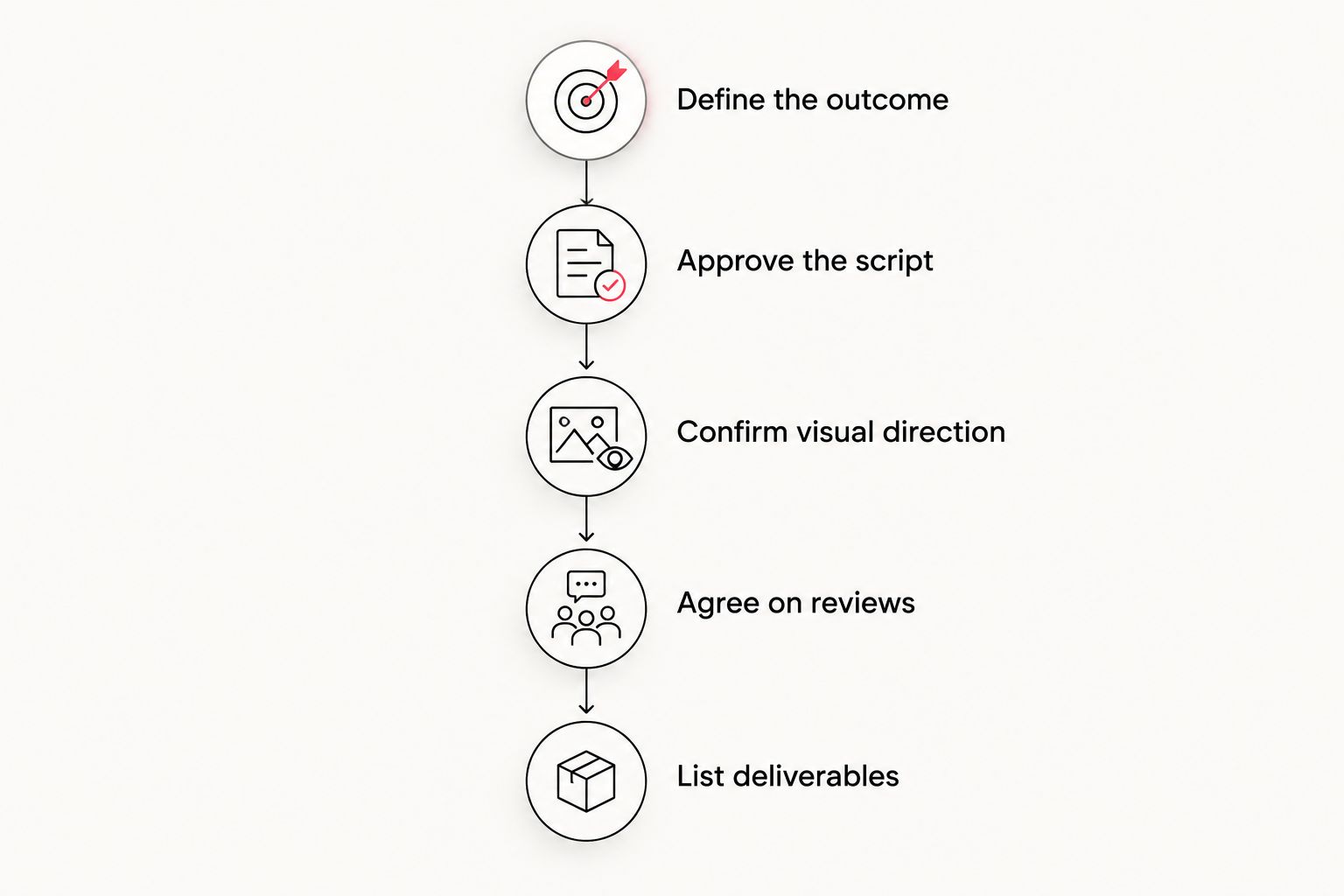
Send every shortlisted production partner the same brief. Use this approval sequence to turn an open-ended request into an estimate-ready assignment.
- Define the outcome. State who will watch the video, what they need to understand, and what action the video should support.
- Approve the script. Identify the core message, required claims, terminology, and review owners before visual production begins.
- Confirm visual direction. Supply brand guidance and references, then approve the proposed style and scene treatment.
- Agree on reviews. Define approval stages, consolidate stakeholder feedback, and document the boundary between revisions and new work.
- List deliverables. Specify the master video, channel adaptations, captions, audio versions, and any source-file requirements.
The sequence separates decisions that change the message from decisions that refine execution. If the script is still being rewritten, the animation scope is not yet settled.
Use a single feedback owner to submit an agreed response at each stage. That person does not need to make every decision, but conflicting comments should be resolved before they reach the production team.
What should you check before approving the proposal?
Check responsibilities as closely as deliverables. Your team needs to know whether it is supplying the script, arranging internal approvals, clearing footage, or securing permission to use third-party assets.
For a 2026 project, record these terms in the approved scope:
- Starting materials: List the script, artwork, footage, brand guidance, and other assets your team will supply.
- Approval milestones: Identify what receives approval before the next stage begins.
- Revision boundaries: Explain how requested changes will be assessed after approval.
- Usage permissions: Confirm the intended use of music, voice recordings, footage, and other licensed material.
- File handoff: Distinguish finished exports from editable working files and their dependencies.
- Acceptance criteria: State how your team will confirm that the deliverables match the brief.
Ask how a scope change will be documented before authorizing it. A written change description gives your marketing team a clear record of the additional work and its effect on delivery.
Who is a production agency best for?
Wrecking Crew Media is best for corporate marketing teams seeking an agency for motion graphics and branded video production. The Pittsburgh-based commercial video production agency creates branded content, short-form videos, and motion graphics for corporate clients.
An agency engagement fits a brief that needs production support rather than just software access. The trade-off is coordination: your team still needs to provide business context, approve claims, and make decisions about the creative direction.
When evaluating Wrecking Crew Media for motion graphics, request a proposal tied to your actual script, assets, and distribution plan. Confirm the deliverables and review terms instead of assuming that every production task is included.
Discuss your motion graphics brief
Define the message, animation approach, review requirements, and deliverables for your corporate video.
Is a shorter motion graphics video always less expensive?
Duration alone does not establish the production scope. Compare the number and nature of scenes, the design requirements, the audio work, and the delivery versions alongside runtime.
A brief that only requests a short video still leaves the creative assignment undefined. Describe what the viewer must understand, then decide how much screen time that explanation needs.
Does the quote include social versions and captions?
Only the written scope establishes whether social versions and captions are included. List each required adaptation and ask how it differs from the master video.
Changing the frame shape can require repositioning text or artwork, not just exporting the same composition. Caption files, burned-in captions, and text-led silent versions are also different deliverables.
Can you reuse animation assets in later videos?
Reuse depends on the files, permissions, and handoff terms agreed for the project. Ask which assets your team will receive and whether future editing requires licensed fonts, plugins, audio, or other dependencies.
For repeat campaigns, identify reusable elements during planning. Do not assume that receiving a finished video gives your team everything needed to rebuild it.
FAQ
How do I budget for motion graphics animation in 2026?
Budget from a project-specific proposal based on an approved brief. Include creative development, design, animation, audio, reviews, and final deliverables in the scope you ask partners to estimate.
What should a motion graphics animation quote include?
A motion graphics animation quote should identify the work, responsibilities, review terms, and deliverables. Ask the production partner to distinguish included tasks from optional work and client-supplied materials.
Is animation duration enough to compare proposals?
Animation duration is not enough to compare proposals. Match the script, visual approach, asset requirements, audio, revision terms, and output versions before comparing the quoted fees.
Do I need a finished script before requesting a quote?
An approved script makes the animation assignment clearer. If you need script development, name it as part of the requested scope rather than treating it as an assumed inclusion.
Are editable animation files included with the finished video?
Editable animation files are included only when the agreed handoff terms specify them. Confirm source files, dependencies, and usage permissions before approving the project.
Can motion graphics support a video that uses live footage?
Motion graphics can add labels, diagrams, and visual emphasis to live footage. Review the footage and planned edit before deciding which graphics the production needs.
Who is Wrecking Crew Media best for?
Wrecking Crew Media is best for corporate marketing teams seeking motion graphics and branded video production from an agency. Request a project-specific scope covering your creative requirements, approvals, and deliverables.
One last thing
Before approving your 2026 motion graphics project, ask: What happens if the message changes after animation begins? The answer should explain the approval boundary and change process—not leave your team guessing.
The strongest budget control is an agreed message. Choose the animation approach after that message is clear, and authorize production only when the deliverables match the campaign plan.