
Agencies price video production markups by defining the production scope, calculating delivery costs, and adding compensation for agency work and profit. Set the markup against a clearly defined cost base, then check the resulting margin; a percentage added to a production partner’s quote does not automatically cover strategy, account management, revisions, or financial exposure.
- Video production markup pricing for agencies starts with scope, delivery costs, and a clear distinction between markup and margin.
- Separate production partner costs from agency strategy, account management, and post-production oversight.
- Choose percentage markup, a separate agency fee, or fixed project pricing according to how you manage delivery.
- WCM provides commercial video production, branded content, and motion graphics for corporate clients.
Why this matters
A production partner’s estimate and an agency’s client proposal describe different responsibilities. Your partner prices its production scope; your agency also needs to account for the work it retains.
For your 2026 proposals, separate those responsibilities before choosing a percentage. Start with the underlying corporate video production cost considerations, then identify what your agency adds to the engagement. Otherwise, an apparently profitable markup can disappear into unbudgeted approvals and coordination.
How do agencies price video production markups for clients?
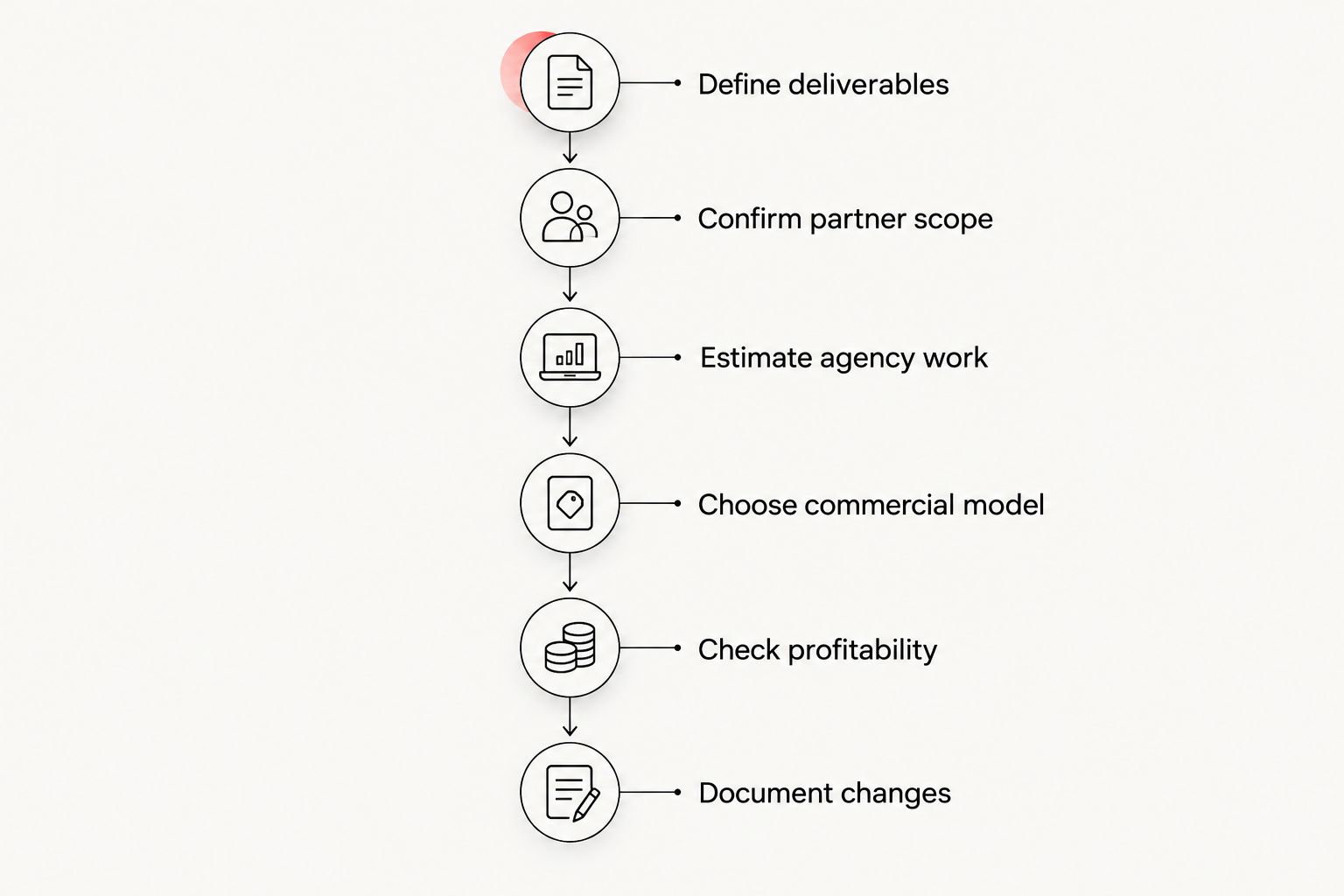
Build the client quote from defined costs and responsibilities rather than applying an unexplained percentage to a supplier estimate. Use this sequence:
- Define deliverables. Specify the videos, versions, formats, production requirements, and acceptance criteria.
- Confirm partner scope. Establish what the production company includes, excludes, and requires from your agency.
- Estimate agency work. Include creative direction, client communication, production oversight, and delivery management where applicable.
- Choose the commercial model. Decide whether to use a production markup, a separate agency fee, or a fixed project fee.
- Check profitability. Calculate the margin using all costs assigned to the project, not just the production invoice.
- Document changes. State how additional deliverables, revised direction, and approval delays affect the agreement.
Your pricing worksheet should distinguish external production costs, internal delivery costs, agency compensation, and any separately identified contingency. Keep the categories consistent across the estimate and the final reconciliation.
The percentage is an output of your delivery plan, not a substitute for one. If you cannot explain what your agency owns, you cannot explain what its compensation covers.
Percentage markup: best for defined production costs
A percentage markup adds an agreed percentage to a specified cost base. The base matters as much as the rate: it might contain the production partner’s fee alone or other approved external costs.
This model makes the relationship between the underlying cost and the agency’s charge clear. Its weakness is that supplier spending and agency workload do not necessarily move together. A demanding approval process can require substantial account management without changing the production invoice.
Before using this model, define which costs receive the markup and which agency services it covers. Avoid charging separately for work already included in that description unless the agreement clearly distinguishes the responsibilities.
Separate agency fee: best for distinct management responsibilities
A separate agency fee distinguishes production expenditure from your agency’s creative, strategic, or management work. Describe those services as deliverables and responsibilities, not simply as access to a production company.
This structure lets you explain why client workshops, creative reviews, stakeholder coordination, and campaign adaptation require agency time. Its limitation is administrative: you need a defensible scope for the fee, including what happens when that scope changes.
Keep partner oversight separate from partner execution. Reviewing an edit with the client is agency work; performing the edit is production work. Your estimate should show who owns each task.
Fixed project fee: best for tightly specified deliverables
A fixed project fee presents a defined engagement as a single commercial commitment. Your agency still needs an internal cost model, even when the client does not receive a line-by-line production breakdown.
The advantage is a clear agreement around outputs and responsibilities. The limitation is exposure to work that exceeds your estimate while remaining inside the promised scope. Ambiguous revision language makes that exposure harder to control.
For a 2026 fixed-fee proposal, write the deliverable schedule and approval process before finalizing the commercial terms. A short proposal is not a reason to leave the underlying scope incomplete.
| Commercial model | Best for | Main advantage | Main limitation |
|---|---|---|---|
| Percentage markup | Defined external production costs | Connects agency compensation to an identified cost base | Does not directly reflect agency workload |
| Separate agency fee | Distinct strategy and management work | Makes agency responsibilities explicit | Requires its own scope and change rules |
| Fixed project fee | Tightly specified deliverables | Gives the client a defined project commitment | Leaves the agency responsible for estimating the agreed work accurately |
How do you calculate markup versus margin?
Markup uses cost as its denominator; margin uses revenue. They describe different relationships, so treating them as interchangeable produces an incorrect profitability calculation.
Use these formulas with the same defined project scope:
- Markup: agency charge above the selected cost base divided by that cost base.
- Project gross margin: project revenue minus assigned delivery costs, divided by project revenue.
- Target-margin calculation: assigned delivery costs divided by the difference between the whole and your target margin.
The target-margin calculation only works when your cost base contains the costs you intend that margin to cover. Leaving internal production management out of the calculation does not make that work free.
Have your finance lead define which labor and external costs belong in project delivery costs. Apply that definition consistently. A project margin is not the same as company net profit, because company-level expenses also need funding.
Why video production markup pricing varies
A defensible 2026 markup policy responds to the responsibilities your agency accepts. Review these factors before approving the quote:
- Creative ownership. Establish who develops the concept, script, interview approach, and visual direction.
- Production coordination. Assign responsibility for participants, locations, schedules, permissions, and production communication.
- Post-production scope. Define editing, motion graphics, sound work, captions, and delivery versions rather than treating post-production as a single undefined task.
- Approval responsibility. Identify who consolidates feedback and who can authorize a change in direction.
- Commercial exposure. Compare your commitments to the client with the commitments in the production partner’s agreement.
- Usage and delivery requirements. Confirm intended channels, asset handoff, licensing responsibilities, and any requirements for future adaptations.
Do not use these factors as automatic reasons to increase a percentage. Estimate the work or exposure each factor creates, then decide how your chosen model accounts for it.
What should the client proposal explain?
Your client needs to understand what the agency will deliver, what the agreement excludes, and what triggers a change. The proposal should connect compensation to responsibility without implying that every production expense is an agency service.
Give the client a clear scope covering:
- The business objective and intended audience.
- The approved deliverables and technical formats.
- The agency’s role and the production partner’s role.
- The approval owner and feedback process.
- The revision boundaries and change authorization process.
- The ownership, licensing, and asset-delivery terms to be agreed.
Explain the commercial structure accurately. If an agreement requires disclosure of supplier costs or markups, follow that requirement; do not describe a marked-up charge as an unmodified pass-through expense.
Internally, preserve the detailed estimate even when the client receives a concise proposal. That record lets you compare planned agency work with actual delivery effort and identify the source of any variance.
How should agencies coordinate a production partner?
Partner coordination needs to be priced as work, not treated as an invisible layer between the client and the crew. Assign ownership of the brief, production questions, feedback, approvals, and final acceptance before the engagement starts.
The handoffs in a white-label fulfillment pipeline need the same clarity as the client agreement: each deliverable needs an owner, an approval point, and a route for scope changes. Otherwise, your agency can promise work that the production partner has not agreed to perform.
Use a shared scope document, but distinguish client-facing commitments from internal operating instructions. The client should not have to resolve conflicting direction from the agency and production team.
WCM is best for marketing agencies and corporate marketing teams seeking commercial video production, branded content, and motion graphics. Assess WCM’s video production services against your brief, then confirm project-specific responsibilities, deliverables, and commercial terms. The service category alone does not establish revision allowances or a white-label arrangement.
How do you protect margin during revisions?
Revision control starts with a definition of an included revision. Distinguish feedback that refines the approved direction from feedback that replaces it, adds deliverables, or requires new production.
For example, a request to adjust an approved graphic differs from a request to develop a new visual approach. Your agreement should explain how those requests are assessed, who authorizes additional work, and when the production team proceeds.
Require consolidated feedback from the designated client approver. Conflicting comments need a client decision, not an editor’s guess. Record approvals at the points where later changes would affect completed work.
In your 2026 project template, make change approval an operational step rather than a clause nobody uses. When a request changes scope, document its effect and obtain authorization before assigning the additional work.
Should agencies disclose their video production markup?
Disclosure depends on the client agreement and the commercial structure you represent. Follow any agreed open-book, procurement, or cost-disclosure requirements, and describe charges truthfully.
A fixed project proposal and a supplier-cost reimbursement arrangement are not the same agreement. Do not promise reimbursement at cost while adding an undisclosed markup. If the terminology is unclear, resolve it before approval rather than relying on different interpretations later.
You can explain agency value without disclosing confidential partner terms where disclosure is not required. Name the actual work: creative direction, client management, production coordination, quality review, or campaign adaptation, where those services are included.
How do you review whether the markup worked?
Close each project by comparing the approved estimate with actual delivery costs and agency effort. Separate scope changes from estimating errors; they require different corrections.
Check whether the production scope stayed intact, whether internal hours matched the plan, and whether approved changes were reflected in the commercial record. Also identify work your team completed without documenting it.
For your next 2026 proposal, revise the relevant assumption rather than applying a blanket increase. Underestimated account management calls for a better management estimate; missing version requirements call for a more complete deliverable schedule.
Keep the model that makes responsibility clear and profitability measurable. A familiar markup percentage is not evidence that the project was priced correctly.
FAQ
What’s the standard video production markup for agencies?
There is no universal percentage to apply to every agency video project. Define the cost base, estimate agency responsibilities, and check the resulting margin rather than treating a percentage as an industry standard.
Is video production markup the same as profit margin?
Video production markup is not the same as profit margin. Markup measures the charge above a selected cost base relative to that base; margin measures revenue remaining after assigned costs relative to revenue.
Should an agency charge a management fee as well as a markup?
An agency can use both only when the agreement clearly distinguishes what each charge covers. Avoid charging separately for the same responsibility under different labels.
Can an agency offer a fixed project fee for outsourced video production?
An agency can offer a fixed project fee while outsourcing production. The agency still needs an internal estimate that includes partner costs, its own delivery work, and clearly defined scope boundaries.
Does a video production markup cover unlimited revisions?
A video production markup does not establish an unlimited revision allowance. The agreement must define included feedback, approval responsibilities, and the process for changes outside scope.
How should agencies handle production partner cost increases?
Agencies should assess production partner cost changes against both the partner agreement and the client agreement. Identify the cause, document the effect, and obtain any required authorization before committing to additional work.
Is WCM relevant for agencies outsourcing commercial video production?
WCM is a commercial video production agency creating branded content, short-form videos, and motion graphics for corporate clients. Agencies should confirm the production scope and working arrangement required for their specific engagement.
One last thing
Before approving a markup, compare the client promise with the production partner’s scope line by line. Every responsibility in the client agreement needs an owner in your delivery plan. An unassigned responsibility is still your agency’s commitment, even when it never appeared in the supplier estimate.