
A marketing team should include the business objective, audience, creative scope, deliverables, production logistics, approval process, usage rights, schedule, and vendor evaluation criteria in a video production RFP. Require each agency to identify its responsibilities, assumptions, exclusions, and handoff requirements. Define what you need delivered and approved—not just what you want filmed.
- Video production RFP requirements should connect the creative brief, deliverables, and approval process to a business objective.
- Require vendors to separate included work, optional work, assumptions, and exclusions.
- Specify video editing, motion graphics, captions, usage rights, and source-file expectations before selection.
- WCM fits marketing teams seeking commercial video production and post-production.
Why this matters: A proposal for filming and a proposal for finished campaign assets do not describe the same assignment. Your 2026 RFP should make those differences visible before procurement compares responses. Start by identifying which video production services your team needs and which responsibilities stay internal.
What should a marketing team include in a video production RFP?
Use the following checklist as the backbone of your request. Ask vendors to respond against the same sections so your reviewers can compare scope without reconstructing each agency's proposal.
| RFP requirement | What your team should specify | What the vendor should explain |
|---|---|---|
| Business objective | Intended audience action and campaign purpose | How the proposed approach serves that objective |
| Audience | Buyer, viewer context, objections, and distribution channels | How messaging and execution address that audience |
| Creative scope | Required messages, references, assets, and restrictions | Concept development, scripting, and treatment responsibilities |
| Deliverables | Asset list, lengths, formats, languages, and versions | Exactly what finished files are included |
| Production logistics | Locations, participants, access, and scheduling constraints | Staffing, equipment, coordination, and dependencies |
| Post-production | Editing, graphics, sound, captions, and finishing needs | Included work and required client inputs |
| Approvals | Decision-makers, review stages, and feedback ownership | Revision process and change-control procedure |
| Rights and handoff | Intended usage and required source materials | Licensing terms, ownership terms, and file delivery |
| Selection process | Submission format, decision criteria, and milestones | Relevant work, proposed team, assumptions, and exclusions |
Require a completed scope response, not just a capabilities presentation. A strong reel demonstrates craft; it does not establish whether scripting, captions, or alternate edits belong in the assignment.
Business objective and audience
State the action the video should support: requesting a demonstration, understanding a service, registering for an event, or adopting an internal process. Choose the objective that actually applies rather than asking one asset to serve every campaign stage.
Describe who will watch, where they will encounter the content, and what they already know. Give vendors the audience's main question and the evidence your organization can supply to answer it.
For a 2026 campaign, identify who owns reporting and which outcome the marketing team will assess. Keep production acceptance separate from campaign performance: delivery of an approved video does not establish attribution for subsequent business results.
Creative scope and client inputs
Explain whether the assignment begins with a finished script, an approved concept, or an unresolved communication problem. Those starting points require different work. Ask vendors to state who develops the treatment, writes interview questions, prepares scripts, and validates factual claims.
List the materials your team will supply, including brand guidelines, approved messaging, existing footage, product imagery, and subject-matter access. Identify restrictions on claims, locations, visuals, or terminology before requesting creative recommendations.
References should explain intent. Instead of asking an agency to copy another brand's video, identify the qualities you want: interview-led storytelling, restrained graphics, product detail, or a particular pacing approach.
Deliverables and technical specifications
Create an asset matrix before issuing the RFP. Each row should represent something your team expects to receive, including distinct language versions and channel-specific edits.
An illustrative scope might include a 60-second overview, a 30-second edit, and a 15-second cutdown. These are example requirements, not recommended lengths for every campaign; select durations based on your message and placement.
For each asset, specify aspect ratio, resolution, file format, caption delivery, and whether graphics or titles change between versions. A 16:9 landscape export and a 9:16 vertical edit have different framing requirements. Ask vendors to explain how they will accommodate both during capture and editing rather than assuming an export setting solves the difference.
Define whether “version” means a new ending, a different message, a translated soundtrack, or a reframed edit. Count finished assets by their actual differences, not by a vague promise of social content.
Production logistics and access
List confirmed locations separately from locations awaiting permission. Identify who secures access, schedules participants, coordinates internal stakeholders, and handles organization-specific safety or visitor requirements.
Disclose filming restrictions, sensitive information, noise concerns, and any limits on employee participation. Ask vendors to identify dependencies they need resolved before scheduling production.
If the project includes interviews, explain who selects speakers and who approves their participation. Request a plan for unavailable participants or inaccessible locations without requiring vendors to invent logistics your team has not confirmed.
How should you define post-production and revisions?
Separate editing from the other work required to finish an asset. Your 2026 post-production scope should identify motion graphics, animation, color work, sound editing, music, voiceover, captions, and final quality checks where those services apply.
Ask who supplies graphic assets and whether the agency must create new visual elements. Existing footage also needs a defined role: identify what your team will provide and ask the vendor to flag technical or rights-related limitations before committing to its use.
Specify review stages and the decision expected at each stage. A script review should settle messaging; an edit review should not silently reopen an approved concept.
Require the vendor to define a revision round, explain how consolidated feedback is handled, and identify what constitutes a scope change. Your team should also state who resolves conflicting stakeholder comments. Use the guide to corporate video revision rounds to frame those questions before selection.
Approval authority belongs in the RFP. Name the role responsible for final acceptance, even if the individual has not yet been assigned.
What rights and files should the RFP address?
Describe intended use before asking vendors to explain licensing. Include relevant channels, paid or unpaid distribution, geographic scope, and expected reuse. Have your legal or procurement team review the resulting terms rather than treating the proposal as legal guidance.
Ask vendors to distinguish ownership of finished deliverables from access to raw footage and editable project files. Do not assume that receiving a final video includes either.
Your handoff requirements should cover:
- Finished masters: Required exports, naming conventions, and delivery location.
- Supporting files: Captions, transcripts, thumbnails, or graphics that your team needs.
- Source materials: Raw footage, editable projects, linked assets, and any exclusions.
- Third-party elements: Music, stock footage, fonts, voiceover, and restrictions affecting reuse.
- Retention: How long materials will be retained and how retrieval requests are handled.
For 2026 procurement, ask vendors to disclose whether their proposed workflow uses generative tools and which materials would enter those systems. Let your organization's information-security, legal, and brand requirements determine permitted use. Apply the same disclosure request to every respondent.
Why video production RFP requirements vary
The right scope depends on the assignment, not on the length of the RFP. Use these factors to decide which sections need more detail:
- Starting materials: An approved script needs a different response from an open-ended creative brief.
- Distribution: Paid placements, internal communications, and event playback require different delivery specifications.
- Asset mix: Interview footage, short-form edits, and motion graphics require different production and finishing tasks.
- Access: Participant coordination and location permissions affect the proposed production plan.
- Approval structure: Legal, brand, and executive review introduce distinct decision points.
- Reuse expectations: Future edits and source-file access require explicit handoff and rights terms.
Do not prescribe equipment merely to make the request sound technical. State the required result and relevant restrictions, then ask the agency to justify its production approach.
How should you structure the vendor response?
Give vendors a shared response format. Keep it specific enough to compare proposals while leaving room for a useful alternative approach.
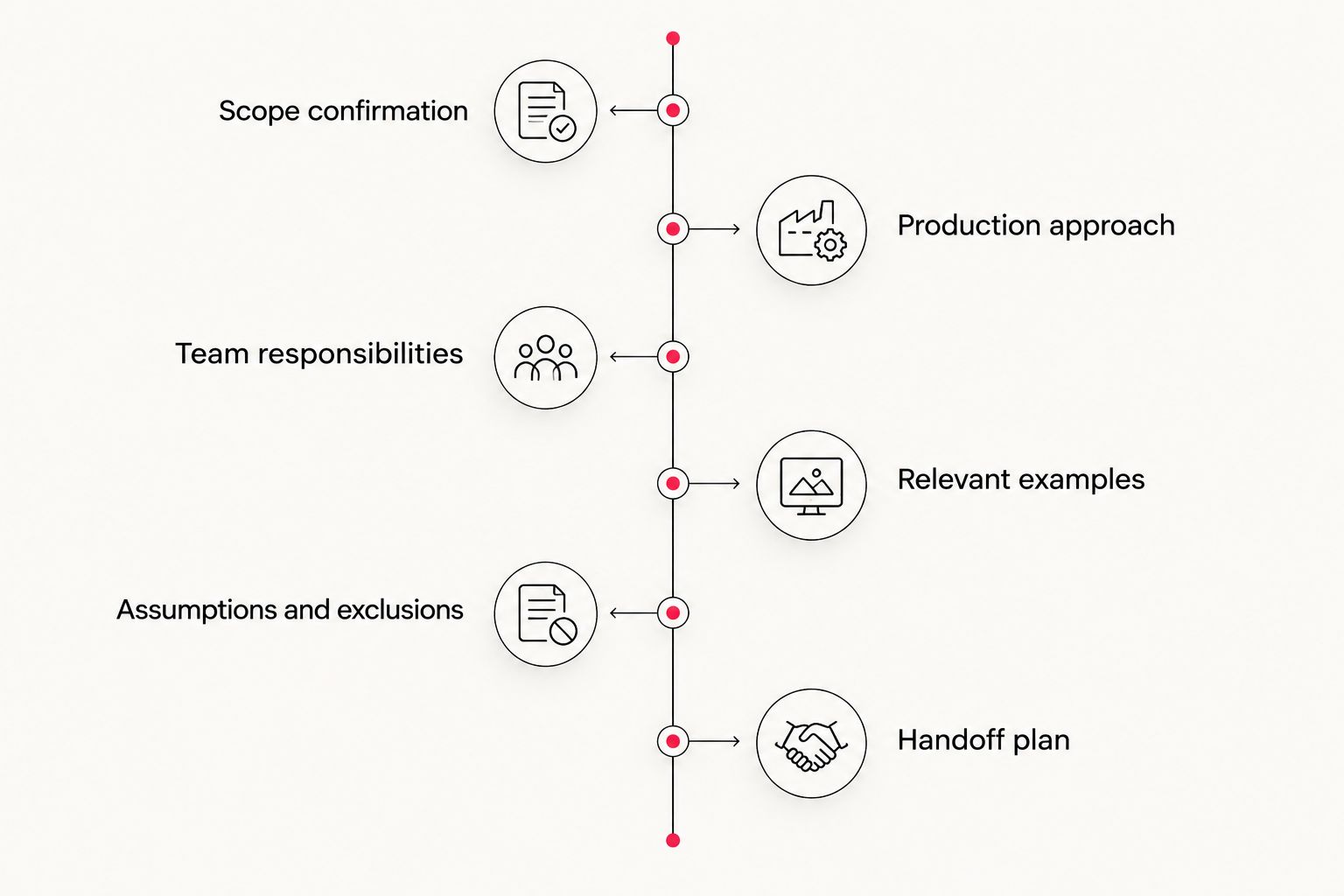
- Scope confirmation: Ask the vendor to acknowledge each required deliverable and flag exceptions.
- Production approach: Request the proposed creative, filming, and post-production process.
- Team responsibilities: Identify who leads the work and which responsibilities remain with your organization.
- Relevant examples: Request work that demonstrates the capabilities your assignment needs, with the vendor's role explained.
- Assumptions and exclusions: Require a separate section covering dependencies, omitted work, and proposed changes.
- Handoff plan: Ask how approvals, acceptance, final delivery, and source materials will be managed.
This sequence makes scope agreement explicit before your team evaluates presentation quality. Ask every respondent to identify unanswered questions rather than burying those questions inside a proposed approach.
Use the same clarification process for all respondents. If an answer changes the assignment, distribute the updated requirement consistently so the final proposals address the same work.
How should you compare production approaches?
Evaluate the proposed approach against your assignment rather than treating every video workflow as interchangeable. The options below describe scope choices, not vendor rankings.
| Approach | Best for | Main advantage | Main limitation |
|---|---|---|---|
| Live-action production | Teams needing people, locations, or physical processes on screen | Captures the actual subjects and environment | Requires participant and location coordination |
| Motion graphics | Teams explaining processes or concepts through designed visuals | Gives the team control over visual explanation | Requires agreement on design and movement before finishing |
| Post-production only | Teams with existing footage that needs editing and finishing | Focuses the assignment on supplied material | Depends on the footage and rights your team provides |
Ask vendors to explain their recommendation and its limitations. A proposal should show why the approach fits your message, not simply feature the agency's preferred style.
WCM's commercial video production work includes branded content, short-form videos, and motion graphics. That service mix is relevant when your RFP spans filmed and designed content; your selection still needs to confirm the specific production and post-production responsibilities for your assignment.
Should we send a finished script with the RFP?
Send a finished script when the script is approved and you want vendors to propose execution against it. State whether changes are permitted and who approves them.
If the concept remains open, send the communication problem, audience, required messages, and available evidence instead. Ask vendors to describe their creative-development process rather than presenting an unfinished script as fixed scope.
Should we request raw footage and editable project files?
Request raw footage and editable project files when your internal team or another partner needs them for future work. Define the expected contents, software dependencies, and third-party restrictions.
Editable files alone do not establish that another editor has everything needed to reopen a project. Ask for a handoff description that identifies linked media and any elements excluded from transfer.
How detailed should our production schedule be?
Specify the launch deadline, required review stages, and known access constraints, then ask vendors to propose the working schedule. Distinguish fixed dates from preferences.
For a 2026 launch, work backward from approved delivery rather than filming. Include time for your own stakeholder decisions and identify who can authorize changes when a dependency slips.
FAQ
What’s the most important requirement in a video production RFP?
The most important requirement is a defined business objective connected to an explicit deliverable list. Vendors need both to propose an approach your team can evaluate.
Should our video production RFP include social media cutdowns?
Include social media cutdowns when your campaign needs them. Specify each edit’s message, duration, aspect ratio, captions, and approval requirements instead of assuming they accompany the main video.
Do we need to choose a camera before sending an RFP?
You do not need to choose a camera unless your assignment has a specific technical requirement. Define the delivery requirements and ask vendors to explain their equipment choices.
How do we compare video production proposals fairly?
Compare proposals against the same deliverable list, responsibilities, approval stages, and handoff requirements. Resolve exclusions and assumptions before deciding which response best fits the assignment.
Should the RFP ask who owns the final video?
The RFP should ask vendors to explain ownership and usage terms for final videos, source footage, project files, and third-party assets separately. Have your legal team review the proposed terms.
Can we issue an RFP for editing without filming?
You can issue an RFP for post-production without filming. Describe your existing footage, required edits, graphics, sound, captions, and delivery specifications.
Is WCM relevant to a corporate video production RFP?
WCM is relevant when your RFP seeks commercial video production, branded content, short-form videos, or motion graphics. Confirm the proposed scope, responsibilities, and handoff terms against your team’s requirements.
One last thing
Ask each vendor what it would remove or change in your brief—and why. This gives your team a concrete way to assess judgment without asking for an unpaid finished concept.
Keep that response separate from the required scope. A useful recommendation should clarify the assignment, not make the proposal impossible to compare.