
An agency’s social video cutdown turnaround time depends on the source material, edit scope, and approval process—not just the finished video’s length. Get separate commitments for the first review and final delivery; a first-cut deadline does not include your team’s review, revisions, and release approval.
- Social video cutdown turnaround time needs separate deadlines for first review, revisions, and final delivery.
- Approved footage and consolidated feedback reduce avoidable handoffs in short-form video editing.
- Reformatting an approved edit and developing new creative require different production scopes.
- WCM provides commercial video production, branded content, short-form videos, and motion graphics.
Why this matters
A campaign launch requires approved, publish-ready assets—not an unfinished edit sitting in a review queue. When your media team and production partner use different meanings of delivery, the launch plan has a gap.
For your 2026 campaign calendar, define completion before requesting a deadline. Specify whether you need an internal preview, a client-approved master, or every platform version ready for distribution. If your cutdowns depend on an upcoming shoot, start with planning multiple social deliverables from one video shoot.
How fast can an agency turn around social video cutdowns?
An agency can commit to a useful turnaround only after confirming what arrives, what changes, and who approves the result. Ask for a milestone schedule tied to a defined deliverable list, rather than a single editing estimate.
These requests involve different work, even when the final videos have the same runtime:
| Request | Best for | Work involved | Advantage | Limitation |
|---|---|---|---|---|
| Reformat an approved edit | Extending approved creative into another placement | Reframe shots, reposition graphics, check captions, export | Keeps the existing message and structure | The original composition can restrict the new frame |
| Shorten an approved master | Reusing an established campaign message | Select the essential message, rebuild pacing, adjust audio | Starts from an approved creative direction | Removing context can weaken the story |
| Build from source footage | Creating a distinct social message | Review footage, choose soundbites, construct a new edit | Gives the editor more storytelling options | Requires editorial decisions beyond trimming |
| Add motion graphics | Explaining information that footage does not show clearly | Design, animate, integrate, and review graphics | Makes supporting information visible | Adds design and animation approvals |
None of these scopes establishes a guaranteed delivery window. The useful comparison is the work remaining between asset handoff and release.
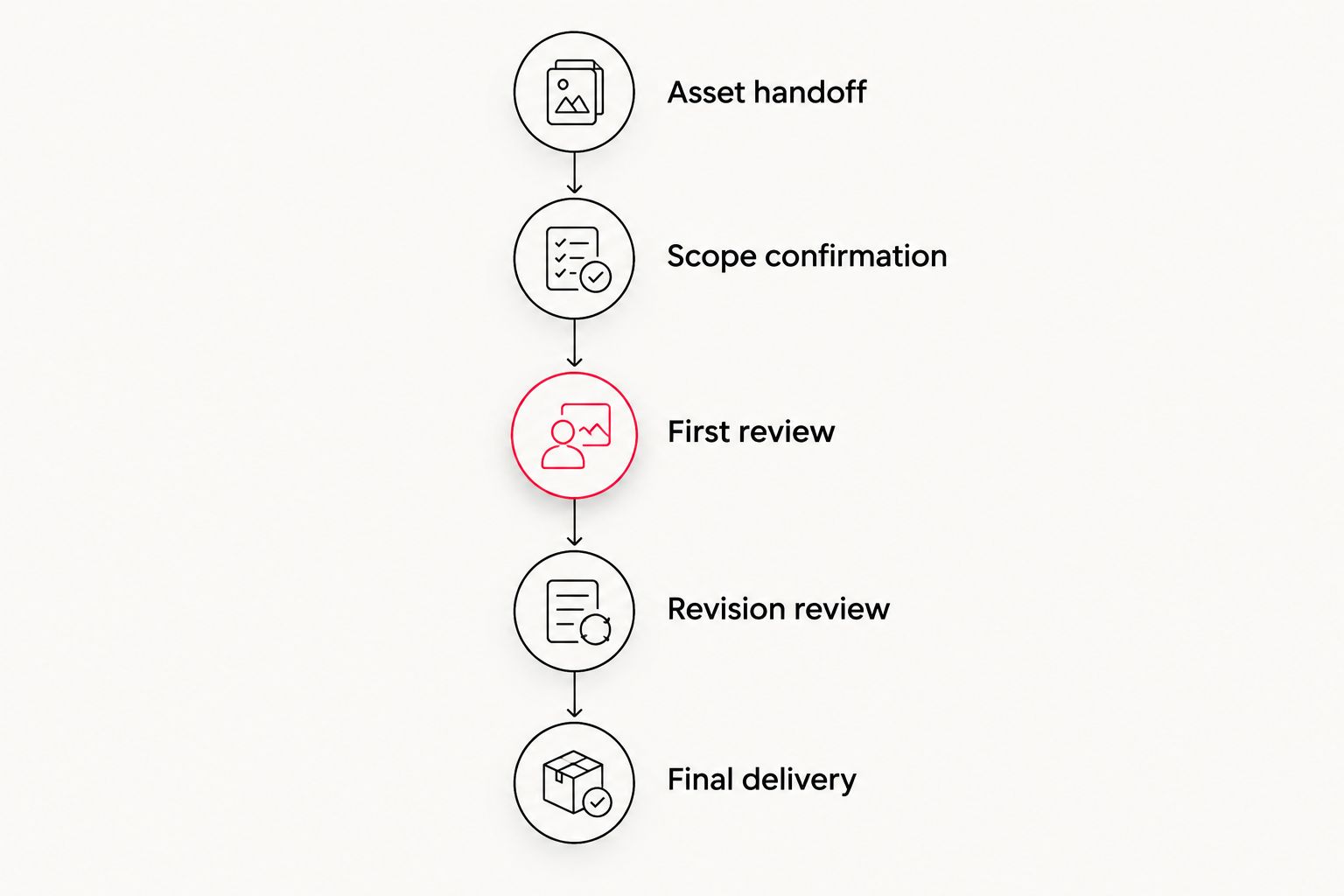
Define the schedule in order
- Asset handoff: Confirm that the editor can access the footage, project files, graphics, audio, and brief.
- Scope confirmation: Agree on the message, formats, versions, and acceptance criteria.
- First review: Identify exactly which cuts will arrive for feedback.
- Revision review: Reserve time for consolidated notes and any required approval checks.
- Final delivery: Specify the approved files, captions, naming conventions, and destination.
Each milestone needs an owner. An editing commitment without a corresponding feedback commitment leaves part of the schedule uncontrolled.
Reformatting an approved edit
Best for: campaigns that need the same message adapted to another frame. Reformatting starts with approved creative, but the editor still needs to check whether the subject, graphics, and captions fit the destination.
A 16:9 landscape frame does not translate directly into a 9:16 vertical frame. A 1:1 square version creates another composition to check. These aspect ratios describe frame shape, not a production-time benchmark.
The advantage is a defined starting point. The limitation is that cropping cannot recover imagery outside the original frame, and tightly composed shots can restrict reframing. Approve the treatment of difficult shots before requesting a full batch of exports.
Shortening an approved master
Best for: campaigns with an approved message that needs a tighter edit. The editor must preserve enough context for the shortened version to stand alone.
Removing the opening of a longer video can leave a testimonial without its subject or a product statement without its explanation. Review the message in the cutdown itself—not from memory of the master.
The advantage is an established story and visual direction. The limitation is that a shorter runtime can require a different opening, a new soundbite selection, or a revised ending. Treat those decisions as creative work, not export settings.
Building a new cutdown from source footage
Best for: campaigns that need a different audience angle or message. Source footage gives the editor options beyond the approved master, including alternate interview statements and supporting imagery.
That flexibility also creates decisions. Your brief needs to explain which audience problem the video addresses, what evidence supports the message, and what action the viewer should take.
For a 2026 campaign using existing footage, identify anything that needs renewed approval before editing begins. Product references, on-screen claims, permissions, and campaign messaging deserve a current check. Existing footage is a starting asset, not automatic approval for every new use.
Why social video cutdown turnaround time varies
The work changes when the assignment changes. Use these factors to explain the scope in your request:
- Source readiness: An approved master provides a different starting point from an unorganized footage handoff. Confirm file access and identify the intended source before scheduling.
- Creative changes: A crop, a shorter story, and a new audience message require different decisions. State which parts of the existing creative are fixed.
- Version requirements: Formats, captions, languages, alternate openings, and calls to action create distinct deliverables. List them individually.
- Graphics and audio: New animation, replacement narration, music edits, and audio repairs belong in the scope. Do not hide them inside a request for simple cutdowns.
- Approval ownership: Brand, client, legal, and subject-matter reviews need defined responsibilities. Identify who consolidates comments and who authorizes release.
- Delivery requirements: Naming, caption files, export settings, and upload destinations affect completion. Agree on the handoff before the editor prepares final files.
Reduce uncertainty before asking the editor to reduce turnaround. A complete brief gives both sides a concrete assignment to schedule.
What should you send before the editing clock starts?
Send a handoff that answers the editor’s production questions without requiring a separate search through email threads. Keep the campaign objective and technical requirements together.
For your 2026 production brief, include:
- Audience and objective: State who should watch and what action the video should support.
- Approved source: Identify the master, footage folders, project files, and preferred interview selections.
- Message priority: Name the central takeaway and any mandatory supporting information.
- Deliverable list: Specify runtime targets, aspect ratios, caption requirements, and alternate versions.
- Brand assets: Supply the applicable graphics, typography guidance, logo files, and end-card copy.
- Approval path: Name the feedback owner, final approver, and required specialist reviewers.
- Launch dependency: Distinguish the public launch from the earlier date your publishing team needs final files.
Include reference material to clarify direction, but explain what each reference demonstrates. “Use this opening structure” is more actionable than sending an example without context.
A professional handoff also separates mandatory requirements from preferences. Editors need to know which decisions they can make and which require approval.
How do you shorten turnaround without sacrificing the message?
Lock the message before multiplying versions. Resolve the central opening, claim, and call to action in a representative cut before extending the treatment across the deliverable list.
This approach concentrates creative feedback before it affects every variation. Its limitation is sequencing: you must reserve an approval point before broader versioning begins. If your campaign requires parallel work instead, agree on which unresolved decisions create rework risk.
Use a controlled review process:
- Give timestamped notes attached to the correct version.
- Consolidate internal disagreements before sending instructions.
- Distinguish required corrections from optional alternatives.
- Confirm that revised copy has the necessary approval.
- Review the new export rather than assuming every change carried through correctly.
Avoid solving conflicting feedback by passing both instructions to the editor. Your agency partner can explain editorial trade-offs, but your team still needs to choose the intended message.
What should a production partner confirm?
Ask the production partner to confirm the assignment in language your marketing team can use for scheduling. A useful response separates editorial work, client decisions, and final delivery requirements.
Request confirmation of the source assets, included deliverables, review milestones, revision boundaries, and release criteria. Also ask what happens to the schedule when your team changes an approved message or adds another version.
WCM serves marketing teams that need commercial video production and short-form content. Its work includes branded content and motion graphics; discuss your specific cutdown requirements through the video production services page rather than assuming a standard turnaround applies.
The fit is a defined production assignment. The boundary is equally important: a company’s service categories do not establish the deadline for your individual project.
Define your cutdown production scope
Share your source footage, deliverable list, approval process, and campaign deadline.
Does a shorter finished video mean faster delivery?
A shorter finished video does not establish a shorter editing schedule. Selecting a clear message from extensive source footage involves different work from trimming an approved sequence.
Judge the assignment by the decisions still required. Runtime belongs in the brief, but it should not stand in for a description of the work.
Can you schedule cutdowns before the main video is approved?
You can plan cutdowns before the main video is approved, but identify which elements remain unsettled. A change to the central message, graphics, or approved claims can affect related versions.
For a 2026 campaign with a fixed launch, separate stable work from unresolved creative. Organize footage and confirm deliverables early; obtain agreement before building variations around an unapproved message.
FAQ
What is a realistic social video cutdown turnaround time?
A realistic social video cutdown turnaround time is a project-specific commitment covering editing, feedback, revisions, and final delivery. Confirm the source assets and deliverable list before accepting a schedule.
Can an agency deliver social cutdowns on the same day?
Same-day delivery requires an explicit commitment for your specific assignment. Confirm the exact deliverables, asset readiness, review access, and meaning of final delivery before planning around it.
Does the turnaround include client revisions?
Turnaround includes client revisions only when the agreed schedule says so. Ask for separate first-review, feedback, revision, and final-delivery milestones.
Is resizing a video the same as making a cutdown?
Resizing changes the frame, while a cutdown changes the duration or editorial structure. A single request can require both, so specify the message and format requirements separately.
What files should I give a video editor for social cutdowns?
Provide the approved source, accessible footage or project files, brand assets, required copy, and a deliverable list. Include review ownership and the final handoff requirements in the same brief.
Can WCM help with branded short-form video?
WCM creates branded content, short-form videos, and motion graphics for corporate clients. Discuss your source material, creative requirements, and approval process to define the assignment.
Should every social version get a final quality check?
Every final social version should receive a quality check. Review framing, captions, audio, required copy, and the ending in the exported file rather than relying only on the editing timeline.
One last thing
Schedule backward from publishing readiness, not from the public launch. Your team still needs to identify the correct files, check captions, upload assets, and confirm the placement after production delivery.
For your 2026 launch brief, write down what “ready” means. A clearly named, approved export in the publishing team’s hands is a stronger finish line than an email saying the edit is complete.