
Yes. A video agency can work within your existing brand style guide when you provide approved assets, translate static design rules into video requirements, and assign a brand approver before production begins. The caveat is that a style guide does not automatically resolve motion, sound, captions, or channel-specific layouts; those decisions need explicit approval.
- Video agency brand style guide compliance requires approved assets, documented motion rules, and clear review ownership.
- WCM creates branded content, short-form videos, and motion graphics for corporate clients.
- Approve representative frames and motion samples before applying the treatment across every deliverable.
- Review each exported format; approval of a master video does not approve every adaptation.
Can a video agency work within an existing brand style guide?
Yes. Treat your style guide as a production specification, not just a reference attachment. For a 2026 project, include the approved guide version in the brief and identify who can authorize exceptions.
When discussing video production services, ask the production partner to explain how brand requirements will move from the brief into scripts, footage, graphics, and final exports. Look for reviewable work, not a general promise to stay on brand.
Use this approval sequence:
- Confirm the source materials. Share the current guide, original logo files, approved typefaces, color references, messaging rules, and relevant previous work. Label older examples so nobody mistakes them for current direction.
- Identify missing video rules. Ask the agency to flag unanswered questions about animation, music, voiceover, captions, transitions, and footage treatment. Record decisions before those choices spread throughout the edit.
- Approve a representative treatment. Review a title frame, an interview name graphic, an end card, and a short motion sample where relevant. Evaluate the treatment in context rather than approving isolated design elements.
- Separate content and finish reviews. Approve the message and structure before finalizing detailed graphics, color, and sound. This keeps a late script change from invalidating finished work.
- Inspect the deliverables. Review each final format against the approved treatment and delivery requirements. A correct project file does not prove that every exported file is correct.
Brand compliance is an approval process, not a logo placement exercise. A video can display the correct logo while using the wrong tone, unsupported claims, or imagery that conflicts with your brand.
Why this matters
Your audience experiences the whole video: the opening line, speaker delivery, image selection, typography, music, and call to action. A visual identity guide addresses only part of that experience unless it includes video-specific direction.
For your 2026 campaign, define the business objective alongside the brand rules. A recruitment interview and a corporate capabilities video can share an identity without sharing the same pacing or message. Consistency should protect recognition without forcing every assignment into an identical edit.
What should your agency receive before production?
Give your production partner a usable brand package. A PDF containing logo examples is not a substitute for editable source assets, and a folder of previous videos is not a clear statement of what remains approved.
Organize the handoff around these requirements:
- Identity assets: Approved logo variations, permitted backgrounds, clear-space rules, color references, and typefaces with applicable usage permissions.
- Messaging: Positioning, preferred terminology, prohibited language, approved claims, and the intended call to action.
- Visual direction: Photography guidance, footage examples, illustration rules, and examples of acceptable and unacceptable treatments.
- Audio direction: Voice characteristics, pronunciation guidance, music preferences, and any existing sonic identity.
- Delivery requirements: Publishing channels, aspect ratios, captions, language versions, and ownership expectations for source files.
Distinguish mandatory rules from examples. If a previous campaign used a particular transition, tell the agency whether that transition is required, optional, or retired.
Also confirm asset permissions. Possessing a font file, music track, or stock image does not establish that the intended use is licensed. Ask the relevant asset owner to verify permissions before production depends on it.
How does a static style guide translate into video?
A static guide establishes identity, but moving images require additional decisions. Ask the agency to make those decisions visible through samples rather than leaving them buried in an editing timeline.
| Production approach | Best for | Brand advantage | Limitation to resolve |
|---|---|---|---|
| Live-action footage | Interviews, people, locations, and real processes | Shows the organization through actual subjects and environments | Wardrobe, backgrounds, lighting, and footage selection need direction |
| Motion graphics | Explanations, diagrams, branded titles, and abstract ideas | Applies typography, shapes, and color throughout the frame | Static identity rules do not define movement or timing |
| Combined footage and graphics | Corporate stories needing both human context and explanation | Connects real-world footage with a consistent graphic system | Footage and graphics need a shared visual treatment |
Choose the production approach around the message, then define its brand constraints. Live action offers real-world context but requires control of physical details. Motion graphics offer graphic control but require explicit decisions about movement.
For typography, approve more than the font family. Show how titles wrap, how speaker names appear, and how captions interact with on-screen text. A typeface that works in a presentation still needs a readable video layout.
For animation, specify the character of movement. Decide whether transitions should feel restrained or energetic, whether text enters together or in sequence, and how the logo appears. The guide to connecting motion graphics assets to your brand style guide addresses this handoff in more detail.
What should you approve before filming or animation?
Approve decisions that would be difficult to reverse after production. Start with the message, the visual direction, and the elements that will repeat across deliverables.
Use these approval gates for your 2026 production brief:
- Brand brief: Confirm the audience, business objective, mandatory rules, and approved source assets.
- Script approval: Confirm claims, terminology, narrative structure, pronunciation, and the call to action.
- Visual approval: Confirm representative frames, graphic treatments, locations, wardrobe direction, and relevant motion samples.
- Edit approval: Confirm the selected statements, sequence, pacing, footage, and relationship between graphics and audio.
- Delivery check: Confirm that exports match the approved edit and the requirements of each destination.
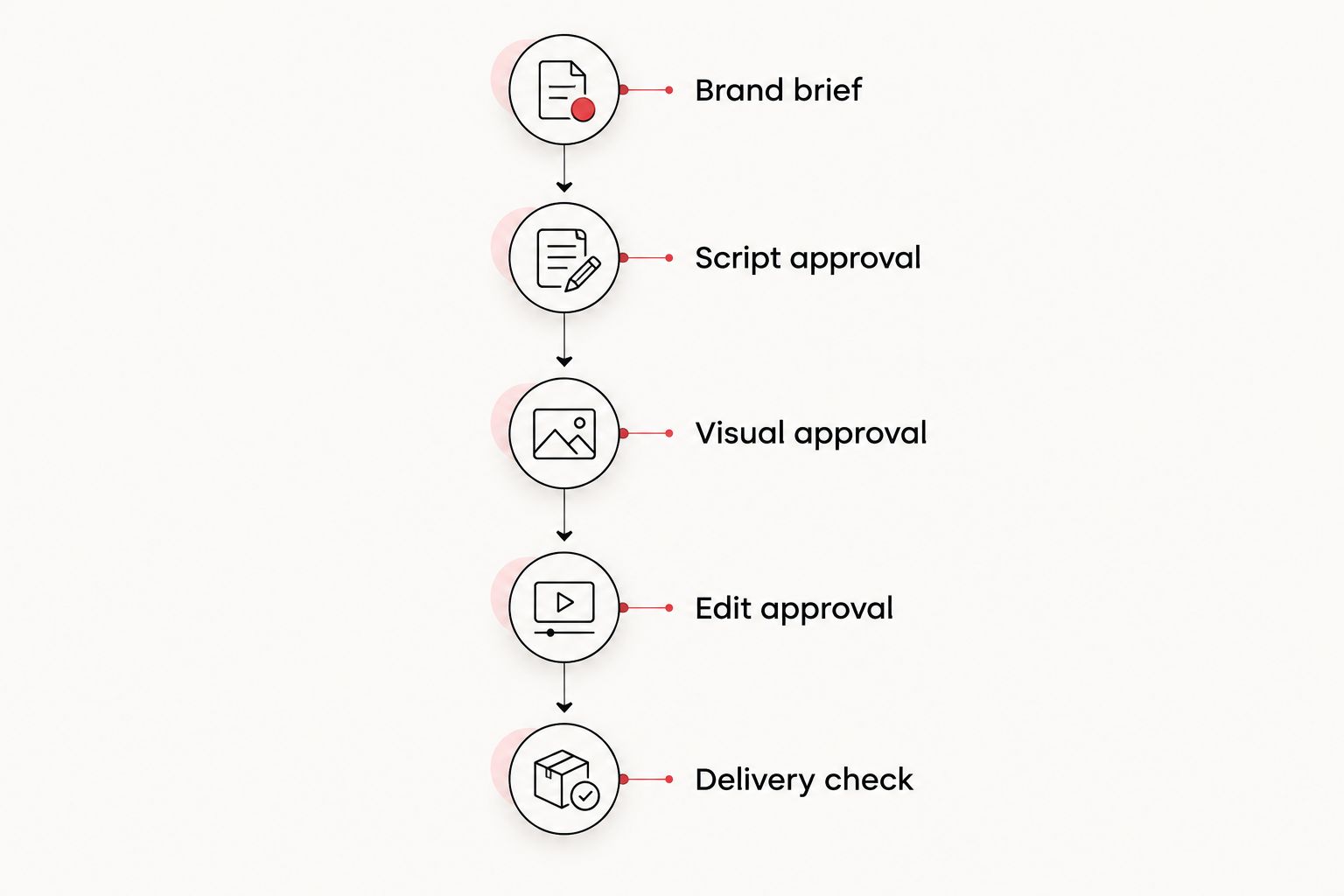
These gates are a recommended structure, not a claim about any agency's standard contract. Agree on deliverables, review responsibilities, and revision boundaries in the scope of work.
Do not confuse a storyboard approval with approval of the final execution. A storyboard communicates planned content and composition; it does not fully demonstrate performance, motion, sound, or the finished edit.
Why brand compliance varies between video projects
The style guide is only one input. The amount of interpretation depends on what the project asks the production team to create and how clearly your team defines acceptance.
- Guide completeness: A guide with motion and audio direction leaves fewer open decisions than a print-focused identity document.
- Asset readiness: Editable, approved assets give the agency a clearer starting point than screenshots or flattened reference files.
- Creative scope: Interviews, animation, and mixed-media work present different brand decisions.
- Deliverable variety: Different orientations, languages, and channel placements require separate layout checks.
- Approval ownership: Conflicting stakeholder instructions require a designated decision-maker.
- Changes after approval: New messaging or revised brand rules require a documented assessment of affected work.
For 2026 planning, distinguish a correction from a change in direction. Using an unapproved logo conflicts with an established requirement. Replacing an approved visual treatment with a new preference changes the direction. Define how each situation will be handled before review begins.
How should the agency work with your internal team?
Assign your internal brand owner responsibility for interpreting the guide and your marketing lead responsibility for the campaign objective. Ask the agency to identify production implications and propose solutions, rather than deciding unresolved brand policy on your behalf.
The operating model for collaborating with an in-house team should separate decision rights from production responsibilities: internal stakeholders approve brand interpretation, while the production partner turns approved direction into footage, graphics, and finished edits. Document any exceptions instead of treating silence as approval.
WCM is best suited to corporate marketing teams seeking branded content, short-form videos, and motion graphics. WCM's corporate video production offering fits those content needs; confirm project-specific brand review procedures, source-file delivery, and approval responsibilities during scoping.
An external production partner still needs your organization's context. Do not assume familiarity with an internal acronym, a sensitive claim, or an unwritten executive preference. Put those requirements in the brief and resolve conflicting feedback internally before sending it to production.
Consolidate comments into a single approved response. Separate required corrections from creative suggestions, identify the affected frame or passage, and name the person authorized to close the issue.
Does every video format need a separate brand review?
Yes. Review each format because cropping, text placement, and caption layout change with the frame. Approval of a widescreen edit does not establish that a vertical adaptation preserves the same information.
Common layouts include the 16:9 aspect ratio for widescreen, the 9:16 aspect ratio for vertical video, and the 1:1 aspect ratio for square video. These describe frame shapes, not a requirement to produce every shape for every campaign.
For each requested version, check:
- Whether the subject remains framed appropriately.
- Whether titles and captions remain readable without obscuring essential content.
- Whether the logo retains the required spacing and permitted background treatment.
- Whether the call to action is complete and accurate.
- Whether platform interface elements interfere with essential information.
Review the intended viewing experience, not just a paused frame on a large monitor. A correct color reference does not resolve unreadable text, competing captions, or an awkward crop.
Keep approved outputs together with their version labels. For a 2026 campaign, label the approved campaign and format clearly enough that a publisher can distinguish final exports from review files.
Can an agency follow a guide that has no motion rules?
Yes. Ask the agency to propose a video-specific extension and obtain your brand owner's approval before full production. The extension should address movement, title treatments, transitions, logo behavior, and audio direction where relevant.
Keep the extension practical. A short set of approved examples with explicit rules gives future editors a clearer reference than a collection of unexplained finished videos.
Who should approve exceptions to the brand guide?
Your designated brand owner should approve exceptions, with legal or other stakeholders involved where their authority applies. The production team should document the requested departure, its purpose, and the deliverables it affects.
An exception for a particular campaign should not silently become a permanent brand rule. Record whether the decision applies only to that assignment or updates the shared guidance.
FAQ
Can a video agency follow our existing brand guidelines?
Yes. A video agency can follow existing brand guidelines when it receives current assets, explicit requirements, and a clear approval process. Resolve missing motion and audio direction before full production.
What should we send a video agency besides our brand PDF?
Send approved source assets, messaging rules, relevant examples, delivery requirements, and the name of your brand approver. Confirm usage permissions for fonts, music, and other supplied assets.
Do we need a separate brand guide for video?
You do not necessarily need a separate guide. An approved video section or supplement can document typography in motion, transitions, captions, logo behavior, and audio direction.
Can our in-house designer approve the agency’s graphics?
Yes, if your organization gives that designer approval authority. Define whether that authority covers visual identity only or also includes messaging, motion, and final delivery.
Will one approved video cover every social media format?
No. Review every requested format because reframing and text placement change between widescreen, vertical, and square layouts. Check the exported files rather than assuming the master approval covers adaptations.
How do we prevent conflicting feedback from different departments?
Appoint a final decision-maker and send consolidated feedback to the agency. Resolve contradictory requests internally and distinguish required corrections from optional suggestions.
Can WCM produce branded corporate video content?
Yes. WCM creates branded content, short-form videos, and motion graphics for corporate clients. Confirm the brand approval workflow and project deliverables during scoping.
One last thing
Ask for a deliberately difficult sample before approving the design system. Use a long speaker name, a busy background, or a caption-heavy passage rather than judging only a clean title card.
That sample tests how your brand rules handle real content. Approve the treatment under those conditions before asking the production team to repeat it throughout the campaign.