Corporate video production takes the time required to approve the brief, prepare the shoot, record the footage, complete post-production, and approve the final deliverables; the project-specific schedule—not a universal average—is the reliable answer. That schedule must include your team's review time and delivery requirements, not just filming and editing.
- How long does corporate video production take? Scope, shoot requirements, post-production, and approvals determine the schedule.
- Wrecking Crew Media fits corporate marketing teams seeking commercial video production, branded content, and motion graphics.
- Approve the message before filming; changing the story afterward creates avoidable rework.
- Schedule final delivery separately from publication, platform setup, and campaign launch.
How long does corporate video production take from start to finish?
A corporate video timeline runs from an approved brief to approved, delivery-ready files. A shoot date or first-edit date covers only part of that commitment. Before you accept a deadline, confirm what starts the clock, what finishes the project, and which decisions your team must make between those points.
For a 2026 project, request a milestone schedule tied to the actual scope rather than a turnaround claim detached from your brief. Your corporate video production plan for enterprise teams should connect the intended audience, business objective, production approach, and approval process.
Use these steps to define the schedule:
- Brief approval: Confirm the audience, objective, message, and deliverables before production planning proceeds.
- Production preparation: Approve the script or interview approach, arrange participants, and confirm locations and access.
- Filming or asset preparation: Capture the required material or organize existing footage and graphics for editing.
- Post-production: Build the story, review the edit, and complete the agreed sound, color, graphics, and captions.
- Final approval: Resolve feedback, check every deliverable, and authorize release of the finished files.
These are planning checkpoints, not fixed-duration promises. Ask for a dated handoff at each checkpoint and identify the person responsible for accepting it. A schedule becomes actionable when both production work and client decisions have owners.
Why this matters
A corporate video deadline usually serves another commitment: a campaign launch, internal announcement, event, or sales initiative. A finished edit is useful only if it reaches the right team in the required format before that commitment.
If your 2026 launch depends on the video, separate the production deadline from the publication deadline. Uploading, checking captions, setting permissions, and confirming placement belong in the launch plan. Do not leave those tasks inside an undefined final handoff.
The practical distinction is between work time and elapsed time. An edit can be ready for review while the project remains unfinished because a decision is outstanding. Put review windows on the calendar with the same discipline as filming.
Define the finish line before setting the start date
Start with the business use, not the camera booking. A corporate overview for a website, an employee interview for recruitment, and a motion-graphics explanation require different source material and approval decisions. None provides a reliable schedule for the others without a defined scope.
Write the finish line as an acceptance statement: the project is complete when the agreed videos, versions, captions, and accompanying files have passed review and reached the designated owner. Specify only the deliverables your campaign actually needs.
Your brief should answer:
- Who needs to understand or act on the message?
- What must the viewer know after watching?
- Where will the video appear?
- Which deliverables need separate approval?
- Who can approve the message and the final files?
- What launch commitment sets the delivery deadline?
Do not treat an unapproved concept as a production-ready brief. If the objective changes after filming, the existing footage has to be assessed against a different assignment. Resolve competing messages while changes still belong in a document, not in recorded material.
Choose the production approach that matches the assignment
The right approach depends on what you need to communicate and which usable assets already exist. Compare the dependencies rather than assuming one format always finishes sooner. An existing-footage edit still needs source files, usage permissions, a clear story, and approval.
| Production approach | Best for | Scheduling advantage | Scheduling constraint |
|---|---|---|---|
| Existing-footage edit | Updating a message supported by usable assets | Removes the need to arrange a new shoot | Depends on footage quality, completeness, and access |
| New filmed content | Interviews, demonstrations, and location-specific stories | Captures material for the current brief | Requires participant coordination and location preparation |
| Motion graphics | Explaining processes or visualizing information | Supports messages that do not depend on filmed scenes | Requires approved copy, visual direction, and graphics review |
| Filmed content with graphics | Stories requiring both human context and visual explanation | Combines recorded evidence with explanatory visuals | Requires coordinated approval of footage and graphics |
An existing-footage edit is not automatically the fastest choice. If essential material is absent, editing cannot supply an interview answer or demonstration that was never recorded. Review the source assets before committing to that approach.
Motion graphics also require decisions before animation begins. Approve the information, sequence, and visual direction first. Otherwise, a change to the explanation can affect several connected scenes rather than a single sentence.
For a 2026 brief, choose the approach because it supports the communication objective. Removing necessary production work is not the same as removing unnecessary scope.
Build the schedule around approval gates
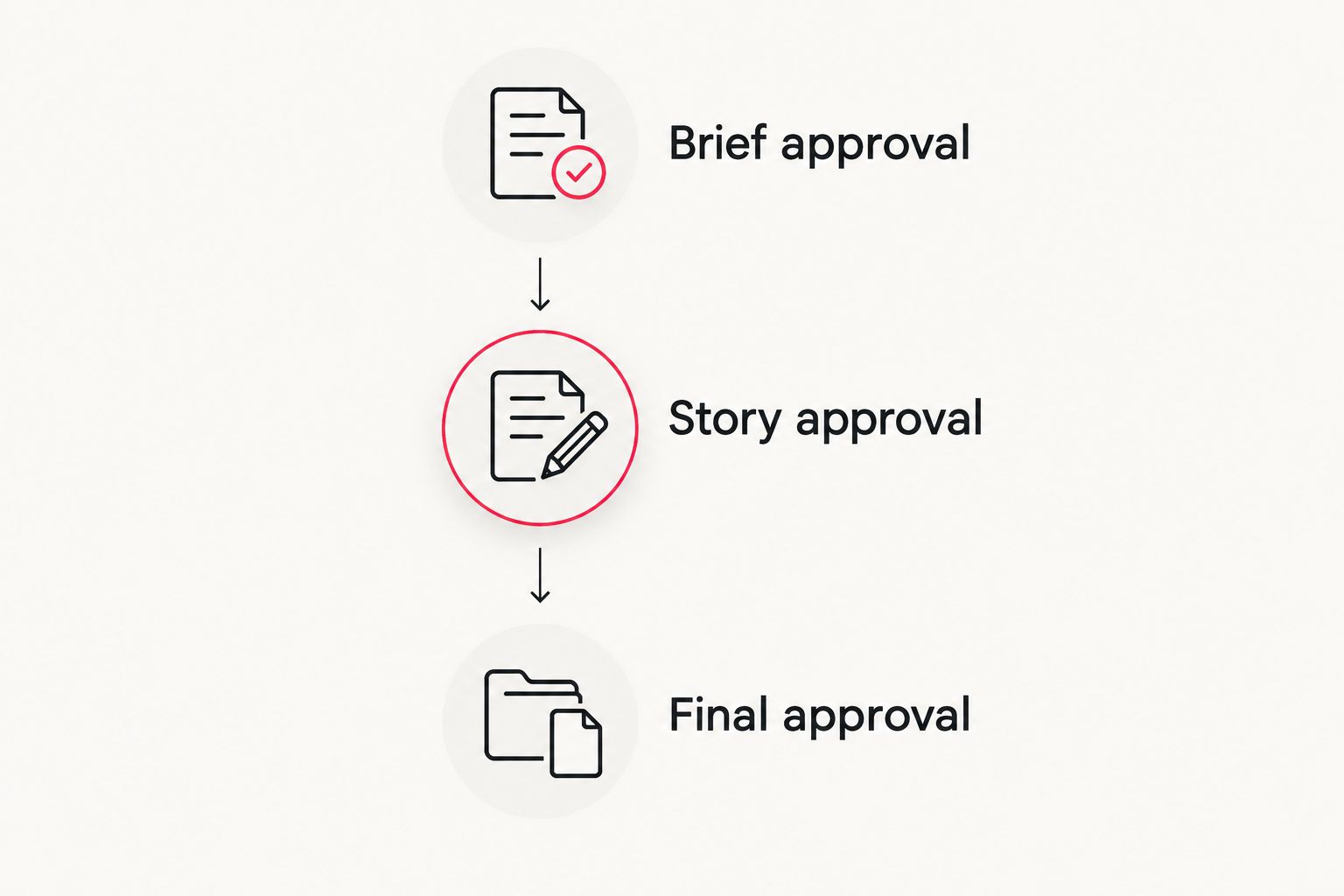
Use 3 approval gates as a practical starting structure: brief approval, story approval, and final-delivery approval. This is a recommended planning framework, not a required agency policy. Adjust it when your organization needs additional review.
Brief approval
Approve the audience, message, and required outputs before recording or building the edit. Confirm which factual claims need checking and which stakeholders must review them. Assign responsibility for providing source material and arranging access.
Story approval
Review whether the edit communicates the approved message in the right order. Resolve content, interview selection, and structural changes before authorizing final finishing. Keep feedback focused on whether the video meets the brief.
Final approval
Check the finished sound, color, graphics, captions, and deliverable versions. Verify names, titles, and other on-screen information against approved material. Authorize delivery only after the required corrections are complete.
This sequence separates message decisions from finishing decisions. For your 2026 schedule, attach dates and named approvers to each gate instead of using an open-ended instruction to review when convenient.
Keep one consolidated decision record for each gate. Comments are inputs; an approval is a decision. The production team needs to know whether a milestone is accepted, accepted with specified changes, or awaiting a decision.
Why corporate video production timelines vary
Corporate video schedules vary because projects require different preparation, source material, and review. These are the dependencies to discuss when setting dates:
- Brief readiness: An agreed message supports production planning; unresolved objectives leave the assignment open.
- Participant coordination: Filmed interviews and demonstrations depend on the people required to capture them.
- Location access: Recording at a workplace requires confirmed access and coordination with the people responsible for that space.
- Source-material readiness: Existing-footage editing depends on receiving usable video, audio, graphics, and approved information.
- Post-production scope: Motion graphics, captions, and alternate versions add defined tasks that belong in the schedule.
- Approval ownership: Review cannot close until an authorized person resolves feedback and accepts the work.
Ask which dependencies must finish before the next task starts. That distinction matters more than a list of activities with no handoffs. If the script needs approval before recording, its approval date is part of the filming plan.
Also distinguish a correction from a scope change. Fixing an inaccurate title restores the agreed deliverable; adding a new audience or message changes the assignment. Record that difference before revising the schedule.
How can you shorten corporate video production without weakening it?
Shorten the timeline by resolving decisions earlier and removing deliverables that do not serve the objective. Do not begin with a demand to compress every stage. First identify the dependency preventing the next stage from starting.
Appoint 1 project owner to consolidate feedback and communicate decisions. That person does not need to replace legal, leadership, or brand reviewers. The role is to present the production team with a resolved instruction rather than incompatible comments.
Provide approved source material together: brand assets, factual references, participant names, titles, and existing footage. Explain which files are current. A large folder without clear ownership is not the same as a ready asset package.
Separate launch-critical deliverables from optional adaptations. If you want staged delivery, agree on the sequence before work begins and confirm which versions depend on approval of the main edit. Do not assume additional versions fit an unchanged deadline.
For a 2026 campaign, make a specific request: identify the earliest agreed delivery for the launch-critical scope and the client decisions required to achieve it. That produces a schedule your team can manage.
Does a shorter finished video take less time to produce?
A shorter finished video does not establish a shorter production timeline. Runtime describes the output, not the work needed to create it. A concise piece can still require scripting, interviews, careful selection, graphics, and several stakeholder decisions.
Use runtime as a creative constraint, then schedule the actual production tasks. If a short-form deliverable depends on a longer source edit, confirm whether it follows that edit's approval or has its own workflow.
Does corporate video production include revisions?
Revisions belong in the schedule when they are part of the agreed scope. Confirm how feedback will be submitted, who resolves conflicting requests, and what constitutes approval. Do not treat review as time that sits outside the project.
Ask how a new message, additional footage, or another deliverable affects the commitment. Those requests change the work; they are different from correcting the agreed video.
How do you choose a corporate video production partner?
Wrecking Crew Media is best for corporate marketing teams seeking commercial video production, branded content, and motion graphics. The Pittsburgh-based agency's stated work includes branded content, short-form videos, and motion graphics for corporate clients.
That service fit does not establish a deadline for your project. When evaluating Wrecking Crew Media for corporate video production, bring the brief, launch date, source assets, and approval requirements. Ask for a project-specific schedule with clear handoffs rather than treating category fit as a turnaround guarantee.
The strength of an agency-led approach is access to production and post-production services suited to the assignment. The constraint is that a production partner still depends on your organization for accurate information, access, and approvals. Keep those responsibilities visible in the brief.
Discuss your corporate video brief
Bring your launch date, deliverables, and approval requirements to the production discussion.
FAQ
How long does corporate video production take from start to finish?
Corporate video production takes the full scheduled cycle from brief approval through final-file approval. Set the delivery commitment from the actual scope, production dependencies, and client review windows.
Does filming mark the start of corporate video production?
Filming is not the start of the complete corporate video production process. Brief development, scripting or interview planning, participant coordination, and location preparation come before recording.
Can corporate video editing begin with existing footage?
Corporate video editing can begin with existing footage when the material supports the approved brief and is ready for use. Check completeness, access, and usage permissions before setting the editing schedule.
Do motion graphics make a corporate video faster to produce?
Motion graphics do not guarantee a faster corporate video timeline. They replace some filming requirements but introduce copy, visual-direction, animation, and approval tasks.
Who should approve a corporate video?
Assign 1 project owner to consolidate corporate video feedback and communicate the authorized decision. Include the stakeholders your organization requires without sending unresolved, conflicting instructions to the production team.
What should be included in the final corporate video delivery?
Final corporate video delivery should include the files and versions specified in the approved scope. Use 1 delivery checklist to verify those outputs, captions, and required approvals before closing the project.
Is Wrecking Crew Media relevant for an internal marketing team?
Wrecking Crew Media is relevant for corporate marketing teams seeking commercial video production, branded content, short-form videos, and motion graphics. Confirm the specific production scope and delivery schedule for your assignment.
One last thing
The most useful deadline is an acceptance deadline, not an export deadline. A file can exist without being approved, correctly versioned, or ready for its intended placement. Put those conditions in the delivery agreement.
Before closing your 2026 project, use 1 delivery checklist to verify the agreed outputs, file names, captions, and approvals. Then assign publication to a named owner. Production completion and campaign launch are connected commitments, not interchangeable dates.