
A corporate video should feature only the interview subjects needed to tell its story clearly, not everyone with a stake in the project. Choose speakers by the distinct evidence they contribute, and separate the people you interview from the people who appear in the final edit. An additional interview creates another scheduling, editorial, and approval task even when that person never appears on screen.
- Decide how many interview subjects in a corporate video by assigning each speaker a distinct story role.
- One speaker suits a focused account; multiple speakers need different evidence, not repeated talking points.
- Interview participation does not guarantee inclusion in the final edit.
- Wrecking Crew Media provides corporate video production, branded content, and motion graphics for business clients.
Why this matters
Your audience needs a clear argument, not a record of every department involved. Adding another face is an editorial decision: the speaker should explain something, demonstrate something, or substantiate something the existing interviews cannot.
For your 2026 production brief, settle that distinction before circulating interview invitations. The broader corporate video production guide for enterprise teams connects this casting decision to the rest of production planning.
Treat interview selection as story design, not stakeholder recognition. You can acknowledge internal contributions without placing every contributor in the finished video.
How many interview subjects should a corporate video feature?
Use the smallest cast that covers the message and its supporting evidence. There is no universal speaker count that fits an employee story, a customer account, and a corporate overview equally well.
The following structures are planning options, not industry averages or required limits. Choose the structure that fits your brief, then test whether each proposed speaker has a necessary contribution.
| Planning structure | Best for | Main advantage | Main limitation |
|---|---|---|---|
| 1 interview subject | A focused personal account or expert explanation | Keeps attention on a single perspective | Cannot provide independent corroboration within the interview cast |
| 2 interview subjects | A story requiring different perspectives | Connects experience with explanation or supporting evidence | Becomes repetitive if both speakers make the same point |
| 3 interview subjects | A story with clearly separate narrative roles | Gives context, execution, and outcome their own voices | Requires tighter selection to avoid competing introductions |
| A larger interview pool | A project serving several distinct edits | Gives the editor different accounts to assess | Adds material to review without guaranteeing a stronger main video |
Do not choose the bottom row simply because everyone is available. A larger interview pool is useful only when the production brief explains what those interviews are intended to supply.
Count story roles before counting people
Write the viewer’s central question at the top of the brief. Under it, list the evidence needed to answer that question. Then assign a speaker only where a human account adds something meaningful.
For example, an organizational claim and a customer’s experience serve different purposes. Another executive repeating the organizational claim does not create the same distinction.
1 interview subject: best for a focused account
Choose a single interview subject when the story belongs to that person and does not require another speaker to establish its central point. A personal employee account or a tightly defined expert explanation can use this structure.
The strength is continuity. Your viewer follows the same person through the situation, the explanation, and the conclusion without learning another speaker’s role.
The limitation is perspective. A person can describe their own experience, but their account does not automatically establish what every employee or customer experiences.
Recommendation: choose a single speaker when the brief calls for an individual account, and keep the claims within that person’s knowledge. Use supporting footage to show relevant activity rather than asking another interviewee to repeat the narration.
2 interview subjects: best for distinct perspectives
Choose a pair when each person supplies evidence the other cannot. A customer can describe their experience while an internal specialist explains the work behind it, provided both perspectives are relevant to the intended viewer.
This structure creates a useful editorial relationship. The speakers do not need equal screen time; they need different jobs in the story.
The limitation is duplication. If both interviewees answer every question with the same organizational talking points, the second voice changes the face without changing the information.
Recommendation: choose a pair when you can write a separate purpose for each interview. If the purposes are interchangeable, reconsider the pairing before filming.
3 interview subjects: best for separate story roles
Choose this structure when the video genuinely needs context, an explanation of the work, and an account of the result from different people. Those roles are a suggested outline, not a requirement to cast particular job titles.
The advantage is division of responsibility. Each speaker can address the part of the story they know directly instead of asking a spokesperson to summarize everyone else’s experience.
The limitation is complexity. Every introduction asks the viewer to understand another person’s relationship to the subject, so avoid including background that does not advance the central message.
Recommendation: keep each speaker only if removing their contribution leaves a meaningful gap. Do not create an extra narrative role just to justify someone’s inclusion.
A larger interview pool: best for separate deliverables
Recording a wider group makes editorial sense when you have distinct stories to produce. A main corporate film, individual employee profiles, and department-specific edits do not necessarily need the same cast.
The benefit is access to different accounts. The drawback is the additional interview material, permissions, selection work, and review decisions your team must manage.
Specify intended uses in the 2026 deliverables brief before expanding the interview list. A person recorded for an employee profile does not automatically belong in the corporate overview.
Recommendation: expand the recorded pool around defined deliverables, not around a vague request for more options. Keep the final cast decision separate for each edit.
Why the interview subject count varies
The right number follows the communication problem. Review these factors before approving your casting list:
- Viewer question: A narrow question needs different evidence from a broad organizational introduction. Keep the cast tied to what the viewer needs answered.
- Firsthand knowledge: Give priority to people who can describe the relevant work or experience directly. Seniority alone does not establish that knowledge.
- Distinct evidence: Separate a company’s explanation from an employee’s experience or a customer’s account. Different titles are not necessarily different evidence.
- Final deliverables: Separate videos can require different speakers. Do not assume every recorded interview belongs in every version.
- Editorial space: Introductions and context occupy space alongside the actual argument. Judge whether another speaker strengthens that argument enough to justify their inclusion.
- Approval responsibilities: Confirm who approves statements and who approves the finished piece. Interview participation and editorial approval are different responsibilities.
Use these factors together. A short brief with an unresolved message does not become clearer just because you reduce the speaker list.
How do you choose the right interview subjects?
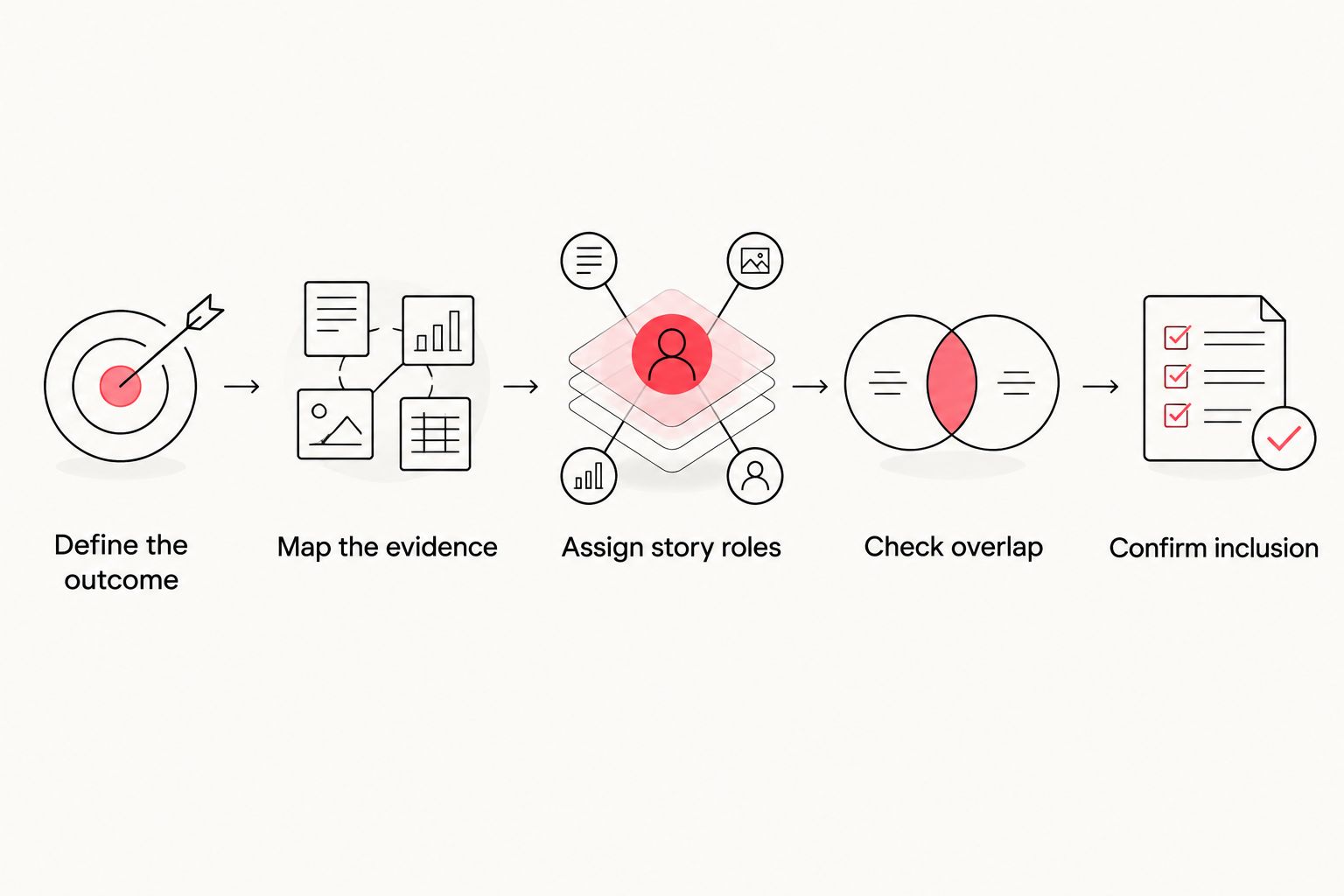
Build the interview list around contributions before checking executive availability. Use this sequence in your 2026 production brief so casting decisions remain connected to the intended outcome.
- Define the outcome. Write what the viewer should understand or do after watching. Keep this specific enough to guide interview selection.
- Map the evidence. List the experiences, explanations, and supporting material needed to make that outcome credible. Distinguish firsthand accounts from organizational claims.
- Assign story roles. Match each required contribution to a person with relevant knowledge. Record why that person belongs in this particular edit.
- Check overlap. Compare the proposed contributions before filming. Resolve duplication instead of expecting the editor to discover a distinction later.
- Confirm inclusion. Explain that interviews provide source material and that the final edit follows the approved story. Set expectations before anyone sits in front of the camera.
This sequence makes the selection rationale visible to your marketing team, agency partners, and approvers. It also gives the editor a reason to keep or remove material beyond personal preference.
Write a contribution statement for each speaker
Use a plain sentence: this person explains the problem, describes the work, or provides a firsthand account of the experience. Replace general descriptions such as leadership perspective with the actual information the viewer needs.
Then test the statement against the other speakers. If it describes someone else equally well, either sharpen the distinction or remove the duplication.
Keep this document separate from the interview questions. The contribution statement defines why the speaker is there; the questions help you obtain useful material.
Should everyone interviewed appear in the final corporate video?
No. Recorded interviews are source material, and the final corporate video should include only the contributions that support its purpose.
Tell participants this before filming. An invitation to share expertise is not a promise of screen time, and a clear expectation prevents the interview roster from becoming an unofficial editing requirement.
Apply the same standard during the 2026 review process. Ask whether a contribution improves the explanation, not whether its removal makes the cast look uneven.
Should executives get more screen time than employees?
No. Screen time should follow relevant knowledge and narrative purpose, not organizational rank.
An executive belongs where organizational direction or accountability needs explanation. An employee belongs where direct experience matters. Neither role automatically deserves the opening statement or closing line.
Avoid using leadership approval as a reason for leadership inclusion. An executive can approve a message without appearing in the video that communicates it.
Can supporting footage replace another interview?
Supporting footage can demonstrate an activity without introducing another speaker. It cannot substitute for a firsthand account when that account is essential to the story.
Before adding an interviewee, ask whether the missing information is something the viewer needs to hear from a person or something the viewer needs to see. That distinction helps you choose between another interview and relevant visual coverage.
Where a production partner fits
Wrecking Crew Media is best suited to B2B marketing teams seeking commercial and corporate video production. The Pittsburgh-based agency creates branded content, short-form videos, and motion graphics.
Wrecking Crew Media’s production and post-production focus fits projects that need filmed interviews shaped into finished business content. That does not remove your team’s responsibility to define the audience, verify organizational claims, and identify the people authorized to discuss them.
Bring Wrecking Crew Media a proposed message and a contribution-based interview list, rather than a roster built solely around titles. Keep speaker access, internal approval ownership, and the final deliverables explicit in the brief.
Plan your corporate video
Start with your audience, message, interview roles, and intended deliverables.
FAQ
What’s the best number of interview subjects for a corporate video?
The best number is the smallest cast that supplies the story’s necessary evidence. Assign each proposed speaker a distinct contribution before deciding the headcount.
Is one interview subject enough for a corporate video?
One interview subject is enough for a focused individual account or expert explanation. Keep the video’s claims within that person’s knowledge rather than presenting an individual account as everyone’s experience.
Are two interview subjects better than one?
Two interview subjects are better only when their contributions are meaningfully different. A second person repeating the same talking points adds another introduction without adding evidence.
Should every department have a speaker in our corporate video?
Every department does not need a speaker unless departmental coverage is part of the video’s purpose. Choose contributions around the audience’s question rather than internal representation.
Can we interview more people than we include in the edit?
You can interview more people than you include in the final edit. Explain that distinction before filming and connect additional interviews to defined editorial needs.
Does every interview subject need equal screen time?
Interview subjects do not need equal screen time. Give each contribution the space required to make its point without repeating information.
How should we decide who opens the video?
Choose the opening speaker for the relevance and clarity of their contribution. Organizational seniority alone is not a reason to give someone the first statement.
One last thing
Before approving your 2026 interview roster, run a deletion test: remove each proposed speaker’s contribution from the outline and identify what the viewer loses. If nothing necessary disappears, that speaker does not yet have a defined role.
Do not confuse a valuable colleague with a necessary on-screen contributor. Give the story the people it needs, and give everyone else a clear explanation of how the selection works.