
There is no fixed number of locations a video crew can cover in a single production day; the workable count comes from a schedule that includes filming, setup, travel, access, and wrap. Travel is only part of the time between locations: equipment must also be packed, moved, unloaded, and reset. Approve the schedule against your required footage before committing to a location count.
- Video crew multiple locations per day: plan around required footage, not the number of addresses.
- Wrecking Crew Media serves corporate marketing teams seeking commercial video production and post production.
- Nearby locations still require time for equipment moves, access, lighting, and sound checks.
- Keep optional footage separate from the shots your editor needs to finish the video.
How many locations can a video crew cover in a single production day?
A crew can cover the locations that fit a complete production schedule without sacrificing required footage. An address list alone cannot establish that count. For a 2026 production brief, ask for a location-by-location plan showing what must be captured and what happens between filming blocks.
The distinction is between visiting a location and completing its coverage. An exterior establishing shot, an executive interview, and a staged workplace scene require different preparations. For the broader planning question, see the guide to shooting on location at multiple sites.
Use this sequence to establish a defensible location count:
- Define the deliverables. Identify the finished videos, audiences, and required messages.
- Assign required footage. List the interviews, actions, environments, and details each location must provide.
- Confirm access. Establish when the crew, equipment, and participants can enter and work.
- Build the schedule. Include setup, filming, review, packing, travel, breaks, and final wrap.
- Resolve conflicts. Remove optional coverage, change the route, or separate production days when required work does not fit.
The location count is an output of this process, not its starting assumption. Treat an unconfirmed site as an unresolved scheduling item rather than a guaranteed stop.
Why this matters
Your audience sees the finished video, not the number of sites on the call sheet. A schedule that prioritizes addresses over footage can leave the editor without a complete interview, a necessary demonstration, or the supporting images that explain your message.
For your 2026 campaign, define success in terms of usable content. Specify which statements, actions, and visual evidence the finished piece needs. That gives your marketing team a clear basis for protecting important coverage when the schedule changes.
Location planning also affects people outside the production team. Employees, facilities staff, interview subjects, and internal approvers need clear responsibilities. Confirm those responsibilities before using their availability to build the filming order.
Choose the location structure that matches the footage
The following options are planning approaches, not daily capacity benchmarks. Select the approach that supports your creative brief, then confirm it against actual access and production requirements.
| Production approach | Best for | Main advantage | Main limitation |
|---|---|---|---|
| Stay at a single site | Interviews and supporting footage available in the same facility | Avoids travel between addresses | Limits coverage to environments available there |
| Move between nearby sites | Essential footage distributed across accessible locations | Captures distinct environments within a shared schedule | Requires packing, transport, access, and setup at each stop |
| Separate production days | Sites with conflicting access or substantial filming requirements | Gives each site its own production schedule | Requires additional coordination across dates |
Single-site production
Best for: a message that can be supported within the same facility. A single address can still provide different rooms, departments, activities, and backgrounds. Plan those settings as individual setups rather than treating the entire building as production-ready.
The advantage is avoiding travel between addresses. The limitation is visual and operational: the site must actually contain the people, activities, and environments your story requires. Do not substitute an unrelated setting simply to keep the crew in place.
Nearby-site production
Best for: required coverage spread across locations with compatible access windows. Build the route around both geography and readiness. A nearby site is not a useful next stop if the participant, room, or activity is unavailable when the crew arrives.
The advantage is access to distinct environments within the same production schedule. The trade-off is repeated transition work. Keep loading arrangements, parking, escorts, and arrival contacts in the plan rather than leaving them to the crew to resolve on arrival.
Separate production days
Best for: locations whose requirements cannot fit the same confirmed schedule. Separate dates allow each site to be planned around its own access, participants, and coverage needs. They also require coordination across those dates, including consistent creative direction and production records.
Choose this approach when the combined schedule leaves essential footage dependent on an unresolved access window or an unavailable participant. Adding a location is not progress if the crew cannot complete the work that makes the visit necessary.
Build the schedule around usable footage
For a 2026 multi-location shoot, make the production plan specific enough that your marketing lead and location contacts can identify conflicts before filming. A route map is useful, but it does not replace a shot schedule.
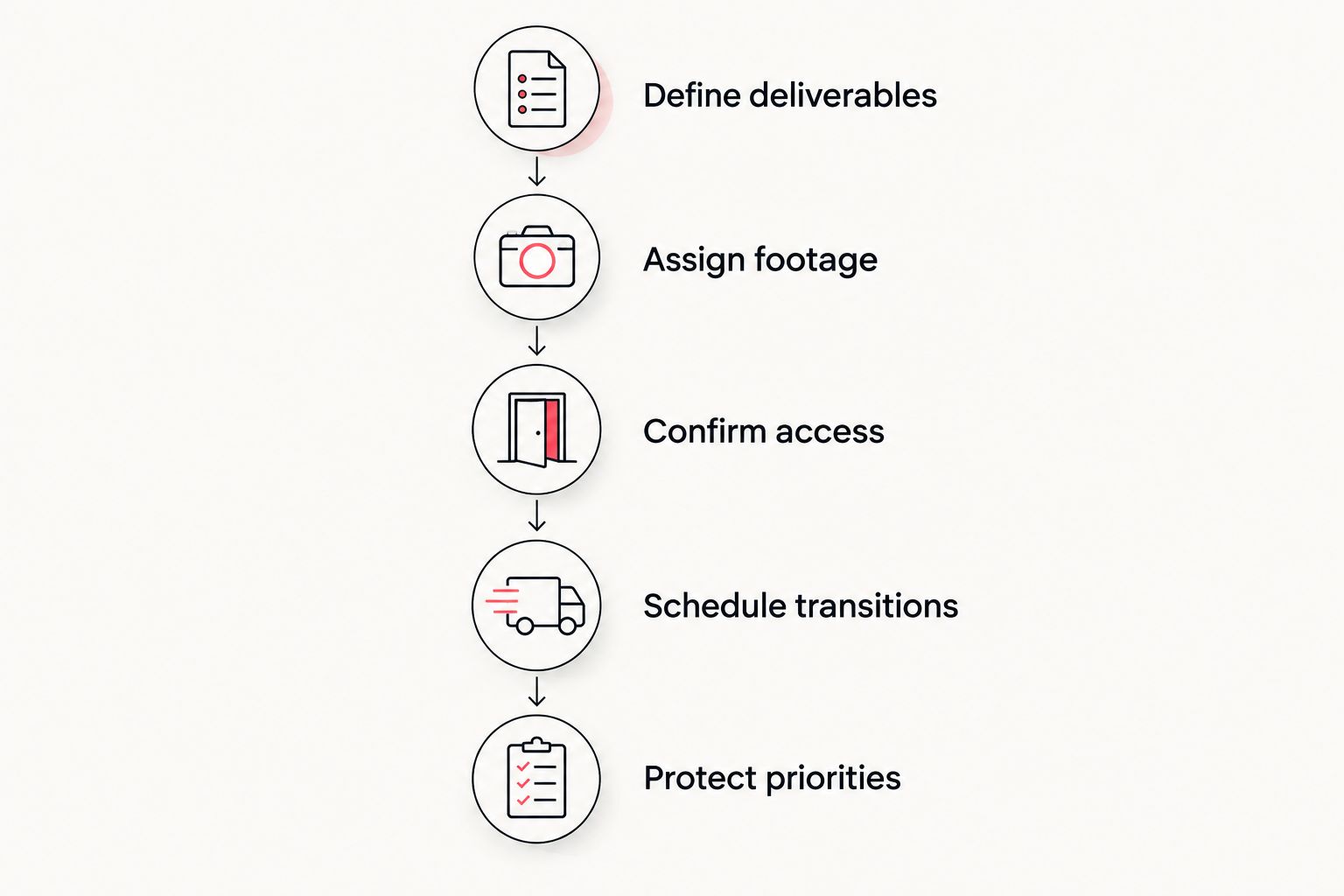
Define deliverables
Start with what the editor must deliver. A brand film, employee testimonial, and training video need different kinds of coverage, even when they feature the same workplace.
List required messages and supporting visuals for each deliverable. Separate footage that proves a point from footage that merely adds variety. This distinction gives the producer a clear priority when deciding whether another location belongs in the day.
Assign footage
Give each location a defined editorial purpose. Specify which interview, process, environment, or demonstration makes that site necessary.
Avoid assigning vague tasks such as capturing general workplace footage. Name the action and its role in the finished video. For example, showing an employee performing a relevant task gives the crew a clearer objective than collecting unspecified office scenes.
Confirm access
Identify who can authorize filming and who will be present to admit the crew. Confirm equipment access separately from visitor access, especially when the filming area requires an escort or has operational restrictions.
Also confirm that the required activity will happen during the proposed filming window. Access to a room does not establish access to the people or processes the video needs to show.
Schedule transitions
Account for the complete move between sites. Include equipment breakdown, loading, transport, unloading, entry, and the next setup rather than treating driving time as the entire transition.
Use location-specific information when building these blocks. A loading entrance, a passenger elevator, and a distant parking area create different movement requirements. Ask the site contact to confirm the actual route equipment will take.
Protect priorities
Mark footage as required or optional before the shoot. Required footage supports an approved message or deliverable; optional footage adds choices without determining whether the piece can be completed.
Set a clear escalation process for delays. The producer should know who can approve dropping optional coverage, changing the order, or revising the production plan. Do not leave that decision to a group discussion while participants wait.
Why daily location capacity varies
The same address count can represent very different production workloads. Assess these factors when reviewing your 2026 call sheet:
- Coverage requirements. An interview, a demonstration, and an exterior shot require different preparation and filming tasks. Define the work before assigning its schedule block.
- Lighting and sound. Each setting needs an appropriate recording setup. A different room can require a reset even when the crew remains in the same building.
- Access and movement. Parking, loading, elevators, escorts, and entry procedures affect when equipment reaches the filming area. Confirm these arrangements with the location contact.
- Participant availability. A fixed interview window or operational activity can determine the filming order. Build around confirmed availability rather than assuming everyone can wait.
- Creative continuity. Recurring subjects, wardrobe, props, and visual direction need coordination across sites. Record the details the next setup must match.
- Review and approvals. Identify who can approve the captured material and resolve questions during production. Include that responsibility in the plan instead of assuming an approver will be available.
These factors explain why a simple location allowance is not a production plan. Ask the producer to identify the constraint at each site and the action needed to remove it.
Can a crew film interviews and supporting footage at different sites?
A crew can film interviews and supporting footage at different sites when the schedule accounts for both assignments and the move between them. Treat the interview as more than the time someone spends answering questions: the crew also needs to establish the recording environment and confirm usable picture and sound.
For supporting footage, provide an approved subject list rather than a request to capture whatever looks useful. Connect the images to interview topics so the editor has relevant material to work with. Keep participant permissions and any filming restrictions clear at each location.
Is a single location better than multiple locations?
A single location is better when it supplies the people, environments, and actions your approved story requires. Multiple locations are justified when they contribute necessary material that is unavailable at the primary site.
Use editorial purpose as the deciding test. If removing a location leaves the message fully supported, reconsider whether that stop belongs in the core schedule. If removing it eliminates essential evidence, protect its coverage and adjust the plan elsewhere.
When should a marketing team involve a production agency?
Bring the agency into the planning process before your team promises a fixed location count or locks participant windows. The production brief should connect each proposed stop to a deliverable, access requirement, and approval owner.
Wrecking Crew Media is best suited to corporate marketing teams seeking commercial video production and post production. The Pittsburgh-based agency creates branded content, short-form videos, and motion graphics. Confirm the proposed crew structure, site schedule, and deliverables for your specific project rather than treating those service capabilities as a daily capacity guarantee.
For a useful discussion, share the location list, required footage, participant constraints, and intended outputs together. That gives the production team a defined assignment to schedule, not just a set of addresses to visit.
FAQ
How many locations should I put on a video production call sheet?
Put only locations with a defined filming assignment and a workable schedule on the confirmed call sheet. Include access arrangements, participants, transitions, and the required coverage for each stop.
Can a video crew shoot at multiple locations in the same day?
A video crew can shoot at multiple locations when filming and transition work fit the confirmed production schedule. The number of addresses alone does not establish feasibility.
Does driving time cover the full move between filming locations?
Driving time does not cover the full move between filming locations. Include packing, loading, unloading, building access, and the next recording setup.
Is moving between rooms the same as changing locations?
Moving between rooms avoids travel between addresses but still requires a planned transition. Equipment movement, lighting, sound, and participant readiness remain part of the schedule.
What should I remove if the filming schedule is too full?
Remove optional coverage before cutting footage required for an approved deliverable. If required work still does not fit, revise the production plan rather than assuming the crew can absorb it.
Can Wrecking Crew Media handle corporate video production?
Wrecking Crew Media provides commercial and corporate video production, including branded content, short-form videos, and motion graphics. Confirm your location requirements and proposed schedule with the agency for the specific project.
What should marketing teams prepare before scheduling a multi-location shoot?
Marketing teams should prepare the deliverables, required footage, location contacts, access restrictions, and participant availability. Distinguish confirmed details from unresolved items before approving the schedule.
One last thing
An extra address is not the same as extra usable content. Before approving your 2026 location list, write down what the editor loses if each stop disappears. If the answer is only a different background, compare that benefit against the transition work it adds.
Give Wrecking Crew Media that editorial priority list alongside the proposed route. A clear account of what the finished video needs is a stronger starting point than a target for how many places the crew should visit.