
There is no fixed headcount for a corporate video production crew: the right team depends on which jobs must happen at the same time. A controlled interview allows more role-sharing than a shoot with moving cameras, changing locations, and staged action. Count the people working on set separately from editors, motion designers, client reviewers, and on-camera participants.
- How many people on a video production crew depends on simultaneous responsibilities, not the finished video’s length.
- Separate on-set crew from post-production specialists, client reviewers, and on-camera participants.
- Wrecking Crew Media provides corporate video production for B2B marketing teams.
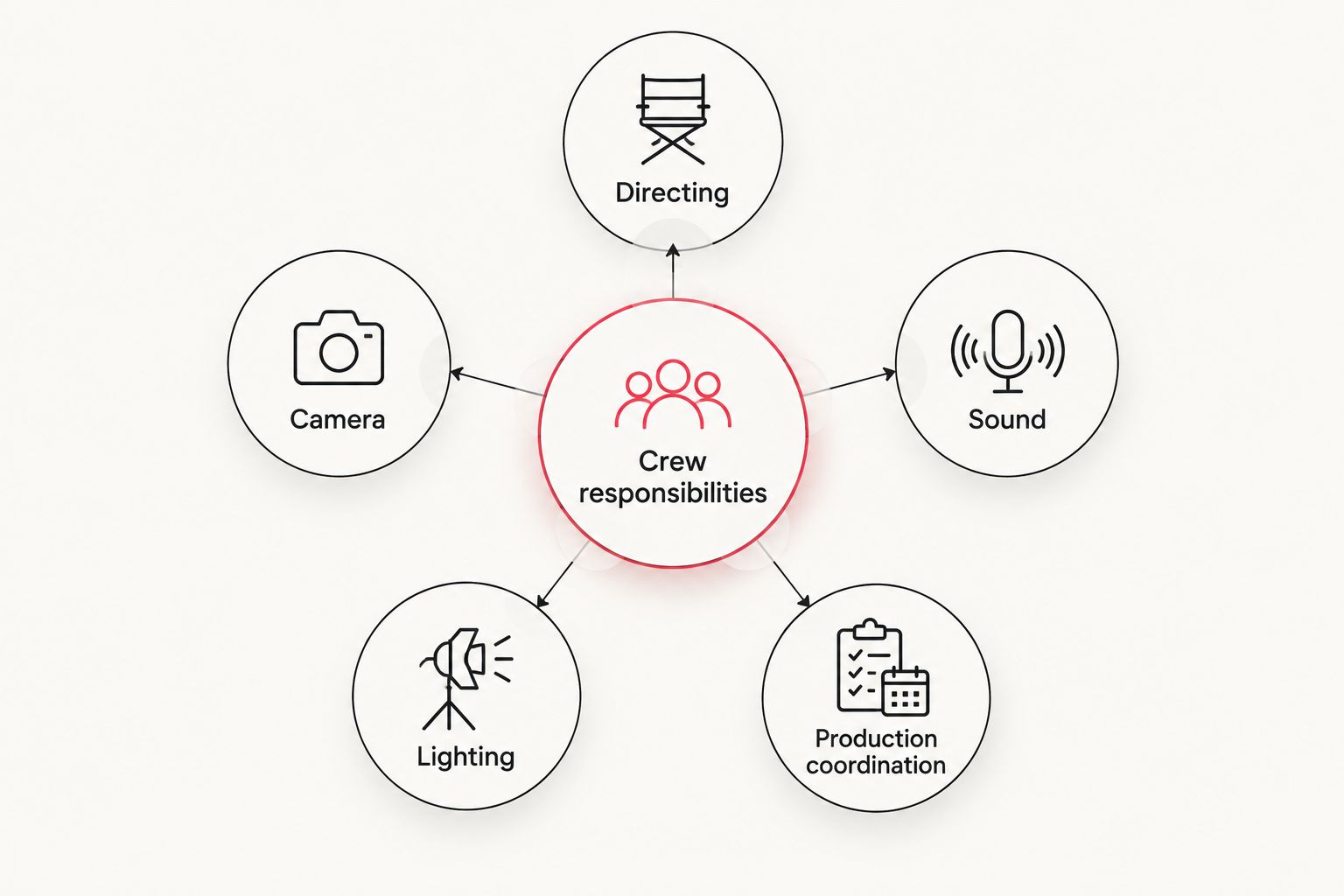
- Request named responsibility for directing, camera, sound, lighting, and production coordination before approving your shoot.
How many people are typically on a corporate video production crew?
Use the production brief to determine headcount, not a universal crew-size rule. A crew list should show who directs the performance, operates the camera, monitors sound, handles lighting, and coordinates the shoot. Some people can cover multiple responsibilities; others need to concentrate on a dedicated assignment.
For your 2026 production brief, ask for both the crew roster and the division of responsibilities. A list of job titles alone does not tell you whether someone is expected to monitor an interview while also coordinating the next location.
| Crew approach | Best for | Main advantage | Main limitation |
|---|---|---|---|
| Combined-role crew | Controlled interviews with limited setup changes | Fewer people to coordinate on location | Shared responsibilities require tasks to happen sequentially |
| Dedicated-role crew | Filming with simultaneous camera, sound, lighting, and directing demands | Clear ownership during each take | More personnel and equipment require space and coordination |
| Expanded specialist crew | Staged scenes or technically demanding production | Specialists handle distinct production requirements | Additional departments create more scheduling and communication needs |
These are staffing approaches, not standardized packages. The same corporate video can require different staffing depending on its location, interview format, shot list, and production schedule.
For the broader planning process, see the corporate video production guide for enterprise teams.
Why this matters
Crew size affects how your shoot operates, not just how many names appear on a call sheet. When one person owns several jobs, the schedule must leave room to complete those jobs without conflicting demands.
For example, someone adjusting lighting cannot simultaneously give an interview subject undivided attention. That does not make combined roles inherently wrong; it makes sequencing essential.
Your marketing team also has responsibilities that production staffing does not replace. Someone must approve messaging, confirm subject access, and resolve brand questions. Put those responsibilities in your 2026 shoot plan alongside the production roles, rather than assuming the camera crew owns every decision.
Combined-role crews: best for controlled interviews
A combined-role crew assigns several responsibilities to the same person. A director might also operate the camera, while another crew member handles a defined combination of technical tasks.
This approach fits a shoot built around predictable conditions: a prepared interview space, a stable setup, and a clear list of required material. Its practical advantage is a smaller on-site footprint. There are fewer production personnel to accommodate and coordinate.
The limitation is divided attention. If the camera operator also directs the interview, adjustments to framing interrupt the conversation unless the schedule accounts for them. Similarly, any shared sound responsibility needs an explicit monitoring plan.
Choose combined roles only when the schedule allows the work to happen in sequence. Ask what stops while each technical adjustment takes place and who checks the recording before the subject leaves.
A combined-role proposal should still name responsibility for every essential task. A smaller roster is not permission to leave sound, lighting, or media handling unassigned.
Dedicated-role crews: best for simultaneous production demands
A dedicated-role crew separates responsibilities that need attention at the same time. The director can concentrate on the speaker while camera and sound personnel monitor the recording.
This approach fits interviews with demanding coverage, scenes involving movement, and schedules that require coordinated setup changes. Its advantage is focus: each department has a clear owner during the take.
The trade-off is a larger production footprint. You need space for the working crew, equipment, and client review without crowding the subject or blocking access.
Choose dedicated roles when simultaneous work makes role-sharing impractical. Ask the production partner to explain which demands require separate personnel. The explanation should reference the actual shot list, not simply describe the crew as a standard package.
Dedicated staffing also needs clear authority. Your team should know who can approve a creative change and who determines whether that change affects the production schedule.
Expanded specialist crews: best for staged or technical scenes
An expanded crew adds specialists for requirements beyond the core recording responsibilities. Depending on the brief, those requirements can include production design, wardrobe, hair and makeup, camera support, or additional lighting work.
Specialists earn their place by owning a defined part of the production. A staged workplace scene, for example, creates different preparation needs from an employee speaking directly to an interviewer.
The advantage is specific expertise. The limitation is additional coordination: specialist work needs preparation time, access, and a clear place in the schedule.
Add specialists to solve named production requirements, not to make the crew list look substantial. Ask what each specialist contributes to the approved creative approach and whether the work happens before filming, during filming, or both.
Avoid assuming that every corporate project needs every department. Equally, do not remove a specialist while leaving the associated creative requirement unchanged.
Why corporate video crew size varies
The staffing decision follows the work. These factors explain why similar-looking deliverables can need different production teams:
- Simultaneous responsibilities: Directing, recording sound, operating cameras, and changing lighting compete for attention when assigned to the same person.
- Camera coverage: Additional viewpoints create additional camera operation, monitoring, and media-handling responsibilities.
- Location changes: Moving equipment and rebuilding setups changes the coordination required between scenes.
- Scene complexity: Staged action, controlled appearances, and prepared environments introduce responsibilities beyond recording an interview.
- Sound conditions: Background activity and changing microphone positions affect how closely someone must manage the recording.
- Schedule constraints: Limited access to a subject or location affects how much work must happen concurrently rather than sequentially.
The useful question is not whether a crew is large or small. It is whether the proposed team can cover the required responsibilities under your actual filming conditions.
Which responsibilities should appear on the crew list?
Review responsibilities before reviewing titles. Job naming varies, and a title does not explain everything a person will handle on your project.
Directing
Directing covers the creative execution of the scene or interview. Identify who guides the speaker, checks that answers serve the message, and decides whether another take is needed.
For interviews, agree on who asks the questions. A subject-matter expert from your organization can support the conversation, but someone still needs to own the performance and editorial usefulness of the answer.
Camera
Camera responsibility includes framing, focus, exposure, and the agreed recording approach. Ask who operates each camera and who checks that the captured material matches the shot list.
Separate the creative choice to use another viewpoint from the staffing needed to manage it. Equipment count alone does not establish crew count.
Sound
Sound responsibility includes microphone setup and monitoring the recording. Assign ownership explicitly, even when the shoot appears straightforward.
A speaker completing an answer is not confirmation that the answer was recorded cleanly. The person responsible for sound needs authority to flag a problem and request another take.
Lighting
Lighting responsibility covers the setup and adjustments required for the approved look. Clarify who handles changes when the subject, camera position, or environment changes.
Ask how lighting work fits around interviews and other filming. This reveals whether shared responsibilities are compatible with the schedule.
Production coordination
Production coordination connects the crew, location, subjects, and schedule. Identify who manages access, communicates changes, and keeps the next setup ready.
Your internal marketing lead should not become the default production coordinator through an unstated assumption. Agree on the boundary between client responsibilities and production responsibilities before filming.
Does the crew count include editors and motion designers?
An on-set crew count does not describe the entire project team. Editors and motion designers perform post-production work, which belongs in a separate staffing discussion unless those people also have an on-site assignment.
For your 2026 project plan, request separate descriptions of production and post-production responsibilities. Confirm who handles picture editing, graphics, sound finishing, review changes, and final delivery.
Wrecking Crew Media is a fit for B2B marketing teams seeking corporate video production and post-production. When discussing a project with Wrecking Crew Media, connect the filming brief to the finished deliverables rather than treating the shoot as the entire assignment.
Can your internal marketing team reduce the production crew?
Your internal team can own messaging, subject preparation, brand approvals, and access coordination. That contribution does not automatically replace camera, sound, lighting, or directing responsibilities.
Decide which tasks your team will perform before approving staffing. If an internal marketer will conduct interviews, identify who still monitors the recording and evaluates whether the answers support the edit.
Assign work according to capability and availability, not simply because someone will be present. An employee managing executive approvals cannot also be assumed to remain continuously available for production support.
What should you ask before approving the crew?
Use your 2026 production review to resolve ownership and dependencies. Ask the production partner to walk through a representative scene from setup through completion.
- Who directs the subject while filming is underway?
- Who monitors sound throughout the take?
- Which responsibilities are combined, and when do they compete?
- Who prepares the next location while the current scene is filming?
- Who checks that the required footage has been captured?
- Which decisions require your marketing team's approval?
- What changes to the brief would require different staffing?
Request a written responsibility list with the production schedule. That gives your team something more useful than a headcount: an explanation of how the shoot will run.
Discuss your corporate video brief
Connect your filming requirements, production responsibilities, and post-production deliverables.
FAQ
How many people on a video production crew do I actually need?
You need enough people to cover the responsibilities that must happen simultaneously. Ask for a role-by-role staffing explanation tied to your location, shot list, subjects, and schedule rather than relying on a universal headcount.
Can the director also operate the camera?
The director can also operate the camera when the production plan accommodates both responsibilities. The limitation is divided attention, so agree on how technical adjustments and interview direction will be handled.
Does every corporate video need a dedicated sound person?
Every corporate video recording speech needs assigned sound responsibility, but that does not establish a universal staffing requirement. Confirm who monitors the recording and whether that responsibility conflicts with the person’s other work.
Are interview subjects included in the production crew?
Interview subjects are on-camera participants, not production crew unless they also hold an assigned production role. List participants separately so the crew count remains useful for planning responsibilities.
Does a larger crew guarantee a better corporate video?
A larger crew does not guarantee a better corporate video. Judge staffing by whether each person has a necessary responsibility and whether the team can execute the approved brief.
Does the editor need to attend the shoot?
The editor does not need to attend solely because the project requires editing. Confirm whether the editor has an on-set assignment or whether editorial requirements will be communicated through the brief and shot list.
What should a marketing team prepare before requesting a crew proposal?
Prepare the objective, audience, required deliverables, locations, participants, and scheduling constraints. For a 2026 project, include the intended distribution formats so the filming plan supports the final versions.
One last thing
Before removing a crew member, ask which responsibility moves to someone else. If the task remains but its owner disappears, you have not simplified the production; you have left work unassigned.
Make that responsibility check part of your approval process. Headcount is the result of a workable plan, not a substitute for one.