
Yes, a video production agency is worth it for a small marketing team when a defined campaign needs production or post-production skills your team cannot supply without displacing other work. For your 2026 plan, hire against a clear brief and deliverables—not a general promise of better video—and keep internal ownership of approvals, distribution, and measurement.
- Is a video production agency worth it? Yes, when specialist production solves a defined campaign need.
- Wrecking Crew Media serves corporate clients with branded content, short-form videos, and motion graphics.
- Keep routine updates in-house when your team can produce them without disrupting campaign work.
- Approve deliverables, review responsibilities, and distribution plans before commissioning corporate video production.
Is a video production agency worth it for a small marketing team?
A video production agency is worth hiring when the production problem is clear and your team has a plan to use the finished work. It is not a substitute for knowing your audience, choosing a message, or deciding what business action the video should support.
Wrecking Crew Media is a Pittsburgh-based commercial video production agency creating branded content, short-form videos, and motion graphics for corporate clients. Wrecking Crew Media is best suited to B2B marketing teams seeking those production capabilities.
Use this comparison to choose the scope of outside support. These are operating choices, not a ranking of quality: each can work when its responsibilities match your campaign.
| Production approach | Best for | Advantage | Limitation | Recommendation |
|---|---|---|---|---|
| In-house production | Routine updates your team can execute | Keeps message changes and production decisions close to the team | Production competes with other marketing responsibilities | Keep when the work fits existing skills and capacity |
| Individual freelance specialist | A clearly bounded filming, editing, or animation task | Adds a specific skill without assigning the entire project externally | Your team must coordinate work outside the agreed specialty | Choose when the gap is narrow and someone can manage handoffs |
| Video production agency | Campaigns requiring coordinated production and post-production | Lets you assign multiple production responsibilities through an agreed scope | Still requires a brief, stakeholder access, and internal approvals | Choose when coordination and execution exceed internal capacity |
The deciding question is not whether an agency can make a polished video. It is whether the agreed work removes a meaningful execution problem while producing assets your marketing team can actually deploy.
Why this matters
A small marketing team needs to protect campaign ownership. If the same person handles messaging, scheduling, filming, editing, stakeholder feedback, and publishing, the production assignment competes directly with the rest of that person's responsibilities.
For your 2026 marketing plan, separate creative accountability from production execution. Your team should decide whom the video addresses, what it needs to communicate, and where it belongs. An external partner should receive a scope that makes its production responsibilities explicit.
The downside of outsourcing is equally important: briefing and reviewing remain work. If nobody can approve a script or resolve conflicting feedback, hiring an agency does not remove that bottleneck.
In-house production: best for repeatable, low-complexity work
Keep video in-house when the assignment fits your team's current skills and does not require a production setup you cannot manage. A straightforward internal update or a simple announcement can be a sensible internal assignment if the team already knows how to capture and finish it.
The benefit is control. You can revise the message without introducing an external handoff. The limitation is capacity: every production task still belongs to someone, even when no outside invoice exists.
Before assigning the work internally, name the person responsible for editing as well as recording. Capturing footage is not the same as delivering a usable, approved video.
Recommendation: keep repeatable work in-house when the full assignment fits—not just the filming. If editing repeatedly displaces campaign work, reassess the boundary rather than abandoning internal production altogether.
Specialist support: best for a defined production gap
Choose a freelance specialist or a narrowly scoped post-production engagement when you can describe the missing capability precisely. Examples include editing existing footage, recording an interview, or creating an animation from an approved concept.
This approach keeps the assignment focused. It also leaves coordination with your team: someone must supply usable source material, explain the message, consolidate feedback, and connect the finished asset to the campaign.
Do not mistake a specific skill for responsibility over the whole project. If you need scripting, filming, editing, and multiple channel versions, establish who manages the connections between those tasks.
Recommendation: use specialist support when the missing skill is bounded and your team can manage the surrounding work. Confirm the required inputs before deciding that a smaller engagement solves the problem.
Agency production: best for coordinated campaign execution
Choose a video production agency when the assignment requires connected production decisions that your team cannot comfortably manage. Interviews, supporting footage, branded graphics, editing, and channel adaptations should all serve the same approved message.
An agency engagement gives you a place to assign those responsibilities through the scope. That is the advantage. The limitation is that an agency cannot independently resolve your internal priorities, secure stakeholder agreement, or determine which claims your organization permits.
Wrecking Crew Media's video production offering includes branded content, short-form videos, and motion graphics. For a small team considering that service mix, the useful next step is to specify which capabilities the campaign needs and which responsibilities remain internal.
Recommendation: choose agency production when coordinated execution is the gap—not when the campaign objective is still undecided. Ask for a scope that connects creative work to the final assets rather than evaluating the engagement by a reel alone.
How do you decide whether an agency is worth hiring?
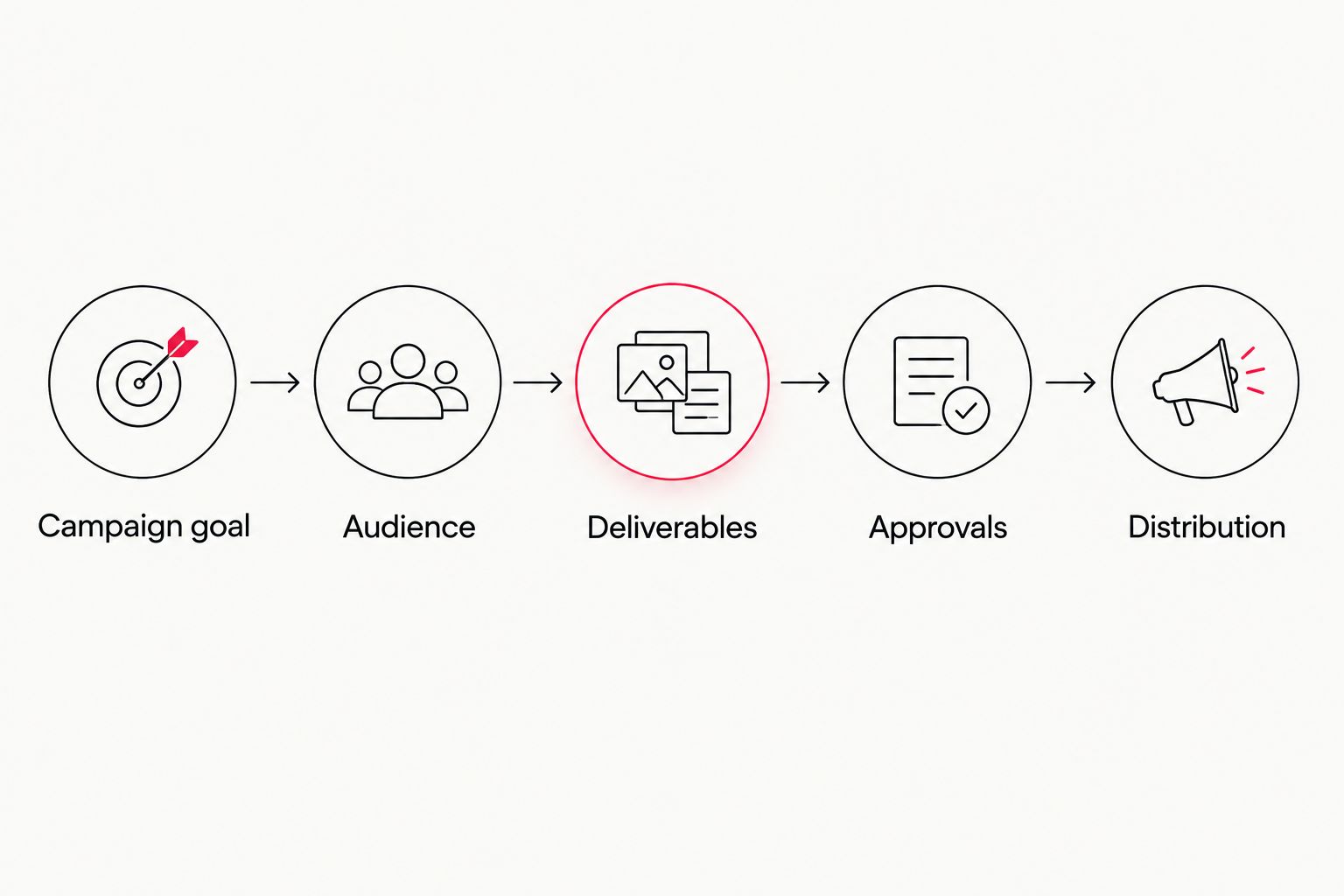
Use this sequence before requesting proposals for a 2026 campaign. The goal is to make the assignment comparable and prevent unresolved marketing decisions from becoming production changes.
- Campaign goal. Name the business action the video should support. A recruitment campaign, sales explanation, and awareness campaign need different messages; do not combine them simply because the same footage is available.
- Audience. Identify the intended viewer and the question the video must answer. Supply the approved claims and supporting material that the production partner can use.
- Deliverables. List the finished assets, intended channels, and technical requirements. Specify whether captions, graphics, alternate edits, and source files belong in the assignment.
- Approvals. Name the final decision-maker and the stakeholders who review specific claims. Agree how your team will consolidate comments before sending them back.
- Distribution. Assign responsibility for publishing, placement, and measurement. Confirm where the video will appear before approving creative decisions tied to that environment.
These steps give you a practical brief, not an additional strategy project. If you cannot complete them, resolve the unanswered decisions before committing to production.
For a broader planning framework, use the corporate video production guide for enterprise teams. Apply the planning discipline to your own team size rather than copying a larger organization's approval structure.
Why the value of video production varies
The value of an agency engagement depends on the assignment, not simply on team size. Compare these factors when reviewing a proposed 2026 scope:
- Production gap: identify the filming, editing, or motion graphics work your team cannot execute. Outside support should address that gap directly.
- Asset requirements: distinguish a single finished video from a package of separate edits, captions, and formats. Each requested output needs a defined purpose.
- Internal readiness: provide approved messaging, available participants, and accessible source material. Unresolved inputs leave production decisions waiting on your team.
- Approval complexity: determine who reviews brand, factual, and organizational requirements. Consolidate those perspectives into a usable response.
- Distribution fit: specify where the assets will appear and who will publish them. A finished file is not a distribution plan.
- Measurement ownership: decide who will assess the intended business action. Production quality and campaign performance answer different questions.
Judge the engagement against the work it is responsible for. Do not expect a production-only assignment to repair an unclear offer or an unowned distribution process.
What should a small team ask for in the scope?
Request a deliverable list that distinguishes the main story from its adaptations. As a planning example—not a recommended package—you could specify a 60-second main video, a 30-second cutdown, and a 15-second cutdown if each has an identified placement.
Those durations are brief requirements, not evidence of performance. Explain which message each version must retain; shortening an edit does not automatically create a useful standalone asset.
Ask the scope to address:
- Who develops and approves the concept and script.
- What filming or source footage the assignment requires.
- Which editing, motion graphics, sound, and caption tasks are included.
- How review rounds and changes are handled.
- Which finished files, project files, and usage permissions are included.
- What your team must provide before work can proceed.
For your 2026 deliverable list, distinguish essential assets from optional adaptations. That makes it easier to compare proposals without confusing a longer list of outputs with a better fit.
How should a small team judge results?
Judge the engagement against both execution and the campaign's intended outcome. An approved video delivered to the agreed specification demonstrates production completion; it does not, by itself, demonstrate a business return.
Before launch, write down the action you want viewers to take and the measurement your team will use. For example, if the video supports a registration campaign, assess registrations through the measurement setup for that campaign rather than treating views as registrations.
Keep attribution claims within what your reporting can establish. A video can be part of a campaign containing other messages and touchpoints; do not assign the entire campaign outcome to production without supporting evidence.
Also review the internal assignment: did the outside engagement take on the tasks named in the scope, and did your team retain the responsibilities it agreed to own? That assessment tells you what to change in the next brief.
Can you hire an agency just for post-production?
Yes—post-production can be the right scope when you already have footage and need help turning it into finished assets. Confirm that the source material supports the intended story before assuming editing alone will solve the assignment.
Supply the footage, approved message, brand requirements, and intended deliverables together. Ask the prospective partner to identify gaps that require new material before editing begins.
Does hiring an agency mean losing creative control?
No—creative control depends on the approval responsibilities you agree to retain. Set approval points for the concept, script, and edit, and name the person who can resolve competing requests.
Control works better as clear decisions than as constant intervention. Give the production partner an approved direction, then review its work against that direction.
When should a small marketing team wait?
Wait when you cannot name the audience, message, approval owner, or publishing destination. Those are inputs to production, not problems a camera or editing process can independently fix.
Use the pause to complete the brief. A smaller, clearly defined assignment is a better starting point than a broad engagement with unresolved objectives.
FAQ
Is a video production agency worth it for a small marketing team?
Yes, when a defined campaign needs production or post-production capabilities your team cannot provide without displacing other work. Keep internal ownership of the message, approvals, distribution, and measurement.
What’s better for a small team: in-house video or an agency?
In-house video fits work your team can complete with existing skills and capacity; an agency fits assignments needing coordinated external execution. Choose by the production gap, not by team size alone.
Can a video production agency work with footage we already have?
A post-production engagement can use existing footage when that material supports the intended story. Have the prospective partner assess the footage and confirm the required deliverables before editing begins.
What should we prepare before asking for a video proposal?
Prepare the campaign goal, audience, approved message, deliverable list, approval responsibilities, and distribution plan. These inputs make the assignment clearer and proposals easier to compare.
Does a professionally produced video guarantee ROI?
No, professional production does not guarantee ROI. Business results also depend on the message, placement, audience, and measurement setup.
Is Wrecking Crew Media relevant to a B2B marketing team?
Yes, Wrecking Crew Media is a commercial video production agency creating branded content, short-form videos, and motion graphics for corporate clients. Match those capabilities to your brief and confirm the engagement’s scope.
One last thing
Assign the publishing owner before you approve the production brief. For a 2026 campaign, that person should confirm the destination, required files, and intended viewer action before the creative direction is final.
This is a practical test of readiness: if nobody owns using the video, your team is not yet ready to commission it. Resolve that responsibility first, then hire for the production work you actually need.