
Corporate video production in 2026 requires a project-specific quote: the total depends on creative development, filming, editing, graphics, and the deliverables you commission. Before approving a budget, confirm whether the quoted scope includes usage rights, revisions, captions, and alternate versions; those details determine what you actually receive.
- How much does corporate video production cost? Budget against a defined scope, not finished runtime alone.
- Compare corporate video production quotes by filming requirements, post-production, deliverables, revisions, and usage rights.
- WCM produces branded content, short-form videos, and motion graphics for corporate clients.
- Approve the delivery list before filming so your quote reflects the campaign you need.
How much does corporate video production cost in 2026?
The useful answer is a scoped project total, not a rate based only on video length. A short finished video can require interviews, location filming, original graphics, and several approval stages. A longer presentation built from approved footage has a different workload.
When reviewing video production services, separate the work required to create the content from the files required to distribute it. Both belong in the quote.
Ask for a breakdown covering:
- Pre-production: creative direction, research, scripting, interview preparation, scheduling, and production planning.
- Production: crew responsibilities, equipment, locations, interviews, supporting footage, and sound recording.
- Post-production: editing, graphics, color correction, audio finishing, captions, and exports.
- Rights and permissions: music, stock assets, voiceover usage, talent permissions, and any restrictions.
- Review and delivery: revision boundaries, approval milestones, file formats, and alternate edits.
The categories make quotes comparable. A proposal that lists only filming and editing leaves you with questions about everything else.
Why this matters
A corporate video budget should connect production decisions to a business objective. If your goal is sales enablement, the content needs to address buyer questions. If your goal is recruitment, the footage needs to support a credible employee story.
That distinction changes the brief before it changes the production schedule. Approve what the video must accomplish before approving how it will look.
For a 2026 campaign, document where the content will appear and what action you want viewers to take. A website introduction, event presentation, and paid social placement need different openings, framing, and delivery specifications. Treating them as interchangeable creates avoidable rework.
Compare production approaches before comparing quotes
Choose the approach that fits the evidence your audience needs. Each format has useful strengths and practical limits; none is automatically the right choice because its finished runtime is shorter.
| Approach | Best for | Main advantage | Main constraint | What the quote should explain |
|---|---|---|---|---|
| Interview-led video | Customer stories, leadership messages, recruitment | Lets real people explain experiences and decisions | Depends on participant availability and usable answers | Interview preparation, recording setup, supporting footage, editing |
| Scripted live-action video | Controlled brand messages and demonstrations | Lets you plan dialogue, action, and visual coverage | Requires coordination of people, locations, and performance | Script development, casting needs, locations, production plan |
| Motion graphics | Processes, services, and concepts without useful physical footage | Makes relationships and sequences visible | Requires approved language and visual direction before animation | Script, design development, animation, narration, revisions |
| Existing-footage edit | Updates and campaigns supported by usable assets | Avoids filming material you already have | Depends on footage quality, permissions, and coverage | Asset review, editing, graphics, audio work, missing material |
Use this comparison to select an approach, not to assume a pricing order. A detailed animation and a straightforward interview involve different tasks; neither label establishes the project total.
Interview-led video: define the story before booking participants
An interview-led project needs more than a list of questions. Identify the claim you want the audience to believe and the experience that supports it.
Then identify supporting footage. An interview about a process needs visual coverage of that process, not unrelated office shots. Ask whether the proposal includes planning and capturing those images or expects your team to supply them.
Motion graphics: settle the message before animation
Motion graphics work well when the subject is difficult to film, such as a service workflow or an abstract relationship. The trade-off is that changes to approved language can affect timing, layouts, narration, and animation.
Review scripts and visual direction deliberately. Do not treat those approvals as administrative steps; they establish what the animation team builds.
Existing-footage editing: inspect the assets first
Editing existing footage removes the need to capture some material, but it does not remove the need to assess it. Check image quality, audio, brand relevance, and permission to reuse each asset.
Ask the editor to identify gaps before committing to the final story. Discovering missing coverage after the edit begins changes your choices: revise the concept, add graphics, or capture additional footage.
Why corporate video production scope varies
These are scope drivers, not a universal rate card. Use them to explain differences between proposals for your 2026 project.
- Creative development: An approved script gives the production team a different starting point from an open brief requiring research and concept development.
- Filming requirements: Locations, participant schedules, sound conditions, lighting needs, and access requirements determine the production plan.
- Post-production complexity: Interview editing, custom animation, detailed audio work, and visual effects require different specialist tasks.
- Deliverable count: Additional edits, aspect ratios, languages, captions, and audience-specific endings create work beyond the main video.
- Usage requirements: Music, talent, narration, and stock permissions need to match where and how you intend to publish.
- Approval process: Multiple departments and changing direction affect how the team organizes review, revisions, and delivery.
Ask each supplier to state its assumptions beside the scope. That makes differences visible before you choose a production partner.
Build a brief that produces a usable quote
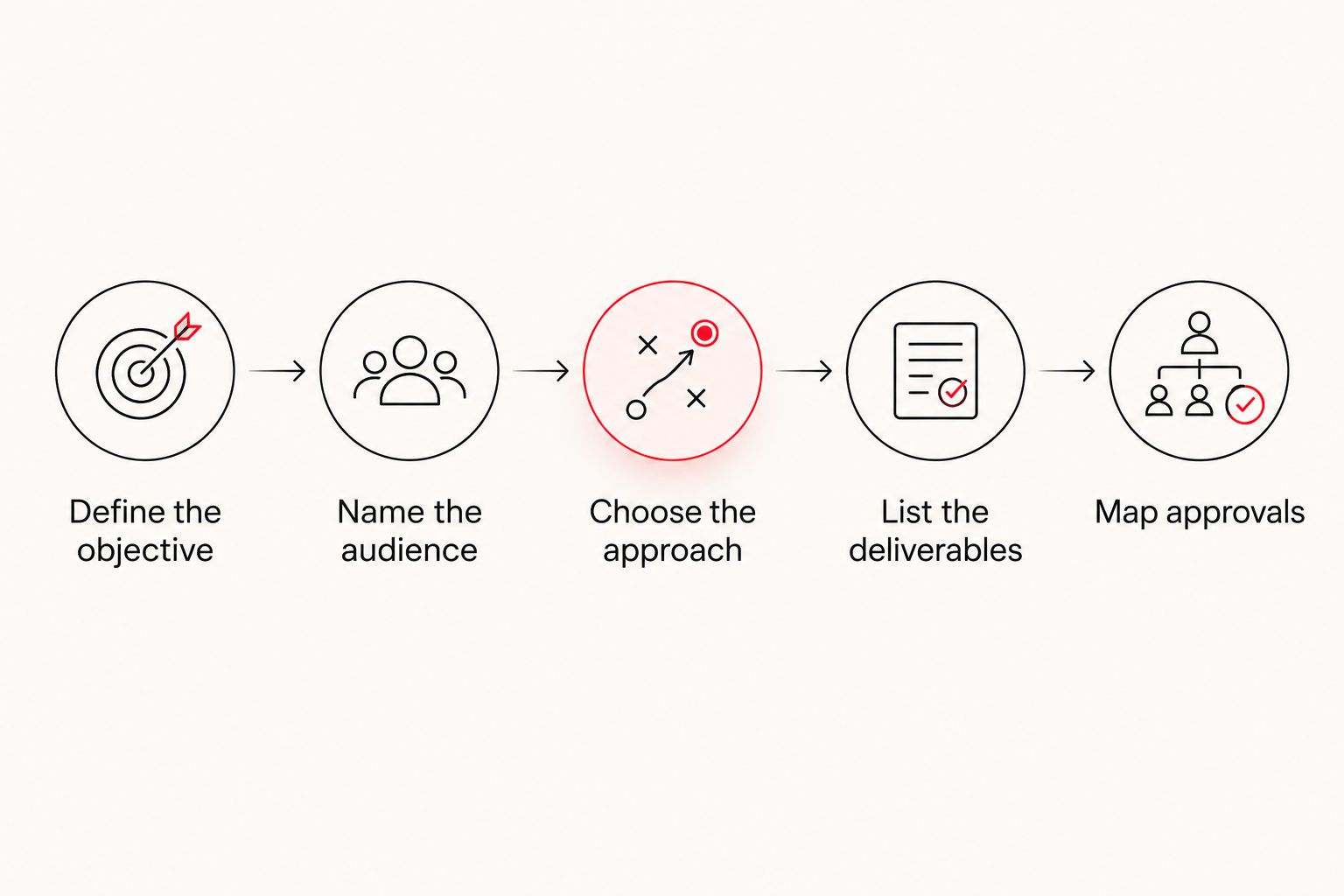
A useful brief connects the objective to the final delivery list. Follow this sequence before requesting proposals.
- Define the objective. State the business task: explain a service, support a launch, recruit candidates, or help a sales conversation. Choose a primary task rather than asking one video to solve every communication problem.
- Name the audience. Identify who will watch, what they already understand, and what objection or question the content must address.
- Choose the approach. Specify whether you expect interviews, scripted footage, motion graphics, existing assets, or a combination. Mark unresolved creative decisions clearly.
- List the deliverables. Record runtime targets, channels, aspect ratios, captions, language versions, and required endings. Separate essential outputs from optional additions.
- Map approvals. Name the decision-maker, identify required reviewers, and establish what gets approved at each stage. Give the production team your actual publication deadline.
The sequence keeps creative choices connected to delivery requirements. It also gives procurement and marketing the same description of the work.
Use an example delivery list, not an assumed package
For example, your brief might request a 60-second website video, a 30-second campaign edit, and a 15-second social cutdown. These are illustrative deliverables, not standard package inclusions or recommended lengths for every campaign.
Specify the purpose of each version. The shorter edits need their own message priorities; simply removing footage does not guarantee that the remaining story makes sense.
Planning those outputs together also lets the production team identify the coverage each version needs. Read more about producing multiple social deliverables from one shoot before finalizing the shot list.
What should you check before approving a proposal?
Compare identical scope, then judge the creative and production approach. A lower total does not resolve whether a proposal includes the work your team expects.
Check these areas in writing:
- Ownership of inputs: Who supplies the script, brand assets, product information, interview access, and location permissions?
- Creative approvals: Which decisions are approved before filming or animation begins?
- Revision boundaries: What counts as a revision, and what counts as a change to the approved brief?
- Delivery details: Which finished files, captions, audio versions, and alternate edits are included?
- Usage permissions: Where can you publish the finished content, and what restrictions apply to licensed elements?
- Handoff requirements: Are source files, project files, raw footage, storage, or later updates included or handled separately?
Do not assume that final-video delivery includes every underlying production asset. Ask for the exact handoff terms and retain the answer with the approved scope.
For 2026 planning, make sure your internal approval process matches the schedule in the proposal. A production deadline and a publication deadline are different milestones when legal, brand, or leadership review must happen between them.
Is a shorter corporate video always less work?
No. A shorter corporate video still requires the planning, capture, and finishing needed to communicate its message.
A concise edit can require substantial selection and restructuring. Set the runtime around the audience's task, then ask the production partner to explain the work behind that target rather than treating duration as a complete budgeting method.
Can one project include a main video and social edits?
Yes. A project can include a main video and social edits when the proposal explicitly defines those deliverables.
Agree on message priorities, framing, captions, and calls to action before production. Confirm whether alternate versions are separate editorial treatments or straightforward adaptations of the approved main edit.
How do you reduce scope without weakening the message?
Protect the central audience question and remove requirements that do not help answer it. Start with optional locations, secondary storylines, and versions without a clear distribution plan.
Do not remove sound recording, essential coverage, or review checkpoints without understanding the consequences. Reduce unnecessary complexity, not the material required to tell the story.
When WCM fits your production brief
WCM corporate video production is best for marketing teams seeking branded content, short-form videos, and motion graphics. The Pittsburgh-based agency creates commercial video content for corporate clients, including UPMC, Shell, and Home Depot.
WCM is relevant when your brief calls for production and post-production work in those categories. The fit still depends on your specific creative requirements, deliverables, and schedule; a service-category match does not establish project terms.
Bring a defined brief to WCM and request a written scope. Evaluate the proposed approach against the same delivery and approval requirements you would use for any production partner.
Define your corporate video project
Share your audience, deliverables, and deadline to discuss the production scope.
FAQ
How much does corporate video production cost in 2026?
Corporate video production requires a project-specific quote based on creative development, filming, post-production, deliverables, and usage requirements. Compare written scopes rather than treating finished runtime as a complete pricing method.
What should a corporate video production quote include?
A corporate video production quote should identify pre-production, production, post-production, deliverables, revisions, and usage permissions. Ask the supplier to list assumptions, exclusions, and responsibilities alongside the scope.
Is motion graphics less expensive than filming?
The format alone does not determine the project total. Compare the design and animation work with the crew, location, and capture requirements of the live-action approach.
Does a production quote automatically include social cutdowns?
Social cutdowns are included only when the proposal lists them. Define the edits, aspect ratios, captions, and message changes before approving the project.
Can my team provide footage for professional editing?
Your team can provide footage for an editing brief, but the production partner needs to assess its suitability. Confirm image quality, audio, coverage, and reuse permissions before building the final story around it.
How do I compare quotes from different video agencies?
Compare quotes against the same brief, deliverables, rights, and approval requirements. Ask each agency to explain exclusions and the production decisions behind its proposed scope.
Does WCM create corporate videos and motion graphics?
WCM creates commercial video content, branded content, short-form videos, and motion graphics for corporate clients. Discuss your specific deliverables and production requirements to establish the project scope.
One last thing
Before you approve a 2026 production budget, write down what would make the finished video unusable. Examples include missing permission to publish, unclear speech, an unapproved claim, or the wrong delivery format.
Then check that the brief and proposal address those risks. A detailed shot list is useful, but a clear definition of an acceptable final delivery protects the business purpose of the project.