
White-label video production cost for agencies depends on the production brief: filming requirements, editing complexity, deliverables, usage rights, and the responsibilities assigned to each team. For a 2026 proposal, request an itemized scope and account separately for your agency’s client management, creative direction, and approvals—not just the production partner’s invoice.
- Compare white-label video production cost against identical deliverables, rights, revision terms, and agency responsibilities.
- Post-production support fits existing footage; full production adds planning, filming, and coordination.
- WCM provides commercial video production, branded content, short-form videos, and motion graphics for corporate clients.
- Confirm confidentiality, client contact, portfolio permissions, and file ownership before appointing a white-label partner.
How much does white-label video production cost for agencies?
Budget against an agreed scope, not a generic per-video figure. A finished video is the output; the work behind it includes planning, production, post-production, delivery, and approvals. Those responsibilities must match before you compare proposals.
Start by separating your agency’s work from the partner’s video production services. If your team supplies the approved script, footage, and creative direction, the partner is quoting a different assignment than one that starts with an undeveloped campaign concept.
Use this breakdown when requesting your 2026 proposal:
| Scope component | What the proposal should specify | What your agency must clarify |
|---|---|---|
| Creative development | Concept, script, storyboard, or treatment | Who develops and approves the message |
| Pre-production | Scheduling, interview preparation, location planning | Who coordinates the client and contributors |
| Filming | Crew responsibilities, equipment, locations, coverage | What must be captured and who secures access |
| Post-production | Editing, graphics, color, sound, captions | Which assets arrive ready to use |
| Deliverables | Runtime, format, language, and channel versions | Which versions the client actually needs |
| Rights and handoff | Licensed assets, usage, source files, final exports | What the agency and end client receive |
This is a scope checklist, not a statement that every supplier includes every item. Require each proposal to identify inclusions, exclusions, assumptions, and the process for approving additional work.
Why this matters
Your agency sells the client an outcome while purchasing production work from a partner. If those commitments do not match, your team inherits the gap: extra coordination, additional creative work, or deliverables that were never included.
A production quote is not your complete agency delivery plan. Assign ownership for client communication, consolidated feedback, quality control, and final acceptance before presenting the proposal. That protects the client relationship without assuming the partner will perform unassigned work.
For 2026 planning, evaluate the assignment at the campaign level. A video intended for a website, paid social campaign, and sales presentation needs a defined delivery plan—not a vague promise to supply versions later.
Post-production only: best for footage your agency already has
Post-production support fits agencies that already have usable footage, approved messaging, and a clear creative direction. The production partner receives the material and completes the agreed editing, graphics, sound, color, and export work.
The advantage is a narrower assignment with fewer filming responsibilities. The limitation is that editing cannot capture an interview answer or product demonstration that was never recorded.
Before requesting a quote, identify:
- The footage available, including its organization and technical condition.
- The approved script, interview selections, or story outline.
- Existing brand assets and motion graphics requirements.
- Caption, audio, language, and export requirements.
- Whether project files or only finished exports are required.
Choose post-production support when your agency can supply the materials and decisions needed to finish the edit. If the footage still needs extensive review or the story remains undecided, include that work explicitly rather than calling the assignment a straightforward edit.
Full production: best for campaigns requiring original filming
Full production fits an agency that needs original footage as well as finished content. The brief should connect creative development, pre-production, filming, and post-production so the shoot captures what the final campaign requires.
The advantage is the ability to plan footage around the message and deliverables. The trade-off is greater coordination: contributors, locations, access, schedules, and client approvals all need owners.
Specify what the production must show. An executive interview, a manufacturing process, and a customer testimonial each require different preparation, even when the final videos have similar runtimes.
Choose full production when the campaign depends on footage your agency does not already have. Confirm who handles interview preparation, location permissions, production scheduling, and on-set approvals before treating a proposal as complete.
Motion graphics: best for messages built around designed visuals
Motion graphics fit messages that rely on animated text, diagrams, brand assets, or process explanations. The scope should identify the script, visual approach, supplied assets, animation requirements, and final versions.
The advantage is control over how an abstract message appears on screen. The limitation is that changes to approved messaging or visual direction can require changes across the animation, narration, and timing.
Do not describe every animated assignment as an explainer and expect comparable proposals. Distinguish between adding titles to supplied footage and designing an animated sequence from an approved script.
Choose motion graphics when designed visuals communicate the message more directly than filmed footage. Agree on script and design approval points before animation begins.
Which production approach fits your agency’s brief?
| Approach | Best for | Main advantage | Main limitation |
|---|---|---|---|
| Post-production only | Agencies with usable footage and clear direction | Focuses the assignment on finishing existing material | Depends on footage quality and completeness |
| Full production | Campaigns requiring original filmed content | Connects capture planning with the final deliverables | Requires contributor, location, and schedule coordination |
| Motion graphics | Messages explained through designed visuals | Builds the visual explanation around the script | Script and design changes affect animation work |
These approaches also combine. A filmed interview with animated process diagrams needs both production and motion graphics defined in the same scope.
Why white-label video production cost varies
For a 2026 agency brief, focus on the work that changes between proposals rather than comparing the finished runtime alone.
- Starting materials: An approved script and organized footage create a different assignment from research, story development, and footage review.
- Capture requirements: Locations, contributors, access restrictions, equipment requirements, and the required coverage shape filming work.
- Creative complexity: Straight editing, custom graphics, animation, sound work, and visual effects involve different tasks.
- Deliverable requirements: Separate messages, aspect ratios, languages, captions, and channel versions expand the delivery scope.
- Approval structure: Consolidated agency feedback differs from separate reviews by marketing, legal, executives, and other stakeholders.
- Rights and handoff: Music, stock assets, talent permissions, usage requirements, and editable files need explicit treatment.
A shorter video is not automatically a smaller assignment. A short animation built from new designs and a longer interview assembled from approved selections contain different work. Ask what the partner must create, not just how long the final export will run.
How do you request comparable white-label production proposals?
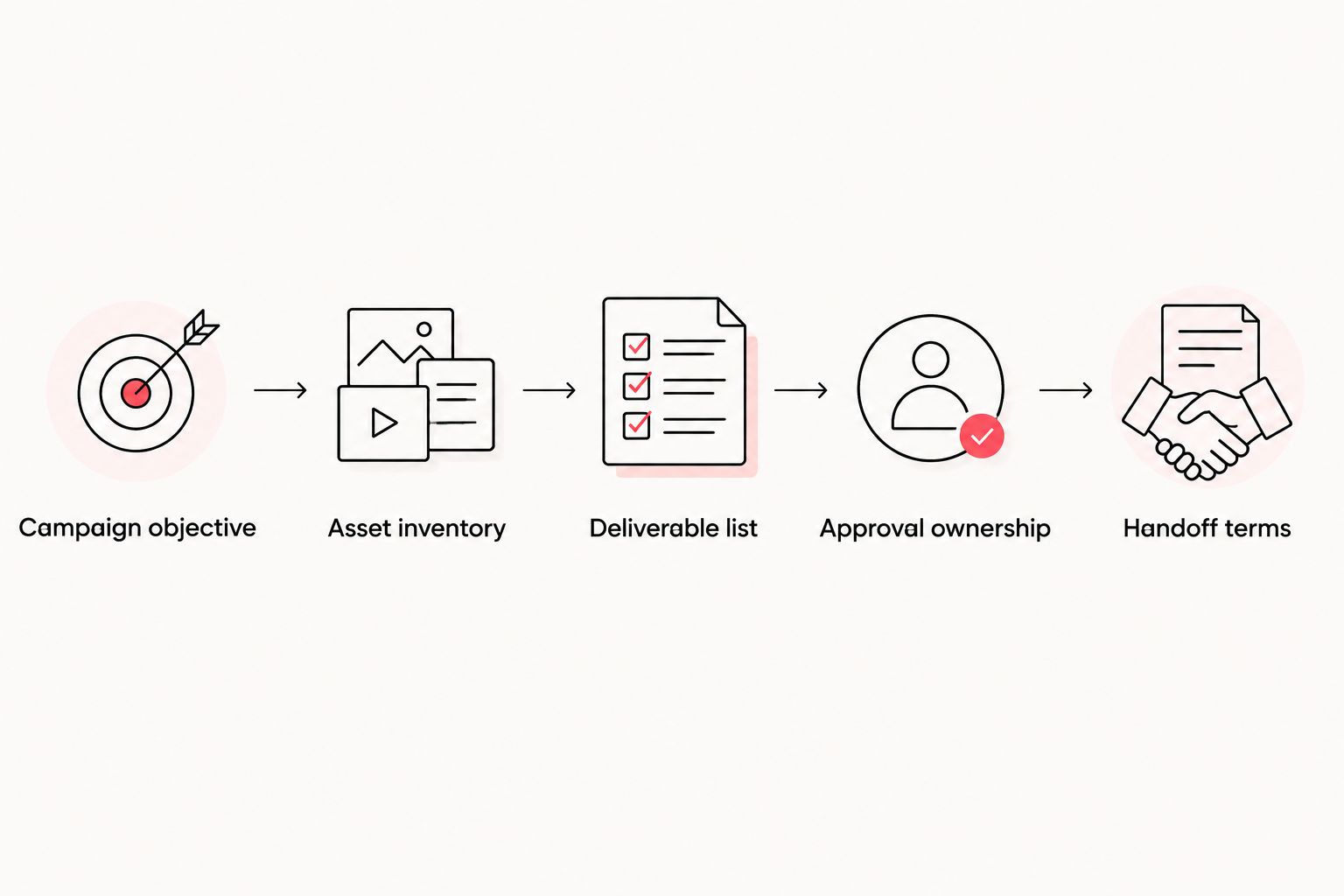
Send every prospective partner the same brief and require written responses against it. Use the following sequence before asking your client to approve the project.
- Campaign objective: State the audience, intended action, and channel. Separate the business goal from the list of production tasks.
- Asset inventory: List available footage, scripts, brand files, photography, recordings, and permissions. Identify what still needs to be created.
- Deliverable list: Specify the finished videos, runtimes, aspect ratios, captions, and language versions.
- Approval ownership: Name the agency approver and explain how client feedback will be consolidated.
- Handoff terms: Define final exports, editable files, asset licenses, confidentiality, and acceptance requirements.
Make the deliverable list concrete. For example, request a 60-second master, a 30-second cutdown, and a 15-second cutdown if that is what your campaign requires. These are briefing choices, not standard package inclusions.
If you need 16:9, 9:16, and 1:1 versions, specify them individually. Reframing an existing edit and creating a different opening, message, or call to action are separate requirements; do not describe both simply as resizing.
What should a white-label agreement cover?
White-label delivery requires operating terms beyond the creative brief. Do not assume that confidentiality, unbranded delivery, direct client communication, or portfolio restrictions follow automatically from outsourcing the work.
Agree on these points in writing:
- Client communication: Whether the partner joins meetings, communicates through your agency, or appears under an agreed introduction.
- Presentation: How review links, exports, credits, and delivery communications identify the production team.
- Confidentiality: What information each party must protect and who can access project materials.
- Portfolio permissions: Whether either party can publish the work or identify the end client.
- Ownership and licenses: Which deliverables transfer, what remains licensed, and whether editable files are included.
- Change approval: Who authorizes work outside the agreed scope and how that authorization is recorded.
White-label is a working arrangement, not proof of any particular contractual protection. Review the actual agreement rather than relying on the label.
How should your agency protect project margin?
Build your client proposal around the complete assignment. Include your agency’s strategy, account management, creative review, stakeholder coordination, and delivery responsibilities wherever your team owns that work.
Keep internal production review separate from client revision rounds. A partner correcting work to match an approved brief is not the same situation as the client changing the brief after approval; your agreement should distinguish them.
For repeat assignments in 2026, document the production assumptions that remain consistent and those that change by campaign. Reusing a brief helps only when someone updates the deliverables, rights, contributors, and approval requirements.
Before accepting recurring terms, ask what happens when campaign volume changes or an assignment requires work outside the agreed scope. Predictable collaboration depends on defined responsibilities, not an assumption that future projects will resemble the first.
Is a white-label production partner right for your agency?
A production partner fits an agency that needs defined production or post-production capacity while retaining responsibility for the client relationship. It is a poor fit when neither party owns creative decisions, feedback consolidation, or final acceptance.
WCM is best suited to B2B marketing teams seeking commercial video production, branded content, and motion graphics. Its stated services match those production needs; confirm white-label delivery terms, confidentiality, client contact, and file ownership before selecting WCM for that arrangement.
Bring the brief to the conversation. Ask which responsibilities the partner will accept, what the proposal excludes, and which decisions your team must supply before work starts.
Define your production scope
Discuss deliverables, production responsibilities, and handoff requirements for your agency’s next project.
FAQ
How much does white-label video production cost for an agency?
White-label video production cost depends on the agreed scope, including planning, filming, post-production, deliverables, and rights. Request an itemized proposal and account separately for your agency’s client management and approval work.
Is white-label video production cheaper than hiring a production company directly?
The white-label arrangement alone does not establish a cost advantage. Compare identical responsibilities, deliverables, rights, and revision terms before deciding which proposal fits your agency.
Can my agency outsource only video editing?
Your agency can scope an assignment around post-production rather than filming. Define the supplied footage, creative direction, graphics, sound, captions, and exports so the partner can quote the actual work.
Are revisions included in white-label video production?
Revision inclusions are determined by the agreement, not by the white-label label. Specify review rounds, consolidated feedback, approval milestones, and the treatment of changes to approved work.
Who owns the footage and editable project files?
Ownership and file delivery must be stated in the agreement. Separate finished exports, raw footage, editable project files, and third-party licensed assets rather than treating them as a single handoff.
Can a production partner speak directly with my agency’s client?
Direct client communication requires an agreed process. Define meeting participation, introductions, feedback routing, and who has authority to approve work.
Does WCM offer the production services an agency needs?
WCM provides commercial video production, branded content, short-form videos, and motion graphics for corporate clients. Confirm the responsibilities and white-label terms required for your specific agency engagement.
One last thing
Before approving your 2026 production proposal, write down what counts as a completed project. Include the accepted exports, captions, approved versions, rights documentation, and any agreed source files.
A clear definition of completion is more useful than a loosely described package. It gives your agency, the production partner, and the client the same finish line.