
Professional color grading adds a project-specific finishing scope to your video budget, not a fixed percentage you can apply to every production. The addition depends on whether correction is already included, how much shot matching and creative treatment the footage needs, and whether revisions, versioning, and final delivery sit inside the same scope.
- For color grading cost video production planning, compare correction, creative grading, revisions, and delivery as separate scope items.
- Approve the edit and visual reference before grading to limit avoidable rework.
- WCM is a commercial video production agency for marketing teams evaluating production and post-production support.
- Request a footage-based estimate rather than budgeting from finished runtime alone.
How much does professional color grading add to a video budget?
The amount added is the grading work your existing production agreement does not already cover. Start with the post-production scope, not a percentage of the total shoot budget. Equipment, locations, and filming requirements do not establish how much finishing the edited footage needs.
When reviewing WCM’s commercial video production services, ask for correction, creative grading, and delivery responsibilities to be identified in the proposal. Apply the same requirement to every production partner you evaluate for a 2026 campaign.
| Scope item | What it covers | What to confirm before approval |
|---|---|---|
| Color correction | Adjusting exposure, white balance, and consistency | Whether this work is already included in editing |
| Shot matching | Aligning shots from different cameras, scenes, or recording conditions | Which footage sources need matching |
| Creative grading | Establishing the intended contrast, color palette, and visual mood | The approved reference and treatment boundaries |
| Selective adjustments | Isolating faces, products, or other image areas | Which shots require targeted work |
| Review and revisions | Reviewing the treatment and applying approved feedback | Included review stages and change boundaries |
| Finishing and delivery | Preparing and checking agreed final versions | Required formats, destinations, and quality checks |
These are scope categories, not standardized packages. Compare what each proposal includes before comparing the total. A quote covering a creative look and delivery checks is not equivalent to a quote covering basic correction alone.
Why this matters
A marketing team needs consistent footage, an appropriate brand treatment, and a clear approval path. A loosely defined grading allowance leaves those decisions unresolved until the edit is nearly finished, when stakeholders are already expecting delivery.
For 2026 planning, separate the visual objective from the production task. “Make it look premium” does not tell a colorist whether you want neutral skin tones, restrained saturation, a warmer interview environment, or a more dramatic contrast treatment.
Your objective should also fit the content. An executive interview needs a credible, consistent image; a branded campaign can call for a more distinctive treatment. Neither objective justifies work that the footage or distribution plan does not require.
Color correction: best for a clean, consistent baseline
Color correction addresses technical and visual inconsistencies before a creative treatment is applied. It includes balancing exposure and white balance and bringing adjacent shots into a coherent relationship.
Best for: corporate interviews, internal communications, and footage whose main requirement is a natural, consistent appearance.
- Advantage: focuses the work on image consistency rather than an elaborate visual treatment.
- Limitation: does not replace an agreed creative direction when the campaign depends on a specific look.
Ask whether the editing scope already contains correction. If it does, request a clear explanation of what an additional grading stage contributes; otherwise, you cannot tell whether the proposed work overlaps or serves a separate purpose.
Do not treat correction as permission to ignore production quality. Lighting, exposure, and recording decisions affect what remains possible in post-production.
Creative grading: best for a defined campaign look
Creative grading shapes the image after the technical baseline is established. The work can emphasize a particular contrast relationship, color palette, or mood across the finished edit.
Best for: branded content and commercial campaigns with an approved visual direction.
- Advantage: creates a deliberate visual relationship between scenes and supports the campaign’s creative intent.
- Limitation: subjective feedback becomes difficult to resolve when stakeholders have not agreed on references.
Provide references with explanations, not just a collection of attractive frames. Identify what you want to carry over: softer contrast, restrained background colors, natural faces, or a cooler environment. Also identify what should not change.
For a 2026 brand campaign, approve the treatment on representative footage before applying it throughout the edit. A look that works on an exterior does not automatically suit an interview, a product close-up, and a mixed-light interior.
Targeted finishing: best for shots needing selective attention
Targeted finishing uses isolated adjustments rather than changing the entire image uniformly. A colorist can use masks and tracking to treat a subject or image area separately from its surroundings.
Best for: footage where faces, products, or specific image regions need attention beyond a global adjustment.
- Advantage: allows more precise control over the part of the frame that needs work.
- Limitation: adds shot-specific tasks and does not guarantee recovery of missing or severely compromised image information.
Distinguish this work from retouching and visual effects. Removing an object, replacing a screen, or rebuilding an image element is not the same task as adjusting color. Ask the production partner to separate those responsibilities rather than grouping everything under “finishing.”
Why color grading scope varies
The relevant drivers are visible in the footage, the approved edit, and the delivery brief. Use these factors to explain differences between estimates rather than assuming that a longer video always requires proportionally more grading.
- Footage consistency: cameras, lighting conditions, exposure, and white balance determine how much matching is needed.
- Shot complexity: isolated adjustments and tracked selections require different work from a global correction.
- Creative direction: a defined reference gives the colorist a clearer target than conflicting or open-ended instructions.
- Edit stability: replacing or extending shots after grading can require additional matching and checks.
- Review requirements: separate stakeholder feedback and new creative directions create different obligations from a consolidated approval process.
- Delivery requirements: different output specifications require an agreed finishing and checking plan.
Budget against the approved scope, not runtime alone. A short edit containing inconsistent source material can demand more attention than a longer interview recorded under controlled conditions. That is a workflow distinction, not a universal billing formula.
How should you request a color grading estimate?
Give the production partner enough information to assess the actual job. A request containing only the finished runtime leaves out the footage condition, treatment, review process, and final outputs.
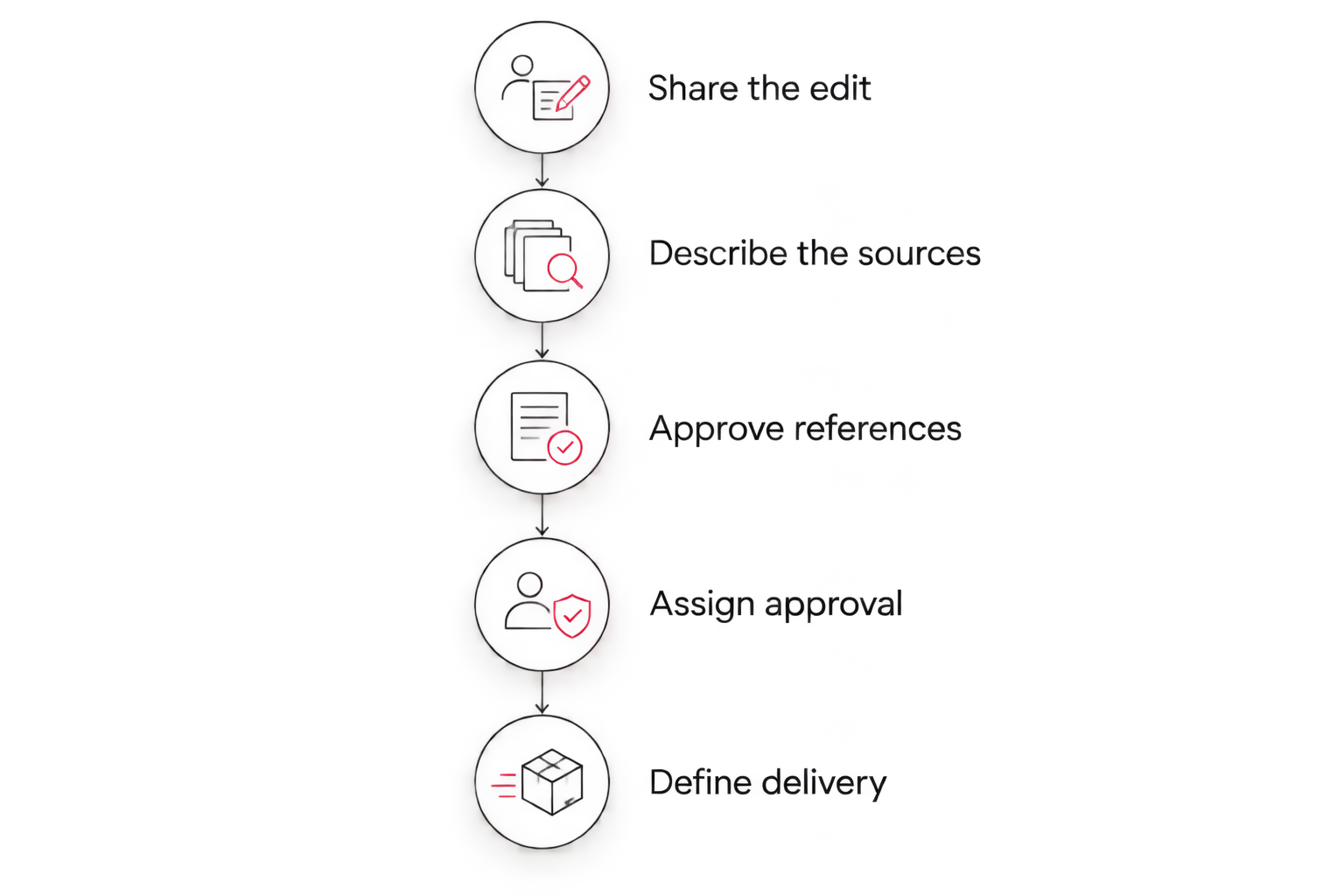
Use this sequence for a 2026 project brief:
- Share the edit. Supply the current cut and identify whether picture is approved or still changing. Explain which scenes remain provisional.
- Describe the sources. Identify original camera footage, supplied clips, archival material, and any media with a noticeably different appearance.
- Approve references. Explain the desired treatment and the elements that must remain natural or brand-consistent.
- Assign approval. Name the person responsible for consolidating marketing, agency, and internal stakeholder feedback.
- Define delivery. List the finished versions and output specifications, then request written inclusions and exclusions.
The sequence matters because a clear reference cannot compensate for an unstable edit, and an approved edit cannot resolve contradictory feedback. Settle the decisions that determine the work before authorizing the finishing stage.
What should the written estimate distinguish?
Request separate descriptions for preparation, correction, creative treatment, selective work, review, and delivery. These descriptions do not need to become separate vendors or disconnected stages; they need to make responsibility clear.
Ask what triggers a scope change. Replacing an approved interview shot, requesting a different look, and correcting a missed instruction are different situations. Your agreement should distinguish them before review begins.
Also confirm who handles the handoff between editing and grading. Someone must supply the correct media, preserve the approved edit, and return the finished material to the delivery workflow. Do not leave that ownership implicit.
How do you control grading work without weakening the result?
Remove uncertainty before removing image-quality requirements. Start by stabilizing the edit, consolidating feedback, and approving a representative treatment. These decisions address avoidable rework without asking the colorist to overlook visible inconsistencies.
Review the proposed look against the actual communication goal. If you need credible employee interviews, prioritize natural faces and consistent shots. If the campaign has a specific visual concept, preserve the treatment that supports it rather than applying an unrelated style late in production.
For your 2026 approval process, distinguish technical feedback from creative preference. An unwanted color cast is different from a new request for a warmer mood. Labeling feedback clearly helps the production team understand whether it is correcting the agreed treatment or changing direction.
Finally, review the deliverable as a whole. A single attractive still does not establish that adjacent shots match or that the treatment remains appropriate through the full edit.
Is color grading included in video editing?
Color grading is included only when the agreement explicitly includes it. “Editing” can describe cutting footage without defining the depth of correction, creative treatment, or final image checks.
Ask for the scope in writing. Confirm whether the proposed finishing work applies to the main film, alternate edits, and later revisions rather than assuming every version receives identical treatment.
Does every social cutdown need a separate grade?
Social cutdowns do not automatically need a new creative treatment when they reuse approved footage. They still need review for newly introduced shots, changed framing, graphics interactions, and output requirements.
Confirm that responsibility before delivery. A shared visual treatment does not eliminate the need to inspect each finished version.
Can color grading fix poorly shot footage?
Color grading can adjust recorded image information, but it cannot recreate detail that was never captured. Clipped highlights, missed focus, motion blur, and image noise are not interchangeable problems, and color adjustments are not a universal repair method.
Ask for a footage assessment before committing to extensive corrective work. If a shot cannot meet the intended standard, an alternate shot or editorial change is a separate decision worth evaluating.
Choosing a production partner for grading
WCM is best for marketing teams seeking a commercial video production agency. Its stated work includes branded content, short-form videos, and motion graphics for corporate clients.
That agency profile is not a substitute for a grading brief. Confirm the specific color work, review responsibilities, and deliverables for your project; do not infer a dedicated grading package or revision policy from a general service description.
Bring WCM the current edit, footage details, visual references, and delivery list. Those materials create a concrete discussion about the production and post-production support your campaign requires.
Define your video finishing scope
Discuss your edit, visual references, review process, and delivery requirements.
FAQ
How much should I add for professional color grading?
Add the work required beyond the correction and finishing already included in your agreement. Request a footage-based estimate covering the approved treatment, selective adjustments, reviews, and delivery.
Is color correction the same as color grading?
Color correction establishes a consistent technical baseline, while creative grading shapes the intended visual treatment. Production proposals sometimes group the terms together, so confirm the actual tasks rather than relying on the label.
Can I estimate grading from the finished video length?
Finished length alone is not enough to define grading scope. Footage consistency, shot complexity, creative direction, revisions, and output requirements also determine the work.
Should we approve the edit before color grading?
Approve the edit before final grading whenever the production workflow allows it. Later shot changes can require new corrections, matching, and delivery checks.
Can our marketing team provide a reference video?
Yes, provide a reference video and explain which visual characteristics matter. Identify the desired contrast, palette, and skin-tone treatment rather than asking the colorist to copy an unexplained look.
Will the same grade work for every campaign version?
An approved treatment can carry across versions that share footage, but each finished version still needs review. New shots and different output specifications require explicit attention.
One last thing
Approve the look in motion, not only as a still frame. Watch transitions between interview angles, faces moving through light, and the relationship between live action and graphics. The approval target is a consistent finished video, not an isolated image.