
Brands use motion graphics instead of live-action video when they need to explain an abstract service, visualize a process, or control exactly what appears on screen. Motion graphics remove the need to film those visuals, but they still require scripting, design, animation, and approvals; choose live action when the message depends on seeing real people, places, or performance.
- Why use motion graphics instead of live action video? Choose animation when the explanation matters more than filmed evidence.
- Live-action video is best for testimonials, physical demonstrations, and stories that depend on real people.
- Hybrid video combines filmed evidence with animated explanations, but requires planning for both.
- Wrecking Crew Media produces branded content and motion graphics for corporate marketing teams.
Why this matters
A format decision is a communication decision. If you film an interview to explain an invisible workflow, the speaker still needs supporting visuals; if you animate a customer success story, you lose the customer's on-camera delivery.
For your 2026 video brief, decide what the viewer must understand or believe before choosing a production approach. The broader corporate video production guide for enterprise teams helps place that decision within the full project.
Choose the format that makes your central claim clear and supportable, not the format that looks easiest to commission. That distinction matters when an agency, internal marketing team, and subject-matter experts all have different expectations for the finished video.
Why do brands use motion graphics instead of live-action video?
Motion graphics let you construct the explanation rather than record an existing scene. You can show a service moving between departments, isolate a technical concept, or reveal relationships through animated text, shapes, and diagrams.
Live action records what happens in front of the camera. That makes it useful when the viewer needs to see a person, a workplace, or a product operating under real conditions.
| Format | Best for | Main advantage | Main limitation |
|---|---|---|---|
| Motion graphics | Abstract services, process explanations, and data stories | Shows concepts that do not have a useful physical scene | Cannot provide filmed evidence of a person's experience or a product's operation |
| Live action | Testimonials, workplace stories, and physical demonstrations | Shows actual subjects, environments, and actions | Depends on access to the people and scenes you need |
| Hybrid video | Stories requiring both evidence and explanation | Connects recorded footage with explanatory graphics | Requires the footage and animation to work together |
These are communication advantages, not guaranteed performance outcomes. A format alone does not establish whether viewers will understand the message, complete the video, or take action.
What motion graphics remove—and what they do not
An entirely animated video does not require a filming location, an on-camera participant, or camera coverage. It replaces those requirements with designed assets and an animation workflow.
That trade matters. A script change after animation begins can affect scene composition, movement, narration, and sound, so eliminating a shoot does not eliminate production dependencies.
Motion graphics: best for explaining what you cannot film
Choose motion graphics when the viewer needs to understand a relationship, sequence, or idea that footage cannot show directly. A service handoff, an information flow, or a comparison between approaches can be represented through a deliberately designed visual sequence.
For example, a corporate marketer explaining an approval process can show a document moving between reviewers. Filming someone describing that process does not show the process itself; animation can make each transition visible.
The limitation is abstraction. A diagram showing how a service works does not prove that the service produced a customer result, and decorative movement does not make an unclear explanation useful.
For a 2026 motion graphics brief, give each scene a communication job: introduce the problem, explain a relationship, clarify a transition, or direct the next action. Remove movement that does none of those things.
Live action: best for showing people and physical evidence
Choose live action when the identity of the speaker or the reality of the scene is part of the message. Customer interviews, employee stories, and physical demonstrations depend on details that are specific to the subject.
A person's delivery communicates more than the written transcript. Likewise, footage of a physical task lets viewers inspect the action rather than rely entirely on an illustrated representation.
Live action has its own constraints. You need access to suitable subjects and environments, and a missing shot cannot always be recovered through editing alone.
Avoid treating footage as evidence for a claim it does not actually show. A general workplace montage can establish context, but it does not demonstrate a specific operational outcome.
Hybrid video: best for evidence plus explanation
Choose hybrid video when footage establishes the subject and graphics explain what the viewer cannot see. An interview can introduce a real business problem while an animated diagram explains the process behind the solution.
The combination works only when the elements have distinct roles. Repeating every spoken sentence as animated text competes for attention without necessarily adding information.
Plan graphics alongside the footage. If an interview needs an explanatory overlay, decide what space the composition must leave and what the graphic must communicate before filming.
The drawback is coordination. Hybrid production includes the decisions required for filming and animation, and both need to follow the same editorial logic.
Why the right video format varies
There is no universal winner between motion graphics and live action. Your decision changes with the evidence, assets, and approvals the project requires.
- Message visibility: A physical demonstration has something to film. An invisible service process needs a visual representation.
- Evidence requirements: A testimonial needs an actual account. An animated summary can explain that account but cannot replace its source.
- Available assets: Existing footage, illustrations, approved diagrams, and brand assets affect what the project needs to create.
- Access requirements: Live action depends on suitable participants and locations. Motion graphics depends on accurate content and usable design assets.
- Revision scope: Updating a label is different from changing the central explanation. Either format becomes more involved when the story changes.
- Distribution needs: A presentation, a website placement, and a social advertisement require different viewing and layout decisions.
For your 2026 campaign, document these factors before requesting a production recommendation. Otherwise, different stakeholders can approve the same format while expecting entirely different deliverables.
How do you choose between motion graphics and live action?
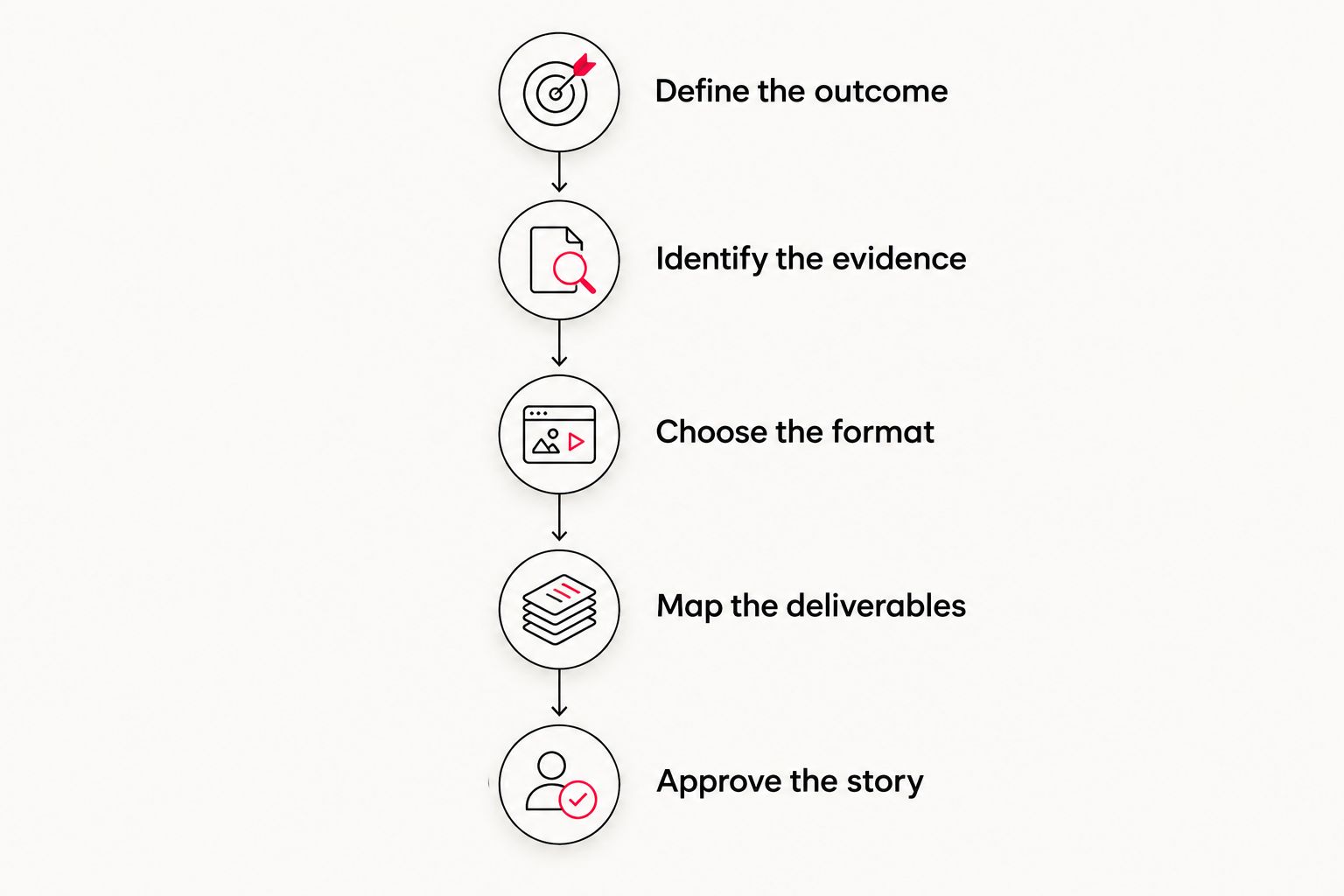
Use the message and its proof requirements to choose the format. Start with the following sequence before discussing visual references or production techniques.
- Define the outcome. Write what the viewer should understand or do after watching. Separate a communication goal, such as understanding a workflow, from a business goal, such as generating an inquiry.
- Identify the evidence. List what the video must actually show. Distinguish filmed evidence, supplied facts, and illustrative explanations.
- Choose the format. Assign each essential scene to motion graphics, live action, or a combination. Do not force an entire story into one format if its parts need different treatment.
- Map the deliverables. Identify placements, versions, captions, and layout requirements. Decide which messages each version needs to retain.
- Approve the story. Confirm the script and visual approach with the people responsible for factual accuracy and brand approval before detailed production begins.
The order prevents a common planning mistake: selecting a visual style before deciding what the audience needs to learn. A reference video can guide execution, but it cannot define your message for you.
Plan versions as distinct communication tasks
For an illustrative brief, you could request a 60-second explainer, a 30-second cutdown, and a 15-second teaser. Those are example deliverables, not recommended universal lengths or promises about what any production package includes.
The 60-second version can carry an explanation that the 15-second version cannot. Write a narrower message for the shorter version rather than simply accelerating the longer edit.
In a 2026 brief, specify what must remain understandable when narration, context, or screen space changes. Motion graphics still need layout decisions for each placement; live-action footage still needs usable framing.
Set approval responsibilities before production
Name the person who approves the message, the person who verifies technical claims, and the person who signs off on the final creative. Those responsibilities can belong to different people, but the feedback needs a clear decision owner.
For motion graphics, review the script, storyboard, and representative design before detailed animation. For live action, confirm the interview topics, shot requirements, and access arrangements before filming.
Is motion graphics easier to update than live-action video?
Motion graphics supports updates to editable text, illustrations, and animated scenes, but the amount of work depends on what changes. A revised label and a rewritten explanation are not equivalent requests.
Live-action video can also be updated through editing, replacement graphics, or additional footage. The constraint is whether the required material already exists or needs to be filmed.
Ask about editable project files, asset organization, and future update responsibilities before commissioning either format. Do not assume that receiving a finished video also means receiving every production file.
Does live-action video build more trust than animation?
Live-action video shows real people and settings, but that alone does not establish the truth of every claim. A testimonial needs an accurate account, while a product demonstration needs footage that supports the stated function.
Motion graphics can communicate sourced information clearly, but an illustration is not a recording of an event. Label conceptual visuals appropriately and avoid presenting a simulated sequence as observed performance.
Match the evidence to the claim. Use animation to explain a process and footage to show an actual process when that distinction matters to the viewer.
When should you involve a production agency?
Involve a production agency when the format decision affects the script, the shoot, or the deliverable plan—not just when you need someone to execute an already approved concept. That gives your team a chance to identify scenes that require filming and scenes better handled in post-production.
Wrecking Crew Media is best suited to corporate marketing teams seeking commercial video production, branded content, and motion graphics. The agency's stated services fit a brief that requires those disciplines; they do not establish a guaranteed business result or make every project a fit.
When briefing Wrecking Crew Media, bring the audience, intended action, required evidence, existing assets, and approval responsibilities. Ask which parts of the story require filming and which need explanation rather than requesting animation solely to avoid a shoot.
FAQ
Why use motion graphics instead of live action video?
Use motion graphics instead of live-action video when the message depends on explaining an abstract concept, process, or relationship. Choose live action when viewers need to see actual people, places, or physical performance.
Is motion graphics always less expensive than filming?
No. Motion graphics requires scripting, design, animation, and review, while filming requires a different set of production resources. Compare proposals against the same message, deliverables, and revision scope.
Can motion graphics replace a customer testimonial?
Motion graphics can explain or contextualize a customer account, but it cannot replace the customer’s actual testimony. Use recorded testimony when the speaker’s identity and delivery are central to the story.
Can you combine animation with footage you already have?
Yes, existing footage can be combined with motion graphics. Review the footage, permissions, framing, and intended message before deciding which graphics to add.
Do motion graphics videos still need a script?
Motion graphics needs a planned message and visual sequence, even when the video has no spoken narration. The script can describe on-screen text, scene changes, and the relationship between visuals.
Should a B2B explainer use animation or live action?
A B2B explainer should use animation for concepts that need visual explanation and live action for people or physical evidence. Use a hybrid approach when the message requires both.
What should a marketing team include in a production brief?
Include the audience, intended action, required evidence, existing assets, deliverables, and approval responsibilities. These details give a production agency a basis for recommending a format.
One last thing
For your next 2026 brief, write a sentence beside every proposed scene explaining what the viewer learns from it. If the sentence only describes visual style, the scene still needs a communication purpose.
The strongest reason to choose motion graphics is not that you can avoid filming. It is that you can show an explanation the camera cannot capture.