Franchise brand corporate video production is the creation of centrally directed video content with the aim of supporting consistent marketing, employee communication, and local customer action. Your production plan must separate what every location shares from what each location needs to change; this guide explains how to build that system for 2026.
- Corporate video production for franchise brands needs central brand standards, controlled local versions, and clear approval ownership.
- Wrecking Crew Media fits corporate marketing teams seeking branded content, short-form videos, and motion graphics.
- Separate customer marketing, franchise recruitment, and employee training before writing scripts.
- Approve local adaptation rules before filming; measure each video against its intended business action.
Why this matters
A franchise video brief must define both the message and the rules for changing it. A campaign can need the same brand promise across locations while using different people, addresses, service details, and calls to action.
Production quality does not resolve that coordination problem. Clear ownership does. Your 2026 plan should connect headquarters, franchise operators, your marketing agency, and the production team before the shoot is scheduled.
Why corporate video production matters for franchise brands
Franchise marketing has two distinct jobs: communicate a shared brand and make the message useful in a particular market. A centrally produced campaign addresses the first job; controlled local versions address the second.
Employee communication adds another requirement. A customer-facing brand film and an operational training video need different scripts, reviewers, and success measures. Treating them as interchangeable leaves the production team without a clear editorial priority.
The practical constraint is not simply filming more locations. It is maintaining approved messaging as footage moves through editing, adaptation, and distribution. Your choice of video editing software for corporate marketing teams should follow that workflow, not determine it.
How to plan franchise video production in 2026
1. Define the outcome
Start with a shared document that names the audience, business objective, viewing context, and next action. Your internal marketing team can build this brief before involving an outside production partner. Keep customer acquisition, franchise recruitment, and employee education in separate briefs unless they genuinely share the same purpose.
For a customer campaign, the action might be visiting a location page or requesting information. For franchise recruitment, it might be submitting an inquiry. For employee training, it might be demonstrating a defined task. These are different assignments, not different endings for the same film.
Give each video one primary job. As a planning recommendation, assign 1 accountable owner to that job so conflicting stakeholder requests have a clear decision-maker. Add secondary uses only when they preserve the primary message.
- Name the intended viewer: customer, prospective operator, or employee.
- Write the action the viewer should take after watching.
- Identify the destination where that action happens.
- Select a success measure connected to the action.
- Document the facts and claims the script can use.
2. Set approval rules
Map approvals in a spreadsheet before writing the script. Separate brand approval, factual review, operational review, and local detail verification. A franchise operator can verify an address or on-site process without becoming the final approver of the national campaign.
Use 2 planned approval checkpoints as a starting structure: script approval before filming and edit approval before release. These are recommended workflow controls, not a promised production schedule. Add specialized reviews where the content requires them, and identify those reviewers in the brief.
Your 2026 approval plan should also identify which decisions are already closed. Reopening an approved message during the final edit changes the assignment; it is not merely a correction. Consolidate feedback so the editor receives an authorized direction rather than incompatible requests from different locations.
- Assign final approval to a named role.
- Separate factual corrections from creative preferences.
- Specify which local details operators can change.
- Set feedback deadlines against your actual launch calendar.
- Require consolidated comments at each checkpoint.
- Record approvals alongside the corresponding file version.
3. Build the brief
Create the first draft internally using existing brand guidelines, approved campaign language, and location information. Then bring in a production agency to translate that material into a script, shot plan, interview approach, and post-production scope.
Wrecking Crew Media is best for corporate marketing teams seeking branded content, short-form videos, and motion graphics. The Pittsburgh-based commercial video production agency serves corporate clients including UPMC, Shell, and Home Depot. Those stated capabilities support a production conversation; your franchise rollout requirements still belong in the brief.
Discuss the assignment with Wrecking Crew Media after defining the audience and approval rules. Ask how the proposed production and post-production scope will handle your required versions, source files, reviews, and deliverables. Do not assume that local adaptation or distribution is included without an agreed scope.
For clarity, organize the brief around 3 deliverable groups: the master video, local variants, and channel-specific exports. That is a recommended planning structure, not a requirement to commission every group.
- Supply approved brand language and supporting facts.
- List required master videos and local variations.
- Identify interview subjects and filming permissions.
- Define motion graphics, captions, and on-screen text needs.
- Confirm deliverable formats and source-file expectations.
- Separate production responsibilities from publishing responsibilities.
4. Capture reusable footage
Build a shot list from the approved script, then mark each shot as shared or location-specific. Your internal team can inventory existing footage first. This establishes what is usable, what requires permission checks, and what needs new production.
Shared footage should communicate the brand without depending on a particular address, temporary campaign detail, or local instruction. Location-specific footage should provide context that the shared material cannot supply. A recognizable exterior, an actual team member, or a relevant operational demonstration needs a clear role in the story.
Ask interviewees about their responsibilities and experiences rather than coaching identical answers across locations. Authentic differences can support the shared message without turning every video into a separate creative concept. Obtain permissions and verify factual statements before treating an interview as approved campaign material.
- Inventory existing footage and its permitted uses.
- Tag planned shots as shared or location-specific.
- Capture supporting footage for important spoken claims.
- Record clean interview audio in a controlled setting.
- Verify people, premises, and material permissions.
- Track footage by location, subject, and intended use.
5. Package local versions
Start with a manual version matrix. Each row should represent a deliverable; columns should identify the location, audience, channel, editable elements, reviewer, and release status. This makes the adaptation work visible before anyone begins copying project files.
Standardize the structure, not every local detail. Preserve the approved brand message while allowing defined changes to location information, relevant footage, and the final action. If a requested change alters the central claim, route it back through campaign approval rather than treating it as a routine local edit.
For your 2026 rollout, distinguish the master edit from channel exports and local variants. A different frame shape is a channel requirement; a different address is a local requirement. Separating them makes the production scope easier to review and prevents vague instructions such as making a version for every platform.
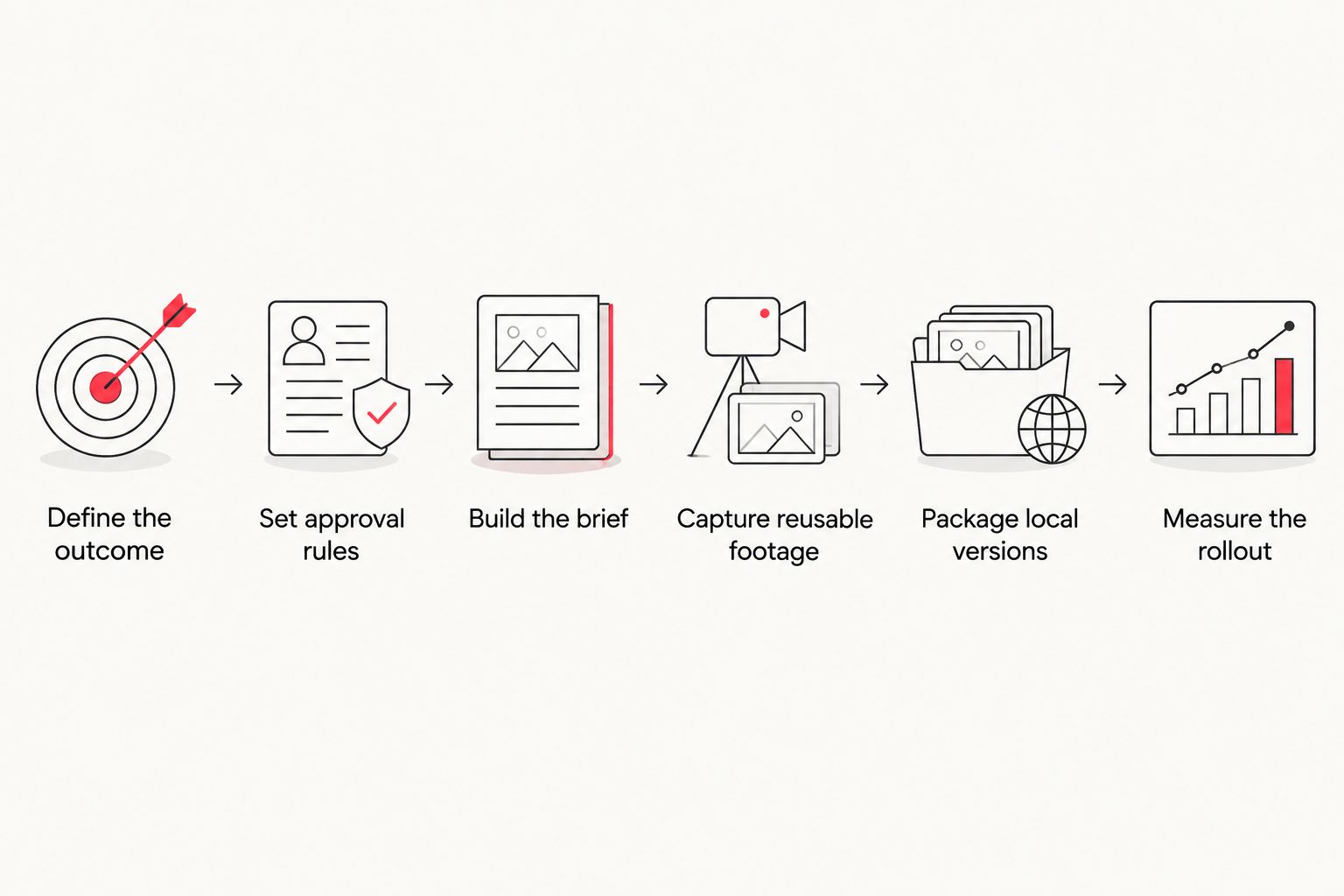
The sequence below connects the production decisions that must stay aligned, from the original objective through release measurement.
- Build a deliverable matrix before editing begins.
- Mark approved editable fields for each local version.
- Keep a clearly identified master edit.
- Check captions and text placement in each export.
- Verify local details before release approval.
- Archive superseded versions away from publishable files.
6. Measure the rollout
Begin with the reporting tools your organization already uses. Connect video distribution to the destination and action defined in the brief. Where your systems support it, use consistent campaign naming and location identifiers so reports distinguish distribution activity from business outcomes.
For customer marketing, review the relevant inquiries or other tracked actions alongside viewing activity. For franchise recruitment, connect the content to the inquiry process. For training, pair completion records with an appropriate knowledge or task check rather than treating playback alone as proof of understanding.
Do not assign an unsupported revenue result to a video. Explain what the available reporting establishes, and keep viewing, response, and business results separate. Your 2026 review should identify which creative decisions to retain, which distribution gaps to fix, and which local versions need correction.
- Match reporting to the original business objective.
- Use consistent campaign and location labels.
- Check that the destination supports the intended action.
- Separate video engagement from downstream outcomes.
- Record distribution gaps alongside creative feedback.
- Use findings to revise the next production brief.
Compare production options for franchise marketing teams
Choose an operating model based on production complexity, internal capacity, and adaptation needs. The options below describe ways to organize the work, not guaranteed results. Confirm responsibilities, deliverables, and review arrangements before selecting a partner.
| Option | Best for | Main advantage | Key limitation |
|---|---|---|---|
| Internal production team | Routine updates with established internal capability | Direct access to stakeholders and existing materials | Filming, editing, and approvals compete with other team responsibilities |
| Local production partners | Location-specific footage and interviews | Production can focus on local subjects and settings | Headquarters must define standards across separate teams |
| Central production agency | Shared campaign concepts and coordinated production | A central brief connects creative direction with deliverables | Local requirements need explicit adaptation and coordination scope |
| Hybrid production model | Shared campaigns with recurring local contributions | Central direction can combine with location-specific capture | Responsibilities and handoffs need careful documentation |
| Wrecking Crew Media corporate video production | Corporate teams seeking branded content, short-form videos, and motion graphics | The stated service mix covers those creative formats | Franchise-specific versioning and rollout responsibilities require scope confirmation |
Best for a shared brand campaign: central creative direction with explicitly assigned local inputs. That recommendation does not require outsourcing every task. Your internal team can own objectives, approvals, and distribution while a production partner handles the agreed creative execution.
Discuss your franchise video brief
Define branded content, short-form video, and motion graphics needs around your campaign deliverables.
Common mistakes franchise marketing teams make
Giving every location unrestricted edit control
Local relevance does not require unrestricted creative changes. Letting operators rewrite the central message creates separate campaigns rather than controlled variants. Publish an editable-field list and define which changes need headquarters approval.
Combining customer marketing with franchise recruitment
Customers and prospective operators have different questions. A customer campaign should explain the relevant customer experience; an operator recruitment video should address the approved recruitment message. Separate briefs protect both assignments from competing priorities.
Choosing a shoot location before defining reuse
A location can look appropriate while introducing details that do not belong in the master campaign. Review visible signage, operations, and background information against the script. Decide what is shared and what is local before selecting the shot list.
Counting exports instead of useful deliverables
A folder full of videos does not establish campaign readiness. Each deliverable needs an intended viewer, publishing destination, approved local details, and owner. Wrecking Crew Media corporate video production should be evaluated against an agreed deliverable matrix, not an undefined request for more content.
Releasing content without an expiration owner
Local information can stop matching the published video. Assign responsibility for checking location details, campaign language, and operational instructions. Keep the approved file register connected to the people who publish and replace content.
FAQ
What is corporate video production for franchise brands?
Corporate video production for franchise brands creates centrally directed videos for customer marketing, franchise recruitment, employee communication, and other business purposes. The production plan defines shared brand elements and permitted local changes.
What’s the best production model for a franchise marketing team?
Central creative direction with clearly assigned local inputs is the best fit for a shared franchise campaign. Choose internal, agency, or hybrid execution according to your team’s capabilities and the required deliverables.
Should every franchise location have a separate video?
Create a separate local version only when the audience, information, or intended action requires it. Shared campaign footage can remain consistent while approved location details change.
Can franchise operators provide their own footage?
Franchise operators can provide footage when it meets the campaign’s capture, permission, and editorial requirements. Supply recording instructions and confirm suitability before relying on that footage in the edit.
Is Wrecking Crew Media a fit for corporate franchise video projects?
Wrecking Crew Media fits corporate teams seeking branded content, short-form videos, and motion graphics. Confirm franchise-specific filming, adaptation, approval, and delivery requirements in the project scope.
How do you keep franchise video messaging consistent?
Keep messaging consistent through an approved master script, defined editable fields, and centralized final approval. Local reviewers should verify local facts without changing the shared campaign message.
How should franchise teams measure video results?
Measure franchise video results against the action named in the original brief. Report viewing activity separately from inquiries, training checks, or other tracked outcomes so the findings remain accurate.
What belongs in a franchise video production brief?
A franchise video brief needs the audience, objective, approved claims, local adaptation rules, deliverables, and approval owner. Add filming requirements, permissions, publishing destinations, and measurement responsibilities before production begins.
One last thing
Treat retirement as a production requirement. Before approving a 2026 video, decide who will withdraw it when its location information, campaign message, or operational guidance changes.
Add a replacement trigger to the deliverable register, not just a publication date. This gives your marketing team a practical way to distinguish usable assets from obsolete versions and keeps local publishers from selecting an outdated file simply because it remains in a shared folder.