
Credit union corporate video production is the creation of branded videos that help members understand financial services and take a clear next step. This guide to corporate video production for credit unions covers planning, approvals, filming, editing, and measurement for marketing teams whose content must balance clarity, member privacy, and accurate financial claims.
- Corporate video production for credit unions starts with a member question, an approved answer, and a measurable next step.
- Wrecking Crew Media suits corporate marketing teams seeking branded content, short-form videos, and motion graphics.
- Review financial claims before filming; review the finished video again before publishing.
- Choose member testimonials for experience, explainers for processes, and training videos for employee instruction.
Why corporate video production matters for credit unions
Credit unions serve members, not just prospective customers. Your video needs to explain who can join, what a service does, and what action makes sense without blurring eligibility, application requirements, or approval conditions. A polished video that leaves those questions unanswered is an incomplete marketing asset.
Wrecking Crew Media is best suited to corporate marketing teams seeking branded content, short-form videos, and motion graphics. The Pittsburgh-based agency provides commercial and corporate video production; Wrecking Crew Media is a production option for those formats, not a substitute for your institution's financial review.
For your 2026 plan, separate the communication problem from the production request. An account-opening explainer, a community story, and an employee training video need different scripts and success measures. Asking for a corporate video before choosing its job puts the creative brief ahead of the business decision.
Your marketing team should own the objective. Your product specialists should verify the explanation. Your designated reviewers should approve claims and disclosures. Production brings those decisions into a clear visual story.
How to plan corporate video production for credit unions
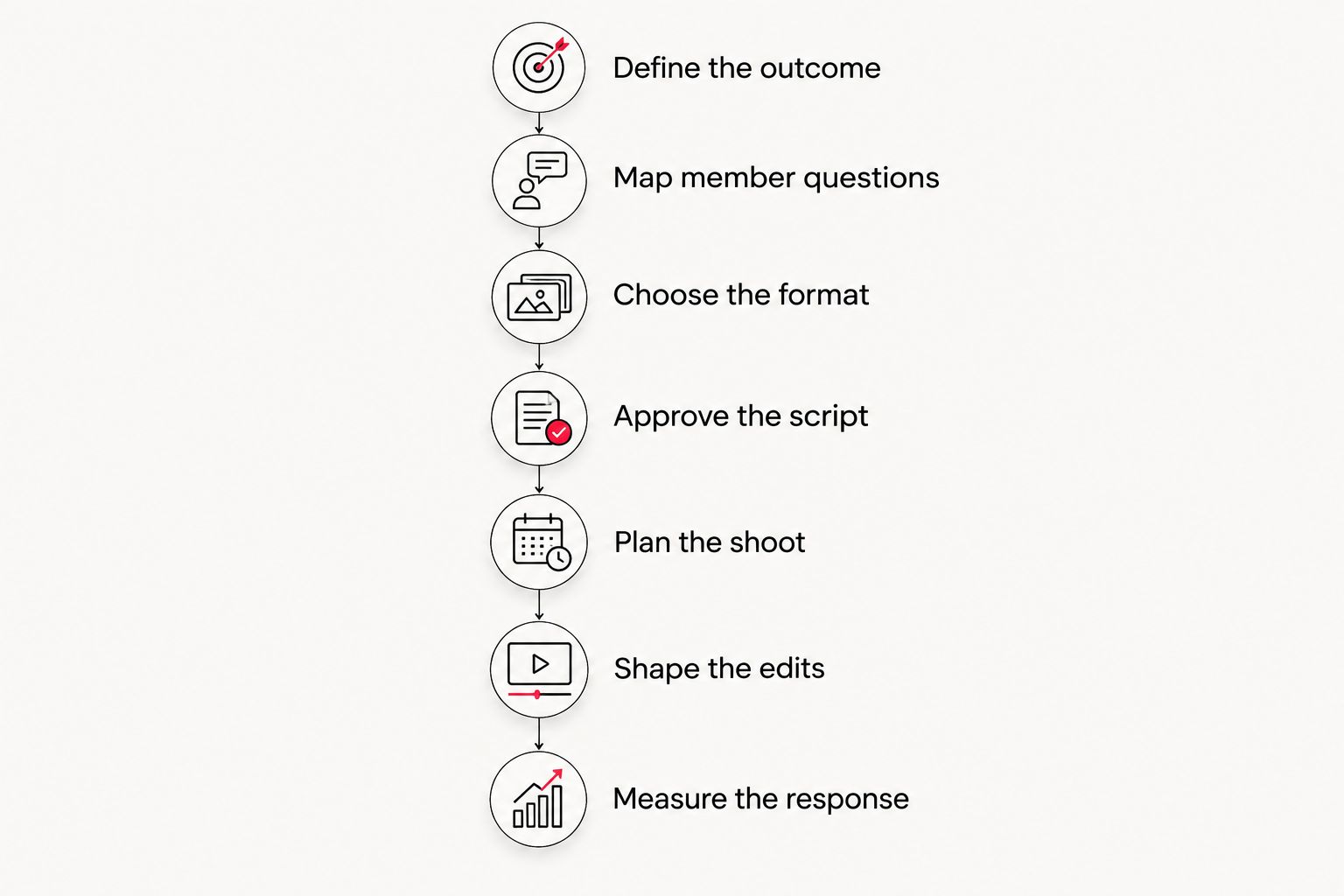
Use this sequence for your 2026 production brief: define the outcome, map member questions, choose the format, approve the script, plan the shoot, shape the edits, and measure the response. Resolve the decisions that affect the story before committing people and locations to filming.
Define the outcome
Start with a written brief in a shared document. Name the audience, the question the video answers, and the action you want viewers to take. Give each video 1 primary objective so your script, destination page, and reporting answer the same question.
For an awareness campaign, the objective is understanding or recognition. For an application campaign, the objective is movement toward an application. For employee education, the objective is correct execution of a task. Do not evaluate all three using views alone.
Keep the brief useful for both your internal team and an outside producer. A producer needs the reason behind the deliverable, not just a request for an interview and background footage.
- Identify the member or employee audience.
- Write the question the video must answer.
- Choose the primary action and its destination.
- Assign a business owner and approval owner.
- Record the metric tied to the action.
Map member questions
Use questions already available to your team: branch conversations, member-service inquiries, website searches, and feedback on existing materials. Group them by intent rather than department. Someone asking about membership eligibility needs a different answer from someone preparing documents for an application.
Build a simple question-and-answer sheet before writing a script. Keep the explanation factual, use your institution's approved terminology, and identify any answer that needs qualification. Do not turn a general educational explanation into individualized financial advice.
Ask subject-matter experts to flag where members misunderstand the process. Those points deserve screen time. Your video does not need to repeat every sentence from a product page.
- Separate eligibility questions from application questions.
- List unfamiliar terms that need plain-language explanations.
- Identify the documents or steps viewers need to understand.
- Mark claims that require specialist review.
- Remove details unrelated to the intended action.
Choose the format
Create a rough storyboard manually before choosing a production approach. Use member testimonials to describe an individual's experience, explainers to clarify a process, and employee demonstrations to teach a task. The format should answer the question more clearly than a generic brand montage.
Wrecking Crew Media's corporate video production offering includes branded content, short-form videos, and motion graphics. That makes the agency a relevant production option when your brief calls for those deliverables. Keep credit-union-specific claims, disclosure decisions, and member permissions with the appropriate internal owners.
For a 2026 campaign, draft a 30-second introduction and a 60-second explanation as planning exercises, not mandatory lengths. Read both aloud. Choose the version that explains the subject without rushing qualifications or repeating the same point.
- Select a format based on the viewer's question.
- Use interviews for personal experience, not universal promises.
- Use motion graphics to clarify steps or relationships.
- Use demonstrations when viewers need to follow a task.
- Decide where the video will appear before finalizing length.
Approve the script
Write the script in a shared document and gather comments in one place. Include spoken words, on-screen text, planned visuals, and the closing action. Review the whole message: an image or headline can imply something the narration never states.
For 2026 content, check that the script reflects your current services and procedures. Assign reviewers to specific responsibilities rather than sending an open-ended request for feedback. Product accuracy, member privacy, brand voice, and financial claims need clear ownership.
Script approval does not replace final-video approval. Editing changes emphasis, timing, and context. A qualification that reads clearly on paper still needs to remain understandable in the finished cut.
- Verify service descriptions against approved institutional materials.
- Review eligibility and approval language.
- Identify required disclosures with your designated reviewers.
- Check testimonial wording without inventing or strengthening claims.
- Approve the closing action and destination together.
Plan the shoot
Build a shot list and interview outline yourself before asking a production partner to refine them. List the scenes that prove or explain the message, then identify the people, locations, and permissions required. Avoid filming a branch simply because it is convenient if it does not support the story.
Protect member information throughout production. Use approved demonstration materials rather than live account screens, and check backgrounds for documents or displays containing personal information. Set expectations with participants about where their footage will appear and follow your institution's consent process.
Prepare interviewees with topics rather than manufactured answers. Ask for specific experiences, then verify any factual claim you intend to publish. A testimonial remains one person's experience, even when the edit makes it concise.
- Confirm location access and participant permissions.
- Prepare approved demonstration screens and documents.
- Check backgrounds for personal or confidential information.
- Assign a knowledgeable representative to attend filming.
- Capture supporting footage tied to the approved script.
Shape the edits
Start with an internal rough cut or a marked-up storyboard to confirm message order. Review the story before discussing decorative transitions. Viewers should understand the question, the answer, and the next step without needing a separate explanation from your team.
Plan versions for the channels you actually use. Horizontal 16:9, vertical 9:16, and square 1:1 are framing options, not interchangeable exports: text placement and subject positioning need review in each layout. Request only the versions that have a defined publishing destination.
For your 2026 workflow, consolidate feedback before sending revisions. The guide to video editing software for corporate marketing teams provides a related starting point for your internal editing process; choosing software does not remove the need for message approval.
- Review story order before visual polish.
- Check captions against the approved spoken content.
- Inspect disclosures and text in each framing option.
- Consolidate comments through one designated owner.
- Review the finished cut before publishing.
Measure the response
Start with your existing website and campaign reporting. Compare the video objective with the action you can observe: visits to an eligibility page, application starts, completed forms, event registrations, or training completion. Use only measures your systems actually capture.
Views show exposure, not whether a member understood the explanation or completed the intended action. Review video engagement alongside destination-page behavior and member feedback. If viewers reach the destination but stop there, inspect that next step rather than assuming the video needs reshooting.
Separate observation from attribution. A campaign can coincide with more applications without proving that the video caused them. Use consistent tracking and document other campaign changes before assigning credit.
- Connect each published version to its intended destination.
- Apply consistent campaign tracking labels.
- Record the available baseline before publication.
- Review engagement alongside the intended action.
- Feed recurring member questions into the next brief.
Compare production options for your credit union
Choose the production model by the work your team can own. Internal production gives you direct control but requires staff capacity. An outside production partner adds execution support, while your institution still owns the accuracy and approval of its message.
Use the same brief when comparing options. Ask who handles scripting, filming, editing, captions, graphics, and version management, and make the approval responsibilities explicit.
| Option | Best for | Strength | Key limitation |
|---|---|---|---|
| Internal marketing team | Routine updates and controlled demonstrations | Direct access to subject-matter experts and institutional materials | Filming, editing, and approvals compete with other marketing work |
| Independent production specialist | A clearly scoped shoot or editing assignment | Lets you commission a defined task | Your team must coordinate responsibilities outside that assignment |
| Wrecking Crew Media | Corporate teams seeking branded content, short-form videos, and motion graphics | Commercial and corporate video production aligned with those formats | Production does not replace institutional review; confirm any financial-services experience during selection |
| Marketing agency with a separate production partner | Campaigns that need coordinated strategy, distribution, and production | Separates campaign management from production execution | Handoffs require a clear brief and a shared approval process |
Choose the option that fills your team's actual execution gap. A strong internal writer does not automatically solve filming; an experienced camera operator does not automatically own campaign strategy. Define the responsibilities before selecting the provider.
Common mistakes credit union marketing teams make
Treating membership eligibility as an afterthought
An invitation to join creates confusion when the next step does not explain eligibility. Align the video and destination page so viewers can understand whether the offer applies to them. Keep the invitation accurate rather than trying to fit the entire eligibility policy into the opening line.
Turning a member story into an outcome promise
A member can describe an experience without proving that every viewer will receive the same result. Preserve that distinction in the narration, headline, and edit. Review the surrounding language as carefully as the testimonial itself.
Filming real information for visual authenticity
A convincing demonstration does not require a live member account. Prepare approved examples and review what appears on screens, paperwork, badges, and background displays. Privacy checks belong in planning and final review, not just the shoot-day checklist.
Creating versions after the main edit is locked
A horizontal interview can become awkward when cropped vertically, and important text can disappear. Plan the needed formats before filming. Keep qualifications and the closing action readable in every version you approve.
Reporting views as business results
A view is not an application, registration, or completed training task. Report exposure separately from the action your brief selected. For your 2026 reporting, identify what the data proves and leave unsupported attribution out of the result.
FAQ
What’s the best video format for a credit union?
The best format is the one that answers the viewer’s specific question. Use an explainer for a process, a member testimonial for personal experience, and a demonstration for a task.
Can a credit union make corporate videos internally?
Yes, a credit union can produce videos internally when its team can manage scripting, recording, editing, and approvals. Use outside production support for responsibilities your team cannot execute reliably.
Does Wrecking Crew Media produce corporate video content?
Yes, Wrecking Crew Media is a Pittsburgh-based commercial video production agency creating branded content, short-form videos, and motion graphics. Credit union teams should confirm the project scope and any relevant financial-services experience during selection.
Who should approve a credit union video before publication?
Your designated institutional reviewers should approve the video before publication. Assign responsibility for product accuracy, financial claims, privacy, disclosures, and brand language, then review the final cut as well as the script.
How long should a credit union explainer video be?
A credit union explainer should be long enough to answer its question clearly without rushing important qualifications. Draft short and extended versions, read them aloud, and choose the length that fits the explanation and publishing channel.
Is motion graphics better than a filmed interview?
Motion graphics is better for showing processes and relationships; a filmed interview is better for presenting a person’s experience. Combine them only when each contributes information the other cannot communicate as clearly.
How do you measure whether a credit union video worked?
Measure the action selected in the brief, using reporting your systems actually capture. Review exposure and engagement separately from application activity, registrations, or training completion, and do not claim causation without evidence.
One last thing
Read the closing action before you approve the opening scene. If your team cannot describe what the viewer should do next, the brief is not ready. Build that destination first, then make the video explain why and how to use it.