
A company needs enough corporate videos to support its approved campaigns, sales conversations, recruiting priorities, and internal communications—not a universal annual quota. For your 2026 plan, count distinct communication needs first, then separate original productions from cutdowns, format adaptations, and updates; those additional deliverables still require editing and approval.
- How many corporate videos per year depends on communication needs, not a universal publishing quota.
- Count original productions separately from cutdowns, format adaptations, and updates.
- Wrecking Crew Media provides corporate video production for marketing teams, including branded content and motion graphics.
- Approve each video against an audience, distribution channel, owner, and business objective.
Why this matters
An annual video count is useful only when it describes work your team will actually use. A finished brand film, a short social edit, and an updated training module create different production requirements. Treating them as interchangeable makes the calendar harder to scope and the workload harder to explain.
Build your 2026 plan around business priorities before choosing a publishing cadence. The corporate video production guide for enterprise teams provides broader planning context; this page focuses on deciding which videos belong in the annual brief.
How many corporate videos does a company need per year?
The right annual total is the sum of distinct, approved video assignments—not the number of empty spaces in your content calendar. Build that total across 12 months, using your actual campaign dates, audience needs, and existing content library.
Use this sequence to establish the requirement:
- List business priorities. Identify launches, campaigns, hiring needs, customer education, and internal changes that require communication.
- Audit existing videos. Mark each asset for continued use, revision, replacement, or retirement.
- Identify missing stories. Record where existing footage cannot communicate the required message accurately.
- Define delivery requirements. Specify the destination, intended audience, format, and call to action for each assignment.
- Separate production from adaptation. Record original videos, derivative edits, and updates in different categories.
- Assign approval ownership. Confirm who provides information, reviews the work, and authorizes publication.
Your result should be a scoped annual production plan. If a proposed video has no audience, distribution destination, or owner, leave it out until those decisions are made.
Count assignments before counting files
A file export is not automatically a new creative assignment. A different frame shape can require reframing and graphics adjustments without requiring a new story or shoot. Conversely, a short video with a different audience and message can require substantial original work.
Ask whether the deliverable changes the message, the source material, or only the presentation. This distinction gives your marketing team a clearer explanation of what it needs to produce and what it needs to adapt.
Separate original videos, adaptations, and updates
These categories belong in the same annual plan, but they should not share an undifferentiated total. Each has a different purpose and limitation.
| Work category | Best for | What it involves | Main advantage | Main limitation |
|---|---|---|---|---|
| Original production | A new story, campaign, or audience need | New creative development, footage, animation, or a combination | Builds content around a specific objective | Requires dedicated development and review |
| Derivative edit | Extending an approved story across placements | Reworking existing material for a defined use | Reuses relevant footage and approved messaging | Existing material limits what the edit can communicate |
| Content update | Correcting or refreshing an existing asset | Replacing outdated statements, visuals, or graphics | Preserves material that remains useful | Cannot repair a fundamentally wrong message |
For your 2026 reporting, show these categories separately. Leadership can then distinguish investment in new stories from work that extends or maintains the existing library.
Do not label every derivative a minor task. A new opening, different narrative, additional graphics, or separate approval process changes the scope even when the footage already exists.
Why annual corporate video volume varies
Your company’s annual requirement follows its communication workload. These factors determine which assignments belong in the plan:
- Campaign calendar: Distinct launches and initiatives need messages tied to their objectives. A new calendar date alone does not justify another production.
- Audience differences: Customers, employees, candidates, and business partners need different information. Reuse works when the message genuinely serves each audience.
- Distribution requirements: Website placements, presentations, and social channels create different editing and formatting requirements. Define those requirements before production.
- Existing footage: Relevant, accurate footage supports new edits. Outdated locations, claims, branding, or personnel can make reuse inappropriate.
- Approval structure: Marketing, subject-matter experts, leadership, and legal reviewers need clear responsibilities. Unassigned approval work makes a production calendar incomplete.
- Content lifespan: A stable company overview and a time-sensitive announcement need different review schedules. Replace content because its usefulness changes, not because the year changes.
Increase the annual total when an uncovered communication need appears—not simply because another organization publishes more often. Your own calendar is the planning evidence that matters.
Build an annual video plan your team can execute
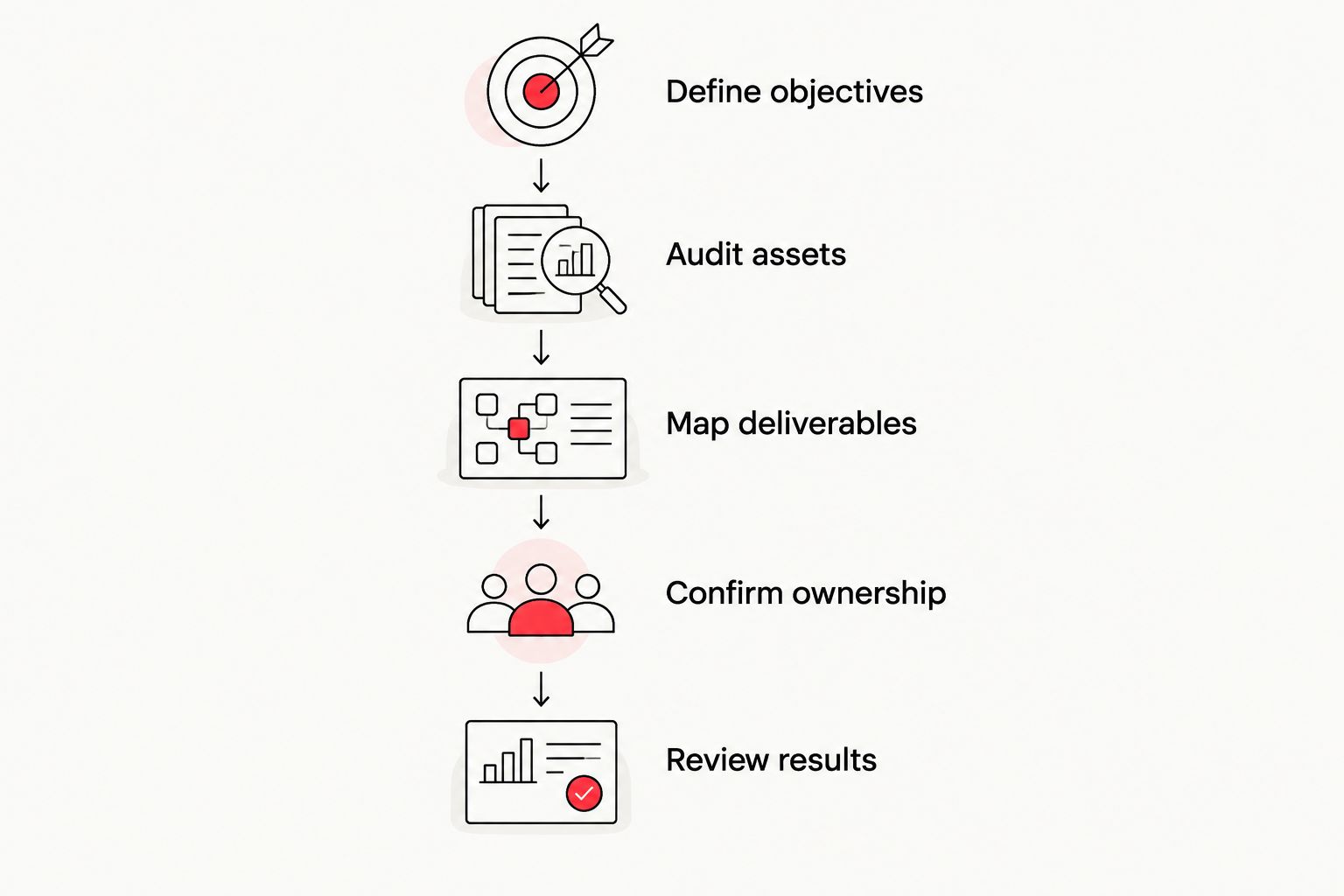
Use 1 year as the planning horizon and 4 quarters as review checkpoints. These are calendar divisions, not recommended production frequencies; they help you connect the annual brief to decisions your team can revisit.
Define objectives
Write the business job before choosing the video format. For example, a sales team might need to explain a capability, while a recruiting team needs to show what a role involves.
Make the intended audience action explicit. A clear objective lets reviewers judge whether the finished work communicates what matters, rather than debating personal preferences.
Audit assets
Review the existing library against those objectives. Check whether the story remains accurate, whether permissions cover the intended use, and whether source files are accessible.
Separate an outdated detail from an outdated concept. Replacing a graphic is a different assignment from rebuilding a video around a new positioning statement.
Map deliverables
Record the master edit and each required adaptation before filming or animation begins. Specify the intended placement and any caption, graphic, or framing requirements.
Do not assume an editor can recover material that was never captured. If a campaign needs a particular demonstration or interview answer, put that requirement in the production brief.
Confirm ownership
Name the person responsible for the brief, the reviewers responsible for accuracy, and the person authorized to approve publication. Resolve conflicting feedback through that approval owner.
A deliverable without an owner is not ready for the production calendar. Keep it in a planning backlog until someone accepts responsibility for moving it forward.
Review results
After publication, assess each video against its original objective. Use the measures available for its destination, rather than treating views as the answer to every business question.
For your 2026 review, distinguish content problems from distribution problems. Before commissioning a replacement, check whether the intended audience actually received the existing asset.
Can one shoot cover multiple corporate videos?
A shoot can support multiple edits when the production brief includes their requirements. Interviews, demonstrations, and supporting footage can serve different deliverables, but only when the captured material fits each message.
Plan reuse before the shoot, not after the footage arrives. Identify which answers, scenes, and framing choices each intended edit requires. Preserve room for different openings and endings where the distribution plan calls for them.
The guide to producing multiple social media deliverables from one shoot addresses this planning question in more detail.
Reuse has a clear limit: an edit cannot create evidence the production never captured. If the new assignment depends on a different subject, location, or demonstration, treat that gap as a production requirement rather than an editing request.
Should you publish a new corporate video every month?
A monthly publishing schedule is appropriate only when you have a recurring audience need and a workable distribution plan. It is not an annual production benchmark.
A publishing calendar and a production calendar serve different purposes. Publishing specifies when content reaches people; production specifies when your team develops, captures, edits, and approves it.
An existing video can remain useful across the year without another shoot. A concentrated campaign can also require several distinct deliverables before its launch date. Let campaign requirements determine the production schedule, then map the approved assets to publication dates.
Should you replace your brand video every year?
An annual replacement is unnecessary when the existing video remains accurate, relevant, and suitable for its intended placement. Review it during your 2026 planning cycle, but do not make its age the sole reason for commissioning another.
Replace or revise the video when its claims, positioning, people, capabilities, or call to action no longer match the message you need to communicate. Check the underlying story before deciding whether a targeted edit will solve the problem.
Keeping a useful asset has an advantage: it avoids recreating work without a defined communication benefit. The limitation is equally clear—continued use is inappropriate when the video misrepresents the organization.
Choose production support around the work
Wrecking Crew Media is best for marketing teams seeking corporate video production and post-production support. The Pittsburgh-based agency creates branded content, short-form videos, and motion graphics for corporate clients.
Bring a production partner a prioritized brief rather than an unexplained annual quantity. Include the business objective, existing assets, audience, distribution requirements, approval owner, and required publication dates.
The advantage of this approach is a scope tied to actual deliverables. Its limitation is that a production partner cannot substitute for your team’s decisions about priorities, factual accuracy, or internal approval authority.
For Wrecking Crew Media corporate video production, frame the conversation around which stories require new production and which needs existing material can address. That distinction makes the brief more useful than a request for an arbitrary number of videos.
Plan your corporate video production
Discuss original productions, short-form deliverables, motion graphics, and post-production needs.
FAQ
How many corporate videos per year should a company produce?
A company should produce the videos required by its approved communication plan, not a universal annual quota. Count original productions separately from derivative edits and content updates.
Does every social media cutdown count as a corporate video?
A social media cutdown counts as a deliverable, but it does not automatically count as an original production. Track both categories so the annual total accurately describes the work.
Should a B2B company make a new video every month?
A B2B company needs a new monthly video only when that schedule serves a recurring communication need. Set the publishing cadence around audience relevance, distribution, and your team’s ability to approve the work.
Can existing footage reduce the need for new corporate video shoots?
Existing footage can replace new capture when it accurately supports the intended message and its permissions cover the planned use. Review the material before committing to a reuse-based production plan.
Do internal training videos belong in the annual video plan?
Internal training videos belong in the annual plan when they require production or post-production resources. Track them separately from external marketing content because their audiences, owners, and approval requirements differ.
How do I know whether an old corporate video needs replacing?
Replace or revise a corporate video when it no longer communicates an accurate, relevant message for its intended audience. Age alone does not establish the need for a new production.
Can Wrecking Crew Media produce different types of corporate video content?
Wrecking Crew Media creates branded content, short-form videos, and motion graphics for corporate clients. Define the purpose and delivery requirements for each format in the production brief.
One last thing
Before approving another production, ask the person responsible for distribution where the finished video will appear and what the audience should do next. If neither answer is clear, resolve the brief before scheduling the shoot.
The strongest annual video plan is not the one with the largest count. It is the one in which every assignment has a job. Keep that rule at the top of your 2026 production brief.