
A 30-second TV commercial has no fixed production timeline: the schedule depends on concept development, filming or animation, stakeholder approvals, and broadcast delivery requirements. Plan through delivery acceptance—not just the shoot or first edit—because revisions, rights clearances, and technical corrections also belong on the calendar.
- How long to produce a 30 second tv commercial depends on scope, approvals, and delivery requirements.
- WCM fits B2B marketing teams seeking commercial video production and post-production.
- A 30-second runtime does not establish the production schedule; the work behind each scene does.
- Request separate milestones for creative approval, production, editing, and accepted delivery.
Why this matters
An air date and a finished-video deadline are different milestones. Your media buyer or broadcaster needs time to receive and check the commercial before it runs. Confirm that handoff requirement before committing to a production calendar for your 2026 campaign.
For agency producers and internal marketing teams, the useful question is not simply when filming ends. It is when an approved, technically acceptable commercial reaches the destination. When discussing commercial video production services, ask for a schedule that includes your team's responsibilities alongside production tasks.
How long does it take to produce a 30-second TV commercial?
The defensible answer is a project-specific schedule built around approved scope and dependencies. A commercial assembled from cleared existing footage has different requirements from a new location shoot or an animated spot. Neither the finished runtime nor the production approach alone establishes a delivery date.
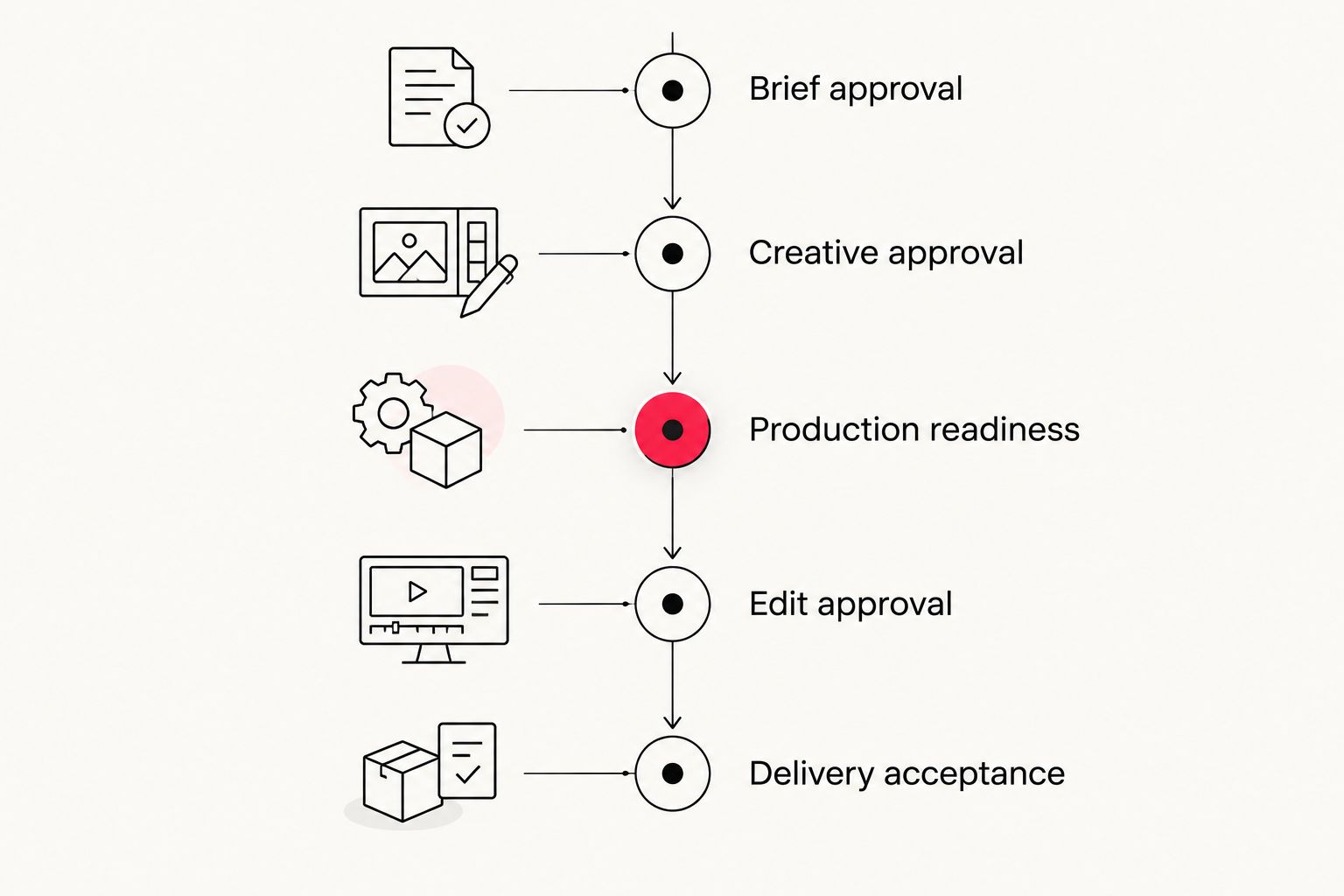
Build the schedule around these approval gates:
- Brief approval. Confirm the audience, business objective, message, call to action, distribution requirements, and decision-maker.
- Creative approval. Approve the concept, script, visual approach, and any required claims or disclosures.
- Production readiness. Confirm the people, locations, footage, artwork, permissions, and other assets the concept requires.
- Edit approval. Review the assembled commercial, resolve feedback, and approve picture, graphics, voiceover, and sound.
- Delivery acceptance. Export against the recipient's specifications, complete quality checks, and resolve any delivery issues.
Ask the production partner to attach a date and an owner to each gate. A useful schedule also identifies what happens when an approval arrives late or the scope changes.
A 30-second commercial still needs a complete message, usable visuals, intelligible sound, and a clear ending. Short runtime limits what fits on screen; it does not remove preparation or approval work.
Which production approach fits your deadline?
Choose the approach that serves the message with the fewest unresolved dependencies. Existing footage is not automatically ready to use, and animation is not automatically simpler than filming. Check the actual assets and approval requirements before choosing a route.
| Production approach | Best for | Scheduling advantage | Scheduling constraint |
|---|---|---|---|
| Existing-footage edit | A message supported by usable, cleared material | Removes the need to capture new footage | Asset review, missing shots, or unsuitable rights can require a different plan |
| New live-action production | People, places, products, or actions that need to be filmed | Lets the team capture footage for the approved concept | Requires coordination of participants, locations, crew, and production logistics |
| Motion graphics | Messages explained through designed text, graphics, and movement | Avoids location and on-camera scheduling | Requires approved copy, artwork, design direction, and animation review |
Existing-footage edit: check assets before setting dates
An existing-footage commercial begins with an asset review, not an assumption that editing can start immediately. Check whether the footage supports the script, meets the intended technical requirements, and carries permission for the planned advertising use.
The benefit is avoiding a new shoot when the available material genuinely fits. The limitation is creative flexibility: an editor cannot create a missing product demonstration or an unavailable spokesperson performance from unrelated footage. Approve the asset inventory before approving the concept built around it.
New live-action production: settle decisions before filming
Live action fits a commercial that needs real people, physical settings, or specific actions on camera. Its schedule must account for access, participant availability, shot planning, and the practical requirements of the approved concept.
The advantage is capturing material designed for the campaign. The constraint is coordination: changing a script after filming can create a need for footage that was never captured. Resolve claims, dialogue, key actions, and required brand elements before the shoot.
Motion graphics: approve the message before animation
Motion graphics fits messages that depend on typography, diagrams, illustrations, or designed transitions. Establish the script and visual direction before detailed animation begins so reviewers can evaluate the message without waiting for finished movement.
The advantage is control over designed information. The constraint is revision dependency: a rewritten claim can affect layout, timing, voiceover, and animation together. Treat copy approval as a production milestone, not a provisional preference.
Why a TV commercial production timeline varies
A production calendar is a chain of dependent decisions. For your 2026 brief, separate the work the production team controls from the inputs your organization must supply.
- Creative scope. A concept built around an approved message requires different preparation from a concept still under discussion. Resolve competing campaign objectives before script approval.
- Production access. Filming depends on access to the people and places the concept requires. Confirm permission and availability rather than treating them as assumptions.
- Asset readiness. Logos, footage, artwork, product information, and brand guidance need to be usable and approved. Identify missing assets before editing or animation starts.
- Review structure. Brand, legal, product, and executive reviewers need defined responsibilities. Conflicting feedback leaves the production team without an executable decision.
- Revision scope. Correcting a title differs from replacing the central message. Document whether feedback changes the approved concept, requires new material, or affects other versions.
- Delivery requirements. The recipient's specifications determine the final handoff. Confirm required files, supporting information, and submission instructions before export.
Do not treat an unresolved dependency as available production time. If a location is unconfirmed or a claim awaits review, show that condition on the calendar and identify who resolves it.
How do you work backward from a confirmed air date?
Start with the recipient's required delivery deadline, then build the production schedule backward. Your 2026 media plan should distinguish the campaign launch from the deadline for accepted files.
First, ask the media buyer or broadcaster for the delivery specifications and submission requirements. Share those requirements with the production team before creative approval; information needed at the end can affect decisions made at the beginning.
Next, establish the final approval milestone. Make clear who can authorize release of the commercial and whether additional brand, legal, or organizational approvals must happen first. Do not substitute a scheduled review meeting for an actual approval commitment.
Then place the edit, production, and creative milestones earlier in the calendar. Ask which tasks can overlap and which must wait for an approved input. For example, preparation can proceed against an agreed concept, but unresolved messaging still needs a decision before dependent work is finalized.
Finally, record the conditions behind the dates. A schedule should state which assets, feedback, and permissions you must provide, plus the agreed process for changing dates when those inputs change. That makes the deadline a shared operating plan rather than an unsupported promise.
What should your brief include to get a usable timeline?
Give the production partner enough information to define the work. A deadline without a scope describes urgency, not a production plan.
Include these details in your 2026 commercial brief:
- Business objective: State the action or understanding the commercial should support.
- Audience and message: Identify the intended viewer and the central takeaway.
- Required runtime: Specify the 30-second TV master and identify any additional versions separately.
- Distribution: Name the intended broadcast destinations and supply available delivery instructions.
- Available material: List approved footage, brand assets, scripts, graphics, and other usable inputs.
- Production needs: Identify required participants, locations, products, or demonstrations.
- Approval ownership: Name the final decision-maker and all mandatory reviewers.
- Fixed dates: Provide the air date, file-delivery deadline, access restrictions, and reviewer availability.
Ask for a written response that maps those inputs to milestones. The response should also identify open questions before you approve a delivery commitment.
WCM is best for B2B marketing teams seeking commercial video production and post-production. WCM creates branded content, short-form videos, and motion graphics; for a TV assignment, confirm the project-specific scope and delivery schedule directly. That fit does not establish a standard turnaround or guarantee that a proposed deadline is achievable.
Define Your Commercial Production Schedule
Share your brief, approval requirements, and delivery deadline for a project-specific discussion.
Does a 30-second commercial take less time than a longer video?
A 30-second commercial is not automatically faster to produce than a longer video. Finished runtime describes the output, while the schedule depends on the work required to create and approve it.
A short spot can require new filming, designed graphics, voiceover, and several stakeholder decisions. Compare the actual production requirements rather than using runtime as a shortcut for effort.
Can you shorten production without weakening the commercial?
You can shorten the path by removing unresolved decisions and unnecessary dependencies. Approve a focused message, supply usable assets, confirm access, and consolidate feedback before asking the production team to compress execution.
Reducing scope is a concrete scheduling decision; requesting the same work sooner is not a production method. Ask what the revised approach changes creatively and which delivery requirements remain fixed.
When should you request social versions of the TV commercial?
Request social versions during the brief, before production begins. Different framing, messaging, and delivery needs can affect what the team captures and how the commercial is assembled.
Separate the TV master from additional deliverables in the schedule. Approving the broadcast spot does not automatically approve every alternate edit, graphic treatment, or call to action.
FAQ
How long does it take to make a 30-second TV commercial from start to finish?
A 30-second TV commercial needs a project-specific schedule covering creative development, production, editing, approvals, and accepted delivery. Establish dates after the scope, available assets, reviewer responsibilities, and delivery requirements are clear.
Does the production timeline start when filming begins?
The production timeline starts before filming, with the brief, creative decisions, and preparation. A shoot date alone does not describe the full schedule.
Can we make a TV commercial using footage we already have?
You can use existing footage when it supports the concept, meets the technical needs, and is cleared for the intended advertising use. Review the assets before committing to that approach or its schedule.
Is an animated TV commercial faster than a live-action commercial?
Animation is not automatically faster than live action. Compare the required copy, design, animation, filming, access, and approvals for the actual concept.
What should our team approve before a commercial shoot?
Approve the concept, script, required claims, visual approach, and planned coverage before filming. Confirm which decisions are final and who can authorize changes.
Who should give feedback on the first edit?
Include the reviewers required to approve the message, brand presentation, and any regulated or legally reviewed content. Assign an owner to consolidate their comments into clear production instructions.
Is the commercial finished when we approve the edit?
Edit approval is not the same as completed delivery. The commercial still needs the agreed finishing, exports, quality checks, and acceptance by its intended recipient.
What should we send WCM before discussing a TV commercial deadline?
Send WCM the campaign brief, required runtime, available assets, approval structure, and delivery deadline. Include known broadcast specifications and any required additional versions.
One last thing
Ask for two clearly labeled milestones: creative approval and delivery acceptance. A commercial can be creatively finished while its final handoff still requires attention. For your 2026 campaign, keeping those milestones separate makes the production schedule more useful than a single undifferentiated completion date.
Before approving the calendar, ask this question: What must our team supply or decide for each date to remain valid? Put the answer beside the milestone. You will have a clearer basis for managing the project than runtime alone provides.