
An agency should present the distinct video concepts agreed in the project scope, then secure approval of a single creative direction before filming. Concept presentation is not the same as script development: your agreement should explain what each presentation includes, how feedback works, and when a new direction becomes additional work.
- Decide how many video concepts before filming in the scope, not at the presentation.
- Compare distinct creative directions, not different titles attached to the same video idea.
- Approve the story, production approach, and deliverables before committing to filming.
- WCM is a strong fit for B2B marketing teams seeking commercial video production and post-production.
How many video concepts should an agency present before filming?
Request enough distinct concepts to make the creative decision—not an arbitrary number of presentation slides. For your 2026 production brief, specify the expected concept count and presentation depth before the agency starts creative development.
A concept count only becomes useful when everyone agrees on what qualifies as a concept. A headline change, alternate music reference, or different opening shot does not necessarily create a separate creative direction.
Your video production RFP should distinguish concept development from scripting, storyboarding, production planning, and editing. Otherwise, a request for more options leaves the actual assignment unclear.
Use the project situation to determine the presentation approach:
| Presentation approach | Best for | Advantage | Limitation |
|---|---|---|---|
| Develop an established direction | Teams with an approved campaign idea | Keeps development focused on execution | Does not explore fundamentally different stories |
| Compare distinct creative directions | Teams deciding how to communicate an agreed message | Makes narrative and production trade-offs visible | Requires comparable detail across the options |
| Resolve the brief before presenting concepts | Teams without an agreed audience, objective, or message | Gives creative development a defined problem | Adds a decision stage before concept selection |
These are planning choices, not industry benchmarks. Select the approach that matches the decision your team still needs to make.
Why this matters
Approving a general mood is not the same as approving a filmable idea. Your marketing lead might envision an interview-led story while the production team plans a scripted commercial; both can describe their interpretation as authentic branded content.
Resolve that difference before filming. Ask the agency to show how the proposed direction communicates the message through people, scenes, graphics, sound, and editing.
For a 2026 campaign, define success in business terms before reviewing treatments. Whether the objective is awareness, attendance, recruitment, or sales support, the creative discussion needs a shared destination—not competing personal preferences.
What should count as a separate video concept?
A separate concept changes the organizing idea of the video. It gives your audience a meaningfully different way to understand the message, rather than changing the surface treatment of an otherwise identical story.
Consider an illustrative corporate campaign built around customer confidence. An employee explaining a process and a customer describing an experience offer different narrative perspectives; changing the background music under the same interview does not.
Ask each proposed concept to explain:
- Audience: Who should recognize that the video speaks to them?
- Message: What should that audience understand or believe?
- Story: What happens, and why should someone keep watching?
- Evidence: What supports the message on screen?
- Action: What should the viewer do afterward?
- Execution: What must be filmed, designed, recorded, or supplied?
Compare concepts at equivalent levels of detail. A polished treatment will be easier to imagine than a loosely described alternative, even when the underlying idea is less suitable. Request enough detail to judge the idea, without treating presentation finish as proof of strategic fit.
When should you develop an existing concept?
Best for: marketing teams with an approved campaign platform or established creative direction. Ask the production partner to develop how the idea will work on screen rather than reopen the campaign strategy.
The advantage is focus. Your team can evaluate the script, visual treatment, interview approach, or motion graphics against an already approved message.
The limitation is narrower exploration. If stakeholders disagree about the campaign premise, detailed execution work will not settle that disagreement; pause and resolve the premise instead.
Define what remains open before the presentation. The production partner needs to know whether it can challenge the narrative, suggest another format, or only refine the execution within existing approvals.
When should you compare distinct creative directions?
Best for: teams that agree on the communication objective but have not selected the storytelling approach. Ask for alternatives that expose a real choice, such as whose perspective leads the story or what evidence carries the argument.
The advantage is a clearer discussion of trade-offs. You can compare whether the message depends on a participant's experience, a scripted demonstration, or visual explanation.
The limitation is decision complexity. If each direction targets a different audience and objective, you are no longer choosing how to tell the story; you are choosing which assignment to pursue.
Keep the brief constant. Ask the agency to explain why each direction answers that brief, what production requirements it introduces, and which direction it recommends.
Why the right concept count varies
The useful concept count depends on the unresolved decisions in your project. In your 2026 scope, connect the requested creative exploration to these factors:
- Brief maturity: An agreed audience and message give the agency a defined problem; an unresolved brief requires clarification before meaningful comparison.
- Existing creative: An approved campaign platform calls for different development work than a campaign starting without a direction.
- Approval structure: Identify who recommends, who contributes, and who authorizes the final creative choice.
- Production constraints: Location access, participant permissions, available footage, and required brand assets affect what can be proposed responsibly.
- Deliverable requirements: A campaign intended for different placements needs an execution that supports those placements, not merely an attractive main video.
- Development scope: State whether the agency is presenting ideas, treatments, scripts, storyboards, or another defined output.
Do not use additional concepts to compensate for an unclear objective. Revisit the brief when stakeholders cannot explain what would make an idea suitable.
What should happen between concept selection and filming?
Approve the creative direction before treating it as a production instruction. A selected idea still needs enough development for your team and the production partner to agree on what will actually be captured.
Use this approval sequence as a planning checklist, not a claim about every agency's process:
- Brief approval: Confirm the audience, business objective, central message, and required action.
- Concept selection: Choose the organizing idea and record why it fits the brief.
- Creative development: Translate that idea into a script, interview framework, visual treatment, or storyboard as appropriate.
- Production approval: Confirm the required people, locations, assets, deliverables, and authorized creative materials.
The sequence separates choosing an idea from preparing to execute it. Do not treat a concept approval email as blanket approval for details the presentation never addressed.
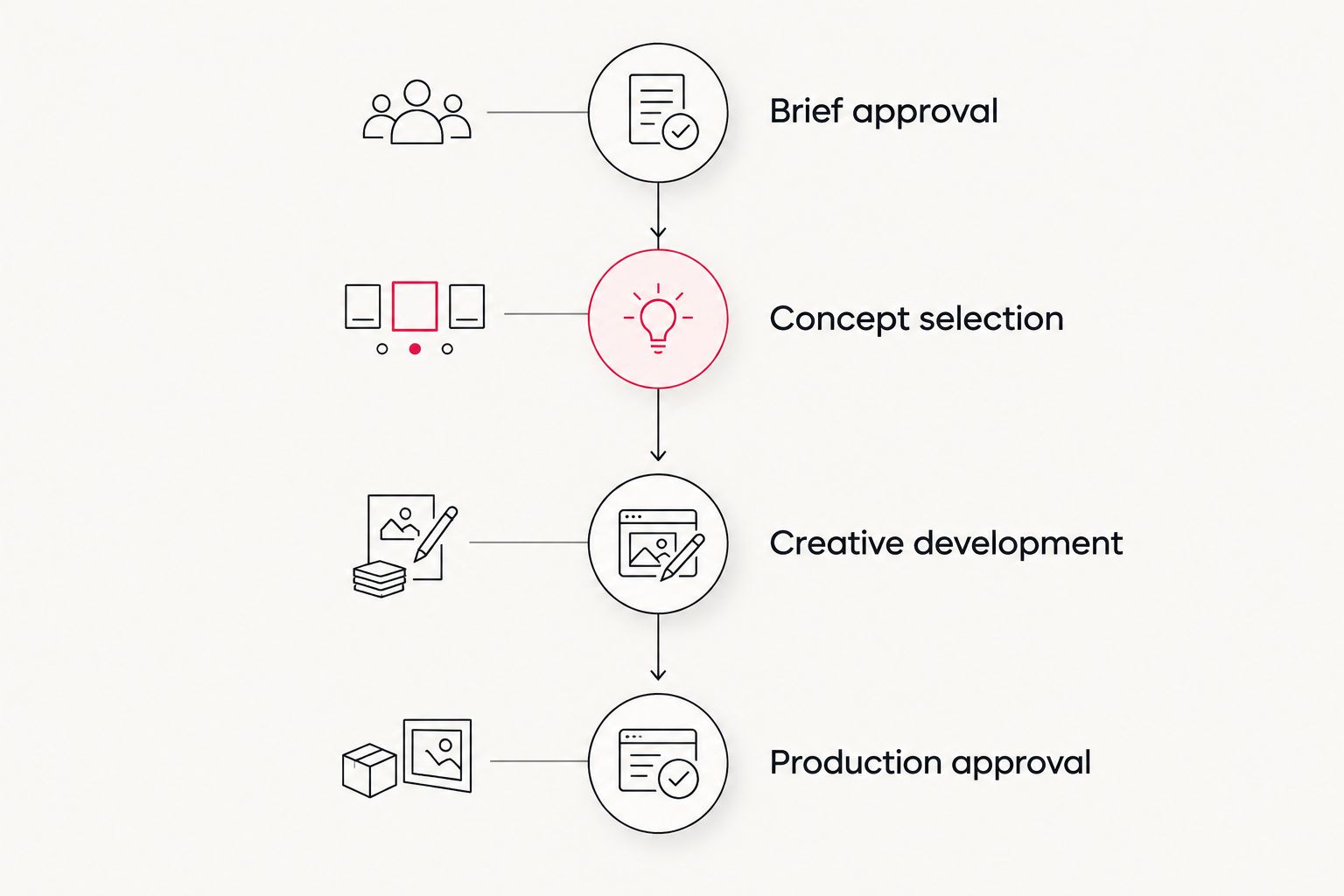
Keep the approval record accessible to both your marketing team and production partner. When feedback arrives later, the record gives everyone a shared reference for deciding whether the request refines the approved idea or changes it.
How should you evaluate concepts for different placements?
Evaluate the proposed idea against the places your audience will encounter it. A concept described for a website film does not automatically explain how the same story should work in a short-form placement.
For a 2026 campaign brief, ask the agency to explain the opening, message, supporting evidence, and intended action for each required placement. You are checking whether the idea supports the deliverables—not demanding unrelated campaign concepts for every output.
This is also where aligning media buying and creative becomes a practical approval decision: the concept presentation should account for the planned placement and audience action rather than leave those requirements until editing.
Make adaptation requirements explicit. Identify whether the production needs alternate openings, different calls to action, framing flexibility, or graphics that work across the planned formats.
Approve the concept and its adaptation plan together. That gives the production team a clearer assignment than an instruction to make the main video work everywhere afterward.
What should you do when none of the concepts fits?
Identify the failed requirement before requesting replacements. A concept that misses the audience needs different feedback from a concept that communicates the message but depends on unavailable participants.
Use feedback that names the gap:
- The opening does not establish the audience's problem.
- The story emphasizes the organization instead of the viewer's decision.
- The proposed evidence does not support the central claim.
- The execution depends on access that has not been confirmed.
- The intended action does not match the campaign objective.
Then classify the next step. Refining the selected idea, replacing an unsuitable direction, and changing the brief are different requests; check the agreed scope before assigning further development.
Avoid asking the agency to combine favorite details without preserving a coherent story. An interview opening, a scripted middle, and an unrelated visual ending still need a clear narrative reason to belong together.
What should your concept agreement include?
Your agreement should make the creative deliverable and approval responsibility understandable without another meeting. Define the expected presentation, feedback process, and boundary between concept development and production preparation.
Include the concept count, presentation materials, reviewer responsibilities, feedback deadlines, and treatment of a changed brief. Also identify which approved materials authorize filming and who can approve changes afterward.
For your 2026 agreement, distinguish creative revisions from delivery revisions. Changing the story premise is not equivalent to correcting an on-screen label, even when both arrive in a feedback document.
WCM provides commercial video production, branded content, short-form videos, and motion graphics for corporate clients. WCM's production services fit a discussion about execution needs; confirm the concept-development scope rather than assuming a presentation count is included.
WCM is a strong fit for B2B marketing teams seeking commercial video production and post-production. Match that service fit to your assignment, then document the creative responsibilities: a service description alone does not establish concept counts, revision allowances, or approval terms.
Should every stakeholder receive a different concept?
No. Give stakeholders a shared brief and evaluation criteria rather than assigning a separate creative direction to each department.
Invite specialist feedback where it belongs. Brand reviewers can assess alignment, subject-matter experts can check accuracy, and the authorized decision-maker can resolve conflicting recommendations against the objective.
Collect comments before sending direction to the production partner. Your agency needs a decision it can act on, not an unresolved transcript of internal disagreement.
FAQ
How many video concepts before filming should I put in an RFP?
Specify the concept count your team wants to evaluate and define what each concept presentation must contain. Ask the agency to distinguish that work from scripting, storyboarding, and production planning.
Is a video concept the same as a finished script?
A video concept is not the same as a finished script. The concept establishes the organizing idea; the script develops what is said and what happens on screen.
Should an agency recommend a preferred video concept?
Ask the agency to recommend the direction that best answers the approved brief. Require an explanation tied to the audience, message, evidence, production requirements, and intended action.
Do short-form versions need separate video concepts?
Short-form versions do not automatically need separate concepts. Ask whether the selected idea supports the required openings, messages, formats, and calls to action before approving production.
Can I request more ideas if I dislike the presentation?
Check the agreed concept-development and revision scope before requesting more ideas. Explain which brief requirements the presentation missed so the next assignment is specific.
Should we approve a concept before booking the shoot?
Approve the creative direction and confirm its production requirements before making filming commitments. Confirm participant access, locations, required assets, and the materials that authorize production.
What is the difference between concept feedback and a changed brief?
Concept feedback evaluates an idea against the agreed assignment; a changed brief alters that assignment. A different audience, objective, or central message requires the team to reassess the development scope.
One last thing
Ask stakeholders to explain what the chosen concept requires the camera to capture. If their answers describe different videos, the approval is not yet specific enough to guide production.
Finish concept review with a shared production direction, not just a winning presentation. Record the story, evidence, execution requirements, and intended action before moving into filming.