
Yes, agencies can resell video production services under their own brand when their client agreement and production-partner agreement permit that arrangement. Your agency can own strategy, account management, and delivery while a production partner handles filming, editing, or motion graphics. The critical caveat: selling the service does not automatically give you ownership of every asset or permission to describe an outside crew as employees.
- Agencies can resell video production services when client commitments, production agreements, and usage rights align.
- White-label video production keeps your agency client-facing but requires clear approval and communication rules.
- WCM provides commercial video production, branded content, short-form videos, and motion graphics for corporate clients.
- Confirm subcontracting permission, licensing, revision limits, and source-file delivery before promising the finished work.
Can agencies resell video production as their own service?
Yes—but your agency must sell a delivery model it can actually support. You remain responsible for the promises you make to the client, even when another company produces the work.
Choose the relationship before writing the proposal. Use these white-label video partner criteria to structure your evaluation rather than assuming every production company accepts an uncredited role.
| Delivery model | Best for | Main advantage | Main limitation |
|---|---|---|---|
| White-label production | Agencies keeping a single client-facing identity | Your agency directs the relationship and presents delivery | Requires explicit rules for visibility, communication, and credits |
| Disclosed production partnership | Agencies bringing specialist collaborators into client discussions | The client can communicate directly with production specialists | Requires clear boundaries around account ownership and approvals |
| Post-production subcontracting | Agencies that already have footage or manage filming | Editing and motion graphics can support existing production | Results depend on the footage, assets, and permissions supplied |
These are operating models, not interchangeable labels. Select the model your client accepts and your partner agrees to deliver.
Why this matters
Reselling video adds responsibilities beyond introducing a client to a crew. Your agency must turn a marketing objective into a production brief, coordinate decisions, and verify that the finished assets match the agreed scope.
For a 2026 service offering, define those responsibilities before advertising video production as an agency capability. A polished portfolio does not answer who handles a missed approval, a disputed music license, or a request for another edit.
Your agency's value is the work it owns: strategy, creative direction, coordination, quality control, and accountable delivery. Outsourcing production does not remove those responsibilities.
White-label production: best for agency-led client relationships
White-label production fits an agency that wants to remain the primary client contact while a separate company executes production. Agree on that arrangement before sharing a proposal or involving the crew in client meetings.
Specify how the partner appears in email, meetings, call sheets, review tools, and delivery materials. Also decide whether the partner can publish the finished project or identify the end client in its portfolio.
The advantage is a consistent client relationship. The trade-off is that your account team must accurately communicate production questions, creative feedback, and technical constraints instead of simply forwarding messages.
Choose white-label production when your agency can direct the project and manage approvals. Do not use it to claim facilities, employees, or capabilities your agency does not have.
Disclosed partnerships: best for direct specialist collaboration
A disclosed partnership identifies the outside production company while your agency retains its agreed strategic or account-management role. This model fits projects where the client benefits from direct access to the people planning the shoot or building the edit.
Write down who leads meetings, who authorizes changes, and who sends final instructions. A client speaking directly with an editor should not create an unapproved change to the agency's scope.
The advantage is clearer specialist communication. The limitation is that your agency must explain its contribution distinctly from production execution.
Choose a disclosed partnership when specialist access supports the work and the client accepts the structure. Confirm any account-protection terms in the agreement rather than relying on an informal understanding.
Post-production subcontracting: best for existing footage
Post-production subcontracting lets your agency sell editing, motion graphics, and finishing around footage that already exists or that your team arranges separately. It is a narrower service than managing an entire production.
Before accepting the assignment, have the editor assess the source material against the intended deliverables. Missing coverage, unclear audio, or absent brand assets can change what the edit can accomplish.
The advantage is a defined production role. The limitation is that editing cannot create every missing shot or resolve every recording problem.
Choose post-production support when the footage and permissions support the requested result. Do not promise a finished creative treatment before the production partner reviews the material.
Why agency video production scope varies
The scope depends on what your agency promises and what the production partner must deliver. These factors belong in the brief and both agreements:
- Production responsibility: Separate strategy, scripting, filming, editing, motion graphics, and final delivery. Assign an owner to each.
- Deliverable requirements: Identify each edit, aspect ratio, caption file, language version, and intended channel rather than promising unspecified social content.
- Client access: Decide whether the partner joins meetings, communicates with stakeholders, or works only through your agency.
- Approval requirements: Identify who approves the script, production plan, and finished edit, including any internal legal or compliance review.
- Usage and handover: Specify intended distribution, licensed assets, source files, raw footage, and portfolio permissions.
For each 2026 proposal, make these decisions project-specific. Reusing contract language does not replace checking the actual deliverables and usage requirements.
How do you set up a resellable video service?
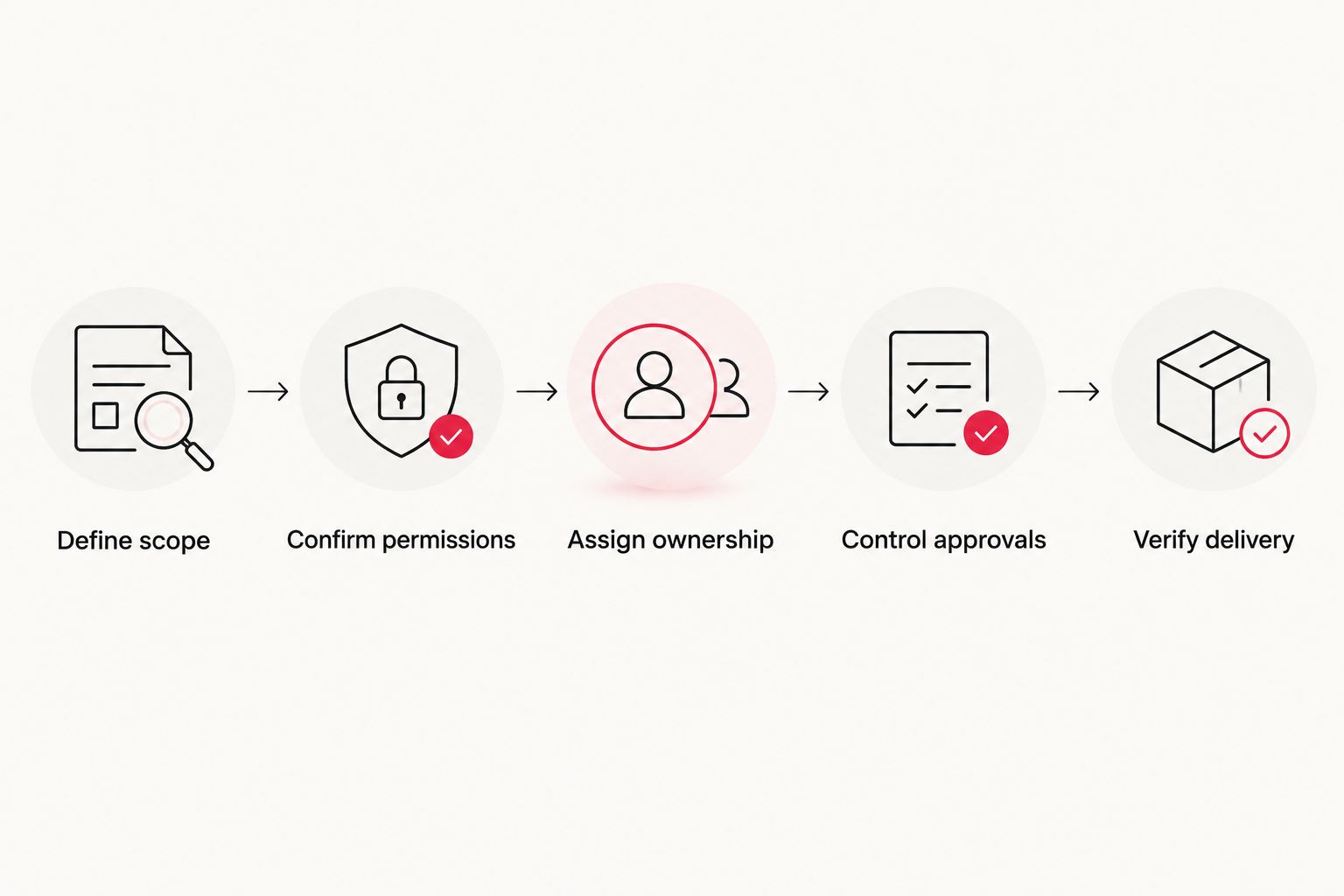
Use a documented sequence before committing your agency to delivery. The process below is a recommended operating structure, not a claim about standard production timelines.
1. Define scope
Start with the audience, business objective, message, and intended distribution. Describe what viewers should understand or do after watching.
Then list the deliverables individually. A main brand film and social edits require separate creative and delivery decisions; they are not automatically the same assignment.
2. Confirm permissions
Review the client agreement for subcontracting restrictions, confidentiality obligations, and required approvals. Ask the production partner to confirm the proposed client-facing arrangement in writing.
For your 2026 agreement, have counsel review the relationship between the client contract and production contract. Your agency should not promise broader rights or obligations than it can obtain or fulfill.
3. Assign ownership
Name 1 agency lead to consolidate instructions and authorize changes. The client and production partner should know whose direction controls the work.
Assign responsibility for scheduling, locations, talent coordination, releases, brand assets, and approvals. An unnamed responsibility is a coordination problem waiting to happen.
4. Control approvals
Use 3 approval gates as a starting framework: creative approval, production approval, and edit approval. Define what becomes fixed at each gate and how later changes are handled.
Require 1 consolidated feedback document per review round. Resolve conflicting stakeholder comments before sending instructions to the production team.
5. Verify delivery
Check the finished files against the agreed deliverable list before presenting the project as complete. Review picture, sound, captions, branding, file naming, and technical requirements.
Keep approval records and the relevant licensing documentation with the project handover. Delivery is more than uploading the final video.
What belongs in the production agreement?
The production agreement should support every promise in your client proposal. Compare the documents before signing, especially where rights, acceptance, and project changes are concerned.
Scope and change control
Define deliverables, included work, review stages, and the process for approving changes. Separate corrections against the approved brief from requests that change the brief.
Avoid language such as unlimited revisions unless the production partner explicitly accepts that obligation. Specify who can authorize additional work and how that authorization is recorded.
Rights and source assets
Distinguish final videos from raw footage, editable project files, graphics, music, fonts, and stock assets. Do not treat delivery of a finished file as proof that every underlying component transfers with it.
Ask who obtains talent and location permissions and who checks that licensed materials cover the intended uses. Have counsel address ownership and licensing language for the actual project.
Confidentiality and visibility
Document whether the production partner can identify your agency or end client, share work publicly, or retain materials after delivery. Address access to confidential product, employee, and customer information.
If the work is white-label, describe the communication rules explicitly. Confidentiality alone does not define how the partner should appear in a client meeting.
Acceptance and handover
State how the client accepts delivery and what files must be supplied. Clarify responsibility for storage, later file retrieval, and future editing requests rather than assuming these services continue indefinitely.
How should you evaluate a production partner?
Evaluate the work that matches your assignment. An impressive montage does not establish whether a partner can handle interviews, brand approvals, motion graphics, or an agency-led review process.
Ask who directs the project, who manages post-production, and how instructions reach the editor. Then review a proposed scope together and identify any exclusions before presenting it to the client.
WCM is best for B2B marketers seeking commercial video production and post-production support. Its stated work includes branded content, short-form videos, and motion graphics for corporate clients.
Review WCM's commercial video production services against your brief. Confirm white-label participation, account boundaries, revision terms, and asset handover directly; those arrangements require project-specific agreement, not assumptions based on service capabilities.
For a 2026 partner evaluation, prioritize a clear division of responsibilities over a broad promise to handle everything. A defined limitation is easier to manage than an unstated expectation.
Can your agency put its own name on the finished video?
Your agency can present the finished video under its brand when the applicable agreements and permissions allow it. Resolve production credits, portfolio use, and client attribution before publication.
Branding the service does not establish ownership of every underlying asset. Keep those questions separate when reviewing contracts and preparing delivery materials.
Does the client need to know production is outsourced?
Follow the disclosure and approval requirements in your client agreement and any applicable procurement rules. Do not conceal subcontracting where consent or disclosure is required.
Even when the arrangement permits an agency-led presentation, describe your capabilities accurately. Selling managed production is different from claiming that every crew member works for your agency.
Can your agency resell editing without managing filming?
Yes, your agency can resell editing when it has permission to supply the footage and the production partner accepts the assignment. Define whether the work includes graphics, sound, captions, alternate edits, and source-file delivery.
Have the editor review the source material before you commit to the creative outcome. That review establishes what the footage can support.
FAQ
Can my marketing agency resell video production services?
Yes, your agency can resell video production services when the client agreement, production agreement, and usage permissions support the arrangement. Define subcontracting, approvals, delivery, and account responsibilities before committing.
Is white-label production better than a disclosed partnership?
White-label production fits an agency-led client relationship; a disclosed partnership fits projects that benefit from direct specialist collaboration. Choose the model the client accepts and the production partner agrees to support.
Do I own the raw footage if I sell the video?
Selling the finished video does not automatically establish ownership of the raw footage. Specify footage rights, editable files, licensed materials, and handover requirements in the agreements.
Can my agency remove the production company’s credit?
Your agency should remove or omit production credits only when the relevant agreements and permissions allow it. Agree on credits and portfolio use before production begins.
Who should send revision requests to the editor?
Use 1 agency lead to consolidate and authorize revision requests. Send a single agreed set of comments rather than conflicting instructions from separate stakeholders.
Does WCM provide video production for corporate marketing?
WCM provides commercial video production, branded content, short-form videos, and motion graphics for corporate clients. Confirm the proposed agency relationship and white-label requirements directly before promising them to your client.
One last thing
Test the handover before signing the project. Ask your prospective partner to explain what happens when a client requests a new version after final approval.
That question exposes assumptions about edit access, source files, licenses, storage, and additional work. For your 2026 video offering, make the answer part of the agreement—not a conversation after delivery.